.webp) Online
OnlineNot sure which channel fits your business?View all services →
Three inputs. Instant KPIs. No spreadsheets.Open a calculator →
OnlineAttempting to "save money" by moving marketing in-house often backfires when you realize the fully loaded cost of a small internal team in 2026 now ranges between $375,000 and $585,000 annually. Management doesn't hate costs; they hate unquantified risk and vanity metrics that fail to move the needl...

Attempting to "save money" by moving marketing in-house often backfires when you realize the fully loaded cost of a small internal team in 2026 now ranges between $375,000 and $585,000 annually. Management doesn't hate costs; they hate unquantified risk and vanity metrics that fail to move the needle. If you're struggling with justifying marketing agency costs to management, it's usually because the conversation is stuck on monthly fees rather than the scalable revenue those fees generate. It's time to stop defending your budget and start proving its value as a high-performance growth engine.
This guide provides the exact data-driven framework to transform your agency strategy into a board-ready business case. You'll learn how to present PPC and CRO performance in a way that resonates with the C-suite, proving that specialized expertise is a strategic investment rather than an overhead expense. We'll examine why the 2026 hybrid model is the optimal choice for mid-market companies, leveraging AI-assisted bidding strategies that deliver up to a 287% ROI. By the end of this article, you'll have the confidence and the benchmarks needed to secure your budget and validate your agency partnership as a core driver of business success.
• Shift the executive perspective by framing marketing as a profit center, focusing on Customer Acquisition Cost (CAC) and Lifetime Value (LTV) rather than just monthly fees.
• Master a data-driven framework for justifying marketing agency costs to management by aligning your digital strategy directly with the CEO’s North Star metrics like EBITDA and revenue growth.
• Identify the hidden financial liabilities of in-house teams, such as recruitment, benefits, and specialized software licenses, to demonstrate the capital efficiency of an agency model.
• Learn to present a "baseline analysis" that quantifies the specific business risks and revenue loss associated with scaling back marketing efforts.
• Build long-term executive trust through a transparent reporting structure that replaces vanity metrics with clear, performance-based insights into behavioral growth.
Corporate psychology often falls into a dangerous trap: viewing marketing as a cost center rather than a profit center. When a department is labeled a cost center, management’s primary goal is to minimize its impact on the balance sheet. This mindset creates a "race to the bottom" where success is measured by how little you spend, not how much you earn. In contrast, a profit center is seen as an engine. You don't ask how to spend less on a profit center; you ask how much more capital it can efficiently absorb to accelerate growth.
Management often defaults to cutting marketing during economic shifts because it's perceived as discretionary. Unlike rent or payroll, marketing fees feel like a tap that can be turned off without immediate structural collapse. This is a short-term survival tactic that ignores long-term market share. In the 2026 landscape, market volatility is the new baseline. Data from the previous fiscal cycle shows that "doing nothing" is no longer a neutral stance; it's a high-risk financial strategy that allows competitors to capture your audience at a lower cost per acquisition. Justified marketing spend is an allocation of capital toward a predictable, scalable return.
CFOs and executives aren't being difficult when they question agency fees. They're doing their job. Their primary objective is risk mitigation and capital efficiency. You can leverage this by shifting the conversation from "brand awareness" to understanding marketing effectiveness through hard numbers. Use behavioral data to prove that your agency isn't just "running ads" but is reacting to real-time shifts in consumer intent. When you move beyond vanity metrics like social engagement and focus on commercial truths like pipeline velocity, justifying marketing agency costs to management becomes a logical business case rather than an emotional plea.
An agency brings assets to the table that an in-house team simply can't match. This includes access to proprietary tech stacks and cross-industry data benchmarks that provide a massive competitive edge. We call this "cross-pollination." An agency sees what’s working for twenty other companies and applies those wins to your account immediately. This prevents you from wasting budget on strategies that have already been proven ineffective elsewhere.
There's also the critical element of risk transfer. By outsourcing your PPC Management, you're hiring a partner to absorb the technical risks of platform changes and algorithm shifts. In 2026, a single error in an AI-driven bidding strategy can deplete a monthly budget in 48 hours. Professional agencies provide the specialized oversight needed to prevent these catastrophes, ensuring your capital is protected while it works to generate revenue. This structural safety is a core part of justifying marketing agency costs to management in a high-stakes digital economy.
Management speaks the language of capital allocation. To succeed in justifying marketing agency costs to management, you must translate marketing activity into financial ratios that reflect business health. The most critical of these is the relationship between Customer Acquisition Cost (CAC) and Lifetime Value (LTV). While internal teams often focus on cost-per-click, executives want to see that your agency maintains at least a 3:1 LTV:CAC ratio. This proves that every dollar invested is effectively tripling in value over the customer's lifecycle, turning the marketing budget into a high-yield asset.
Efficiency doesn't just come from lower costs; it comes from higher output. This is where the "Time to Market" advantage becomes a financial lever. An in-house team typically faces a six-month ramp-up period involving recruitment, onboarding, and training. An agency provides immediate "Expertise Arbitrage," delivering senior-level strategy and execution in under 14 days. If a new campaign is projected to generate $50,000 in monthly revenue, a four-month internal delay represents a $200,000 loss in realized gains. This calculation proves that the agency fee is often lower than the price of institutional inertia.
Standard Return on Ad Spend (ROAS) is often a "vanity" financial metric because it tracks gross revenue, ignoring margins. When making the business case to a CFO, you should pivot to Profit on Ad Spend (POAS). This metric tracks net profit generated per ad dollar, providing the commercial truth management requires. High-performance conversion rate optimization acts as a force multiplier in this equation. It's a mathematical certainty: a 1% increase in conversion can lead to a 20%+ increase in profit by maximizing the efficiency of existing traffic without increasing the ad budget. You can explore our performance-based strategies to see how these profit-focused metrics are tracked in real-time.
In the 2026 digital economy, speed is a competitive moat. The opportunity cost of building an internal department is frequently overlooked in budget meetings. When justifying marketing agency costs to management, present the "Lost Revenue" of a campaign that takes six months to launch in-house versus two weeks with a specialized partner. By the time an internal hire is fully productive, an agency has already completed three rounds of A/B testing and scaled the winning variations. This rapid iteration reduces the "cost of a lead" by eliminating waste early in the campaign lifecycle, a benefit that internal teams, burdened by administrative overhead, rarely achieve.
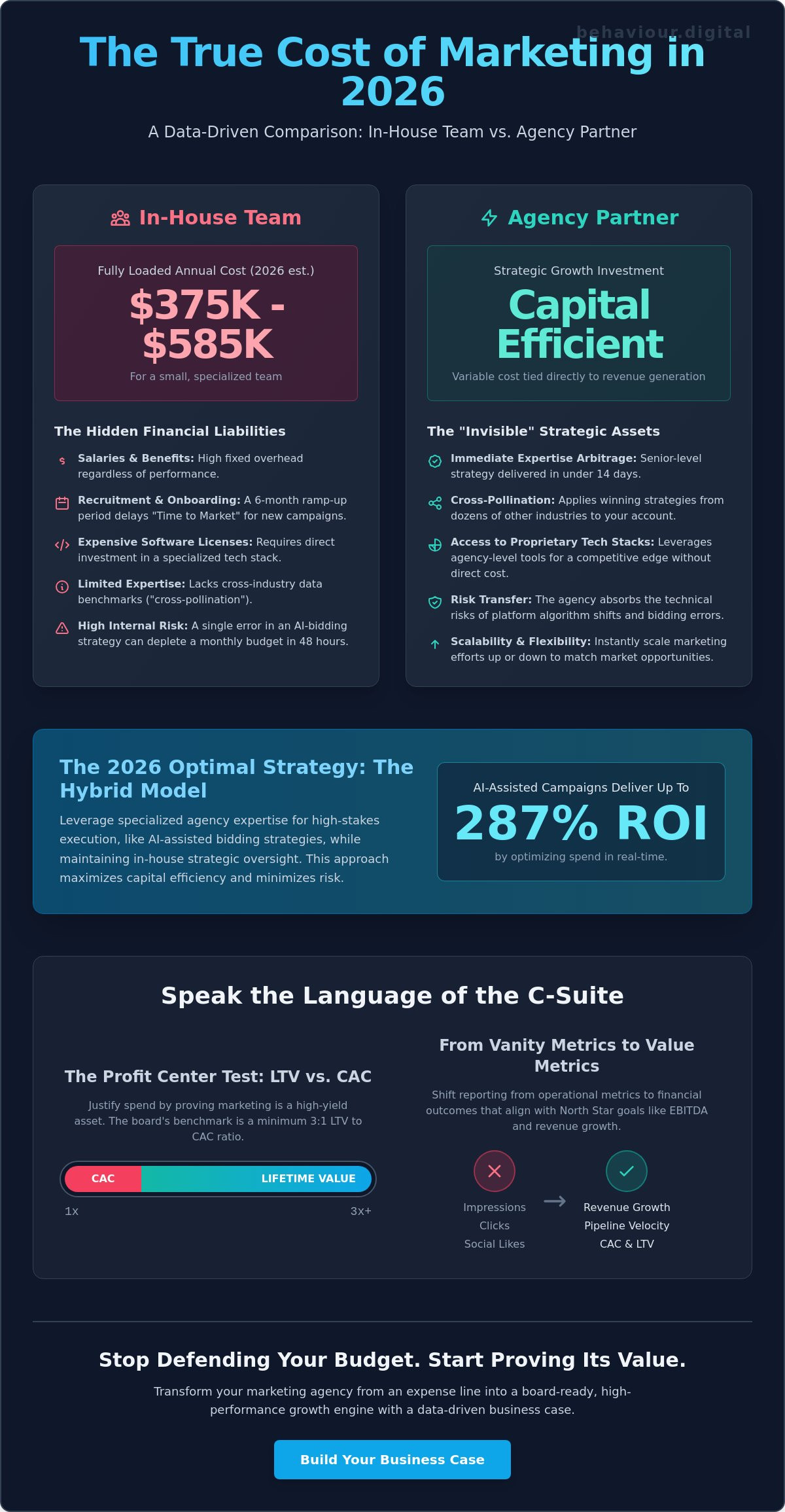
Comparing an agency retainer to a single in-house salary is a common mathematical error. When justifying marketing agency costs to management, you must present the "fully loaded" cost of internal hiring. A base salary is only the starting point. Once you account for National Insurance, pension contributions, healthcare, and recruitment fees, the actual cost of an employee is typically 1.5 times their salary. In 2026, industry data shows the fully loaded cost of a small in-house marketing team ranges between $375,000 and $585,000 annually. This represents a massive fixed liability that lacks the flexibility of an outsourced partnership.
Beyond the payroll, there is the "Tech Stack Tax." High-performance marketing requires enterprise-level tools for data analysis, heatmapping, and bid management. Agencies absorb the costs of platforms like Semrush, Funnel.io, and VWO, which can save a business upwards of $20,000 a year in licensing fees alone. By using an agency, you're not just buying hours; you're buying access to a sophisticated infrastructure that would be cost-prohibitive to build from scratch.
Local market conditions often dictate the feasibility of in-house teams. If you analyze the requirements for a PPC agency Glasgow, it becomes clear that agencies provide a "fractional" team of specialists for a fraction of the cost of one senior hire. One internal employee cannot realistically be an expert in PPC, social media strategy, and conversion optimization simultaneously. There is also the "Retention Risk" to consider. When an in-house specialist leaves, your marketing momentum stops. An agency provides institutional stability, ensuring that your data and strategy remain intact regardless of individual staff turnover.
Fixed labor costs are a significant risk during economic shifts. Agencies offer "Elastic Headcount," giving you the ability to scale your Digital Strategy up for peak seasons like Black Friday or down during quiet quarters without the trauma of layoffs. Many executives believe AI will eventually make agencies redundant, but the opposite is true. While AI-assisted bidding can deliver a 287% ROI, it requires an expert pilot to define the parameters and monitor the output. Justifying marketing agency costs to management means proving that an agency is the most capital-efficient way to access that expert oversight without the long-term burden of a fixed internal department.
Success in justifying marketing agency costs to management depends on your ability to pivot from technical jargon to commercial reality. Executives don't want to hear about click-through rates; they want to see how your budget aligns with the "North Star" metrics of the business, such as EBITDA, net revenue growth, or market share expansion. Start your pitch by demonstrating that you understand these high-level objectives. When you frame agency fees as a tool to achieve a 15% increase in annual recurring revenue, the cost becomes a secondary detail to the outcome.
The second stage of the framework is presenting the "Baseline." You must quantify what happens if the agency partnership stops. Use historical data to show the projected dip in lead volume and the inevitable rise in acquisition costs that occurs when specialized oversight is removed. This creates a "loss aversion" narrative. Following this, show the "Efficiency Gain" by highlighting how the agency is currently optimizing the spend. Finally, present a "Growth Scenario" that outlines the specific revenue milestones you can hit if management chooses to reinvest the savings generated by agency efficiencies back into the ad accounts.
A "Stop/Start/Continue" analysis is the most effective way to visualize agency value. By looking at previous periods of low involvement, you can prove that consistent Social Media Marketing Management Scotland isn't just about daily posts; it's about building long-term brand equity that lowers your blended CAC over time. Data from 2026 shows that brands with consistent social strategies see a 12% higher conversion rate on their paid search campaigns due to increased brand trust. This multi-channel synergy is often the first thing lost when internal teams are stretched too thin.
Your reporting should be designed for a 30-second executive review. Lead with business outcomes, follow with financial efficiency, and leave the granular marketing tactics for the appendix. A structured framework ensures that justifying marketing agency costs to management becomes a routine validation of success rather than a defensive struggle. Use punchy, data-backed statements in your summaries. For example: "Our agency partnership has reduced our blended CAC by 14% while increasing lead volume by 22% over the last quarter."
To see how these frameworks apply to your specific business model, you can book a strategic performance review with our senior analysts to audit your current trajectory.
Management values transparency above all else. At Behaviour Digital, we eliminate the "black box" of agency operations by providing complete visibility into every pound spent. Our "Behavioral Growth" philosophy is built on the principle that scalable success isn't the result of luck. It's the product of conscious strategy and continuous optimization. We don't just act as a service provider; we function as a strategic partner responsible for your commercial outcomes. This partnership model ensures that justifying marketing agency costs to management is a process rooted in shared accountability and measurable business impact.
Our Glasgow-based team integrates directly with your board-level strategy. We don't operate in a vacuum. We align our PPC and CRO efforts with your specific EBITDA targets to ensure every campaign serves a broader business purpose. This level of integration is why our clients view us as an investment in their future rather than a line item in their past. We operate on a performance-based mentality. Our commitment to scalable growth means we only win when you grow. This shared accountability is the foundation of a high-trust partnership, removing the friction often found in traditional agency relationships where fees are disconnected from results.
We use real-time user behavior data to identify friction points before they impact your bottom line. Understanding *why* a user exits a landing page is financially more efficient than simply increasing the ad budget to replace them. This "Behavioural Edge" allows us to pivot campaigns instantly, protecting your capital from wasted spend. By the time a standard internal report would have flagged a performance dip, our specialists have already implemented a data-backed solution. This level of proactive management is essential when justifying marketing agency costs to management in an increasingly volatile digital environment.
Securing budget approval requires more than a standard pitch. We assist our clients by providing a "Business Case Audit." This is a comprehensive breakdown of the projected ROI and efficiency gains specific to your industry and current performance. This document provides the commercial validation your executive team needs to move forward with confidence. It transforms the discussion from a cost-based negotiation into a strategic alignment session. Proving value is simple when the data shows that the partnership is a primary driver of enterprise value. Contact Behaviour Digital to build your data-backed growth strategy today.
Securing your budget for 2026 requires a shift from defending costs to presenting a business case for capital allocation. You've seen how the fully loaded cost of internal hiring often exceeds $375,000 annually, making the agency model a significantly more agile alternative for mid-market firms. By focusing on commercial truths like Profit on Ad Spend (POAS) and maintaining a 3:1 LTV:CAC ratio, you align your marketing activity with the board’s financial objectives.
The process of justifying marketing agency costs to management is no longer a struggle when you use a structured "Stop/Start/Continue" framework. This data-driven approach removes the ambiguity from your digital strategy and proves that specialized expertise is a scalable growth engine.
If you're ready to validate your strategy with board-ready data, our Glasgow-based team is here to help. We provide transparent, performance-focused reporting that connects granular user behavior to your bottom line. Book a Strategic Growth Audit with Behaviour Digital to build your data-backed growth strategy today. Your path to predictable, scalable revenue starts with a single, informed decision.
Justifying a retainer requires shifting the focus from a monthly expense to a risk-adjusted return on capital. CFOs prioritize capital efficiency and predictable pipelines. Present the agency as a variable cost that supports a 3:1 LTV:CAC ratio, turning the retainer into a revenue-generating asset. Use historical performance data to prove that the agency provides a more stable and scalable result than a fixed internal headcount, which is essential for accurate financial forecasting.
Agencies are typically more cost-effective for mid-market firms because they eliminate the "Tech Stack Tax" and high HR overhead. The fully loaded cost of a small in-house team in 2026 ranges between $375,000 and $585,000 annually. This includes National Insurance, benefits, and specialized software licenses. An agency provides a full team of PPC, social media, and CRO specialists for a fraction of that investment, allowing for higher capital efficiency without long-term liabilities.
Management prioritizes "Commercial Truths" that impact the balance sheet over vanity metrics like likes or shares. Focus on Customer Acquisition Cost (CAC), Lifetime Value (LTV), and Profit on Ad Spend (POAS). These metrics directly influence the company's EBITDA and overall market share. Providing a transparent link between digital strategy and realized profit is the most effective way of justifying marketing agency costs to management during quarterly reviews.
Proving ROI in 2026 requires a focus on first-party data and closed-loop attribution models. You must demonstrate how your agency’s efforts influence the entire customer journey, from the first touchpoint to the final sale. Use data from AI-assisted bidding strategies, which have delivered up to a 287% ROI compared to manual methods. By tracking behavioral shifts and conversion path velocity, you can present a clear, data-backed view of how every pound spent contributes to growth.
The primary opportunity cost is "Institutional Inertia" and the revenue lost during the months it takes to recruit and train an internal team. If an agency launches a high-performing campaign in 14 days while an internal hire takes 180 days, you lose nearly six months of market capture. This delay results in significant missed revenue. Additionally, you miss out on "Expertise Arbitrage," where agencies apply proven wins from other industries to accelerate your specific growth.
Respond with a data-backed "Stop/Start/Continue" analysis rather than an emotional defense. Quantify the projected revenue loss and the inevitable rise in CAC that occurs when specialized oversight is removed. Show the risk of losing market share to competitors who maintain their spend during economic shifts. By framing the budget cut as a direct threat to the company’s revenue targets, you move the conversation from a cost-saving exercise to a strategic risk-management discussion.
Outsourcing PPC is often safer because it transfers the technical risk of platform changes to a specialized partner. A single error in an AI-driven bidding strategy can deplete a monthly budget in 48 hours. Agencies provide the senior-level oversight and proprietary tech stacks needed to prevent these catastrophes. This allows your internal lead to focus on brand strategy while the agency handles the high-stakes execution, ensuring your capital is protected and optimized for profit.
Explain Conversion Rate Optimization (CRO) as a financial "force multiplier" for your existing assets. It's the process of making your website more efficient so that a higher percentage of visitors become paying customers. A 1% increase in conversion can lead to a 20% increase in net profit without increasing your advertising spend. CRO is a primary tool for justifying marketing agency costs to management because it maximizes the efficiency of every dollar already being invested.

Luke leads strategy across every Behaviour Digital account — building data-driven advertising systems for ambitious brands. When he's not auditing ad accounts, he's writing about what he found in them.
Get a free, tailored growth plan — we'll run our framework on your accounts and show you exactly what we'd do.
Get your free growth plan →