.webp) Online
OnlineNot sure which channel fits your business?View all services →
Three inputs. Instant KPIs. No spreadsheets.Open a calculator →
OnlineWith average Google Ads CPCs jumping by 12% in 2026 to as high as $5.42, simply bidding higher is no longer a viable growth strategy. You've likely noticed that your acquisition costs are climbing while landing page bounce rates remain stubbornly high. It's frustrating to watch expensive traffic lea...

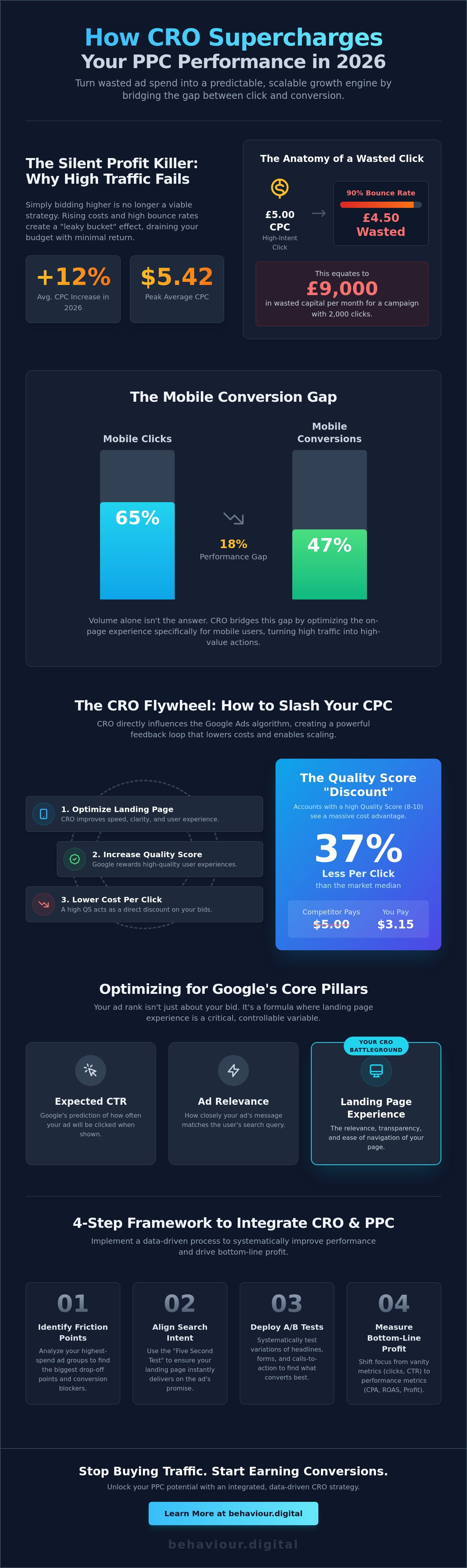
With average Google Ads CPCs jumping by 12% in 2026 to as high as $5.42, simply bidding higher is no longer a viable growth strategy. You've likely noticed that your acquisition costs are climbing while landing page bounce rates remain stubbornly high. It's frustrating to watch expensive traffic leave without converting, making it nearly impossible to justify budget increases to your stakeholders. This guide breaks down exactly how cro improves ppc performance by turning those bounces into measurable business value.
We understand that the gap between a click and a conversion is where most profits disappear. Mobile devices now account for 65% of clicks but only 47% of conversions, proving that volume alone isn't the answer. You'll learn how to bridge this performance gap and stabilize your returns despite the rising competition. We'll explore the data-driven methodology behind high-converting landing pages and the technical adjustments that lower your ad spend. This is your roadmap to a predictable, scalable digital strategy that delivers a higher Return on Ad Spend and a significantly lower Cost Per Acquisition.
• Learn how a high Quality Score acts as a hidden discount, allowing you to pay significantly less per click than the market median.
• Understand the technical mechanics of how cro improves ppc performance by optimizing landing page experience to secure higher ad rankings.
• Discover the "Five Second Test" methodology to ensure your landing pages immediately align with specific transactional search intent.
• Implement a 4-step integration framework to identify friction points and deploy A/B testing on your highest-spend ad groups.
• Shift your focus from vanity traffic metrics to a unified performance model that prioritizes bottom-line profit and sustainable scaling.
In 2026, the average CPC for Google Search campaigns has increased by 12%, with cross-industry averages now ranging between $2.96 and $5.42. For many UK businesses, this trend has turned once-profitable accounts into cost centres. Doubling your ad spend to compensate for a 1% conversion rate is a flawed logic that ignores the "leaky bucket" problem. If your landing page can't convert the traffic you already have, sending more users to it only accelerates your financial losses. This is the fundamental reason why understanding how cro improves ppc performance is critical for any performance-led business.
We see too many brands focusing on vanity metrics like click-through rates while ignoring the value metrics that actually drive the bottom line. Clicks don't pay the bills; revenue does. Modern users have zero patience for friction, and the "3-second rule" for landing page relevance is now an industry standard. If your page doesn't demonstrate immediate value and load speed within that window, you've lost the lead and the capital spent to acquire it. Success in 2026 requires a shift from buying traffic to earning conversions.
Consider the financial reality of a high-intent keyword with a £5 CPC. With a 90% bounce rate, you're effectively throwing away £4.50 of every £5 spent. For a campaign generating 2,000 clicks a month, that equates to £9,000 in wasted capital. Scaling this budget without fixing the conversion path is the most expensive way to grow. This inefficiency also carries a hidden cost: eroded brand trust. A disjointed post-click experience tells the user that your business doesn't understand their needs, making future re-engagement significantly harder and more expensive.
The shift from simple keyword-matching to complex intent-matching is now complete. In our current cookie-less environment, you can't rely solely on third-party tracking to understand your audience. On-site behavioural data is your primary source of truth. Implementing Conversion rate optimization gives you the tools to analyze this data and refine your broader digital strategy. Whether you are competing for local leads in Glasgow or expanding internationally, success depends on matching the ad's promise with a seamless on-page reality. This integrated methodology ensures that you understand how cro improves ppc performance by turning every pound of ad spend into a measurable business outcome.
Most advertisers treat their PPC bids and their landing pages as separate entities. This siloed thinking is a costly mistake. Google's auction system doesn't just look at who is willing to pay the most; it prioritizes the user experience. By improving your on-page elements, you're directly influencing the algorithm that determines your costs. This technical synergy is exactly how cro improves ppc performance at a fundamental level. When your page provides a seamless, high-speed experience that matches the user's search query, Google rewards you with a higher Quality Score.
This reward manifests as a "hidden discount" on every click you buy. Verified data from 2026 shows that accounts maintaining a high Quality Score between 8 and 10 pay 37% less per click than the market median. This means a competitor with a poor landing page might pay $5.00 for the same visitor that costs you only $3.15. CRO isn't just about what happens after the click. It's a proactive tool that lowers the entry price of the auction itself. High-performing assets create a feedback loop where better engagement leads to lower costs, which in turn allows for more aggressive scaling.
The Google Ads algorithm relies on three primary pillars: Expected Click-Through Rate, Ad Relevance, and Landing Page Experience. While the first two are handled within the ad account, the third is entirely dependent on your CRO efforts. Reducing friction by simplifying forms, improving mobile load speeds, and ensuring ad-to-page continuity signals to Google that your site is a premium destination. Simply put, your landing page experience is a high-leverage cost-reduction tool that dictates your long-term PPC viability.
When you optimize your conversion path, you trigger a multiplier effect that transcends simple arithmetic. For instance, a 20% increase in your conversion rate doesn't just result in more leads; when combined with the lower CPCs earned through a better Quality Score, it can lead to a 40% drop in your total Cost Per Acquisition. This creates a permanent performance floor. Unlike temporary ad hacks, CRO improvements are cumulative and sustainable. To see the specific metrics you should track, you can use frameworks to calculate and increase PPC conversion rate effectively.
Integrating these technical refinements requires a deep understanding of user psychology and data analysis. We've detailed the specific steps for this in our comprehensive guide to conversion rate optimization. By aligning your post-click reality with your pre-click promise, you stop fighting the algorithm and start using it to your advantage. If you're ready to move beyond basic traffic metrics, it may be time to consult with a strategic digital partner who prioritizes bottom-line growth over click volume.
Alignment is the difference between a high-bounce visit and a qualified lead. Before a single pixel is designed, you must identify whether the search intent is informational or transactional. A user searching for "how to reduce CAC" requires a different experience than one searching for "PPC management services," and failing to recognize this distinction is a primary reason for high bounce rates. This alignment is a core component of how cro improves ppc performance, as it ensures that the user's mental model at the time of the click is validated within seconds of landing.
The "Five Second Test" serves as a brutal but necessary filter for your landing pages. If a user can't tell exactly what you offer and what they should do next within five seconds, your conversion rate will suffer. High cognitive load is a conversion killer. When you present too many choices or vague headlines, the user's brain defaults to the easiest option: leaving. By narrowing the focus to a single, clear action, you respect the user's time and reduce the mental effort required to convert.
We often hear stakeholders claim that their product is simply "hard to sell." In reality, the friction usually lies in the presentation, not the product itself. If your ads are generating high-quality clicks but your sales remain stagnant, the disconnect between the ad promise and the page reality is the culprit. Fixing this gap is far more effective than trying to "fix" a product that users haven't even had the chance to understand.
Message Match is the practice of repeating the exact headline or offer from your ad on your landing page. It provides immediate reassurance that the user is in the right place. To diagnose where the flow breaks, we use heatmaps and session recordings. These tools reveal where PPC traffic "dies," allowing us to see if users are getting stuck on a complex form or missing a call-to-action. Behavioural triggers like social proof and urgency can then be applied strategically to address these specific friction points. This methodology is a primary driver of how cro improves ppc performance in competitive sectors.
In 2026, hyper-relevance is the baseline for digital success. Segmenting landing pages by ad group allows for a tailored experience that matches specific keyword clusters. Advanced personalization now includes adjusting content based on UTM parameters, ensuring the page speaks directly to the user's origin. This level of ad-copy-to-page alignment is a hallmark of PPC agency Glasgow expertise, where the focus is on creating a unified journey that prioritizes the final conversion over the initial click. By treating every traffic source as a unique segment, you eliminate the "one-size-fits-all" approach that wastes precious ad spend.
Successful implementation requires more than just changing a button color. It demands a rigorous, four-step integration that aligns your paid media spend with actual user behavior. This framework demonstrates how cro improves ppc performance by creating a self-correcting system where ad data informs the landing page and on-page behavior informs the ad targeting. Without this feedback loop, your PPC campaigns remain static while the market moves forward.
The first step involves auditing the entire PPC-to-landing page flow to identify points of friction. We look for technical barriers, such as slow mobile load times, that disproportionately affect the 65% of users clicking from mobile devices. Step two moves into active A/B testing, specifically targeting high-spend, low-conversion ad groups where the financial impact of an improvement is greatest. In step three, we use keyword performance data to refine landing page headlines, ensuring they mirror the user's exact search intent. Finally, step four establishes a continuous feedback loop between the ad manager and the specialist to ensure both departments work toward the same revenue goals.
We begin by identifying "bleeding" ad groups. These are segments of your account with significant spend but zero conversions over a statistically significant period. By benchmarking these against 2026 industry standards for conversion optimisation, we can see exactly where the disconnect occurs. Setting realistic KPIs for the first 90 days is essential; we focus on reducing bounce rates and increasing micro-conversions before pushing for a full CAC reduction. If you're ready to stop the financial leak in your accounts, you can partner with our strategic team to initiate this audit immediately.
Prioritizing tests is a matter of resource allocation. We use the PIE framework, evaluating every proposed change based on its Potential for improvement, its Importance to the bottom line, and the Ease of technical implementation. In 2026, testing "big" changes like entire layout shifts or value proposition reframes consistently outperforms small tweaks to button colors or font sizes. This high-impact approach is a core part of a wider digital strategy, ensuring that every test contributes to long-term, scalable growth rather than temporary gains. This methodical testing is precisely how cro improves ppc performance over time, creating a robust foundation for your paid media efforts.
At Behaviour Digital, we've eliminated the traditional silos between paid media and conversion optimization. We treat PPC and CRO as a single, unified performance department because one cannot succeed without the other in a high-CPC environment. This structural alignment is the most effective way to demonstrate how cro improves ppc performance. By synchronizing the ad manager's data with the CRO specialist's insights, we create a feedback loop that maximizes every pound invested in the auction.
Our methodology shifts the focus from vanity traffic volume to genuine bottom-line growth. In a market where Google Ads CPCs can reach $5.42, chasing clicks is a path to insolvency. We prioritize the metrics that matter: lead quality, sales velocity, and customer acquisition cost. This data-driven mindset has allowed us to deliver significant results, such as reducing a client’s CPA by 35% within four months. This wasn't achieved by simply lowering bids; it was the result of meticulously refining the landing page experience to convert at a higher rate than the industry average.
Based in Glasgow, our team combines local market knowledge with a global, analytical perspective. We understand the specific competitive pressures of the UK landscape and apply rigorous, evidence-based strategies to overcome them. We don't just act as a service provider; we position ourselves as a strategic partner responsible for your long-term scalability.
We reject the "set and forget" mentality that plagues many agencies. Our reporting style is direct and transparent, connecting your ad spend directly to the revenue generated. We navigate the complexity of modern multi-channel attribution by focusing on the user's entire journey rather than isolated touchpoints. This ensures that every decision we make is backed by quantitative data and aligned with your broader business objectives. Success isn't a matter of luck; it's the outcome of conscious strategy and continuous methodological fine-tuning.
Our "Audit First" philosophy means we never launch or take over a campaign without a comprehensive review of the landing page assets. It's irresponsible to spend capital on traffic that's destined to bounce. If you're looking for a clear understanding of how cro improves ppc performance within your specific niche, our Glasgow-based team is ready to conduct a detailed performance review of your current accounts. We'll identify the friction points and provide a roadmap for sustainable growth.
Ready to stop wasting ad spend? Let’s talk strategy.
The evidence is clear: bidding higher is no longer the solution to rising acquisition costs. We've detailed how a high Quality Score provides a technical discount on your ad spend and why behavioural alignment is the key to stopping the profit-killing cycle of high bounce rates. By adopting a unified framework, you move beyond the limitations of vanity metrics toward a strategy rooted in measurable business value. Understanding how cro improves ppc performance provides the strategic floor you need to scale with confidence.
As Glasgow-based strategic experts, we use a data-driven behavioural methodology to eliminate friction and maximize your returns. Our team has a proven track record of lowering CPA for our partners by focusing on the entire user journey, not just the initial click. We don't believe in "set and forget" campaigns; we believe in continuous refinement and shared success. If you're ready to stop the waste and start scaling, Book a Performance Audit with Behaviour Digital today. Your path to a predictable, scalable digital strategy starts with a single, data-backed decision.
Measurable improvements typically appear within 30 to 90 days. While technical adjustments like page speed can impact Quality Score almost immediately, A/B tests require time to reach statistical significance. We focus on a 12-week window to gather enough behavioural data to validate significant shifts in your conversion rate and cost per lead.
Yes, it directly reduces CPC by improving the Landing Page Experience component of your Quality Score. Google rewards relevant, high-performing pages with lower entry prices in the ad auction. This technical synergy is a primary way how cro improves ppc performance, as it allows you to secure top positions without simply increasing your bids.
High volume is only a requirement for quantitative A/B testing. For accounts with lower traffic, we use qualitative methods like heuristic analysis, user session recordings, and heatmaps to identify friction points. These methodologies allow us to make data-backed improvements that increase performance even when traffic is limited.
The headline and its "Message Match" with the ad copy is the most critical factor. If a user doesn't see the exact promise that triggered their click within three seconds, they'll bounce. Ensuring that your value proposition is clear and immediately visible is essential for maintaining the momentum of the click.
CRO cannot turn irrelevant traffic into revenue. If your PPC targeting brings in users with no intent to buy, on-page optimisation will only prove that the audience is a poor fit. However, the data gathered during the CRO process often helps ad managers identify which specific keywords drive the highest quality engagement, allowing for better budget allocation.
You measure ROI by tracking the reduction in Cost Per Acquisition (CPA) relative to the increase in lead or sale value. When your conversion rate improves, your fixed ad spend produces more output, which directly increases your Return on Ad Spend (ROAS). We focus on these bottom-line metrics rather than isolated traffic numbers.
It's highly effective for B2B lead generation. In B2B contexts, the focus is on reducing form friction and aligning content with complex decision-making journeys. This methodology is exactly how cro improves ppc performance for long sales cycles, as it builds the necessary trust and clarity required to convert high-value professional prospects into qualified leads.

Luke leads strategy across every Behaviour Digital account — building data-driven advertising systems for ambitious brands. When he's not auditing ad accounts, he's writing about what he found in them.
Get a free, tailored growth plan — we'll run our framework on your accounts and show you exactly what we'd do.
Get your free growth plan →