.webp) Online
OnlineNot sure which channel fits your business?View all services →
Three inputs. Instant KPIs. No spreadsheets.Open a calculator →
OnlineYour PPC contract is either a roadmap for growth or a legal trap designed to hold your historical data hostage. With the average UK business allocating £14,083.33 to monthly ad budgets in 2026, the financial risk of ignoring ppc agency contract red flags is substantial. You're likely tired of fee st...

Your PPC contract is either a roadmap for growth or a legal trap designed to hold your historical data hostage. With the average UK business allocating £14,083.33 to monthly ad budgets in 2026, the financial risk of ignoring ppc agency contract red flags is substantial. You're likely tired of fee structures that feel like a black box and the nagging fear that you'll lose years of campaign intelligence if you ever decide to part ways with your provider.
We believe a partnership should be built on measurable business impact, not restrictive legal jargon. This article provides a definitive 2026 checklist to help you identify predatory clauses and transparency gaps that drain marketing budgets. We'll examine why data ownership is non-negotiable under the Digital Markets, Competition and Consumers Act 2024 and how to ensure your contract accounts for the January 5, 2026, HFSS advertising restrictions. You'll gain the confidence to demand total account transparency and a fair, performance-based roadmap for your brand.
• Secure full ownership of your Google Ads Customer ID to prevent your campaign history and quality scores from being held hostage.
• Identify critical ppc agency contract red flags such as 90-day termination notice periods and unrealistic "guaranteed" top-spot rankings.
• Shift your focus from vanity metrics like clicks to conversion tracking and measurable ROI to ensure every pound spent drives business growth.
• Verify that your contract includes explicit clauses for regulatory compliance, specifically addressing the 2026 HFSS restrictions and DMCCA standards.
• Learn how to transition from restrictive, long-term legal "handcuffs" to a transparent, performance-driven partnership model.
In 2026, a PPC agreement functions as the legal foundation for your digital assets. It's not a simple price list. It is a strategic roadmap that dictates how your £14,083.33 average monthly budget translates into enterprise value. Vague terms often mask a lack of technical depth. If your contract doesn't define how your agency manages the transition to the Microsoft Advertising REST API or the monthly Google Ads API v24 updates, you're buying a static service in a dynamic market. This leads to "tactical tinkering" where small, insignificant changes replace the high-level strategy required for scalable growth. A service provider checks boxes; a strategic partner builds a scalable engine for your business.
Identifying ppc agency contract red flags early prevents a slow drain on your long-term ROAS. Hidden clauses regarding the ownership of custom scripts or landing page code can slash your business valuation during an exit. Clean data and portable accounts are balance sheet assets. When these are obscured by ambiguous legal language, your marketing spend becomes a sunk cost rather than a strategic investment. High-performing partnerships in 2026 require clarity on data ownership, API management, and proactive compliance with shifting UK regulations.
Agencies often use 90-day or 120-day notice periods to secure revenue when performance falters. This is an artificial lock-in. It prevents you from pivoting when market conditions shift, such as the January 5, 2026, HFSS advertising restrictions. Being stuck with an underperforming partner for a full quarter is more than an inconvenience. It's a competitive disadvantage that costs you market share while your rivals adapt. This trap creates a psychological toll, forcing marketing managers to defend a failing partnership simply because the exit costs are too high.
Transparency isn't a bonus feature. Under the Digital Markets, Competition and Consumers Act 2024, UK businesses have greater protection against "black box" practices. If an agency hides bid strategies or refuses to share real-time conversion data, they're likely concealing inefficient spend. We prioritise open-book management because you deserve to see exactly how every pound is allocated. Data-driven decision-making requires total visibility. Curated PDF reports that focus on vanity metrics are a relic of the past; real-time access to the Google Ads Customer ID is the modern standard for accountability.
Control over your digital assets is a prerequisite for data-driven decision-making. Many agencies claim they manage your campaigns while actually retaining legal ownership of the account. This is one of the most critical ppc agency contract red flags. If you lack administrative access, you don't own your data; you are merely renting it. Without this control, you cannot audit the granular changes made to your account or verify if the agency is truly optimising for your business goals.
Losing access to your account during a transition is often called a "historical data heist." When an agency refuses to transfer an account, they take your Quality Scores and conversion history with them. Because Google Ads relies on historical performance to determine ad rank and CPC, starting a new account can spike your costs. In the UK, where average CPCs range from £0.80 to £4, this loss of "account seasoning" can drain thousands from your budget in weeks. You must insist on being the primary owner of all tracking pixels, including GA4 and Google Tag Manager, to protect your Conversion Rate Optimisation (CRO) data.
Agencies that refuse to grant "Administrative" level access are usually hiding something. They might claim it is for "security reasons" or to "protect proprietary methods," but these are often excuses for poor performance or a lack of activity. Standard access is insufficient. You need the power to add or remove users and manage billing profiles. If you are unsure about your current level of access, we can help you perform a security and ownership review of your existing setup.
The Google Ads ID is the unique ten-digit identifier that serves as the permanent anchor for your business’s advertising data and historical performance.
You must verify who owns the payment profile linked to this ID in the billing settings. If the agency’s credit card or corporate profile is the primary payer, they hold significant leverage over your data. For a step-by-step guide on verifying this, see our article on Google Ads ID: Where To Find Your Customer ID.
Your contract must explicitly state that all ad copy, image assets, and video content developed during the partnership belong to you. In 2026, where AI-driven creative is the norm, this includes the prompts and logic used to generate these assets. Beware of agencies that use "proprietary" bidding scripts. While these scripts can improve performance, they often only function within the agency's specific environment. If you cannot take the script logic with you, you are facing a technical lock-in. Ensure your agreement specifies that all "work-for-hire" belongs to the client from the moment of creation.
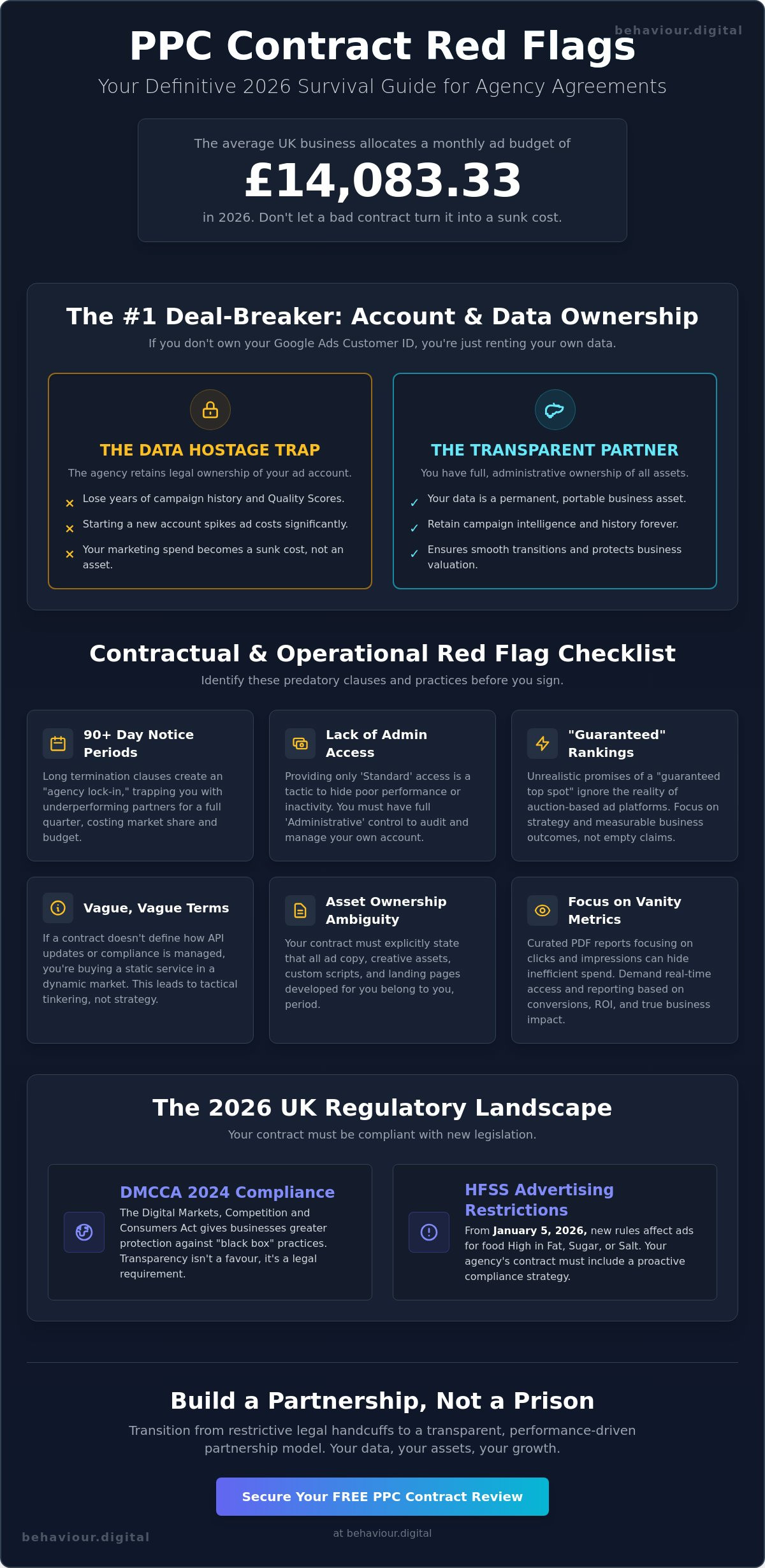
Signing a PPC agreement without a granular audit of the fine print is a gamble with your 2026 marketing budget. Many businesses focus on the monthly retainer, which typically ranges from £400 to £10,000 in the UK, while ignoring the clauses that dictate operational freedom. Guaranteed results are the most immediate of the ppc agency contract red flags. In an era of AI-driven bidding and the January 5, 2026, HFSS advertising restrictions, no agency can honestly promise a "Number 1 spot on Google." Such claims ignore the auction-based reality of modern search. If an agency guarantees specific rankings, they are likely using outdated tactics that don't align with sustainable growth.
Notice periods are another critical friction point. For UK small businesses, a notice period exceeding 30 days is a significant risk. Agencies often push for 90-day or even 120-day termination clauses to protect their own cash flow at your expense. If your ROAS drops or market conditions change, you shouldn't be forced to fund an underperforming campaign for an entire quarter. Additionally, look for "Minimum Spend Requirements." Some contracts mandate a floor for your ad spend, often to ensure the agency hits their own internal revenue targets regardless of your actual ROI.
A vague "Scope of Work" is a recipe for stagnation. If the contract simply promises "account management," you're likely paying for someone to monitor dashboards rather than actively scale your business. A strategic 2026 agreement must explicitly include:
• Continuous A/B creative testing and asset optimisation.
• Proactive management of the Microsoft Advertising REST API transition.
• Conversion Rate Optimisation (CRO) recommendations for landing pages.
• Compliance monitoring for the Digital Markets, Competition and Consumers Act 2024.
The common model of charging 10% to 30% of monthly ad spend creates a fundamental conflict of interest. It incentivises the agency to increase your spend even when marginal returns are diminishing. Flat-fee models or performance-based structures often align better with your actual growth objectives. Beware of high "Setup Fees" that exceed £1,000 without a clear breakdown of technical deliverables. These fees often mask a lack of ongoing strategy. Always check for hidden markups on third-party automation software; you should pay the market rate for the tools used to manage your data.
Your contract must define the end of the partnership as clearly as the beginning. Demand a mandatory "Transition Support" clause. This ensures the agency provides a final audit and hands over all campaign logic to your new partner without friction. Termination fees are a major red flag; you shouldn't be penalised for ending a professional relationship. A clean exit requires the agency to leave the account in a functional state, with all naming conventions, scripts, and historical data intact for the next phase of your growth.
Performance doesn't happen in the legal text; it happens in the account. High-volume clicks are meaningless without conversion data. In 2026, Google Ads API v24 and AI-driven bidding require precise signals to function. An agency focusing on Click-Through Rate (CTR) while ignoring Return on Ad Spend (ROAS) is hiding behind vanity metrics. This is a subtle but dangerous entry on the list of ppc agency contract red flags. Clicks don't pay bills. Conversions do.
Lack of conversion tracking is non-negotiable. If they aren't tracking phone calls, lead forms, or e-commerce transactions, they are essentially guessing. With UK companies spending an average of $14,083.33 monthly on ads, guessing is a luxury you can't afford. Real management requires a deep understanding of how users move through your digital marketing funnel. If your agency doesn't align their bidding strategy with specific stages of that funnel, they are burning your budget on low-intent traffic.
You can identify "set it and forget it" syndrome by checking the account change history. If you see fewer than 10 meaningful changes a month in a mid-sized account, the agency is coasting. High-performance PPC requires constant bid strategy churn, negative keyword refinement, and audience testing. If the account looks static, your management fee is being wasted on automated scripts that require zero human oversight. You deserve a partner who actively scales your growth, not one who simply monitors a dashboard.
Driving traffic to a broken page is a waste of capital. PPC without conversion rate optimisation is only half a strategy. If your agency refuses to audit your landing pages or suggests it is outside their scope, they are ignoring the most critical part of the ROI equation. We integrate CRO into our management because the ad is only the first step. The real business impact happens on your site. If your current provider ignores user behaviour, it’s time to request a performance-led account audit.
Automated PDF reports are a major operational red flag. These reports often lack human context. They fail to explain why performance shifted or how the strategy will adapt to the latest Microsoft Advertising REST API transitions. Monthly reports are the bare minimum. You should demand weekly check-ins and a dedicated account manager. A generic "support" alias is a sign you're just a number. Strategic growth requires a direct line to the person actually pulling the levers in your account.
Selecting a partner requires more than a comparison of management fees. It requires a commitment to total transparency and technical precision. We've built our business model to eliminate the ppc agency contract red flags that compromise your growth. Our "Ownership First" policy ensures that your Google Ads Customer ID remains your property from day one. You own the data, the assets, and the historical intelligence. We believe that if an agency needs to use legal "handcuffs" to retain a client, their performance isn't strong enough to stand on its own.
We don't rely on restrictive 12-month contracts. Our partnerships are built on performance and mutual trust. If we aren't driving measurable business value, you shouldn't be locked into a partnership that drains your budget. This approach forces us to remain agile. In 2026, agility is the only way to navigate the monthly Google Ads API v24 updates and the mandatory transition to the Microsoft Advertising REST API. We treat your budget as a strategic investment, ensuring every pound is optimised for the highest possible return.
Our approach to PPC Management is rooted in behavioural data and technical excellence. We don't just manage clicks; we manage the entire journey from search intent to final conversion. Being based in Glasgow gives us a unique local perspective on the UK market, including a deep understanding of the January 5, 2026, HFSS advertising restrictions. We combine this local expertise with a global reach to help our clients scale their operations without the friction of "black box" agency practices.
The first 30 days of a Behaviour Digital partnership are focused on radical clarity. We begin with a "Deep Dive" audit of your existing accounts to find the "leaks" left behind by previous providers. This includes a full review of your tracking pixels and a security audit of your administrative access. We then set realistic, data-backed KPIs based on your historical performance and current market trends. You'll receive a clear roadmap for the first quarter, with no hidden fees or vague deliverables.
You shouldn't have to guess if your marketing budget is being used effectively. Our Glasgow team is ready to help you audit your current agreements and identify potential ppc agency contract red flags before they become costly liabilities. We offer a no-obligation audit of your existing ad accounts to show you exactly where your spend is being wasted. Stop settling for vanity metrics and start building a scalable growth engine. Book a strategy call with Behaviour Digital today to secure your data and reclaim control of your PPC strategy.
Identifying ppc agency contract red flags is the first step toward reclaiming your marketing ROI. You've learned that administrative access to your Google Ads Customer ID is non-negotiable and that restrictive notice periods often mask poor performance. A strategic partnership requires more than just managing clicks; it demands a deep integration of CRO and proactive compliance with the latest UK digital advertising regulations. Your data is a balance sheet asset. It shouldn't be held hostage by predatory legal clauses or technical lock-ins.
Based in Glasgow and serving businesses across the UK, Behaviour Digital provides a 100% Transparency Guarantee across PPC, Social Media, and CRO. We don't hide behind automated reports or 12-month legal handcuffs. Our focus remains on data-driven growth and measurable business impact that scales with your ambition. If you're unsure about the terms of your current agreement, our team of specialists can help you spot the leaks before they drain your budget further.
Get a Free PPC Audit & Contract Review from our expert team today. Your campaign history is your most valuable asset. Protect it now to ensure a scalable and profitable future for your brand.
An agency can legally own an account if you sign a contract that permits it, but you should never agree to this arrangement. This is one of the most severe ppc agency contract red flags. Under the Digital Markets, Competition and Consumers Act 2024, you have the right to transparency; ensure your agreement explicitly states you own the Google Ads Customer ID and all associated data from the start.
A 30-day notice period is the industry standard for maintaining business agility. Contracts requiring 90 days or more are often designed to protect agency revenue rather than client growth. In the fast-moving 2026 landscape, you need the freedom to pivot your strategy if performance targets aren't met or if regulatory changes like the January 5, 2026, HFSS restrictions impact your sector.
A flat management fee or a performance-led model is generally superior to a percentage of spend. Percentage models create a fundamental conflict of interest, as agencies are incentivised to increase your spend regardless of the marginal return. Choosing a flat fee ensures your partner focuses on efficiency and scaling your ROAS rather than simply inflating your monthly ad budget.
You should retain 100% of your data, including conversion history and Quality Scores, provided you own the account administrative rights. If you don't own the account, you risk a "data heist" where years of campaign intelligence are lost. Your contract must specify that all tracking pixels, custom scripts, and historical data remain your property after the partnership ends.
Yes, guaranteeing a specific ROAS is a major red flag because agencies cannot control external market variables. Factors like your landing page performance, competitor pricing, and seasonal shifts all influence outcomes. A transparent partner will set realistic KPIs based on historical data and market trends rather than making impossible promises to win your business.
Your report must include conversion volume, cost per acquisition (CPA), and actionable human insights. Clicks and impressions are vanity metrics that don't reflect business growth. In 2026, reports should also detail technical updates, such as how the account is leveraging the latest Google Ads API v24 features to improve bidding precision and audience targeting.
No, you should always link your own corporate payment profile directly to the advertising platform. Allowing an agency to pay on your behalf and invoice you later can hide markups and reduces your direct control over the account. Paying Google or Microsoft Advertising directly ensures you have a clear, unedited record of your actual media spend at all times.
You can verify agency activity by viewing the "Change History" section within your Google Ads account. A healthy, actively managed account typically shows 10 or more strategic adjustments per month, including bid changes, keyword refinements, and creative testing. If the history is empty, your agency is likely relying on "set it and forget it" automation instead of active management.

Luke leads strategy across every Behaviour Digital account — building data-driven advertising systems for ambitious brands. When he's not auditing ad accounts, he's writing about what he found in them.
Get a free, tailored growth plan — we'll run our framework on your accounts and show you exactly what we'd do.
Get your free growth plan →