.webp) Online
OnlineNot sure which channel fits your business?View all services →
Three inputs. Instant KPIs. No spreadsheets.Open a calculator →
OnlineWith the average cost-per-click on Google Ads rising to $3.41 in 2026, a 26.8% increase from 2025, the margin for error has disappeared. You likely have specific questions to ask a ppc agency before hiring because you've felt the frustration of reports filled with clicks that don't translate into re...

With the average cost-per-click on Google Ads rising to $3.41 in 2026, a 26.8% increase from 2025, the margin for error has disappeared. You likely have specific questions to ask a ppc agency before hiring because you've felt the frustration of reports filled with clicks that don't translate into revenue. Success isn't luck; it's the result of conscious strategy and continuous optimization. Many agencies still operate on a "set and forget" basis even though 78% of Google Ads spend is now managed through automated smart bidding. You deserve a strategic partner who views your budget as a growth engine, not an expense.
Finding that partner requires looking past polished proposals. We've compiled 15 critical inquiries to protect your investment and ensure transparent, data-driven results. You'll learn how to vet an agency's technical proficiency with tools like AI Max and their readiness for the new 37-month data retention policy starting June 1, 2026. This guide provides a framework to identify a partner who prioritizes real business impact and scalable growth over vanity metrics.
• Identify the "bait and switch" by confirming whether senior strategists or junior account managers will handle your daily campaign execution.
• Master the critical strategic and technical questions to ask a ppc agency before hiring to ensure they leverage behavioral data rather than just targeting generic keywords.
• Secure your business by demanding 100% account ownership and replacing stagnant monthly PDFs with live, transparent data dashboards.
• Learn to evaluate commercial terms like performance-based fees and contract lengths to ensure your agency partner remains accountable for your growth.
• Understand why traffic is a vanity metric without an integrated Conversion Rate Optimization (CRO) strategy to turn clicks into revenue.
Choosing a partner to manage your digital growth is a high-stakes strategic investment. Your initial questions to ask a ppc agency before hiring must cut through polished sales pitches to reveal the operational reality. Industry experience is frequently cited as the primary credential, yet it remains a double-edged sword. While a niche specialist understands your specific terminology, they often fall into a "template trap," applying identical tactics across every client in their portfolio. Conversely, an agency with broad experience across the Pay-per-click (PPC) advertising model brings cross-industry innovations and fresh perspectives that a narrow specialist might overlook. Success in 2026 requires this kind of lateral thinking.
Avoid the "Bait and Switch" trap. This occurs when senior strategists sell the vision during the proposal phase, only to hand the daily management to junior staff once the contract is signed. You must demand clarity on account capacity. As of 2026, 78% of Google Ads spend is managed through Smart Bidding, shifting the manager's role from manual adjustments to high-level strategic oversight. If a single specialist handles more than 12 accounts, they likely lack the bandwidth to perform the deep behavioral analysis your brand requires for scalable growth. Ask for the specific ratio of managers to accounts to ensure your business receives the attention it deserves.
Request a specific bio and the track record of your dedicated account manager. You aren't just hiring a brand; you're hiring an individual's expertise. Inquire about their internal training standards and current Google Partner certifications. Effective communication isn't a stagnant monthly PDF. It's a direct line to the specialist who understands why your conversion rates fluctuated yesterday. Establish the frequency and format of these direct interactions before signing any agreement. You need a partner, not a black box.
Generic claims like "we increased ROI by 200%" are often meaningless without context. Demand case studies that align strictly with your business model, whether that is B2B lead generation or high-volume e-commerce. Ask the agency: "What is the biggest challenge you've faced in my niche and how did you solve it?" Their response will reveal their problem-solving methodology and technical depth. Look for evidence of long-term client retention. A partner that maintains relationships for over 36 months demonstrates the ability to deliver sustainable, long-term business impact rather than just short-term wins.
Growth isn't a byproduct of high ad spend. It's the result of precise technical execution and strategic alignment. When considering questions to ask a ppc agency before hiring, you must evaluate their ability to manage the shift from manual bidding to algorithmic oversight. Performance Max campaigns now account for 42% of all Google Ads spend in 2026. An agency that resists this automation is fighting the platform; an agency that ignores the inputs is wasting your money. The real value lies in how they steer these AI-driven tools using high-intent data and creative testing frameworks.
Targeting keywords is no longer enough. You need to know how an agency identifies "high-intent" signals that indicate a user is ready to buy rather than just browse. Ask about their negative keyword management process to prevent budget leakage on irrelevant queries. A sophisticated partner looks beyond a single platform. They understand how search behavior interacts with Social Media Marketing to create a cohesive multi-touchpoint journey. In March 2026, Meta updated its attribution model to focus strictly on link clicks for website conversions. Your agency must explain how they adapt their multi-channel strategy to these changing technical standards.
Traffic is a vanity metric if it doesn't convert. Most agencies stop at the click, but you should ask: "How do you analyze what happens after a user lands on the site?" A high-performance partner integrates conversion rate optimization into their core PPC workflow. They use behavioral heatmaps and A/B testing to ensure the landing page experience matches the ad's promise. Behavioral data informs bid adjustments by identifying the specific user interactions that correlate with high customer lifetime value. If an agency doesn't have a plan for the landing page, they're only doing half the job. You can audit your current strategy to see where your conversion leaks are occurring.
Data integrity is the final technical hurdle. With the phase-out of third-party cookies, tracking requires first-party data solutions like Google's Enhanced Conversions. Starting June 1, 2026, Google Ads will implement a 37-month data retention policy for granular performance data. Your agency must have a plan to export and utilize this historical data before it disappears. Ask how they ensure attribution accuracy in this privacy-first environment. If they can't explain their approach to server-side tracking or the Conversions API, they aren't prepared for the complexities of 2026. These are the technical questions to ask a ppc agency before hiring that separate executors from strategists.
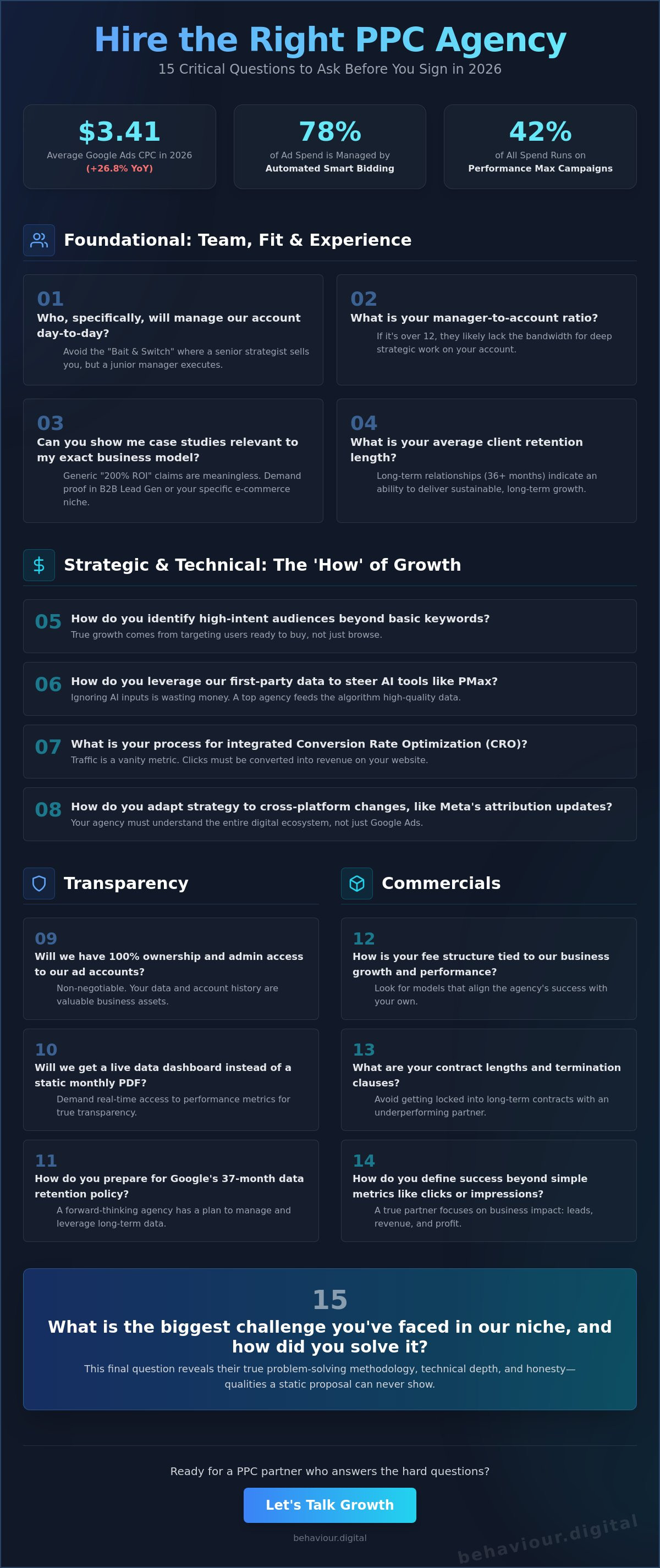
Transparency isn't a bonus feature. It's a fundamental requirement for any scalable strategy. When formulating questions to ask a ppc agency before hiring, you must address the ownership of your digital assets. Many agencies attempt to hold accounts hostage by building them within their own proprietary systems. This creates a dangerous dependency. If you decide to move on, you lose years of optimization data and account structure. In a landscape where Google Ads implements a 37-month data retention policy starting June 1, 2026, losing your historical context is a catastrophic business setback.
Demand "Admin" level access to all platforms from day one. You need to know that if you part ways, you keep the historical data and the account structure you paid to build. Ad spend should always be paid directly to the platform, not through the agency. This prevents hidden markups and ensures you have a direct relationship with the advertising network. If an agency refuses these terms under the guise of "proprietary methodology," walk away. True expertise is found in the strategy, not in hiding the data.
Static monthly PDFs are an outdated relic of 2015. They allow agencies to cherry-pick data and hide underperforming segments. Demand a live dashboard that provides real-time transparency into your performance. You aren't paying for clicks or impressions; you're paying for business impact. Your reporting should focus on metrics that matter to your bottom line: Cost Per Acquisition (CPA), Return on Ad Spend (ROAS), and Customer Lifetime Value (LTV).
Ask to see a redacted sample report from a current client. Pay close attention to how they handle bad news. Every campaign has periods of underperformance. A reliable partner doesn't bury these dips in a sea of vanity metrics. They identify the cause, present the data, and outline the strategic pivot. This level of accountability is what separates a vendor from a strategic partner. These are the critical questions to ask a ppc agency before hiring to ensure your investment is protected by clear, honest communication.
Finally, establish a clear communication cadence. Decide on the frequency and format of your strategy meetings before the contract begins. Whether it's a bi-weekly deep dive or a weekly pulse check, consistency is key. You need a partner who is as invested in your growth as you are, providing regular updates that go beyond the numbers to explain the "why" behind every shift in performance.
Financial alignment is the bedrock of a sustainable agency relationship. When evaluating questions to ask a ppc agency before hiring, you must move beyond the monthly retainer to understand the total cost of ownership. In 2026, the global PPC market has reached $306 billion, driven by an 11% year-over-year growth rate. This expansion has led to a diversification of fee structures. You need to ensure the agency's incentives align with your business growth rather than just their own bottom line. Whether you're operating a local service in Glasgow or a national e-commerce brand, the commercial terms must reflect the complexity of the current regulatory environment, including the UK HFSS advertising restrictions implemented on January 5, 2026.
Agency fees for PPC management typically range from 10% to 25% of monthly ad spend. For mid-market accounts, a common range sits between 12% and 15%. However, flat monthly retainers are becoming more standard for businesses seeking predictability, usually ranging from $3,500 to $7,500 per month. Use the table below to compare the three primary models.
| Pricing Model | Primary Advantage | Potential Risk |
|---|---|---|
| Percentage of Spend | Scales with your growth. | May incentivize unnecessary budget increases. |
| Flat Monthly Retainer | Predictable budgeting and costs. | Can lead to stagnation if the agency "sets and forgets." |
| Performance-Based | Maximum alignment with ROI. | Requires complex tracking and high trust. |
Inquire about setup fees, which typically range from $2,500 to $10,000 depending on account complexity. You must also clarify what is included in your Monthly PPC Management Fees. Ask specifically about hidden costs for creative asset production, landing page builds, or the technical implementation of server-side tracking. If these aren't bundled, your "total cost" could be 30% higher than the initial quote suggests.
The Scottish market presents unique competitive dynamics, particularly in high-density hubs like Glasgow and Edinburgh. Ask the agency how they handle regional targeting and local search trends specific to the UK. Consumer behavior in Scotland often differs from the broader UK market in terms of search terminology and peak conversion times. A PPC agency in Glasgow provides a competitive edge by leveraging localized data to outmaneuver national competitors who use generic, broad-stroke targeting. They understand the nuances of local competition and can optimize bids based on regional performance data that others might overlook.
Finally, ensure all billing discussions include VAT and platform-specific taxes. Since ad spend is paid directly to platforms like Google or Meta, you need a partner who understands the tax implications for UK businesses to avoid unexpected budget shortfalls. You can request a commercial audit to ensure your current or proposed fee structure is built for performance, not just agency profit.
At Behaviour Digital, we don't just manage ad accounts; we architect systems for measurable business expansion. We've built our methodology on answering the toughest questions to ask a ppc agency before hiring with radical transparency and verified data. Our team prioritizes a holistic Digital Strategy that aligns your ad spend with long-term revenue goals. We understand that in May 2026, success requires more than just technical setup. It demands a deep understanding of user behavior and the agility to adapt to platform shifts like the recent deprecation of call-only ads.
Account ownership is our baseline. We guarantee 100% portability and "Admin" level access from day one. Your historical data is a primary business asset, especially with Google's 37-month data retention policy taking effect on June 1, 2026. We also bridge the gap between traffic and revenue by integrating Conversion Rate Optimization (CRO) into every campaign. If the landing page doesn't convert, the PPC spend is wasted. By analyzing behavioral heatmaps and intent signals, we ensure your budget targets users ready to take action. Based in Glasgow, we combine this global technological expertise with local market insights to give Scottish firms a distinct competitive edge.
Our "No-Sallang" policy is simple: we eliminate marketing fluff. We don't report on impressions or "brand awareness" unless they correlate directly with your bottom line. We focus on scalable growth. This means identifying the exact point where increasing your spend yields the highest marginal return. Our reports are live, interactive dashboards, not static PDFs that hide underperformance. We invite you to a Discovery Call to put our strategists to the test. Ask us these 15 questions directly and expect nothing but straight, data-backed answers.
Hiring an agency is a high-stakes decision. To find a high-performance partner, compare the responses of 2-3 different firms against this summary checklist of dealbreakers:
Will I own the Google Ads and Meta accounts 100% if we part ways?
Is landing page testing and behavioral analysis included, or just "ad management"?
Will I speak directly with the specialist managing my budget, or an account manager?
Do you provide a live dashboard with real-time access to CPA and ROAS data?
How are you implementing server-side tracking to handle the cookieless landscape of 2026?
If an agency cannot provide a clear, confident answer to these questions to ask a ppc agency before hiring, they aren't equipped to manage your growth. Don't settle for a "set and forget" vendor. Book your PPC audit with Behaviour Digital today and let's build a transparent, high-performance strategy together.
Success in the shifting digital landscape requires more than just technical setup. You now possess the critical questions to ask a ppc agency before hiring to identify a partner who prioritizes business impact over vanity metrics. True growth depends on three pillars: absolute data ownership, integrated conversion rate optimization, and a strategy rooted in actual user behavior. Don't settle for opaque reporting or long-term lock-ins that protect the agency instead of your ROI.
Our Glasgow-based expert team is ready to demonstrate how data-driven behavioral strategies and 100% transparent reporting dashboards drive measurable results. We replace the standard agency "black box" with absolute clarity, ensuring every decision is backed by hard evidence. We don't hide behind marketing jargon; we focus on the facts that fuel your bottom line. It's time to move past bad experiences and transform your ad spend into a predictable, high-performance engine for scalable growth.
Ready to scale? Ask us these questions in a free discovery call.
Your next high-performance partnership starts with a single, informed conversation.
Agencies provide a strategic depth and technical redundancy that freelancers often lack. While a freelancer might offer lower overhead, 92% of PPC managers now use AI tools for ad copy generation. This requires a level of tool investment and cross-platform expertise that agencies are better equipped to maintain. An agency acts as a strategic partner, whereas a freelancer is often just a tactical executor without the bandwidth for deep behavioral analysis.
Expect to pay between 10% and 25% of your monthly ad spend for professional management. For mid-market accounts, flat monthly retainers typically range from $3,500 to $7,500. Additionally, one-time setup fees for new accounts in 2026 generally fall between $2,500 and $10,000. The average hourly rate for PPC agencies currently sits between $100 and $150, reflecting the high level of strategic oversight required.
Initial performance data usually stabilizes within 30 to 90 days of an agency taking over. While immediate improvements can occur through technical quick wins, the platforms' Smart Bidding algorithms require a learning phase to process behavioral data. By the third month, the agency should demonstrate scalable growth and a clear trajectory based on your specific business goals. Success is the result of conscious strategy, not luck.
A major red flag is any agency that refuses to grant you 100% account ownership or Admin level access. If they cannot clearly answer your questions to ask a ppc agency before hiring regarding their technical approach to the June 1, 2026 data retention policy, they lack the necessary expertise. Avoid agencies that promise guaranteed ROI without first auditing your first-party data and tracking infrastructure.
You must allocate resources for landing page optimization because traffic is useless without a high conversion rate. Since the average conversion rate on Google Ads has risen to 8.14% in 2026, failing to optimize the post-click experience means you're overpaying for every lead. High-performance agencies often bundle conversion rate optimization into their management to ensure the ad spend delivers a real business impact, not just clicks.
Industry specialization is helpful but often leads to stagnant, templated strategies that ignore fresh perspectives. It's more critical to hire a partner who understands behavioral data and the technical complexities of 2026 platforms. An agency that manages diverse portfolios brings cross-industry innovation. They apply successful tactics from one sector to another, giving you a competitive advantage that niche-only agencies frequently miss.
A full-service digital partner can integrate your search strategy with social media marketing management Scotland to create a cohesive omnichannel presence. Since mobile devices account for 68.4% of global search spend in 2026, synchronizing your PPC and social ads ensures you reach customers across multiple touchpoints. This unified approach prevents data silos and significantly improves overall attribution accuracy for your brand.
Cancellation terms vary, but you should avoid long-term lock-ins that exceed 90 days. A performance-based partner relies on results to retain your business rather than restrictive legal clauses. Ensure your contract specifies that you retain all account data and structures upon termination. This portability is essential to protect your historical optimization efforts and maintain business continuity after the relationship ends.

Luke leads strategy across every Behaviour Digital account — building data-driven advertising systems for ambitious brands. When he's not auditing ad accounts, he's writing about what he found in them.
Get a free, tailored growth plan — we'll run our framework on your accounts and show you exactly what we'd do.
Get your free growth plan →