.webp) Online
OnlineNot sure which channel fits your business?View all services →
Three inputs. Instant KPIs. No spreadsheets.Open a calculator →
OnlineOnly 1 in 7 A/B tests produce a statistically significant winner, which means 85% of your optimization efforts might be failing to move the needle. If you're relying on gut feelings or random website tweaks, you're likely watching your ad spend evaporate on pages that simply don't convert. To achiev...

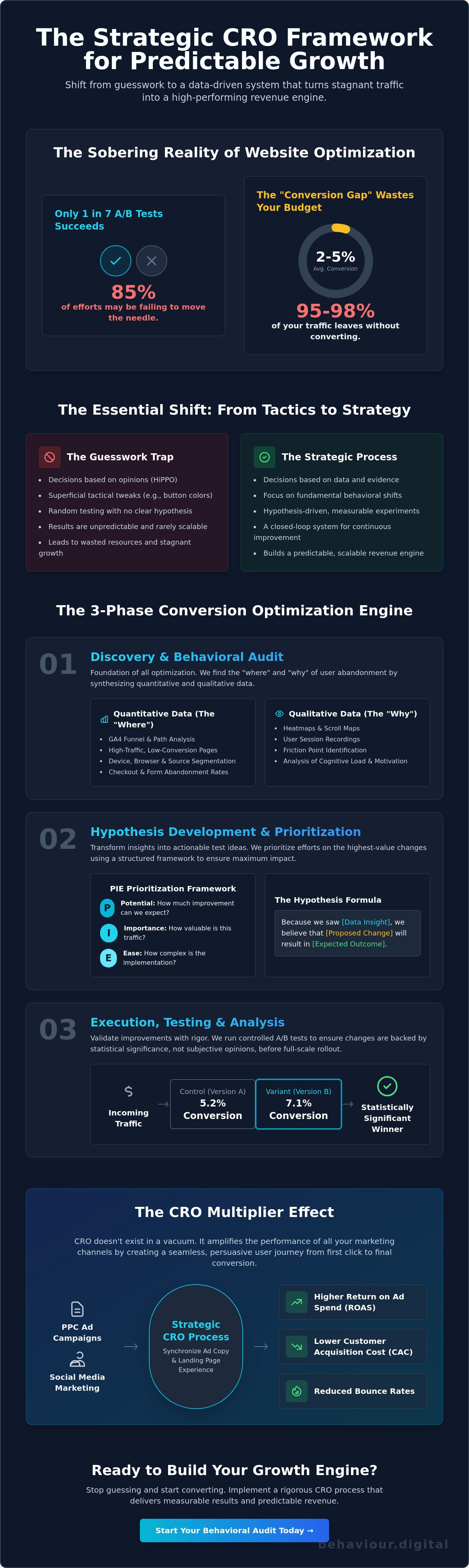
Only 1 in 7 A/B tests produce a statistically significant winner, which means 85% of your optimization efforts might be failing to move the needle. If you're relying on gut feelings or random website tweaks, you're likely watching your ad spend evaporate on pages that simply don't convert. To achieve scalable growth, you need a rigorous conversion rate optimisation process that replaces guesswork with quantitative certainty.
It's frustrating to drive high-quality traffic through PPC or social media marketing only to see it stall at the finish line. You recognize that every percentage point increase in your conversion rate directly compounds your revenue without requiring a single extra dollar in ad spend. This article delivers the exact, seven-step framework used by elite agencies to build high-performing revenue engines. We'll explore how to navigate 2026's regulatory landscape, including the FCC’s one-to-one consent rules and New York’s AI disclosure laws, while implementing a data-backed system that turns stagnant traffic into predictable growth.
• Shift from superficial tactical tweaks to a strategic conversion rate optimisation process that focuses on measurable behavioral shifts and sustainable revenue growth.
• Utilize a dual-layered audit approach, combining quantitative GA4 metrics with qualitative heatmaps to pinpoint exactly where and why your funnel is leaking.
• Implement the PIE framework to rank testing opportunities by potential impact and technical ease, ensuring your resources are focused on the highest-value changes.
• Establish a rigorous testing environment that prioritizes statistical significance over subjective opinions to validate website improvements before full-scale rollout.
• Learn how to synchronize landing page content with PPC and social media ad copy to lower bounce rates and amplify your total return on ad spend.
A professional conversion rate optimisation process isn't a collection of "best practices" or aesthetic preferences. It's a rigorous, closed-loop system designed to align your digital environment with the psychological needs of your audience. While many define it as simply increasing the percentage of visitors who take action, What is Conversion Rate Optimisation? actually represents a deeper, data-driven methodology for extracting maximum value from existing traffic. It's the difference between guessing and knowing.
We must distinguish between tactical and strategic approaches. Tactical CRO involves superficial changes like testing button colors or adjusting headline fonts. These might provide minor lifts, but they rarely scale. Strategic CRO focuses on fundamental behavioral shifts. It addresses why a user hesitates, what information they lack, and how to eliminate the friction points that cause them to abandon your site. Without a documented process, growth is random. With one, it's a predictable outcome of methodology.
Most companies suffer from a "Conversion Gap." Research shows that average website conversion rates hover between 2% and 5%. This means up to 98% of your marketing budget is effectively wasted on traffic that doesn't convert. A systematic process bridges this gap by turning stagnant traffic into a revenue engine.
Relying on the Highest Paid Person's Opinion (HiPPO) is the fastest way to stall growth. A structured conversion rate optimisation process removes ego from the decision-making loop. Instead of guessing which design looks better, we move toward a hypothesis-driven culture. Every proposed change starts with a specific observation: "Because we saw [data], we believe [change] will result in [outcome]." This ensures every website modification is a measurable experiment with a clear, quantifiable ROI. It transforms your website from a static brochure into an evolving laboratory.
Efficiency is no longer optional. Rising Customer Acquisition Costs (CAC) in the UK market have made it impossible to simply "buy" your way to profitability. As AI Overviews and fragmented search journeys change how users find information, your on-page conversion power must be higher than ever. You can't control the cost of a click, but you can control what happens after that click. Deeply integrated conversion rate optimization significantly impacts your long-term business valuation by proving you have a scalable, efficient system for acquiring customers. It's the difference between a fragile marketing setup and a resilient revenue machine.
The foundation of a successful conversion rate optimisation process begins with forensics, not aesthetics. Before a single pixel is moved, we must understand the "where" and the "why" of user abandonment. This phase isn't just about collecting data; it's about synthesizing quantitative metrics with behavioral psychology to identify the specific friction points that stall your revenue engine. Many agencies stop at the numbers, but a professional audit looks deeper into the user's mental model.
A true behavioral audit assesses three core pillars: cognitive load, friction points, and motivational triggers. We map the entire user journey, starting from the initial ad click through to the final conversion event. This holistic view ensures that we aren't just optimizing a page in isolation, but rather refining a data-driven CRO process that respects the user's intent at every touchpoint. If you're ready to stop guessing and start scaling, our team can help you build a bespoke digital strategy tailored to your specific business goals.
We start with the "where." Using Google Analytics 4 (GA4) and server-side tracking, we pinpoint exactly where users exit the funnel. We look for high-traffic, low-conversion landing pages as these represent the most immediate opportunities for growth. It's not enough to look at site-wide averages. We segment data by device, browser, and traffic source to find hidden discrepancies. For instance, with mobile traffic now accounting for over 50% of all web visits as of May 2026, a small drop in mobile performance can devastate your total ROAS. We analyze checkout drop-off rates and lead-gen form abandonment to prioritize our testing roadmap based on hard numbers rather than intuition.
Once we know where the leaks are, we use qualitative tools to understand the "why." Tools like Hotjar or Microsoft Clarity allow us to watch real session recordings and analyze heatmaps. We see where users get stuck, which elements they ignore, and where they experience "rage clicks." We supplement this with five-second tests and exit-intent surveys to capture the user's immediate psychological state. Heuristic evaluations based on established UX principles allow us to identify where your site's interface creates unnecessary cognitive load. This layer of analysis reveals the motivational triggers that are missing, allowing us to build hypotheses that actually move the needle.
Data gathered during your behavioral audit is merely raw material. To turn these insights into revenue, you must transition from observation to structured experimentation. A professional conversion rate optimisation process relies on a rigorous hypothesis-driven culture. This stage ensures that every test you run has a clear purpose, a measurable goal, and a logical foundation. Without this structure, you're simply guessing with your marketing budget.
A hypothesis is a predictive statement that links a specific behavioral observation to a proposed solution. It's not a "gut feeling." It's a scientific formula. Every experiment should follow this template: "Because we saw [specific data point], we believe that [specific change] will result in [measurable outcome]." For example, if your session recordings show users struggling to compare product features, your hypothesis might be: "Because we saw high exit rates on the product comparison section, we believe that implementing a sticky comparison table will result in a 12% increase in cart additions." This approach defines your primary KPI before the test even begins.
Every test must be rooted in a directional shift, not a vague aesthetic preference. Testing a "different image" is a weak approach. Instead, test a "lifestyle image versus a technical product shot." This provides a clear insight into what motivates your audience. You aren't just looking for a winner; you're looking for a lesson that can be applied across your entire digital strategy. Every experiment should aim to answer a specific question about your customer's psychology. If you can't define why you're testing something in a single sentence, don't run the test.
Resources are finite, so you must decide which tests to launch first. Most teams fail because they waste time on low-impact changes. We use the PIE Framework to rank opportunities based on three specific criteria:
How much improvement can realistically be made on this page? A page with a 1% conversion rate often has more "room" for growth than one at 10%.
How valuable is the traffic hitting this page? Optimizing a high-volume PPC landing page will always yield a higher return than a low-traffic blog post.
What is the technical effort required? A test that can be launched via a tag manager in an hour should often take precedence over one requiring deep backend development.
For agile teams, the ICE Framework (Impact, Confidence, Ease) serves as a similar alternative. Once your tests are ranked, you must select the right methodology. A/B testing is the standard for most scenarios, but if you have high traffic volumes, multivariate testing can help you understand how different elements interact. For significant architectural changes or completely new designs, split testing is the more robust choice. This systematic approach ensures your conversion rate optimisation process remains focused on the highest-value opportunities at all times.
Execution is the technical bridge between a theoretical hypothesis and measurable revenue. A professional conversion rate optimisation process requires a stable testing environment using platforms like VWO or Convert, integrated via server-side tracking or a robust tag management system. This stage is where many internal teams stumble by rushing to go live without proper validation. Precision in setup is the only way to ensure the data you collect is actually actionable. Data doesn't lie; interpretations do.
QA is non-negotiable. A variant that looks perfect on a desktop Chrome browser might break entirely on a mobile Safari viewport or a specific tablet device. Before sending a single visitor to a new variant, you must verify that tracking events fire correctly and the user experience remains fluid across all devices. Most experiments start with a 50/50 traffic split, but for high-risk architectural changes, you might start with a smaller 10% segment to minimize potential negative impact. Monitoring guardrail metrics, such as Average Order Value (AOV) or lead quality, ensures that a lift in conversion rate doesn't come at the expense of your total profit margins.
Statistical significance is your shield against random variance. Research shows that only 1 in 7 A/B tests produce a statistically significant winner, so "peeking" at results after forty-eight hours is a recipe for false positives. You must let the test run until it reaches a 95% confidence level and has captured enough full business cycles to account for weekend or holiday fluctuations. Patience in the testing phase leads to confidence in the scaling phase.
Once a test concludes, we don't just look at the headline "lift." We segment the results to find hidden opportunities. A variant might fail site-wide but perform exceptionally well for users arriving from specific PPC Management campaigns. This level of granularity allows you to align your landing page "scent" with specific ad copy, creating a seamless journey that lowers bounce rates and increases ROAS. If you're ready to stop burning budget on unoptimized funnels, our team can help you build a performance-driven digital strategy that prioritizes measurable outcomes.
Losing tests aren't failures; they're data points. Every "loss" tells you something critical about what your audience doesn't value or what causes them friction. Documenting these learnings in a centralized internal knowledge base prevents your team from repeating the same mistakes. It builds a sophisticated profile of your user's behavior over time. This compounding knowledge is what separates scalable growth from temporary spikes in performance.
A professional conversion rate optimisation process doesn't exist in a vacuum. It's the engine that powers high-performing paid media campaigns. When you align your on-page experience with your traffic sources, you create a seamless transition that significantly reduces bounce rates. This is precisely why CRO is the secret weapon for any elite PPC Agency Glasgow businesses rely on for scalable growth. If your ads promise one thing and your landing page delivers another, your ROAS will inevitably suffer. Consistency isn't just about branding; it's about maintaining the user's momentum.
Integration with Social Media Marketing is equally critical. Qualitative data from heatmaps and session recordings reveals what specific audiences value most. You can use these insights to inform your creative direction and audience targeting. For example, if your conversion rate optimisation process shows that mobile users from Instagram prioritize "fast shipping" over "technical specifications," you can adjust your ad copy to lead with that benefit. This creates a feedback loop where your website performance dictates your ad strategy. It ensures you aren't just buying clicks, but investing in high-intent behavior.
The most significant advantage of an optimized funnel is the ability to bid more aggressively. If your competitor converts at 2% and you convert at 4%, you can afford to pay more for the same top-tier keywords while remaining profitable. This mathematical edge allows you to dominate the auction and capture market share that was previously out of reach. Efficiency in conversion allows for aggression in acquisition.
The "Golden Thread" of conversion connects the initial search query to the final CTA. Maintaining this "ad scent" is vital for lowering your Cost Per Click (CPC). When Google or Meta sees that users stay on your page and complete actions, your Quality Score improves. We recommend testing specific landing page variations for your highest-value ad groups to ensure the headline and imagery perfectly mirror the ad copy. Small discrepancies here often lead to massive drop-offs in the first five seconds of a visit.
Scaling ad spend without a rigorous conversion optimisation strategy is like pouring water into a leaky bucket. You might see a temporary increase in volume, but your margins will quickly erode. The "Profit Loop" is the only sustainable way to grow. Higher conversion rates lead to a higher ROAS, which generates the surplus capital needed to increase ad budgets and fuel faster expansion. By treating your optimisation methodology as a core component of your digital strategy, you transform your marketing from a cost center into a predictable revenue engine. Collaborating with a strategic partner who understands the full funnel ensures that every click has the highest possible probability of turning into a customer.
Success in the 2026 digital landscape is reserved for those who treat their website as a scientific laboratory rather than a static brochure. Moving from subjective design changes to a systematic conversion rate optimisation process is the only way to ensure your marketing spend translates into measurable revenue. You've learned how to identify high-value leaks through behavioral audits and how to prioritize experiments that deliver the highest ROI. When you align this methodology with your PPC and social media strategies, you create a compounding effect that lowers acquisition costs while increasing total business valuation.
Behaviour Digital operates as your ambitious, analytical strategic partner. We specialize in data-driven growth and use a proven 7-step behavioral framework to bridge the gap between traffic and conversions. As Glasgow-based specialists, we focus on the quantitative facts that drive your bottom line. It's time to stop guessing and start implementing a predictable system for expansion. Every percentage point gained in your conversion rate is revenue you don't have to buy twice.
Book a Free Strategy Audit with Behaviour Digital today to begin refining your funnel for peak performance. Your growth shouldn't be left to chance; it should be the result of a conscious, methodical strategy.
An initial audit and the first testing cycle usually require four to six weeks to execute properly. The conversion rate optimisation process isn't a one-time project; it's a cyclical program of continuous improvement. While you'll see initial insights quickly, the most significant revenue gains come from the compounding effect of multiple test cycles over several months.
Average website conversion rates across most industries currently hover between 2% and 5%. However, benchmarks vary wildly by sector. Top-performing SaaS companies often achieve rates significantly higher than the 1.1% average seen in lower-tier competitors. You should focus on improving your own baseline metrics rather than chasing generic industry numbers that don't account for your specific traffic quality.
You don't need millions of visitors to begin, though high traffic makes statistical significance easier to reach. If your traffic is lower, we shift the conversion rate optimisation process toward qualitative methods like user testing and heuristic evaluations. These techniques identify friction points and psychological barriers that can be fixed to improve performance even without large data sets.
A/B testing compares two versions of a single page to see which performs better overall. Multivariate testing evaluates how multiple variables on a page interact with each other simultaneously. A/B testing is generally more efficient for most businesses because it requires less traffic and provides clearer answers about which specific directional changes are driving your revenue growth.
A professional audit requires a stack that covers both quantitative and qualitative data. Google Analytics 4 is the standard for identifying drop-off points, while tools like Hotjar or Microsoft Clarity provide session recordings and heatmaps. For the testing phase, platforms like VWO or Convert allow you to deploy experiments and track results without requiring deep backend development resources.
Pricing for CRO services in the UK depends on the scale of your website and the frequency of testing required. Most professional agencies operate on a retainer or project basis tailored to your specific growth targets. You should view this as a strategic investment; a successful project often pays for itself by increasing the efficiency of your existing marketing spend.
You can implement basic changes yourself, but an agency provides the specialized expertise in data science and behavioral psychology needed for scalable growth. Agencies have the experience of running hundreds of tests, which helps you avoid common pitfalls and false positives. This partnership allows you to focus on your core business while experts handle the technical complexity of experimentation.
A negative result is a success because it prevents you from implementing a change that would have decreased your revenue. We treat every "losing" test as a critical data point that reveals what your audience doesn't value. We analyze these results to refine our understanding of user behavior, which leads to a more accurate and powerful hypothesis for the next experiment.

Luke leads strategy across every Behaviour Digital account — building data-driven advertising systems for ambitious brands. When he's not auditing ad accounts, he's writing about what he found in them.
Get a free, tailored growth plan — we'll run our framework on your accounts and show you exactly what we'd do.
Get your free growth plan →