.webp) Online
OnlineNot sure which channel fits your business?View all services →
Three inputs. Instant KPIs. No spreadsheets.Open a calculator →
OnlineScaling your Meta campaigns in the UK has officially become a matter of regulatory math rather than just creative intuition. With the 2% location fee implemented on July 1, 2026, combined with mandatory 20% VAT, your baseline overhead has shifted significantly before a single impression is even serv...

Scaling your Meta campaigns in the UK has officially become a matter of regulatory math rather than just creative intuition. With the 2% location fee implemented on July 1, 2026, combined with mandatory 20% VAT, your baseline overhead has shifted significantly before a single impression is even served. Understanding the true facebook advertising costs uk 2026 requires a move away from guesswork and toward a data-driven budgeting model that accounts for these new platform levies.
You're likely feeling the pressure of a saturated market where targeting London can cost 35% more than other regions. It's difficult to predict a reliable return on ad spend when hidden fees and rising auction competition constantly move the goalposts. This guide provides the clarity you need to master your 2026 Meta budget with updated UK benchmarks and strategic ROI frameworks. We'll break down current CPC and CPM averages, explain how to calculate your total liability including the latest regulatory surcharges, and show you how to protect your margins through advanced digital strategy and conversion rate optimization.
• Identify the updated 2026 UK benchmarks for CPC and CPM to evaluate your campaign efficiency against verified market data.
• Account for the mandatory 2% location fee and 20% VAT to determine the actual facebook advertising costs uk 2026 for your business.
• Master the Meta ad auction by selecting campaign objectives that balance immediate delivery costs with long-term conversion value.
• Implement a strategic 80/20 budget split between scaling proven winners and testing new variables to maintain a sustainable ROI.
• Utilize conversion rate optimization as a primary lever to lower lead costs and mitigate the impact of rising platform competition.
Understanding the financial architecture of Meta's platform starts with three core pillars. Online advertising metrics like Cost Per Click (CPC), Cost Per Mille (CPM), and Cost Per Action (CPA) serve as the primary indicators of campaign health. These aren't just vanity numbers on a dashboard; they're the quantitative variables that determine your market share and long-term profitability. In a saturated market, failing to account for these benchmarks leads to budget depletion without measurable business growth.
For 2026, UK businesses are seeing a baseline CPC range of £0.45 to £1.10. This range is wider than in previous years, reflecting increased volatility in the auction. High-intent sectors like finance and real estate frequently pay a premium, often exceeding £2.00 per click when targeting competitive London demographics. Conversely, e-commerce brands focusing on high-volume retail often sit at the lower end of the spectrum. Your Cost Per Action (CPA) will vary even more wildly, with lead generation costs typically ranging from £10 to over £50 depending on the complexity of your offer and the quality of your digital strategy.
CPM rates in the UK currently fluctuate between £5.00 and £15.00 per 1,000 impressions. This variability is driven by audience granularity and seasonal demand cycles. Compared to broader European markets, the UK remains one of the most expensive territories to reach, second only to specific Nordic regions in terms of impression costs. For most UK SMEs, a baseline CPC of £0.85 represents a realistic starting point for performance-based campaigns in 2026. If your costs sit significantly above these averages, it's often an indicator of poor ad relevance scores or an inefficient bidding strategy rather than just market pressure.
The landscape has shifted due to the maturity of AI-driven bidding environments. Meta's algorithms now prioritize high-quality user experiences, which can inflate costs for advertisers with lower engagement scores. However, the most significant change is the introduction of the 2% location fee on July 1, 2026. This mandatory surcharge, designed to offset the UK's Digital Services Tax, adds a direct layer of overhead to every pound spent on UK-targeted impressions. It's applied based on the user's location, meaning even international businesses targeting the UK must pay it.
When combined with the standard 20% VAT, your facebook advertising costs uk 2026 are inherently higher than in previous cycles. This doesn't mean the platform is less viable; it means your margins are under more pressure. Success in 2026 requires a shift from simple "ad buying" to a comprehensive approach involving social media marketing and conversion rate optimization to ensure every paid click has the highest possible chance of generating a return. Precision in your facebook advertising costs uk 2026 projections is no longer optional if you intend to scale profitably.
Meta's auction system doesn't simply reward the highest bidder. It operates on a "Total Value" formula that balances your financial bid with estimated action rates and user quality scores. To effectively manage your facebook advertising costs uk 2026, you've got to understand that the algorithm prioritizes the user experience as much as your budget. If your ad generates high engagement, Meta effectively grants you a "relevance discount," lowering your CPM. Conversely, low-quality creative or poor landing page experiences will drive your costs up as the system penalizes ads that users find intrusive or irrelevant.
Audience specificity has undergone a major shift. In 2026, hyper-targeting small niches often triggers a "niche tax," where limited inventory leads to skyrocketing prices. Modern digital strategy now favors "Broad" targeting, allowing Meta's AI to find the most cost-effective path to your objective within a larger pool of users. This approach typically results in lower CPMs and more stable delivery. While you're optimizing these variables, you must also stay compliant with the latest UK advertising regulations, as non-compliant ads are often throttled by the auction, leading to inefficient spend.
Your choice of campaign objective is the single biggest lever for your baseline costs. Direct Sales and Lead Generation objectives always command a higher premium because you're competing for users with a proven history of converting. In contrast, Awareness or Traffic campaigns are significantly cheaper but often result in "hollow" costs. You'll see a low CPC, but if those users don't have the intent to buy, your total cost per acquisition will actually be higher. Successful advertisers in 2026 align their objectives strictly with their bottom-line goals rather than chasing low-cost vanity metrics that don't translate to revenue.
Creative fatigue is a silent budget killer that causes your CPMs to creep up over time. As users stop engaging with your content, the auction algorithm deems your ad less valuable and increases the price to show it. In 2026, short-form video, particularly Reels, remains the most cost-effective placement for driving high engagement at a lower cost. If you're looking to refine your approach, integrating data-driven social media marketing management Scotland can help you rotate creatives before they become expensive liabilities. A proactive social media marketing plan ensures your creative assets stay fresh and your auction performance remains competitive.
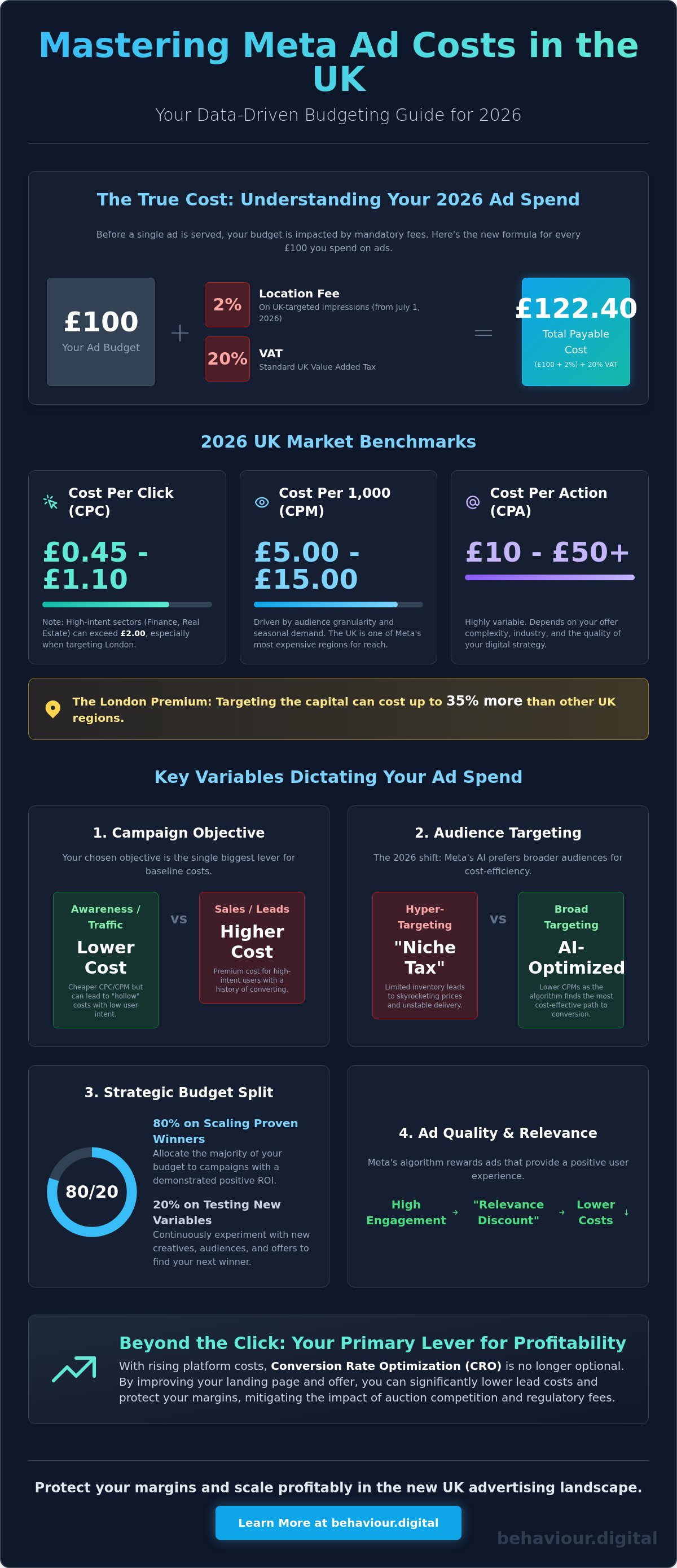
Calculating facebook advertising costs uk 2026 requires looking beyond the Ads Manager dashboard. Your final invoice isn't just your ad spend; it's a composite of platform bids, regulatory levies, and administrative overhead. The most immediate impact on your cash flow is the 20% VAT. This tax is applied to your total spend unless you're VAT registered and provide Meta with a valid ID. Failing to account for this 20% surcharge leads to significant end-of-month budget discrepancies that can derail your financial planning. Professional advertisers treat VAT as a non-negotiable baseline cost rather than an afterthought.
Beyond taxes, you must account for the infrastructure required to maintain performance. As privacy regulations tighten, relying solely on Meta's native reporting is often insufficient for accurate ROAS calculation. A robust digital strategy incorporates the costs of third-party attribution and tracking tools into the overall performance model. When you view your facebook advertising costs uk 2026 as a holistic investment including VAT, location fees, and professional management, you gain the clarity needed to protect your profit margins.
Effective July 1, 2026, Meta introduced a 2% location fee for all ads delivered to users in the United Kingdom. This isn't a performance fee; it's a pass-through cost designed to cover the UK's Digital Services Tax. According to the IAB UK's Digital Policy Guide, these regulatory adjustments are becoming standard across high-value digital markets. To put this in perspective, on a £5,000 monthly campaign budget, you'll pay an additional £100 in location fees alone. This makes the UK a more expensive environment than regions like Spain or Austria, where such fees are structured differently or don't apply.
Many businesses view agency fees as an additional cost, but in a high-fee environment, expert oversight is a primary cost-reduction tool. DIY management often results in budget leakage through inefficient bidding and poor audience segmentation. Partnering with a PPC agency Glasgow businesses trust can actually lower your CPA by identifying and cutting wasted spend that far exceeds the management fee itself. Professional management ensures your campaigns are technically sound, from tracking implementation to auction strategy, preventing the common mistakes that inflate your average costs.
Effective budgeting for facebook advertising costs uk 2026 isn't about what you can afford to lose; it's about what the algorithm requires to succeed. Underspending is often more expensive than overspending because it traps your ads in the Learning Phase. In this state, CPMs are at their highest and performance is most volatile. You must calculate your "Breakeven ROAS" by factoring in product margins, the 20% VAT, and the 2% location fee before launching your first campaign. If your margins can't support the current auction prices, no amount of creative testing will make the campaign profitable.
Strategic allocation also involves a 80/20 split. Dedicate 80% of your budget to proven "evergreen" campaigns that drive consistent revenue. The remaining 20% should be reserved for experimentation. This testing budget allows you to find new audiences and creative formats without risking your core stability. In the UK market, failing to innovate leads to rapid performance decay as competitors adopt newer short-form video strategies. If you want to ensure your spend is optimized for growth, it's time to refine your digital strategy with a performance-first approach.
For UK SMEs in 2026, a daily budget of £20 to £50 per ad set is the functional minimum for effective data gathering. This floor is dictated by the "Rule of 50," which requires 50 conversion events per week for Meta's AI to stabilize delivery. Your budget acts as the primary fuel for the algorithm's learning process; insufficient funding ensures your campaigns never reach peak efficiency.
Aim for enough spend to generate at least 7-10 conversions daily.
Highly competitive sectors like finance may require a £100+ daily minimum to remain visible in the auction.
Campaigns targeting London and the South East will deplete budgets faster than those targeting Northern regions.
Scaling requires a disciplined approach to avoid resetting the algorithm's progress. Use the "20% Rule": increase your daily spend by no more than 20% every 48 to 72 hours. Larger jumps often trigger a return to the Learning Phase, leading to a temporary spike in CPA and wasted spend. Monitor your "Frequency" closely during this process. In the UK market, reaching the same user too often leads to rapid creative fatigue and rising costs. For time-sensitive events like the Black Friday window, switching from daily budgets to "Lifetime" budgets allows Meta to spend more aggressively during peak traffic hours, ensuring you don't miss high-intent windows. Mastering your facebook advertising costs uk 2026 means knowing exactly when to push the budget and when to hold steady based on real-time frequency and ROAS data.
Focusing solely on front-end metrics like CPC is a strategic error that leads to rapid budget exhaustion. In the context of facebook advertising costs uk 2026, a £1.00 click is exceptionally cheap if your landing page converts at 10%, resulting in a £10.00 acquisition. However, that same click becomes an unsustainable liability if your site converts at 1%, pushing your acquisition cost to £100.00. Your true cost of advertising is dictated by your ability to convert traffic, not just buy it. This is where conversion rate optimization becomes your most effective lever for maintaining profitability as platform fees rise.
Meta's auction algorithm explicitly factors in the landing page experience. If your site is slow or provides a poor mobile UX, the system increases your CPM as a penalty for sending users to a low-quality destination. Professional PPC Management requires a deep dive into behavioral data to ensure the post-click journey is as polished as the ad itself. By improving site speed and navigation, you aren't just helping the user; you're directly lowering your auction bids by improving your relevance scores. This synergy between paid media and site performance is the only way to offset the 2% location fee and 20% VAT overheads inherent in the UK market.
Identifying "leaky buckets" in your sales funnel is the fastest way to improve ROAS without increasing your daily spend. When you implement rigorous conversion optimisation, you effectively double the power of your existing ad budget. In 2026, this process must include server-side tracking. With the continued erosion of traditional cookie-based tracking, server-side implementation is the only way to ensure your facebook advertising costs uk 2026 are reported accurately. Without precise data, you'll inevitably overspend on underperforming segments while starving your most profitable audiences.
Long-term success relies on a first-party data strategy that prioritizes Lifetime Value (LTV) over single-transaction ROI. By using retargeting to re-engage existing visitors, you lower your average cost of acquisition over time. High-performing brands don't just pay the facebook advertising costs uk 2026 once; they build a data asset that allows them to reach their audience more efficiently in future cycles. If your current campaigns aren't delivering the margins you need to scale, get a data-driven audit from Behaviour Digital to identify exactly where your budget is being wasted and how to capture more value from every click.
Navigating the platform's current environment requires a shift from reactive spending to methodological precision. Success depends on your ability to integrate the 20% VAT and 2% location fee into a broader performance model that prioritizes conversion efficiency over raw click volume. By aligning your campaign objectives with the "Rule of 50" and maintaining a disciplined 80/20 budget split, you can transform these rising overheads into a barrier to entry for less sophisticated competitors. Managing your facebook advertising costs uk 2026 is no longer just about the bid; it's about the technical synergy between your auction strategy and your site's behavioral data.
To ensure your capital is deployed with maximum efficiency, you need a partner that prioritizes measurable outcomes over vanity metrics. Our specialist Glasgow-based PPC team provides transparent, data-driven reporting and a proven track record in UK conversion optimisation. Maximise your 2026 ROAS with Behaviour Digital's expert management and turn platform volatility into a scalable growth engine. The most profitable campaigns of 2026 will be those built on a foundation of analytical rigor and continuous refinement. Your business is ready to lead that charge.
The average Cost Per Click (CPC) for facebook advertising costs uk 2026 typically ranges between £0.45 and £1.10 across most industries. High-intent sectors such as finance, legal services, or real estate frequently see averages exceeding £2.00 due to intense auction competition. Your specific cost depends heavily on your ad relevance score and the saturation of your target demographic.
Meta's 2% location fee is a mandatory surcharge applied to all impressions delivered to users in the United Kingdom as of July 1, 2026. This fee is added to your total spend at the point of invoicing rather than being deducted from your active campaign budget. To maintain your previous impression volume, you must increase your gross budget allocation by 2% to cover this regulatory pass-through cost.
A £500 monthly budget provides approximately £16.40 per day, which is usually insufficient for scaling conversion-based campaigns. While this amount can support brand awareness or traffic objectives, it's difficult to reach the 50 weekly conversions required for algorithmic stability on such a low spend. For businesses seeking measurable lead generation or sales, a minimum budget of £1,000 per month is recommended.
Yes, the standard UK VAT rate of 20% applies to all Meta advertising services. Meta automatically adds this tax to your final bill unless you've provided a valid VAT registration number in your business settings. It's critical to factor this 20% overhead into your facebook advertising costs uk 2026 projections to ensure your reported ROAS accounts for your total tax liability.
Rising costs are driven by the new 2% location fee combined with increased auction density in the UK's high-value regions. Meta's AI-driven bidding system has also become more sensitive to ad quality; if your engagement rates are low, the algorithm increases your CPM to compensate for the poor user experience. Saturated markets like London and the South East continue to see the most significant inflationary pressure.
You can lower your costs by improving your Ad Quality Score through high-engagement creative formats like Reels. Higher engagement signals relevance to the auction, which often results in a CPM discount. Additionally, implementing conversion rate optimization on your landing pages ensures that you extract more value from every paid click, effectively lowering your cost per acquisition even if CPCs remain static.
A sustainable Return on Ad Spend (ROAS) for most UK businesses in 2026 falls between 3:1 and 4:1. This target must be calculated after accounting for the 2% location fee, 20% VAT, and your internal cost of goods sold. If your ROAS consistently sits below 2.5:1, your margins are likely being eroded by platform fees and mandatory taxes.
DIY management is suitable for small, local campaigns with minimal budgets, but professional management is vital for scaling beyond £2,000 in monthly spend. Professional agencies possess the digital strategy expertise to navigate complex technical requirements like server-side tracking and behavioral data analysis. Expert oversight typically reduces wasted spend by enough to offset the management fee while providing more stable performance.

Luke leads strategy across every Behaviour Digital account — building data-driven advertising systems for ambitious brands. When he's not auditing ad accounts, he's writing about what he found in them.
Get a free, tailored growth plan — we'll run our framework on your accounts and show you exactly what we'd do.
Get your free growth plan →