.webp) Online
OnlineNot sure which channel fits your business?View all services →
Three inputs. Instant KPIs. No spreadsheets.Open a calculator →
OnlineWhile the median landing page conversion rate across industries sits at 6.6%, the top 10% of performers are achieving rates of 11.45% or higher. Understanding how to improve landing page conversions isn't about following generic trends; it's about closing the gap between your current performance and...

While the median landing page conversion rate across industries sits at 6.6%, the top 10% of performers are achieving rates of 11.45% or higher. Understanding how to improve landing page conversions isn't about following generic trends; it's about closing the gap between your current performance and that elite tier. You're likely frustrated by rising cost-per-acquisition and wasted spend on PPC or social campaigns that don't deliver. Conflicting CRO advice often creates more confusion than clarity, leaving your ROAS stagnant.
We've built a framework that cuts through the noise. You'll master the data-driven behavioral tactics that turn passive visitors into high-value leads and customers. By focusing on measurable business outcomes rather than superficial metrics, you can transform your digital strategy into a predictable growth engine. This article details a repeatable system for landing page success, from leveraging the new GA4 AI Assistant channel to solving the 42% conversion gap found in mobile traffic. We'll move straight from theory to the specific methodology required to lower your CPA and maximize your global or Glasgow based campaign returns.
• Identify the psychological barriers and cognitive load that prevent visitors from completing their transaction of trust on your page.
• Master a 5-step methodology on how to improve landing page conversions by combining GA4 technical data with qualitative user insights.
• Customize your landing page experience based on traffic source, separating high-urgency PPC intent from social media engagement.
• Deploy behavioral triggers such as authority bias and real-time scarcity to drive measurable user actions and lower your CPA.
• Transition from isolated tactical changes to a comprehensive CRO framework that aligns with your long-term digital strategy.
A landing page is more than a destination for traffic; it's a psychological transaction. Every visitor arrives with a specific intent and a limited amount of mental energy. When businesses analyze how to improve landing page conversions, they must first acknowledge the "Conversion Gap." This gap represents the disconnect between the high-intent promise of a PPC ad and the actual experience of the landing page. If the transition isn't seamless, the visitor experiences immediate friction. You aren't just losing a click; you're breaking a promise made during the initial engagement.
Friction manifests in three primary forms: technical, visual, and cognitive. Technical friction includes slow load speeds, which are particularly damaging given that mobile traffic now accounts for 65% of all web visits but converts 42% lower than desktop. Visual friction involves cluttered layouts that distract the eye from the primary objective. However, cognitive friction is the most subtle and destructive barrier. It occurs when the user has to think too hard to understand your value proposition or navigate your interface. Effective Conversion rate optimization (CRO) focuses on removing these barriers to ensure the path to action is the path of least resistance. Without a systematic approach to reducing this load, even the most expensive traffic will fail to convert.
Hick’s Law states that the time it takes for a person to make a decision increases with the number and complexity of choices. On a landing page, this translates to decision paralysis. If you present three different call-to-action buttons, five navigation links, and a ten-field form, you aren't being helpful; you're creating a cognitive wall. Reducing visual noise is essential for success. By stripping away secondary options and focusing on a singular conversion goal, you guide the user’s eye exactly where it needs to go. This methodology turns a confused visitor into a high-value lead by simplifying the mental work required to say yes.
The digital environment in 2026 is defined by deep skepticism. Generic social proof, such as unsourced testimonials or "as seen on" logos without context, no longer moves the needle for modern consumers. Users now require "Micro-Trust" signals throughout their journey. These are small, verifiable indicators of authority that address specific anxiety points, such as data privacy or service reliability. Whether it's a transparent data deletion policy or industry-specific case studies, trust must be earned at every scroll depth. Identifying where users feel vulnerable is a critical step in how to improve landing page conversions. If your page feels like a generic template, you've already lost the psychological transaction before it began.
Effective optimization isn't a series of random adjustments; it's a rigorous methodological cycle. To master how to improve landing page conversions, you must move beyond generic checklists and rely on your own specific dataset. This process begins with Step 1: Quantitative Analysis. By leveraging GA4’s newest cross-channel attribution reports and AI-powered insights, you can pinpoint exactly where visitors exit your funnel. Heatmaps complement this by revealing where engagement stalls, whether it's a hero section that fails to resonate or a primary CTA that remains unseen due to poor visual hierarchy.
Step 2 shifts to Qualitative Research. While numbers tell you what is happening, surveys and user recordings reveal why. Understanding the user's "why" allows you to address specific objections before they lead to abandonment. Once you've identified the friction, Step 3 involves Hypothesis Building. Use a strict "If/Then" framework: "If we reduce the form fields from six to three, then conversion rates will increase because we've lowered the cognitive barrier." This leads directly to Step 4: A/B Testing. Running controlled experiments ensures that every change is validated by statistical significance rather than intuition. Finally, Step 5 is Iteration. Success in 2026 is a moving target. Sustainable growth requires a continuous loop where every test result informs the next hypothesis.
You can't improve what you don't measure with precision. Distinguishing between "What" data (clicks and sessions) and "Why" data (user intent and friction) is the foundation of conversion rate optimization. Focus on high-impact metrics like scroll depth, time-to-action, and form abandonment rates. If data shows that 70% of users drop off before reaching your social proof, your page length or content relevance needs immediate adjustment. Tracking these micro-interactions allows you to diagnose technical failures before they drain your ad spend. For businesses seeking a more structured approach, our team at behaviour.digital specializes in turning these behavioral insights into measurable ROAS.
Avoid the common mistake of testing everything at once. Use the PIE framework to prioritize your efforts based on Potential (how much improvement is possible), Importance (how much traffic the page receives), and Ease (how difficult the change is to implement). This prevents the "spaghetti at the wall" approach that wastes resources and muddies your data. Set realistic KPIs for your first 90 days, such as a 10% reduction in CPA or a specific increase in qualified lead volume. A logical roadmap ensures that every experiment contributes to a repeatable framework for long-term landing page success.
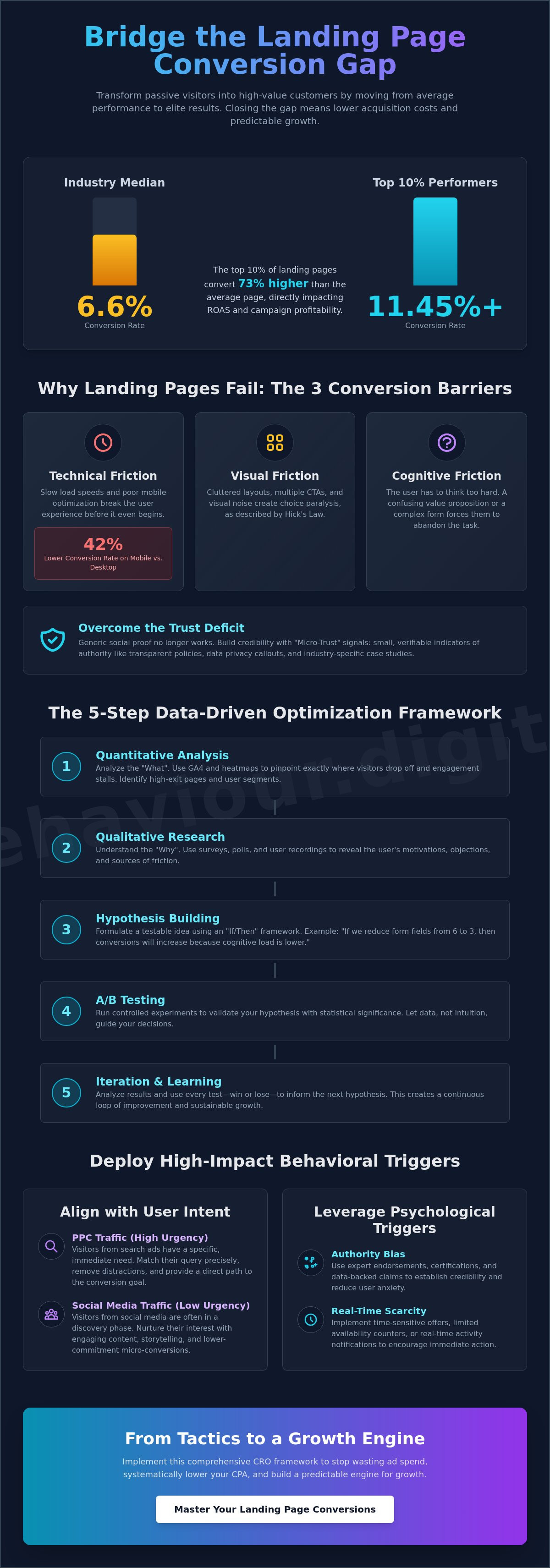
Traffic source is the primary determinant of visitor psychology. Treating a high-intent search user the same as a passive social media scroller is a fundamental strategic error. When exploring how to improve landing page conversions, you must align your page architecture with the specific intent of the referral channel. Paid search traffic typically has a benchmark conversion rate of 10.9%, while paid social averages 12.0%. These numbers only materialize when the landing experience mirrors the user's mental state. A Google Ads visitor is often in "solution-seeking" mode; they have a specific problem and are hunting for a definitive answer. Conversely, a TikTok or Instagram visitor is in "discovery" mode. They didn't ask for your solution; you interrupted their entertainment with a compelling offer.
The "Message Match" rule is the most critical factor in reducing immediate bounce rates. If your ad copy promises a "2026 Strategic Framework," your H1 heading must contain those exact words. Any discrepancy creates instant cognitive friction, causing the visitor to question if they've landed in the right place. This alignment is not just about aesthetics; it's about validating the click and maintaining the momentum generated by the ad. For businesses running complex global or regional campaigns, this level of precision is what separates profitable accounts from those that waste their PPC budget.
PPC landing pages require absolute clarity above the fold. Search users are impatient. They need to see a clear value proposition and a primary call-to-action without scrolling. To maximize ROI, sophisticated marketers use Dynamic Text Replacement (DTR). This technology adjusts the page copy to match the specific keywords the user searched for, creating a hyper-relevant experience. Our experience as a PPC agency Glasgow businesses trust has shown that tightening the synergy between keyword intent and page content is the fastest way to lower CPA. When the page feels like a custom-built answer to a specific query, trust is established instantly.
Social media traffic is overwhelmingly mobile, with 65% of all web traffic now originating from handheld devices. Your social landing pages must be mobile-first, not just mobile-responsive. Since social users are coming from a visually rich environment, your page should leverage video content to maintain that energy. Static, text-heavy pages feel like a "mood-killer" after a dynamic video ad. Because social traffic is often "colder" than search traffic, a "Soft Conversion" strategy is frequently more effective. Instead of asking for a high-commitment purchase immediately, offer a high-value lead magnet. This approach captures the lead and allows your digital strategy to nurture the relationship over time, eventually solving the 42% conversion gap typically seen in mobile-heavy traffic segments.
Behavioral triggers aren't marketing gimmicks; they're calculated responses to how the human brain processes risk and reward. While technical speed and layout are foundational, the psychological layer determines the final action. The Scarcity Principle remains one of the most potent tools in a marketer's arsenal. By using real-time data to show limited availability or expiring offers, you trigger loss aversion. This biological response forces a decision, effectively reducing the time-to-action metric we track in GA4. It's a direct way to influence how to improve landing page conversions by creating a genuine sense of urgency that overrides passive browsing.
Authority Bias and the Liking Principle work in tandem to build a trust bridge. Modern users, especially those in the technology sector where the average CPA can reach $133.52, need to see definitive expertise before committing. Positioning your brand as an authority through data-backed claims and humanizing it with storytelling reduces the perceived risk. Reciprocity then seals the deal. By providing a high-value resource or lead magnet first, you create a psychological debt. This makes the visitor significantly more likely to engage with your primary CTA. Understanding these nuances is essential for anyone operating in a skeptical, high-competition market.
Social proof serves as a critical tool for de-risking the user's decision-making process. In 2026, static, anonymous quotes are largely ignored by savvy consumers. You need dynamic, verifiable proof. Video testimonials offer facial cues and vocal tonality that build authentic trust in ways text cannot. Combining this with "Wisdom of the Crowd" signals, such as live activity pop-ups showing recent sign-ups, creates a sense of momentum. Expert endorsements from recognizable industry figures further validate your authority, moving the user closer to a conversion without increasing your ad spend.
The final hurdle is often the call-to-action itself. Micro-copy optimization focuses on the small phrases that surround your buttons and forms. Replacing generic text like "Submit" with benefit-driven language such as "Send Me the Strategic Framework" can significantly impact results. Use anti-friction copy near form fields to address final anxieties. Phrases like "No credit card required" or "Privacy compliant" are essential, especially with 20 different state privacy laws now in effect across the US. This meticulous attention to detail is the hallmark of professional conversion optimisation. If you're ready to apply these behavioral triggers to your own campaigns, partner with our strategic team to drive measurable growth.
A "best practices" listicle is a dangerous place to stop. While these standard rules provide a baseline, they don't account for your unique audience behavior or the specific friction points in your funnel. True growth happens when you stop looking for silver bullets and start building a systematic framework for how to improve landing page conversions. This shift requires moving from reactive, one-off fixes to a proactive culture of experimentation. When optimization is treated as a continuous process rather than a project, every test result, win or loss, becomes a data asset that strengthens your competitive advantage.
Success isn't isolated to a single page. It must be integrated into your broader Digital Strategy to ensure that traffic quality and page experience are perfectly aligned. Professional management removes the guesswork by applying statistical rigor to every change. This methodical approach ensures that your marketing spend isn't just generating clicks, but is actively contributing to a scalable revenue engine. By fostering an internal culture that values evidence over intuition, you create a sustainable path to market leadership.
The impact of conversion rate optimization is cumulative. Small, incremental wins in your form completion rate or headline resonance compound over time, leading to exponential gains in efficiency. For example, a 1% increase in conversion rate can effectively double net profit by maximizing the value of existing traffic without increasing ad spend. This compounding effect lowers your blended CPA across all channels, from high-intent search to discovery-based social. It's the most effective way to improve ROAS in a landscape where media costs continue to rise.
There's a ceiling to what DIY tools and intuition can achieve. When your growth plateaus, it's time to move toward an expert strategy that combines quantitative data with deep behavioral psychology. The Behaviour Digital approach is built on this intersection, focusing on measurable business outcomes rather than superficial metrics. We don't just suggest changes; we implement a data-driven methodology that turns your landing pages into high-performance assets. If you're ready to stop guessing and start scaling, enquire about our CRO services today to see how we can transform your results.
Transitioning from fragmented tactics to a unified behavioral framework is the only way to secure long-term ROAS. We've explored how aligning user intent with specific traffic sources and deploying psychological triggers can bridge the trust deficit and eliminate choice paralysis. Mastering how to improve landing page conversions requires a commitment to continuous, data-driven iteration rather than relying on static checklists that ignore your unique visitor psychology. Success in 2026 demands a shift from reactive fixes to a proactive culture of experimentation.
As Glasgow-based experts in behavioral growth, our team specializes in the rigorous integration of PPC and CRO. We have a proven track record of lowering CPA for UK businesses by replacing intuition with quantitative precision and methodological clarity. To identify the specific friction points currently draining your ad spend and stalling your growth, Book a Free Conversion Audit with Behaviour Digital. Your data holds the exact roadmap to your next phase of scalable success; it's time to start following it with confidence.
A strong conversion rate is relative to your industry, but the 2026 median across all sectors is 6.6%. If you're aiming for elite performance, the top 10% of landing pages convert at 11.45% or higher. These benchmarks vary significantly by sector. For instance, legal services often see rates around 7.4%, while healthcare typically ranges between 3.0% and 4.2%.
You can often see initial data shifts within 14 to 30 days of implementing changes. However, achieving statistical significance depends entirely on your traffic volume. High-traffic campaigns might reach a conclusion in a week, while lower-volume niche campaigns require months of data to validate a hypothesis. Consistency is key to understanding how to improve landing page conversions over the long term.
Significant gains often come from refining copy, offer structure, and technical performance rather than aesthetic overhauls. Adjusting your value proposition or reducing form fields addresses cognitive friction without requiring a designer. Improving back-end load speeds or fixing mobile-specific bugs can also close the 42% conversion gap between mobile and desktop users without a single visual change.
Small businesses should prioritize tools that integrate directly with their existing stack, such as Google Analytics 4’s native testing capabilities or affordable platforms like VWO and Unbounce. The best tool is one that allows for rapid deployment without heavy developer involvement. Focus on platforms that offer visual editors and clear statistical reporting to ensure your decisions are based on data rather than guesswork.
Page load speed is a primary driver of technical friction and bounce rates. Research consistently shows that even a one-second delay can lead to a measurable drop in conversions. This is especially critical for mobile users who account for 65% of web traffic. If your page doesn't load almost instantly, you're losing high-intent visitors before they even see your primary headline.
A landing page is a standalone destination designed for a single conversion goal, whereas a homepage serves as a general portal for your entire brand. Homepages usually contain multiple navigation paths and broad information. In contrast, an effective landing page removes all distractions to focus the visitor on one specific action, such as a lead magnet download or a service inquiry.
The ideal form length depends on your specific conversion goal and the "warmth" of your traffic. Short forms usually increase the quantity of leads by reducing friction, making them ideal for top-of-funnel offers. Long forms often decrease lead volume but significantly increase lead quality by requiring more effort from the user. Testing both against your specific CPA goals is essential.
You should maintain a continuous testing cycle rather than treating optimization as a one-time event. As soon as one test reaches statistical significance, you should implement the winner and start the next experiment. This iterative approach is the core of a professional digital strategy. It ensures your pages evolve with changing consumer behaviors and new technological standards like the GA4 AI Assistant.

Luke leads strategy across every Behaviour Digital account — building data-driven advertising systems for ambitious brands. When he's not auditing ad accounts, he's writing about what he found in them.
Get a free, tailored growth plan — we'll run our framework on your accounts and show you exactly what we'd do.
Get your free growth plan →