.webp) Online
OnlineNot sure which channel fits your business?View all services →
Three inputs. Instant KPIs. No spreadsheets.Open a calculator →
OnlineIn 2026, hiring an agency that focuses solely on keyword management is a recipe for stagnation. With 78% of Google Ads spend now controlled by Smart Bidding, the role of a partner has fundamentally shifted from manual bidding to sophisticated data orchestration. If you are currently vetting potentia...

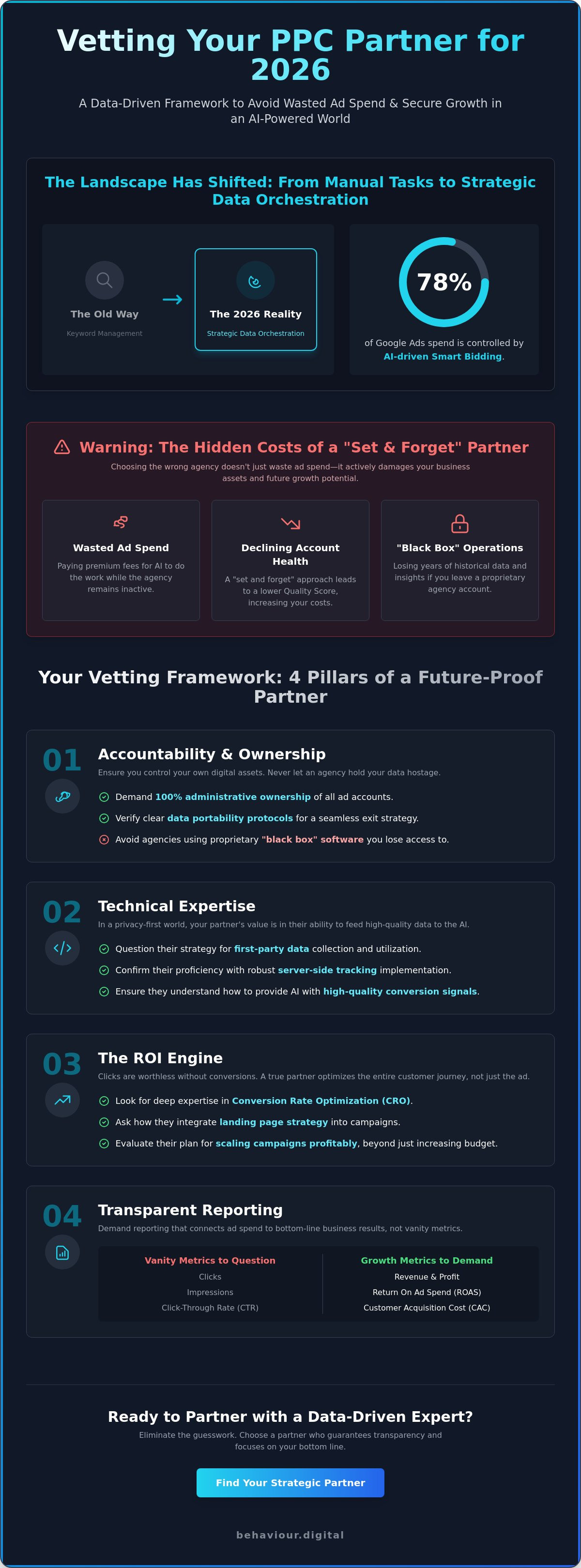
In 2026, hiring an agency that focuses solely on keyword management is a recipe for stagnation. With 78% of Google Ads spend now controlled by Smart Bidding, the role of a partner has fundamentally shifted from manual bidding to sophisticated data orchestration. If you are currently vetting potential partners, the specific questions to ask a PPC agency must focus on how they navigate a keyword-less search environment and AI-driven automation.
You've likely experienced the frustration of high management fees and "set and forget" accounts that deliver clicks but fail to generate actual revenue. It's a common pain point to feel disconnected from your own data or trapped by a lack of transparency in reporting. This guide provides a data-driven framework to help you master the selection process and avoid wasted ad spend. We'll break down 21 critical vetting questions designed to identify partners who prioritize bottom-line growth and guarantee you retain full ownership of your advertising assets.
• Shift your focus from tactical management to strategic data orchestration to ensure your PPC partner thrives in an automated, AI-driven search environment.
• Secure your business assets by ensuring 100% administrative ownership and clear data portability protocols before signing any contract.
• Master the technical vetting process by identifying the specific questions to ask a ppc agency regarding first-party data strategies and server-side tracking implementation.
• Bridge the gap between clicks and revenue by evaluating how potential partners integrate conversion rate optimization and landing page strategy into their core service.
• Eliminate the "Black Box" risk by demanding transparent, bottom-line reporting that prioritizes measurable business growth over vanity metrics.
The selection of a marketing partner in 2026 is no longer about finding someone to manage your bids. It's a high-stakes decision regarding strategic data orchestration. The technology behind Pay-per-click (PPC) has matured to a point where execution is largely automated, meaning the value an agency provides must shift from tactical button-pushing to deep business alignment. If your potential partner can't explain how their strategy integrates with your specific revenue goals, they're just a middleman. Mastering the questions to ask a ppc agency is the only way to ensure your budget isn't being sacrificed for their profit margins.
We're seeing the rise of the "Agency Trap." This occurs when low-value providers use Google's advanced automation, like Performance Max, to mask their own inactivity. They let the algorithms do the heavy lifting while charging you a premium retainer for management that doesn't actually happen. For businesses operating in Glasgow or the wider UK market, this lack of oversight is particularly dangerous. Local market nuances and UK consumer expectations require a level of manual refinement that AI alone cannot replicate. You need to know the right questions to ask a ppc agency to peel back the curtain on their actual workload.
This guide isn't designed for a polite chat. It's a framework of "Hard Questions" that sales-heavy agencies hate because they demand proof of technical competence and operational transparency. By the end of this article, you'll have the tools to separate the data-driven experts from the high-volume shops that rely on your lack of technical knowledge.
Selecting the wrong agency doesn't just waste your ad spend; it actively damages your account's health. A "set and forget" approach leads to a declining Quality Score, which forces you to pay more for the same visibility as your competitors. Even worse is the risk of a "Black Box" agency. These firms often hide your performance data or use proprietary accounts that you don't own. If you leave, you lose years of historical insights and custom scripts. Poor tracking implementation results in months of corrupted data, leaving you with a business strategy based on fiction rather than fact.
In 2026, AI-driven bidding is the industry standard. This change has fundamentally redefined the agency's primary job description. Their role is now to act as a data steward, ensuring the AI receives high-quality signals to optimize against. A modern partner must understand conversion optimisation as deeply as they understand ad copy. Without a focus on the post-click experience, even the most efficient PPC campaign will fail to scale profitably. You need a strategist who looks beyond the click to the actual transaction.
Ownership of your digital assets is a fundamental business right, yet many companies unknowingly sign away control. When evaluating a partner, the most critical questions to ask a ppc agency revolve around who truly holds the keys to your accounts. If an agency insists on creating accounts within their own internal structure rather than your own, they are creating a barrier to your future independence. You must demand 100% administrative ownership of your Google Ads and Meta accounts from day one. This ensures that if the partnership ends, your historical data, conversion tracking setups, and campaign structures remain with you.
Data portability is the right to move your historical performance metrics between partners without friction. Without this, you're essentially starting from zero every time you switch providers. Ask potential partners what happens to custom scripts and automation rules if you part ways. Many agencies use proprietary scripts to manage bidding or reporting. You need to know if these assets are considered work-for-hire or if they'll be stripped from your account upon termination. Similarly, ask if they use "black box" proprietary technology. If their management relies on a software layer that you lose access to after canceling, you aren't just paying for service; you're paying a ransom for your own performance data.
The person who sells you the vision is rarely the person managing the daily spend. Ask specifically who will be the day-to-day contact for your account and what their specific experience level is. It's a common industry practice to have senior strategists lead the pitch while junior staff handle the execution. You deserve a partner who provides direct access to the specialists actually making the decisions. If you want a partner who prioritizes this level of direct accountability, you can explore our strategic approach to see how we structure our partnerships.
Agencies often prefer using their own Manager Accounts (MCC) for administrative ease, but this shouldn't come at the cost of your visibility. Use this checklist to verify your access levels before signing:
The ability to add or remove users and manage all settings.
Total transparency into what is being paid to the platform versus the agency fee.
The freedom to connect your data to your own internal BI tools or third-party dashboards.
Static monthly PDFs are obsolete. In 2026, you should demand access to a real-time dashboard that pulls data directly from the ad platforms. Ask how often you'll meet and which specific KPIs will be reviewed. Effective PPC Management isn't about looking backward at last month's clicks; it's about providing proactive strategic insights. Your reports should focus on bottom-line metrics like revenue and customer acquisition cost rather than vanity metrics that mask poor performance.
The technical architecture of your advertising account is now the primary driver of performance. In 2026, the most vital questions to ask a ppc agency focus on how they handle data collection in a post-cookie environment. If an agency still relies solely on standard browser-side tracking, your conversion data is likely underreporting significantly. You need a partner who can implement Server-Side Google Tag Manager (sGTM) and Enhanced Conversions to bridge the tracking gaps caused by privacy regulations. Ask them to walk you through their specific process for setting up server-to-server tracking. If they cannot explain the technical nuances, they aren't prepared for the modern digital market.
Leveraging first-party data has become a core competitive advantage. Ask how they integrate your CRM data to build custom audiences and lookalikes. High-performing agencies use your existing customer lists to train the Google algorithm, ensuring it seeks out high-value users rather than just cheap clicks. This leads directly to the strategy for AI-driven campaign types like Performance Max, which now accounts for 42% of all Google Ads spend. You must ask how they manage these automated campaigns. Do they use custom scripts to monitor search terms? How do they handle asset groups to prevent brand cannibalization? A passive approach to AI is a guaranteed way to waste your budget.
A PPC agency in Glasgow must be technical experts, not just "creative" types. The phrase "Signal over Spend" defines the 2026 methodology. If the data you feed the Google Ads algorithm is incomplete, the AI will optimize for the wrong actions. This is why a robust tracking audit is mandatory before any spend occurs. We prioritize technical precision because clean data is the only way to scale profitably in the competitive UK market, where every click must be accounted for and verified.
Automation requires constant steering, not abandonment. Ask: "How do you balance human intuition with Google’s automated bidding?" The best agencies treat AI like a powerful engine that needs a skilled driver. They don't just "set and forget." Instead, they perform continuous methodology fine-tuning, such as aggressive negative keyword management in Broad Match environments. This prevents the AI from bidding on irrelevant queries that drain your budget while chasing the 7.04% average conversion rate seen across Google Search in 2026. Your agency should be auditing these automated decisions daily to ensure they align with your actual business margins.
Generating traffic is a commodity service. In 2026, the true value of an agency lies in their ability to convert that traffic into measurable profit. When evaluating potential partners, your questions to ask a ppc agency must move past cost-per-click and focus on the entire sales funnel. If an agency cannot explain how they influence the user journey after the click, they're only doing half the job. You need a partner who views your ad spend as an investment portfolio, where every pound is allocated based on its potential to drive bottom-line growth.
Start by asking how they determine which products or services to prioritize. A strategic partner doesn't just bid on everything; they analyze your margins and lifetime value (LTV) to focus spend where it generates the highest return. You should also demand a clear framework for A/B testing. This shouldn't be a vague promise of "testing copy," but a structured methodology for isolating variables in both ad creative and landing page elements. Finally, ask how they report on true business profit. ROAS is often a vanity metric that ignores your operational costs. A sophisticated agency calculates the actual net gain from your campaigns.
In a competitive market where the average Google Ads conversion rate sits at 7.04%, sending high-intent traffic to a low-performing page is a waste of capital. This is why conversion rate optimization is no longer optional for PPC success. Ask your agency: "If our conversion rate drops, how will you diagnose if the problem is the ad or the website?" They should be using behavioral analysis tools and heatmaps to identify friction points. If they aren't looking at the post-click experience, they aren't managing your ROI; they're just managing your spend.
Scaling a campaign is not as simple as increasing the daily budget. You must ask how the agency handles budget pacing to avoid the common "end-of-month spike" where agencies dump remaining funds into low-quality traffic to meet a spend target. Their process for identifying "winners" should be data-driven, using statistical significance to decide when to scale. There is a fundamental difference between spending more and scaling ROI. A partner who understands this will focus on incremental growth that maintains your profit margins as volume increases. If you are ready to move beyond basic management, book a strategic ROI audit to see how we identify scaling opportunities in your data.
The 21 questions to ask a ppc agency we've outlined aren't just a checklist; they're a defensive strategy for your marketing capital. In an era where 78% of Google Ads spend is managed by Smart Bidding, the differentiator between a stagnant account and a scaling one is the caliber of the human strategy behind the machine. Behaviour Digital operates as the antithesis of the "Black Box" model. Transparency is not a luxury. It's a prerequisite. We give you the keys. We provide our Glasgow and UK-based clients with full administrative access to every account we manage from day one.
Our commitment to your growth is built on technical precision and localized expertise. You'll never be held hostage by proprietary scripts or hidden dashboards. Every decision we make is backed by quantitative data and a relentless focus on your bottom line. We don't hide behind vanity metrics like impressions or clicks. We focus on the revenue those clicks generate. Success is the result of conscious strategy and continuous methodological fine-tuning. We act as an ambitious, analytical partner that shares responsibility for your results.
We view Pay Per Click as a single component of a broader Digital Strategy. A high-performing campaign cannot exist in a vacuum. It requires seamless integration between your PPC efforts, social media presence, and conversion rate optimization. This holistic "No-Sallang" approach ensures that every penny of your budget is working toward a singular objective: scalable business development. We don't offer generic templates. We build custom frameworks designed to survive the volatility of the 2026 digital landscape.
The next time you're on a discovery call, use these questions to ask a ppc agency to test their technical depth and commitment to transparency. If they hesitate to discuss administrative ownership or server-side tracking, they aren't the right partner for your future. We invite you to experience a different kind of agency relationship. We offer a complimentary PPC audit to identify immediate wasted spend and tracking gaps in your current setup. This isn't a sales pitch. It's a data-driven diagnostic of your account health. Book a strategy session with our Glasgow PPC experts today to secure a partner who treats your budget with the same precision as their own.
Navigating the complexity of the 2026 advertising landscape requires more than just a vendor; it demands a strategic partner who prioritizes your administrative ownership and technical integrity. By mastering the questions to ask a ppc agency, you've moved from a position of vulnerability to one of informed control. You now understand that sustainable success relies on high-quality data signals, server-side tracking, and a relentless focus on conversion rate optimization rather than vanity metrics that mask poor performance.
As a Glasgow-based agency specializing in Google Ads, Meta, and LinkedIn, Behaviour Digital is committed to these exact standards of transparency and technical precision. We help you transition from "black box" management to a clear, ROI-focused engine that respects your data assets and 2026 tracking requirements. It's time to demand more from your advertising budget and ensure every click contributes to your bottom line.
Stop wasting ad spend. Get a transparent PPC audit from Behaviour Digital.
Your business deserves a partner that values measurable results as much as you do. Let's start building your scalable growth engine today.
The most critical of all questions to ask a ppc agency is how they align their campaign strategy with your specific net profit goals. You need a partner who understands your unit economics and margins rather than just reporting on vanity metrics like clicks or impressions. This ensures their management is focused on business growth rather than just spending your allocated budget.
You must always maintain 100% administrative ownership of your Google Ads and Meta accounts. If an agency insists on hosting your campaigns in their own manager accounts without granting you admin access, they're essentially holding your historical data hostage. Full ownership ensures data portability and allows you to retain years of optimization signals if you decide to change partners.
Pricing models in 2026 generally fall into three categories: flat monthly retainers, a percentage of ad spend, or performance-based hybrid models. High-performing agencies often prefer hybrid structures that align their incentives with your actual revenue growth. You should prioritize transparency in fee structures and avoid any provider that hides management costs within the platform spend.
Initial performance data typically stabilizes within 14 to 30 days, but full optimization usually requires a 90-day window. This timeframe allows AI-driven bidding algorithms to move through the learning phase and gather enough conversion signals to identify high-value users. You should look for a partner who provides a clear roadmap for this initial testing and scaling period.
A primary red flag is any refusal to grant you full administrative access to your advertising accounts. Other warning signs include "guaranteed" ROAS, vague reporting that ignores bottom-line revenue, and a lack of technical expertise regarding server-side tracking. These are common indicators that the agency may be one of the "black box" providers mentioned in our list of questions to ask a ppc agency.
A local partner in Glasgow provides a significant advantage through their deep understanding of the UK market's specific consumer behaviors and regulatory landscape. While global agencies offer scale, a local strategist can provide more direct accountability and nuanced keyword refinement. The ability to meet for strategic methodology fine-tuning often leads to better long-term alignment with your business goals.
No legitimate agency can guarantee a specific Return on Ad Spend because they don't control external factors like market volatility or competitor bidding. Any provider offering such a guarantee is likely using it as a sales tactic to mask a lack of technical depth. You should instead look for a partner who provides a data-driven framework and a commitment to continuous methodological fine-tuning.
Modern agencies use Server-Side Google Tag Manager and Enhanced Conversions to maintain data accuracy in a privacy-first world. These technical standards are essential for bypassing the limitations of browser-side tracking and the decline of third-party cookies. Accurate attribution ensures that the AI-driven bidding platforms receive the high-quality first-party data signals they need to optimize for actual sales.

Luke leads strategy across every Behaviour Digital account — building data-driven advertising systems for ambitious brands. When he's not auditing ad accounts, he's writing about what he found in them.
Get a free, tailored growth plan — we'll run our framework on your accounts and show you exactly what we'd do.
Get your free growth plan →