.webp) Online
OnlineNot sure which channel fits your business?View all services →
Three inputs. Instant KPIs. No spreadsheets.Open a calculator →
OnlineOnly 13% of A/B tests produce a statistically significant winning result, which means the vast majority of optimization efforts are effectively noise. If you're seeing stagnant conversion rates despite a scaling ad spend, you're likely caught in the trap of testing low-impact variables that don't in...

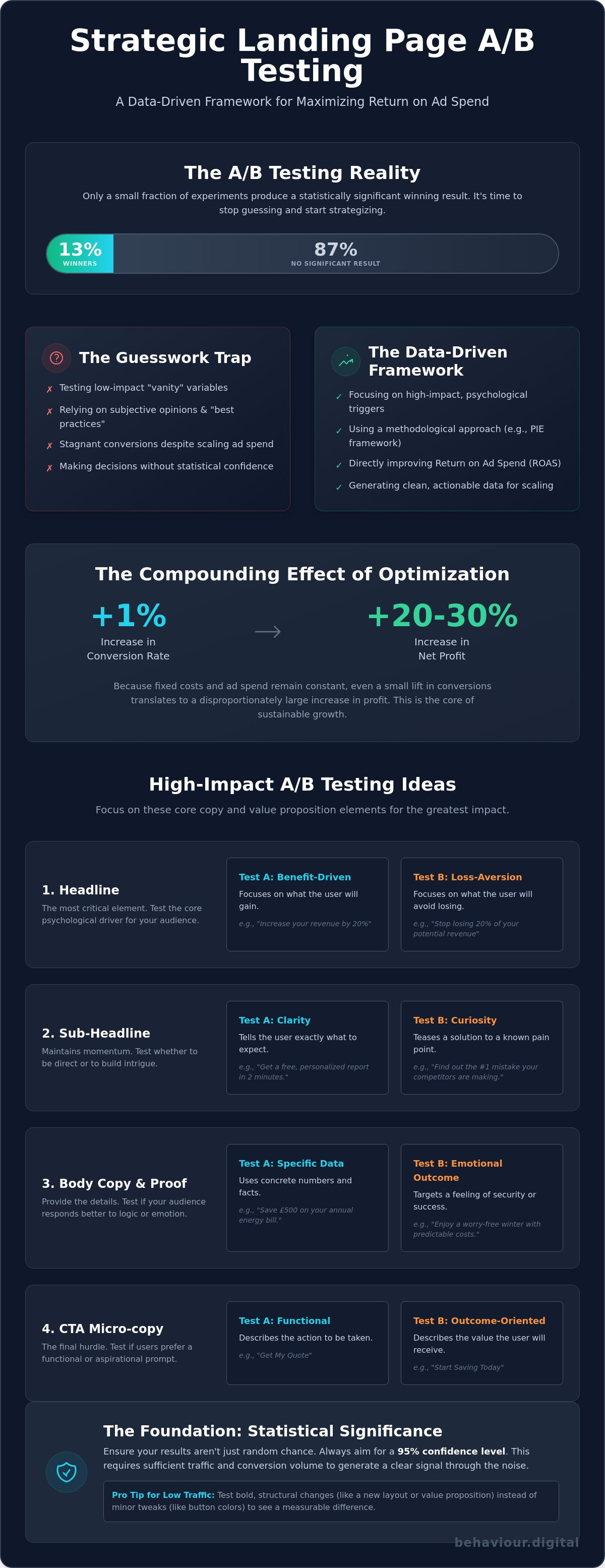
Only 13% of A/B tests produce a statistically significant winning result, which means the vast majority of optimization efforts are effectively noise. If you're seeing stagnant conversion rates despite a scaling ad spend, you're likely caught in the trap of testing low-impact variables that don't influence user psychology. We understand the frustration of executing "vanity" tests that fail to move the needle on your bottom line. Professional growth requires moving past surface-level tweaks and focusing on variables that drive measurable business value.
This guide provides 25 strategic landing page a/b testing ideas designed to maximize your ROI in 2026 by focusing on high-impact, data-driven hypotheses. You'll move beyond superficial cosmetic changes to implement a repeatable framework for conversion rate optimization. We'll explore everything from story-driven hero sections to mobile-first structural shifts that directly improve your Return on Ad Spend. By the end of this article, you'll have a prioritized roadmap for testing that replaces guesswork with methodological precision and ensures every experiment contributes to sustainable growth.
• Learn how to replace intuitive guesses with a methodological approach using the PIE framework to prioritize experiments with the highest growth potential.
• Discover how to implement high-impact landing page a/b testing ideas that target user psychology, such as benefit-driven messaging and loss-aversion headlines.
• Master the use of visual hierarchy and choice architecture to reduce friction and guide visitors toward your primary call to action.
• Understand the importance of testing one variable at a time to ensure clean, actionable data that can be used to scale your business results.
• Align your Conversion Rate Optimization with professional digital strategy to ensure your testing efforts directly improve your overall Return on Ad Spend.
Landing page A/B testing is a controlled experiment where two versions of a page are shown to different segments of visitors simultaneously. It's the scientific method applied to digital marketing. Instead of relying on subjective opinions or outdated "best practices" that might not apply to your specific audience, you use real-world data to validate your landing page a/b testing ideas. This transition from gut-feeling marketing to data-driven decision making is what separates high-growth brands from those that eventually stall. As customer acquisition costs rise, guessing is no longer a viable business strategy.
The financial impact of this methodology is often underestimated by marketing managers. A mere 1% increase in conversion rate doesn't just mean a linear 1% increase in revenue. Because your fixed costs and ad spend remain constant, that 1% lift often translates into a 20% or even 30% increase in net profit. This is the essence of Behavioural Growth. We focus on the intersection of user psychology and quantitative data to create a compounding effect on your bottom line. Every test is a step toward a more efficient, predictable revenue engine. Effective landing page a/b testing ideas are rooted in this data-first philosophy.
You can't stop an experiment just because Version B looks like it's winning after 48 hours. Statistical significance ensures your results aren't just a product of random chance. In plain English, a p-value tells you the probability that the performance difference between your pages happened by pure luck. We typically look for a 95% confidence interval. This means there's only a 5% chance the result is a fluke. To reach this level of certainty, your page needs sufficient traffic and conversion volume. If your traffic is low, testing small elements like button colors is an exercise in futility. You need bold, structural changes to generate enough signal through the noise.
A/B tests compare two distinct versions of a page, while Multivariate Testing (MVT) tests multiple variables in different combinations at once. While MVT sounds sophisticated, it requires massive traffic volumes to reach statistical significance for every possible combination. For most businesses, it's an inefficient use of time and budget. At Behaviour Digital, we recommend starting with bold A/B hypotheses. Testing foundational elements like your primary value proposition or the entire hero section layout delivers faster, more reliable insights. Once your foundational conversion rate is healthy, you can consider the granular complexity of MVT to fine-tune the details.
A Value Proposition is the primary reason a prospect should buy from you rather than a competitor. It's the foundation of your entire page. When developing landing page a/b testing ideas, your headline is the first lever to pull. You should test "Benefit-Driven" messaging against "Loss-Aversion" hooks. For instance, compare "Increase your revenue by 20%" with "Stop losing 20% of your potential revenue to competitors." Human psychology often weighs the pain of loss more heavily than the joy of gain, and identifying which trigger resonates with your specific audience is critical for scaling.
Your sub-headline serves a different purpose: maintaining momentum. Test clarity against curiosity. A clear sub-headline tells the user exactly what happens next, while a curiosity-based one teases a solution to a known pain point. This is where you refine your A/B testing definition of success by measuring scroll depth and time on page. Beyond the headline, test specific data points against emotional outcomes. "Save £500 on your annual energy bill" provides a concrete anchor, whereas "Enjoy a worry-free winter with predictable energy costs" targets a feeling of security. Both are valid, but only one will dominate your specific market segment.
Micro-copy on buttons often represents the final hurdle in the conversion journey. Instead of generic labels like "Submit" or "Click Here", test text that reflects the user's intent. Compare "Get My Quote" with "Start Saving Today." The former is functional and low-friction, while the latter is outcome-oriented. Small shifts in language can significantly alter the perceived effort of the task. If your current conversion rates are underperforming, a professional Conversion Rate Optimization audit can help identify which psychological triggers are missing from your copy.
The offer itself is frequently the biggest point of friction. If a "Free Consultation" isn't converting, test a "Price Estimate Tool" or an interactive calculator. This reduces the perceived commitment required from the user. You should also experiment with "Hard" offers like "Buy Now" versus "Soft" offers like "Download the 2026 Industry Guide" for visitors who are still in the research phase. Finally, test the impact of scarcity ("Only 3 spots left for July") against high-volume social proof ("Join 5,000+ industry leaders") to see which social trigger drives faster action.
Users don't read landing pages; they scan them. Test bulleted lists against short, punchy paragraphs to see which format leads to higher form completion. Content should be "You-focused" rather than "We-focused." Replace company-centric descriptions with language that places the user as the protagonist of the story. Use strong action verbs like "Accelerate," "Protect," or "Eliminate" at the start of every list item to maintain a high-energy pace and drive the reader toward the final call to action.
Visual hierarchy dictates the sequence in which a visitor processes information. It's the difference between a user bouncing in three seconds and a user completing a high-value lead form. When brainstorming landing page a/b testing ideas, you must evaluate your above-the-fold content first. Test a single, dominant Call to Action (CTA) against a "Choice" architecture that offers two distinct paths, such as "Request a Demo" versus "View Pricing." While a singular focus often reduces decision fatigue, high-consideration B2B audiences sometimes require a secondary, low-friction option to remain in the funnel. Removing global navigation links is another foundational test. By eliminating these exit points, you keep the user focused on the singular conversion goal, which typically results in a measurable lift in conversion rates for qualified traffic.
Strategic layout also involves directing the user's gaze through intentional visual cues. You can use A/B testing to compare the effectiveness of directional arrows against human eye-line cues. Eye-tracking data reveals that visitors instinctively follow the gaze of a person in a hero image. If the person in your photography is looking at the lead form, the visitor's attention will follow. We also analyse content placement using the "F-Pattern" for text-heavy pages and the "Z-Pattern" for visual-heavy layouts. Aligning your most critical value propositions with these natural scanning habits ensures your message is absorbed during the initial three-second scan. Effective landing page a/b testing ideas focus on these structural shifts rather than superficial aesthetic changes.
Friction is the primary barrier to conversion. Verified data from 2026 shows that shortening a form from 11 to 4 fields can increase conversions by 120%. You should test multi-step forms against single-page layouts, particularly for complex service offerings. Multi-step forms reduce perceived effort by categorising questions into logical stages. We also recommend testing the removal of all "optional" fields. If the data isn't essential for your immediate sales process, it's a liability. Inline validation and progress bars are also worth testing; while they often guide users, they can occasionally create visual noise that distracts from the final submission.
Trust is a quantifiable asset. You should test whether a row of recognisable customer logos builds more authority than a single, deep-dive testimonial. While video testimonials are highly engaging, they should be tested against traditional text-based reviews with star ratings to see which format your specific audience actually consumes. Placement of industry certifications and "As Seen On" badges is also a high-impact variable. Moving these trust signals directly beneath the CTA can provide the final psychological nudge required to overcome buyer hesitation and complete the conversion.
Executing a high volume of experiments without a prioritisation system is a common mistake that leads to inconclusive results and wasted resources. To maximise ROI, your landing page a/b testing ideas must be filtered through a rigorous framework. We use the PIE method to maintain strategic focus. This system evaluates every hypothesis based on three criteria: Potential (the expected lift in performance), Importance (the volume of traffic and ad spend directed to the page), and Ease (the technical effort required for implementation). By scoring each idea, you ensure that your team focuses on the 20% of changes that will drive 80% of your business growth.
Precision requires isolation. Testing one variable at a time remains the gold standard for clean, actionable data. If you change the headline, the hero image, and the CTA simultaneously, you'll never know which element caused the performance shift. Every experiment should begin with a formal hypothesis: "If we change [X], then [Y] will happen because of [Z]". This structure forces you to ground your tests in psychological observations rather than aesthetic preferences. It also helps mitigate the danger of false positives. Statistical anomalies occur frequently in short-term data, which is why we recommend a minimum test duration of at least 14 days to account for weekly traffic fluctuations.
Effective testing requires a dual-lens approach. Your GA4 data provides the quantitative "what", showing you exactly where users drop off in the funnel. However, to understand the "why", you must look at qualitative sources like heatmaps, session recordings, and user surveys. These tools reveal the friction points and cognitive hurdles that numbers alone cannot capture. For a deeper look at how to integrate these data streams into a repeatable growth engine, explore our comprehensive guide on conversion rate optimization. Combining these insights allows you to build hypotheses that address real user frustrations.
A winning strategy on desktop often fails on mobile devices due to different user contexts and physical constraints. Mobile conversion rates in 2026 typically average between 2.49% and 2.9%, significantly lower than the 4.8% to 5.06% seen on desktop. This performance gap is often caused by poor mobile layout. You should specifically test thumb-friendly button placement and font legibility for smaller screens. Speed is also a critical variable; with a one-second delay reducing conversions by 7%, technical performance is as much a part of your A/B testing strategy as your copy. If you want to stop guessing and start scaling, our team can help you build a data-driven digital strategy that delivers measurable results.
Scaling a conversion engine requires more than just a list of landing page a/b testing ideas; it demands a disciplined, long-term roadmap. Most in-house teams abandon their experimentation programs after just three or four "failed" tests. This is a strategic error. In high-level CRO, a test that doesn't produce a winner is still a successful data acquisition exercise. It narrows the search space and refines your understanding of user psychology. A professional agency doesn't just run tests. We manage a continuous cycle of validation that protects your ad spend and compounds your ROI over months and years.
The most significant gains happen at the intersection of PPC Management and landing page optimisation. When your traffic acquisition and conversion strategies are siloed, you lose the ability to iterate quickly. By aligning these functions, we use real-time ad performance data to inform our next round of landing page a/b testing ideas. If a specific hook is winning in your Google Ads copy, it's a prime candidate for your landing page headline. This integrated approach allows us to move beyond isolated page tweaks toward comprehensive conversion optimisation that covers the entire customer journey.
True optimisation requires perfect "Message Match" from the initial click to the final form submission. A user arriving from a high-intent Google Search query has different psychological needs than a professional browsing LinkedIn. We test audience-specific landing pages that mirror the tone and promise of the specific ad creative. Using ad performance metrics like CTR and engagement rates, we identify which value propositions are already resonating with your market before we even write a single line of landing page code. This ensures that every experiment is grounded in proven user interest.
Our approach is built on Behavioural Strategy, not just changing button colours because a blog post suggested it. We leverage deep data from our Glasgow-based PPC campaigns to fuel high-probability CRO wins for our partners. We don't just act as a service provider; we operate as a strategic partner responsible for your growth. Success isn't about running the most tests, it's about running the right ones. If you're ready to stop wasting budget on inconclusive experiments, you can enquire about our Conversion Rate Optimisation services today. Let's build a repeatable framework that turns your traffic into a predictable revenue stream.
Transitioning from random experimentation to a structured growth engine is the defining factor for high-performing brands. By implementing high-impact landing page a/b testing ideas rooted in behavioural psychology rather than aesthetic preference, you shift from guessing to a predictable revenue model. Success requires a commitment to a rigorous prioritisation framework and the seamless integration of your paid media data with your conversion assets. Every data point gathered is a step toward reducing customer acquisition costs and improving your overall return on ad spend.
Behaviour Digital operates as a strategic partner for businesses that demand measurable growth over superficial metrics. Our Glasgow-based team of data-driven PPC and CRO specialists brings deep expertise in Meta, LinkedIn, and Google Ads optimisation to every experiment. We focus on the facts of user behaviour to drive genuine business development. If you're ready to move beyond stagnant conversion rates and start scaling with precision, our methodology provides the clarity you need. Book a Free CRO Strategy Session with Behaviour Digital today. Let's turn your existing traffic into a compounding asset for your business.
You should run an experiment for at least 14 days to account for variations in user behaviour across two full weekly cycles. Stopping a test prematurely often leads to deceptive results because early data hasn't accounted for the different conversion patterns seen on weekends versus weekdays. Consistency over time is essential for verifying that a performance lift is sustainable and not a statistical anomaly.
The median conversion rate for a dedicated landing page across all industries is 4.02% in 2026. However, high-performing pages in the top 25th percentile achieve conversion rates of 11.45% or higher. While these benchmarks provide a useful baseline, your specific target should be based on your industry's historical performance and the friction level of your lead generation offer.
Low traffic websites can still benefit from testing, but you must focus on radical landing page a/b testing ideas rather than granular tweaks. Testing small elements like button colours requires massive traffic to reach significance. Instead, test "Big Rock" variables such as your entire value proposition or a completely different page structure to generate a stronger signal through the noise.
The headline is the most critical variable to test first because it's the primary factor in a visitor's decision to stay or bounce. It sets the psychological frame for the rest of the page. Once you've validated a winning headline, move your focus to the hero image and the primary call-to-action button, as these elements have the highest impact on conversion rates.
Zoho PageSense and Varify.io are excellent choices for UK businesses seeking a balance between features and cost. Zoho starts at approximately $20 per month, making it highly accessible. Varify.io offers a flat rate of €149 per month for unlimited traffic and experiments, which provides professional-grade precision without the enterprise pricing of platforms like Kameleoon or AB Tasty.
A result is considered significant when it reaches a 95% confidence interval, meaning there's only a 5% chance the difference in performance happened by luck. Most modern testing software calculates this automatically. You must ensure your test has collected enough data points, both in terms of total visitors and total conversions, before you can trust the validity of the result.
A/B testing involves changing specific elements on a page using a JavaScript snippet while keeping the URL the same. Split testing, also known as redirect testing, sends half of your traffic to an entirely different URL. Split testing is generally more effective for radical redesigns or testing completely different page layouts that require unique backend configurations.
A/B testing doesn't negatively impact your SEO rankings as long as you follow standard best practices. Use rel="canonical" tags on your variant pages to point search engines back to the original version. This prevents issues with duplicate content and ensures that Google understands the page version is part of a temporary experiment rather than a permanent change.

Luke leads strategy across every Behaviour Digital account — building data-driven advertising systems for ambitious brands. When he's not auditing ad accounts, he's writing about what he found in them.
Get a free, tailored growth plan — we'll run our framework on your accounts and show you exactly what we'd do.
Get your free growth plan →