.webp) Online
OnlineNot sure which channel fits your business?View all services →
Three inputs. Instant KPIs. No spreadsheets.Open a calculator →
OnlineWith global social media advertising spend surpassing $317.33 billion in April 2026, the cost of entry has never been higher. You’re likely tired of seeing your budget consumed by a United States Meta CPM that fluctuates between $16.08 and $23.00 while cross-platform tracking remains a fragmented me...

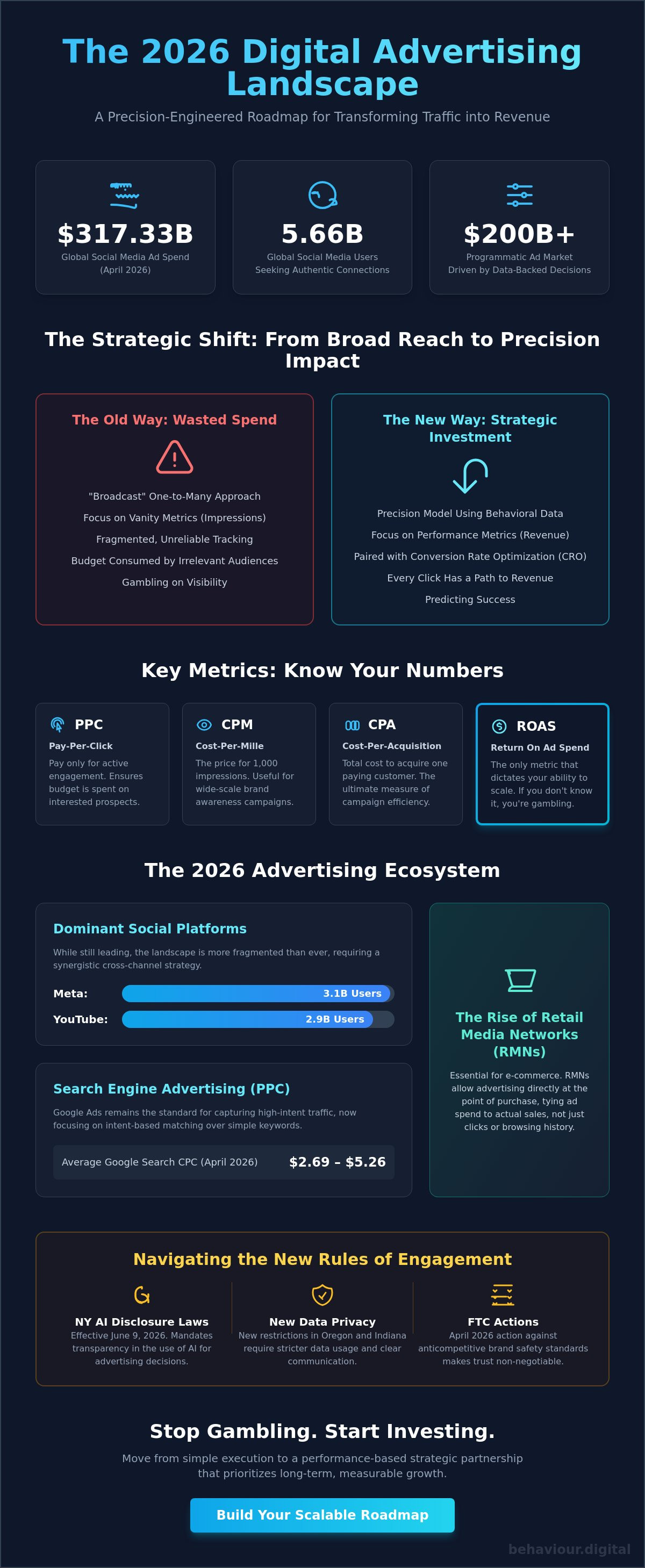
With global social media advertising spend surpassing $317.33 billion in April 2026, the cost of entry has never been higher. You’re likely tired of seeing your budget consumed by a United States Meta CPM that fluctuates between $16.08 and $23.00 while cross-platform tracking remains a fragmented mess. It’s frustrating to manage a landscape where terminology like PPC, CRO, and ROAS feels more like a barrier than a tool for growth. You’ve probably realized that simply buying visibility is a losing game in a market where 5.66 billion users are increasingly seeking authenticity over automated noise.
This guide provides the exact mechanics you need to transform raw traffic into measurable revenue through behavioral data and strategic optimization. We’ll move past the noise to build a precision-engineered roadmap for your ad investment. You’ll learn how to handle the June 9, 2026, New York AI disclosure laws and the new data privacy restrictions effective in Oregon and Indiana. By the end of this article, you’ll understand how to leverage the $200 billion programmatic market to scale lead generation with absolute transparency and predictable success.
• Transition from broad-reach tactics to a precision-engineered model where advertising functions as a strategic investment in specific user behaviors.
• Identify the highest-impact channels for 2026, including dominant social platforms and the essential rise of Retail Media Networks for e-commerce.
• Eliminate wasted budget by pairing traffic acquisition with Conversion Rate Optimization (CRO) to ensure every click has a clear path to revenue.
• Establish a scalable roadmap by auditing your tracking infrastructure and aligning spend with measurable business objectives like lead generation or sales.
• Navigate technical complexity by shifting from simple execution to a performance-based strategic partnership that prioritizes long-term growth over vanity metrics.
Modern advertising isn't just about buying attention. It's a strategic investment in paid media designed to trigger specific, measurable user actions. To understand What is Advertising in its historical context, one must look at its evolution from broad messaging to the current era of hyper-personalization. Traditional "broadcast" methods relied on a one-to-many approach, often wasting budget on irrelevant audiences. In contrast, precision digital models use behavioral data to meet users exactly at their point of need.
The shift from vanity metrics to performance is now absolute. In 2026, global programmatic spend is projected to exceed $200 billion, proving that the market has moved toward automated, data-backed decisions. We've moved past the era of simple impressions. Success is now measured by how effectively you can transform raw traffic into revenue. Behavioral data allows us to stop guessing and start predicting, ensuring your message reaches the right person before they even realize they're ready to buy.
Your strategy must distinguish between lead generation and brand awareness. Lead generation focuses on immediate conversion, while awareness builds the long-term funnel. Effective campaigns support the entire customer journey, not just the initial click. This requires a commitment to transparency. Following the April 2026 FTC action against anticompetitive brand safety standards, and the June 9, 2026, New York law requiring AI disclosures, building trust through paid media is no longer optional. It's a requirement for sustainable growth. Accurate data usage and clear communication are the only ways to maintain high-value relationships with your audience.
Understanding the vocabulary of growth is essential for making informed decisions. Here is a breakdown of the core mechanics:
You only pay when a user actively engages with your ad, ensuring your budget is spent on interested prospects.
The price for 1,000 impressions, useful for wide-scale awareness where the average global Meta CPM sits at $6.59 as of April 2026.
The total cost to acquire one paying customer or qualified lead, which is the ultimate measure of efficiency.
While these metrics matter, Return on Ad Spend (ROAS) is the only figure that truly dictates your ability to scale. If you don't know your ROAS, you aren't investing; you're gambling. Ad inventory in 2026 represents the real-time availability of digital space across platforms, auctioned off in milliseconds to the highest bidder whose creative matches the user’s predicted intent and behavioral history.
The digital ecosystem in 2026 is defined by fragmentation and the dominance of closed-loop environments. While Meta and YouTube still lead with 3.1 billion and 2.9 billion active users respectively, the landscape has expanded beyond traditional social feeds. Retail Media Networks (RMNs) have become essential for e-commerce brands. These platforms allow you to place advertising directly where the purchase happens, tying spend to actual sales rather than just clicks. This shift ensures that every dollar invested is backed by transactional data, not just browsing history.
Managing this complexity requires a deep understanding of AI in advertising. Automated bidding algorithms now handle the majority of real-time auctions, but they aren't "set and forget" tools. They require high-quality data inputs to function effectively. Without a clear cross-channel strategy, these automated systems can quickly drain budgets by over-bidding on low-value traffic. Success in 2026 relies on synergy across platforms to ensure a consistent message reaches the user throughout their fragmented journey.
Google Ads remains the gold standard for capturing high-intent traffic. With an average Search CPC ranging from $2.69 to $5.26 as of April 2026, the cost of inefficiency is high. We've moved beyond simple keyword matching. Today's systems focus on intent-based matching, using behavioral signals to determine if a searcher is ready to convert. This level of technicality is why comprehensive PPC management is no longer optional for businesses looking to scale. You need a partner who understands how to feed the algorithm the right signals to maintain a healthy ROAS.
Social platforms demand a different psychological approach. You're competing with a user's social circle, not just other brands. Native content ads that blend into the feed outperform traditional interruptive banners every time. On TikTok, where the average CPM sits between $4.00 and $12.00, authenticity is the primary driver of engagement. For businesses looking for a localized approach, our guide to social media marketing management Scotland explains how to apply these global trends to specific regional markets.
Targeting has also undergone a massive shift. With 2026 privacy laws in Oregon, Indiana, and Kentucky restricting the sale of precise data, first-party data is your most valuable asset. Brands that own their audience data can achieve hyper-accurate targeting that third-party cookies never could. If you're ready to audit your current channel mix and leverage these insights, you can start your growth journey here with a dedicated strategic partner.
Many brands fail because they view advertising as a standalone solution for revenue. It isn't. Ads are simply the engine that drives traffic to your digital storefront. If your website suffers from "Leaky Bucket" syndrome, you're essentially pouring expensive resources into a container that can't hold them. In April 2026, where a single click on Google Search can cost as much as $5.26, sending that user to a confusing or slow landing page is a waste of capital. You aren't just losing a sale; you're actively subsidizing your competitors by failing to capture the intent you paid for.
Conversion Rate Optimization (CRO) is the essential partner to any paid media strategy. While ads handle the "who" and "where," CRO manages the "what happens next." By analyzing user behavior, we can identify exactly where friction occurs in the customer journey. Psychological triggers like social proof, clear value propositions, and frictionless checkouts are what turn a casual click into a loyal customer. Without this focus on the post-click experience, even the most sophisticated ad campaign will eventually hit a growth ceiling.
Improving your conversion rate is the most effective way to lower your cost-per-acquisition (CPA). If your current conversion rate is 1% and you manage to increase it to 2%, you've effectively doubled your ad profitability without spending an extra cent on the platforms. This methodology is explored deeply in our guide to Conversion Rate Optimization. It's the difference between struggling to break even and achieving true scalability. When your site converts at a higher rate, you can afford to bid more aggressively, effectively pricing your competitors out of the market.
We don't rely on "gut feeling" for creative or design. Every element on a landing page is a variable to be tested. Through rigorous A/B testing, we refine messaging and visuals based on how real people interact with them. This process requires absolute transparency in reporting. You should know exactly where every penny of your budget goes and how it contributes to your bottom line. We use these insights to bridge the gap between ad creative and the user's final action. Success isn't about luck; it's the result of continuous, data-backed refinement that prioritizes the user's actual behavior over subjective opinions.
Scaling your advertising isn't a matter of luck. It's a calculated process of moving from a testing phase to a high-performance growth phase. Before committing significant capital, you must define a primary business objective. Whether you're chasing high-intent lead generation or broad-scale awareness, your goal dictates your channel selection and creative direction. You can't scale what you can't measure. This makes a comprehensive audit of your digital footprint and conversion tracking the first non-negotiable step in any strategic roadmap. If your tracking pixels aren't firing correctly, your data is compromised, and your budget is being spent blindly.
Selecting the right platforms requires an analytical look at where your audience actually converts. For example, B2B brands often find higher value on LinkedIn despite CPMs that can exceed $90.00 for senior-level targets, because the intent matches the cost. Conversely, e-commerce brands are increasingly moving toward Retail Media Networks to close the gap between the ad and the purchase. Once your channels are selected, you must adopt an "Always-On" approach. Digital growth isn't a one-time campaign; it’s a process of continuous optimization where data from today’s spend informs tomorrow’s strategy.
You need a data-backed budget that accounts for both the testing and scaling phases. During the testing phase, expect to spend 20% to 30% of your budget simply gathering behavioral data. This allows you to calculate your break-even ROAS, which is determined by your gross margins. Knowing this number is the only way to ensure your investment is actually profitable. A 90-day strategy window provides the necessary data density to account for algorithmic learning and seasonal fluctuations while allowing for aggressive performance pivots. Without this timeframe, you risk cutting off a campaign before the machine learning has had time to optimize for your target CPA.
While digital platforms are global, consumer behavior is often regional. This is why partnering with a PPC agency in Glasgow or another local hub provides a distinct competitive edge for UK-based brands. Local experts understand regional nuances in search behavior and social engagement that a generic, global approach might miss. They can navigate specific market landscapes and competitor tactics with greater precision. Having a strategic partner who understands your specific territory ensures your messaging resonates on a cultural level, not just a technical one. If you’re ready to move past generic tactics and build a custom growth engine, you can request a performance audit to see where your strategy is currently leaking revenue.
The era of the generalist marketer is over. By 2026, the technical barriers to entry in advertising have become too steep for anything other than specialist management. Between navigating the June 9, 2026, New York AI disclosure laws and managing the algorithmic pricing shifts under new FTC scrutiny, the margin for error is non-existent. You don't need a vendor to simply click buttons on a dashboard. You need a strategic growth partner who assumes responsibility for your business outcomes. This shift from task-based execution to performance-based partnership is what separates stagnant brands from those that achieve scalable growth.
We see advertising as one component of a larger, integrated engine. High-intent traffic from Google Search or engagement from TikTok, where CPMs average $4.00 to $12.00 as of April 2026, means nothing if the data isn't synchronized across your entire funnel. Fragmented strategies lead to fragmented results. A true strategic partner doesn't just look at ROAS in a vacuum; they look at how paid media influences the entire customer lifetime value. This requires a level of transparency and data ownership that many traditional agencies still refuse to provide.
Our methodology is built on Behavioral Growth. We merge deep psychological insights with hard behavioral data to understand why users convert, not just when. This framework is detailed in our guide to digital strategy, which outlines how we combine PPC, social media, and CRO into a single, unified growth engine. We don't believe in black-box solutions. You own your data, your accounts, and your insights. Our role is to provide the analytical expertise and technological readiness needed to turn that data into a competitive advantage.
Success in 2026 demands an integrated approach. If your current campaigns are managed in silos, you're missing hidden opportunities for optimization. The first step toward scalability is a data-first audit of your existing digital footprint. We look for the friction points that are currently costing you leads and the untapped audience segments that your competitors have overlooked. It's time to stop guessing and start investing with precision. If you’re ready for a performance-focused consultation that prioritizes measurable business impact over vanity metrics, contact us today to schedule your strategy session.
The 2026 digital landscape doesn't reward trial and error. Success requires a unified engine where behavioral data and technical precision meet. We’ve established that high-intent traffic means nothing without conversion optimization; a 1% lift can double your profitability. Navigating a world of $23.00 Meta CPMs and strict AI disclosure laws requires more than just a vendor. It demands a strategy that prioritizes transparency and measurable business impact over vanity metrics.
Your advertising should be a predictable revenue driver, not a financial drain. Behaviour Digital provides the specialist PPC and CRO expertise needed to turn raw traffic into scalable growth. Our Glasgow-based strategic team uses a data-driven behavioral growth approach to ensure your investment is protected and your results are transparent. It's time to stop managing campaigns and start engineering success. Scale your business with a data-driven advertising strategy today. We’re ready to help you build the roadmap your business deserves.
Marketing is the overarching business strategy that includes product development, pricing, and distribution. Advertising is a specific, paid tactical subset of marketing used to buy visibility and drive immediate user actions. While marketing builds the long-term brand framework, advertising focuses on precision-engineered investments in media to generate measurable leads or sales.
A growth-oriented small business should typically allocate 5% to 10% of gross revenue to their ad budget. In 2026, you must account for platform minimums, such as the $50 daily campaign budget required by TikTok. With United States Meta CPMs reaching as high as $23.00, your budget must be large enough to provide the algorithm with the data density needed for effective optimization.
Google Ads is superior for capturing high-intent searchers actively looking for a solution, while Facebook excels at behavioral targeting and demand generation. Google Search CPC averages between $2.69 and $5.26, making it a premium choice for "pull" marketing. Facebook is often more cost-effective for building a top-of-funnel audience through native content that influences users while they scroll.
You should see initial engagement data within 14 days, but a campaign requires a full 90-day strategy window to reach peak efficiency. This timeframe allows machine learning algorithms to move past the "learning phase" and optimize bids based on real-time behavioral signals. Consistent data collection during this period is what eventually drives down your cost-per-acquisition.
Yes, because advertising has evolved into native and shoppable formats that bypass traditional desktop blockers. There are now 5.66 billion social media users worldwide who engage with content primarily through mobile apps where blockers are less prevalent. Shifting spend toward Retail Media Networks and Connected TV (CTV) ensures your message reaches consumers in environments where they are ready to buy.
A 4:1 ROAS is the common benchmark for profitability in e-commerce, but your specific target depends on your gross margins. For high-seniority LinkedIn campaigns where CPMs can exceed $90.00, a lower ROAS might still be highly profitable if your average contract value is significant. You must calculate your break-even point before scaling spend to ensure the investment remains sustainable.
Managing your own ads is possible for simple campaigns, but the technical complexity of 2026 tracking makes professional management safer for scaling. Hiring a specialist agency provides access to advanced behavioral growth tools and ensures compliance with new regulations, such as the June 9, 2026, New York AI disclosure law. Expert management prevents the "leaky bucket" syndrome that often leads to wasted ad spend.
AI lowers the cost of creative production and media planning, making high-level strategies more accessible to smaller budgets. It allows for performance forecasting that was previously reserved for enterprise brands. However, the June 9, 2026, New York law requiring AI disclosures means businesses must be more transparent, and the rise of AI-generated content has increased the premium on authentic, human-centric messaging.

Luke leads strategy across every Behaviour Digital account — building data-driven advertising systems for ambitious brands. When he's not auditing ad accounts, he's writing about what he found in them.
Get a free, tailored growth plan — we'll run our framework on your accounts and show you exactly what we'd do.
Get your free growth plan →