.webp) Online
OnlineNot sure which channel fits your business?View all services →
Three inputs. Instant KPIs. No spreadsheets.Open a calculator →
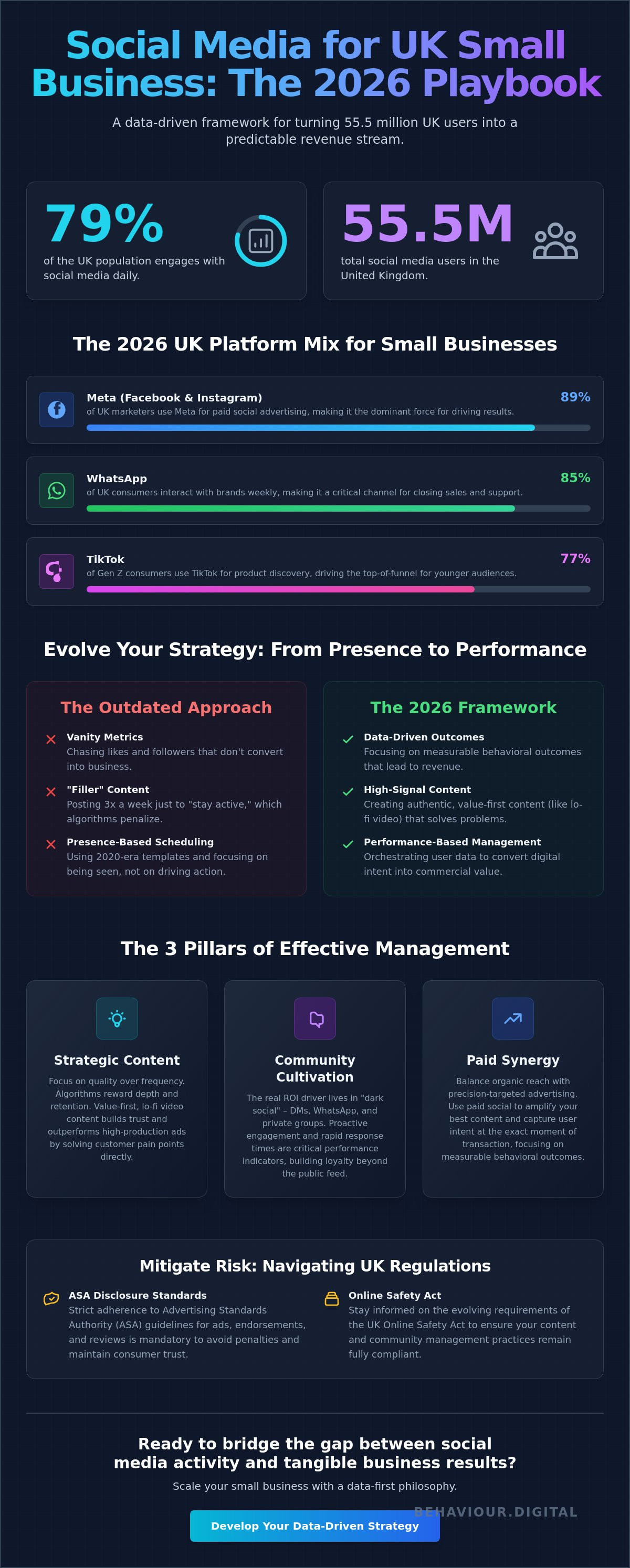
Online79% of the UK population now engages with social media, yet most small businesses still struggle to turn those 55.5 million users into a predictable stream of revenue. If your current approach to social media advertising for small business uk feels like a constant battle against algorithm fatigue an...

79% of the UK population now engages with social media, yet most small businesses still struggle to turn those 55.5 million users into a predictable stream of revenue. If your current approach to social media advertising for small business uk feels like a constant battle against algorithm fatigue and rising costs, you aren't alone. It's common to feel that your digital presence has become a time-sink rather than a strategic asset that delivers measurable results.
We understand that inconsistent lead generation and high management costs are significant barriers to scaling your operations. This guide provides the strategic framework you need to link your social activities directly to your bottom line. You'll learn how to balance organic reach with paid performance, navigate the 20% VAT on digital spend, and ensure your content meets the latest ASA disclosure standards. We'll outline a methodology that prioritizes quantitative data and business development over superficial engagement metrics, moving your brand toward a model of sustainable, performance-based growth.
• Shift from vanity metrics to a data-driven framework built on strategic content, community cultivation, and paid synergy to ensure social media serves as a revenue driver.
• Maximise your ROI by balancing organic engagement with precision-targeted social media advertising for small business uk, focusing on measurable behavioral outcomes.
• Evaluate the true cost of management by analyzing the opportunity cost of DIY efforts versus the efficiency of a hybrid model that utilizes professional strategic oversight.
• Mitigate regulatory risk by implementing strict adherence to ASA disclosure standards and the evolving requirements of the UK Online Safety Act.
• Discover how a data-first philosophy bridges the gap between creative execution and tangible business results through continuous methodological refinement.
The digital environment for UK small businesses has undergone a fundamental shift. Social media is no longer a secondary communication channel; it's a sophisticated behavioral data exercise. To succeed in 2026, you must view every interaction as a data point that informs your broader commercial strategy. In 2026, social media management for UK small businesses is the systematic orchestration of user behavioral data to convert digital intent into measurable commercial value. This evolution requires moving away from vanity metrics toward a methodology that prioritizes precision and conversion.
Effective social media marketing now demands a hyper-local focus. While broad reach once seemed desirable, the saturation of the UK market means that niche community engagement delivers higher ROI. Integrated platform-native commerce, such as TikTok Shop and Meta's direct checkout features, has transformed social apps into full-funnel sales environments. For those utilizing social media advertising for small business uk, the goal is no longer just visibility. It's about capturing intent at the exact moment a user is ready to transact. A behavioral approach succeeds because it analyzes why a user is on the platform, rather than just when they are online.
Algorithms now actively penalize low-value "filler" content. The era of posting three times a week just to "stay active" ended years ago. Modern platforms prioritize performance-based management over presence-based scheduling. Users in 2026 are highly discerning; they ignore generic brand updates but engage deeply with creator-led, authentic content. If your strategy relies on 2020-era templates, you're likely wasting resources on content that the algorithm suppresses. The focus must shift to high-signal content that triggers meaningful user actions.
Success depends on appearing where your specific audience resides. Meta remains the dominant force for paid social, used by 89% of UK marketers to drive social media advertising for small business uk results. However, the customer journey often includes private channels. 85% of UK consumers now interact with brands on WhatsApp at least once a week, making it a critical tool for closing sales. LinkedIn remains the standard for B2B precision, while 77% of Gen Z consumers use TikTok for product discovery. Integrating these platforms with your Google Business Profile ensures a seamless transition from social discovery to local physical or digital transactions.
Management isn't a static task; it's a continuous cycle of data collection and iterative optimization. For UK brands, this means moving away from a linear "post and forget" model. Instead, we use a framework built on Strategic Content, Community Cultivation, and Paid Synergy. These pillars are central to social media marketing management Scotland, where regional data nuances dictate specific content directions. By employing active social listening, businesses can identify market gaps and customer frustrations that competitors often overlook.
Success in 2026 relies on value-first content that addresses specific UK customer pain points. Algorithms now reward depth and retention over high volume. We've seen a decisive shift toward lo-fi, authentic video content. This format often outperforms high-production advertisements because it builds trust through perceived transparency. When content is engineered to solve problems rather than just fill a feed, it becomes a powerful tool for conversion optimisation, guiding users from awareness to action without friction.
The rise of "dark social" means much of your brand's impact happens in private DMs, WhatsApp groups, and community hubs. With 85% of UK consumers interacting with brands on WhatsApp weekly, your response speed is a critical performance indicator. Proactive management involves engaging with users before they reach out to you. By following the UK guidance on social media endorsements, you can safely turn followers into brand advocates through transparent influencer partnerships. Authentic engagement in these private spaces often yields a higher lifetime value than public-facing comments.
To scale, you must apply a PPC Management mindset to your social channels. This involves using social media advertising for small business uk to amplify content that has already proven its value organically. Small budgets often face the "Boost vs Campaign" debate. While boosting is simple, structured campaigns allow for better A/B testing and granular targeting. Effectively deploying social media advertising for small business uk ensures that every pound spent is backed by behavioral data. If you want to refine this balance, exploring a tailored digital strategy can help align your spend with your sales targets.
The decision to manage social channels in-house or outsource to a partner is fundamentally a calculation of opportunity cost. Many directors view DIY management as a cost-saving measure, yet they often fail to account for the hundreds of hours diverted from core business operations. According to Top UK Small Business Statistics, resource allocation remains a primary hurdle for growth-stage companies. When you factor in the technical complexity of social media advertising for small business uk, the risk of mismanaged budgets becomes a significant liability rather than a saving.
A hybrid model often provides the best equilibrium for scaling brands. This approach keeps content creation close to the brand's heart internally while leveraging external expertise for high-level strategy and technical execution. However, the UK market is currently saturated with "Social Media Cowboys"-low-cost providers who offer generic posting without a measurable link to sales. Avoiding these requires a rigorous vetting process. If you are looking for a PPC agency Glasgow, prioritize those who can demonstrate a clear lineage between social engagement and bottom-line revenue.
In-house management carries financial burdens beyond simple salary costs. A dedicated internal resource must manage content production, community engagement, and technical reporting, often consuming 20 to 30 hours per week. Additionally, the software stack required for scheduling, sentiment analysis, and advanced attribution can cost a small business hundreds of pounds monthly. Perhaps the greatest risk is the "single point of failure." If your only social media manager leaves or takes leave, your entire digital pipeline stalls, leading to inconsistent lead generation and algorithm penalties that take months to rectify.
Transparency is the baseline for any professional partnership. You should always maintain full ownership and access to your own ad accounts; any agency that obscures this data is a major red flag. Effective partners integrate social efforts into a broader Digital Strategy rather than treating it as an isolated channel. For social media advertising for small business uk, cultural and linguistic nuance is non-negotiable. UK-based account managers understand the specific regulatory environment and consumer sentiment shifts that offshore teams often miss. This local expertise ensures your brand remains compliant while resonating deeply with your target demographic.
Regulatory oversight in the UK has reached a peak in 2026. The Competition and Markets Authority (CMA) now has the authority to fine brands up to 10% of their global turnover for repeated or serious breaches of consumer law. This makes compliance a core pillar of social media advertising for small business uk. Neglecting these standards doesn't just risk a slap on the wrist; it threatens the financial viability of your enterprise. Success requires a methodology that integrates legal safeguards directly into your creative process.
The Advertising Standards Authority (ASA) and the CAP Code dictate how promotional content must appear. A common error is placing disclosure labels after the "see more" break. In 2026, labels like #ad or "AD" must be at the very beginning of the post. Both the brand and any influencer partner share legal responsibility for this disclosure. Even gifted products without a monetary fee are considered advertisements if the brand retains any control over the content. Additionally, the Online Safety Act 2023, with updates effective as of January 2026, requires platforms and brands to take preventative measures against priority offenses, including encouraging serious self-harm.
Lead generation through social platforms must adhere to UK-GDPR and the Privacy and Electronic Communications Regulations (PECR). Collecting user data via platform-native lead forms requires clear privacy notices and explicit consent. You can't simply move social leads into an email sequence without a documented legal basis. Managing social proof also requires ethical rigor; the CMA actively investigates businesses that suppress negative reviews or solicit fake endorsements.
Specific industries face even tighter scrutiny. If you operate in finance or aesthetics, your social media advertising for small business uk must include specific risk warnings and avoid unsubstantiated claims.
• Labels like #ad must be clear and conspicuous.
• Disclosures must appear before any user interaction, such as clicking "see more."
• Digital ad spend must account for the current 20% VAT rate added to the total spend.
The ASA monitors "stealth marketing" closely. Reputational damage from a public ruling often outweighs the initial financial penalty.Safely managing data is a prerequisite for scaling. As social platforms integrate deeper checkout features, ensuring your management tools are UK-GDPR compliant is vital. Privacy-first tracking is now a standard component of conversion rate optimization. It allows you to gather behavioral insights without compromising user trust or legal standing. If you need a partner to manage these complexities while driving growth, contact our team for a strategic social media assessment.
Scaling a brand in a saturated market requires more than high-frequency posting; it demands a systematic approach to user behavior. Behaviour Digital’s data-first philosophy treats social media as a performance engine rather than a digital billboard. We focus on bridging the gap between creative content and tangible business results, ensuring that every interaction serves a commercial purpose. By choosing a Glasgow-based strategic partner, UK brands benefit from localized market insights and a deep understanding of the regional regulatory environment. Our methodology follows a rigorous four-stage process: a quantitative audit, bespoke strategy development, precision execution, and continuous iterative optimisation.
Our process begins with a comprehensive audit that strips away vanity metrics to reveal the true health of your digital presence. We then craft a digital strategy that prioritizes high-intent audiences. Execution is handled with methodological precision, ensuring every post and ad is optimized for conversion. The final stage, iterative optimisation, uses real-time data to pivot and refine our tactics. This ensures your social media advertising for small business uk remains effective even as platform algorithms evolve. We don't believe in static plans; we believe in constant, data-backed evolution.
Likes and comments are secondary indicators; our reporting focuses on value metrics that impact your balance sheet. We use behavioral data to map the entire social media funnel, identifying exactly where potential customers drop off. By analyzing these friction points, we can refine your social media advertising for small business uk to improve lead quality and lower acquisition costs. Our transparent monthly reviews ensure you understand the quantitative link between your digital spend and your revenue growth. We speak the language of business development, providing the clarity needed to make informed scaling decisions.
Transitioning from a presence-based model to a performance-based one starts with a Discovery Call. This initial consultation allows us to align our social media marketing and digital strategy with your specific commercial objectives. We view monthly management fees as an essential investment in your business infrastructure, providing the expertise needed to navigate complex algorithm shifts and regulatory changes without the overhead of an entire in-house department. It's time to move beyond guesswork and implement a framework designed for scalable growth. Book your strategy session with Behaviour Digital today to begin your transition to a data-driven social presence.
Successful management in 2026 hinges on moving beyond the noise of generic, high-frequency posting. It requires a rigid framework where strategic content and community cultivation are amplified by precision-targeted social media advertising for small business uk. You've seen how internal opportunity costs and shifting UK regulations make professional oversight a technical necessity rather than a simple option. Relying on outdated strategies only leads to algorithm fatigue and wasted budget.
As Glasgow-based strategic experts, we specialize in the critical synergy between PPC performance and social engagement. Our data-driven behavioral approach ensures that your digital spend translates into measurable revenue growth rather than superficial metrics. We bridge the gap between your brand's creative social presence and the quantitative results required to scale in a competitive landscape. The transition from a time-sink to a revenue driver is a matter of consistent, methodological refinement. Scale your business with expert social media management and turn your social presence into a predictable growth engine. Success isn't a matter of chance; it's the result of a deliberate, data-backed strategy.
Costs vary significantly based on the depth of the strategy and the technical requirements of your campaigns. Factors influencing the investment include content production volume, the level of community engagement needed, and the complexity of your paid performance management. Businesses should evaluate these costs against the opportunity cost of diverting internal resources away from core operations.
No, attempting to maintain a presence on every platform often dilutes your impact and wastes resources. Success requires identifying the specific channels where your target demographic is most active. For instance, while 77% of Gen Z consumers use TikTok for discovery, B2B brands may find higher precision and ROI by focusing exclusively on LinkedIn.
You can achieve results independently if you have the technical expertise to analyze behavioral data and the time to maintain consistent output. However, many small businesses struggle with algorithm fatigue and inconsistent lead generation. A hybrid approach often works best, allowing you to keep content authentic while leveraging professional strategy for technical execution.
Organic social media focuses on nurturing your existing community and building trust through unpaid content. Conversely, social media advertising for small business uk utilizes paid spend to reach specific, cold audiences based on detailed behavioral data. An effective strategy uses organic posts for brand depth and paid ads for scalable, measurable lead generation.
Paid campaigns can generate measurable traffic and leads almost immediately after launch. Organic growth is a longer-term investment, typically requiring three to six months of consistent data collection and iterative optimization to produce significant commercial results. The timeline depends on the accuracy of your initial strategy and the competitiveness of your sector.
The fundamental difference lies in the platform selection and the complexity of the user journey. B2B strategies often prioritize LinkedIn for precision targeting and longer nurturing cycles. B2C brands typically leverage the visual nature of Instagram or TikTok to drive immediate discovery and platform-native sales through integrated social commerce features.
You should prioritize value metrics over vanity metrics like likes or follower counts. Focus on conversion rate, cost per lead, and return on ad spend (ROAS). These quantitative data points provide the insight necessary to refine your social media advertising for small business uk and ensure your digital presence contributes to your bottom line.
All promotional content must be clearly and conspicuously labeled with identifiers like #ad or "AD" at the very beginning of the post. The ASA requires these labels to appear before any "see more" truncation. Additionally, you must ensure all data collection is UK-GDPR compliant and account for the 20% VAT applied to digital advertising spend.

Luke leads strategy across every Behaviour Digital account — building data-driven advertising systems for ambitious brands. When he's not auditing ad accounts, he's writing about what he found in them.
Get a free, tailored growth plan — we'll run our framework on your accounts and show you exactly what we'd do.
Get your free growth plan →