.webp) Online
OnlineNot sure which channel fits your business?View all services →
Three inputs. Instant KPIs. No spreadsheets.Open a calculator →
OnlineA single second of page load delay now costs UK retailers up to 7% in lost conversions, a margin that separates market leaders from those struggling with rising acquisition costs. You've likely noticed that even with a steady stream of PPC traffic, your conversion rates remain stubbornly flat. It's...

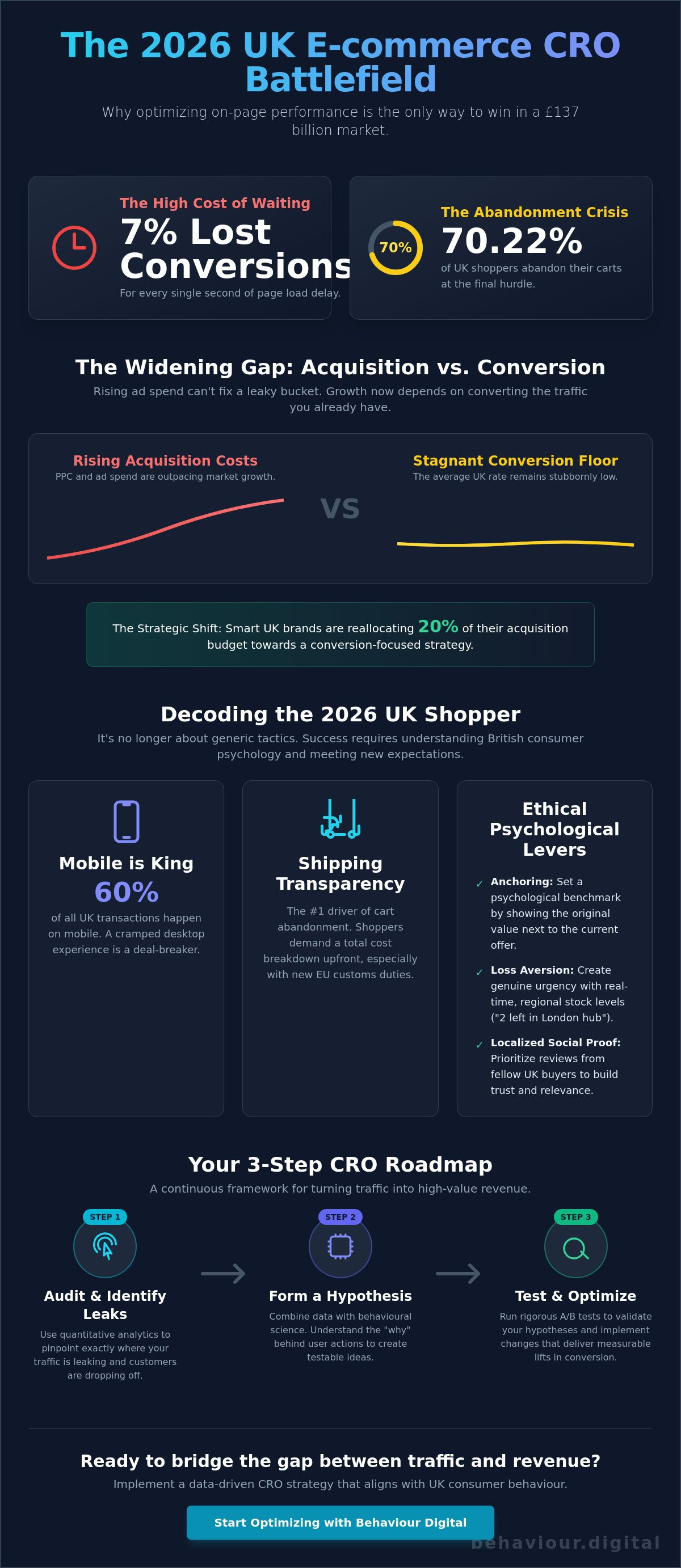
A single second of page load delay now costs UK retailers up to 7% in lost conversions, a margin that separates market leaders from those struggling with rising acquisition costs. You've likely noticed that even with a steady stream of PPC traffic, your conversion rates remain stubbornly flat. It's frustrating to invest in a sophisticated digital strategy only to see 70.22% of UK shoppers abandon their carts at the final hurdle. This reality is why analyzing the latest cro case studies ecommerce uk brands are utilizing is no longer optional for sustainable growth.
We understand that success in a £137 billion market requires more than just site updates; it demands a deep alignment with British consumer psychology and behavioral science. You'll discover how top-tier brands turn stagnant traffic into high-value revenue by optimizing for a 60% mobile-first audience. This article provides a clear framework for A/B testing and a data-driven justification for your marketing spend. We'll examine how to improve Average Order Value and navigate the specific shifts of 2026, including the impact of new customs duties on consumer behavior. Everything is built on the principle that success is the result of conscious strategy and continuous methodological fine-tuning.
• Bridge the widening gap between rising customer acquisition costs and conversion floors by shifting focus from traffic volume to on-page performance.
• Move beyond generic urgency tactics and adopt a Behavioural Growth Framework that aligns site triggers with British consumer psychology.
• Examine high-impact cro case studies ecommerce uk retailers use to optimize mobile checkout experiences and reduce cart abandonment through shipping transparency.
• Learn how to conduct a rigorous audit to identify where your traffic is leaking and generate testing hypotheses based on quantitative data.
• Understand the critical synergy between high-quality PPC traffic and conversion rate optimization to maximize your overall marketing ROI in 2026.
The UK retail e-commerce market has reached a valuation of approximately £137 billion in 2026, but this growth isn't evenly distributed. Success is now reserved for brands that bridge the widening gap between rising PPC costs and stagnant conversion floors. When you analyze cro case studies ecommerce uk brands are currently implementing, a clear trend emerges: the era of simply "buying" growth is over. You can't rely on brute force ad spend when the average UK conversion rate hovers between 2% and 5% while acquisition costs continue to climb at a rate that outpaces the 4.0% year-over-year market growth.
British consumers in 2026 have developed a sophisticated immunity to generic "urgency" tactics. Flashing countdown timers and artificial stock warnings no longer trigger a purchase; they trigger skepticism. Modern shoppers demand a transparent, frictionless journey that respects their intelligence. Implementing Conversion rate optimization (CRO) is no longer just a site improvement task; it's a defensive financial strategy. Without it, you're effectively paying an "ad spend tax" on every visitor who leaves because of a minor usability hurdle.
Acquiring customers in the UK has become a high-stakes investment. In competitive digital hubs like London and Glasgow, the cost-per-click for high-intent keywords has reached a point of diminishing returns for many retailers. If your site doesn't convert at peak efficiency, your PPC budget is essentially subsidizing your competitors' research. In the Scottish e-commerce sector, we're seeing a shift where brands are reallocating 20% of their traditional acquisition budgets toward conversion strategy to protect their bottom line. It's a move from transactional volume to margin preservation.
Shipping transparency has become the primary driver of cart abandonment in 2026. With the introduction of the €3 EU customs duty on low-value parcels in July 2026, UK shoppers are hyper-sensitive to hidden fees. They don't just want fast delivery; they want a total cost breakdown before they enter the checkout funnel. Trust signals have also evolved. British consumers now look for specific regulatory badges and data privacy certifications rather than generic "secure checkout" icons. The shift from transactional shopping to experience-based browsing means your mobile experience, which now handles 60% of all UK transactions, must feel like a premium service rather than a cramped version of your desktop site.
Effective conversion optimization moves beyond the "best practice" lottery. It shifts the focus from what changed to the behavioral why. When we review the cro case studies ecommerce uk leaders rely on, the differentiator is always a deep understanding of cognitive psychology. We don't just guess. We build behavioral hypotheses grounded in quantitative evidence and qualitative feedback. This methodology ensures that every test contributes to a compounding knowledge base rather than a one-off win. Qualitative insights, such as post-purchase surveys and user testing, provide the context behind the numbers found in your analytics dashboard. The most effective cro case studies ecommerce uk retailers publish often highlight this shift toward data-driven empathy.
According to UK e-commerce statistics for 2026, online sales now constitute 30% of all retail spending. With such high market penetration, consumers are more discerning. They require brands to move from transactional interfaces to high-trust environments. Merging hard data with cognitive psychology allows us to predict how a user will react to a specific layout change before we even launch a test.
Applying anchoring is critical for UK retailers. By presenting the original value alongside the current offer, you set a psychological benchmark for quality. Data reveals the truth. Loss aversion is another powerful tool, provided it's used ethically. Showing real-time stock levels for specific regions, such as "2 items remaining in our London hub," creates genuine urgency without eroding trust. Social proof must also be localized. UK shoppers prioritize reviews from fellow domestic buyers over generic global ratings, as these imply shared standards for shipping and service quality.
We use heatmaps and session recordings to visualize friction points where users drop off. UK traffic isn't a monolith. London-based shoppers often exhibit "time-poor" behavior. They prioritize express checkout options. Conversely, cohorts in Glasgow may spend more time on product specifications and value-based trust signals. A robust digital strategy must account for these regional nuances to prevent budget leakage. CRO is the systematic reduction of friction through behavioral evidence. By segmenting your data, you can tailor the user journey to meet specific regional expectations. This ensures your site performs as a precision sales tool rather than a generic storefront.
Real-world data is the only metric that validates a behavioral hypothesis. When we examine the most successful cro case studies ecommerce uk brands have executed, a pattern of precision emerges. Success isn't found in radical site redesigns that alienate existing customers. Instead, it's found in incremental, data-backed refinements that solve specific friction points in the British buyer's journey. As detailed in a recent UK eCommerce market overview, the local landscape is defined by high expectations for technical efficiency and payment flexibility. To drive measurable growth, you must focus on three core areas: the mobile checkout, shipping transparency, and product page clarity.
Key metrics provide the baseline for these improvements. While the primary goal is often the conversion rate, sophisticated retailers prioritize Average Order Value (AOV) and Revenue Per Visitor (RPV). These figures offer a more accurate reflection of business health than simple transaction counts. If your RPV is declining while traffic stays steady, your site is failing to communicate value effectively.
The UK checkout experience is a battleground for trust and speed. Integrating Buy Now, Pay Later (BNPL) options like Klarna and Clearpay has become a standard requirement rather than a competitive advantage. Data from recent cro case studies ecommerce uk retailers show that offering these flexible payment methods can increase AOV by up to 15% for high-ticket items. Another critical friction point is the postcode lookup phase. Implementing a seamless, error-free address finder reduces form completion time, which is vital since mobile commerce now accounts for 60% of all UK transactions. We've also found that testing a "Guest Checkout" option against mandatory account creation often yields a significant lift in completion rates, as British shoppers value speed over long-term commitment during their first purchase.
Clarity is the ultimate conversion driver on product pages. We've tested "Free UK Delivery" badges against "Next Day Delivery" options to gauge consumer priorities. For many UK brands, the certainty of speed often outweighs the benefit of a small cost saving. Video content has also proven essential for UK apparel brands. It provides a realistic sense of fit and movement, which directly reduces return rates; a major profit drain in the UK market. Don't overlook the "Add to Cart" micro-conversion. Ensuring this button is prominent and provides immediate haptic or visual feedback on mobile devices is a small change that yields measurable results in user progression through the funnel.
Building a sustainable growth engine requires more than a list of best practices. It requires a structured roadmap that prioritizes evidence over opinion. A roadmap ensures your team isn't just running tests; they're systematically uncovering the specific reasons why your UK visitors aren't converting. By examining the cro case studies ecommerce uk market leaders rely on, it's clear that the most successful initiatives begin with a rigorous audit phase rather than immediate implementation. This methodological precision prevents wasted resources on tests that don't move the needle.
Identifying where your traffic leaks is the first priority. We start by reviewing GA4 data to find pages with high exit rates, but quantitative data only tells half the story. You must cross-reference these numbers with behavioral tools like Hotjar to understand the friction behind the bounce. If your PPC landing pages have a 5% higher drop-off rate than your site-wide average, the issue is likely a lack of message match or a technical performance hurdle. Given that a one-second delay can reduce conversions by up to 7%, technical performance is a non-negotiable part of the audit. We look for high-drop-off points in the UK user journey, particularly where the 70.22% average cart abandonment occurs.
Once you've identified the friction points, you'll likely have a long list of potential tests. We use an adapted PIE Framework to rank these based on three criteria:
How much total improvement can be made on this specific page?
How much high-value traffic does this page currently receive?
How technically difficult or time-consuming is it to implement the test?
In the UK market, we prioritize high-traffic pages first to gain statistical significance faster. With 60% of transactions happening on mobile in 2026, your mobile product pages and checkout flow should always sit at the top of the backlog. The testing cycle typically runs for two to four weeks to account for weekly shopping cycles. Even a failed test is a win if it provides a clear insight into your audience's behavior. Analysis and iteration are where the real growth happens. You take the learnings from a losing variant and use them to refine your next behavioral hypothesis. If you're ready to stop guessing and start growing, partner with our digital strategy experts to build your custom roadmap.
The disconnect between acquisition and conversion is the primary reason many UK retailers fail to scale. You shouldn't treat traffic and on-page performance as separate silos. When these two forces work in isolation, your cost-per-acquisition (CPA) inevitably rises because your site isn't optimized for the specific intent of your visitors. Our analysis of high-performing cro case studies ecommerce uk brands reveals that the most efficient growth happens when the strategy driving the traffic also dictates the on-page experience. Success is a result of this conscious, methodological alignment.
As a Glasgow PPC agency, we take a holistic view of your digital strategy. We align the psychological triggers in your ad copy with the behavioral cues on your landing pages. This synergy is essential. It ensures that the promise made in the search result is fulfilled the moment the user lands. By integrating conversion rate optimization directly into your paid media management, we don't just find more visitors; we find the right visitors and provide a frictionless path to purchase. This approach is designed to lower CPAs by maximizing the value of every single click.
Managing the entire user journey allows for faster iteration and more precise data. If a specific ad variant drives high-quality traffic that fails to convert, we don't just pause the ad. We analyze the landing page behavior to find the specific friction point. This closed-loop system is what separates our cro case studies ecommerce uk projects from generic marketing efforts. Having a single partner manage both PPC and CRO eliminates communication gaps and ensures your budget is always allocated to the highest-performing segments of your funnel.
Your journey toward a more efficient storefront starts with an objective look at your current data. We recommend requesting a comprehensive behavioral audit to identify exactly where your revenue is leaking. From there, we work with you to set realistic growth targets for the next 12 months based on your specific market sector and the 2026 competitive landscape. It's time to turn your stagnant traffic into a high-value revenue stream through continuous methodological fine-tuning. Book a strategy call with Behaviour Digital today to begin your optimization process.
The digital landscape of 2026 leaves no room for inefficient ad spend or fragmented strategies. Success is now a product of methodological precision. You've seen how top-performing cro case studies ecommerce uk brands move beyond surface-level design to address the core psychological triggers of their audience. By merging quantitative data with behavioral science, these retailers have turned rising acquisition costs into a competitive advantage. They don't just buy traffic; they engineer an environment where that traffic is compelled to convert.
Building a high-performance storefront requires a partner who understands the deep synergy between PPC quality and on-page friction reduction. As Glasgow-based strategic experts, we specialize in this behavioral science-led approach to deliver proven results for UK e-commerce brands. It's time to stop reacting to market shifts and start dictating your own growth trajectory through a systematic, data-driven roadmap. Maximize your ROI with a data-driven CRO strategy from Behaviour Digital and transform your site into a precision sales tool. Your next phase of measurable expansion is just one strategic audit away.
Typical e-commerce conversion rates in the UK range between 2% and 5% in 2026. While the global average often sits lower, the UK's mature digital market means top performers frequently exceed 3.5%. Your specific benchmark depends on your product category and traffic quality, but anything falling below the 2% floor suggests significant friction in your checkout funnel or a lack of trust signals.
You can identify measurable performance shifts within two to four weeks of launching your initial A/B tests. This duration accounts for full weekly shopping cycles and ensures your data reaches statistical significance on high-traffic pages. While individual wins happen quickly, the most substantial growth comes from a compounding program that runs over six to twelve months to refine the entire user journey.
Professional CRO testing doesn't harm your search rankings when you follow industry standard protocols. Search engines prioritize sites that offer superior user experiences and fast load times. By ensuring your testing variants don't slow down your site and avoiding practices like content cloaking, you maintain full compliance. Improved engagement metrics often serve as positive signals to search algorithms over time.
Lack of shipping transparency and hidden fees are the primary drivers of the 70.22% average cart abandonment rate in the UK. Shoppers in 2026 are especially cautious about the €3 customs duty on low-value parcels introduced in July. Other significant friction points include mandatory account creation and technical errors during the postcode lookup phase of the checkout process.
The investment for a professional audit depends on the complexity of your site and the depth of behavioral data required. Businesses should check with strategic partners for specific engagement models tailored to their traffic volume. A high-quality audit provides a data-backed roadmap that justifies your marketing spend by identifying exactly where your revenue is leaking and how to fix it.
High traffic isn't a strict requirement for beginning your optimization journey. While A/B testing relies on volume for statistical significance, sites with lower traffic can still achieve growth through heuristic analysis and qualitative user testing. You can implement high-impact changes by analyzing cro case studies ecommerce uk brands have used to scale from smaller baselines to high-volume retailers.
CRO reduces your total Google Ads spend by significantly lowering your cost-per-acquisition. When your site converts a higher percentage of visitors, you hit your sales targets with fewer clicks. This increased efficiency allows you to either scale your reach without increasing your budget or reduce your ad spend while maintaining your current revenue levels.
UX focuses on the general usability and satisfaction of the visitor's experience on your site. CRO is specifically concerned with driving a measurable business outcome, such as an completed purchase or an increased average order value. While they work together, CRO uses quantitative evidence and A/B testing to ensure that design improvements actually translate into measurable financial growth.

Luke leads strategy across every Behaviour Digital account — building data-driven advertising systems for ambitious brands. When he's not auditing ad accounts, he's writing about what he found in them.
Get a free, tailored growth plan — we'll run our framework on your accounts and show you exactly what we'd do.
Get your free growth plan →