.webp) Online
OnlineNot sure which channel fits your business?View all services →
Three inputs. Instant KPIs. No spreadsheets.Open a calculator →
OnlineThe most expensive mistake in 2026 is treating your social ads like digital billboards. Success no longer depends on how many people see your content, but on how effectively your algorithmic signals align with a high-intent conversion experience. If you're facing a climbing Cost-Per-Lead and stagnan...
The most expensive mistake in 2026 is treating your social ads like digital billboards. Success no longer depends on how many people see your content, but on how effectively your algorithmic signals align with a high-intent conversion experience. If you're facing a climbing Cost-Per-Lead and stagnant lead quality, your b2b social media advertising strategy requires a shift from broad awareness to precision-targeted revenue generation.
We know the frustration of trying to prove social media ROI to skeptical stakeholders while fighting creative fatigue. It's difficult to scale when your ad performance feels "boring" and fails to deliver measurable business growth. This article provides a comprehensive, result-oriented blueprint to transform your social channels into a predictable engine for MQLs and SQLs. You'll gain a clear roadmap for your 2026 ad spend that focuses on lowering customer acquisition costs through a rigorous, data-driven framework. We're moving past vanity metrics to focus on the methodological precision that connects your social spend directly to your bottom line.
• Learn how to transition from broad awareness to intent-based signal marketing to drive measurable revenue.
• Master a platform selection framework that aligns your ad spend with specific deal sizes and sales cycle lengths.
• Discover why a modern b2b social media advertising strategy requires broad targeting paired with creative filtering to optimize AI performance.
• Implement the "Scroll-Stop" creative framework to capture executive attention within the first two seconds of engagement.
• Bridge the gap between ad traffic and sales by integrating Conversion Rate Optimisation (CRO) into your post-click experience.
B2B social media advertising has evolved from a secondary awareness channel into a precision-tooled revenue driver. In the 2026 market, high-growth firms don't chase impressions. They chase pipeline velocity. This shift marks the end of broad demographic targeting. Instead, we've entered the era of intent-based signal marketing. When you focus on reach alone, you're essentially paying to talk to people who will never buy from you. It's an expensive way to feel busy without actually growing the business.
While traditional social network advertising often prioritised gross reach, modern frameworks prioritise the quality of the signal. Reach is a vanity metric that masks inefficiency. If ten thousand people see your ad but none have the authority or intent to buy, your budget is wasted. A successful b2b social media advertising strategy focuses on identifying and capturing prospects already displaying purchase signals. We measure success by how quickly a lead moves from an initial ad click to a qualified sales conversation.
Signal-Based Advertising is the methodology of using real-time behavioral data and high-intent actions to trigger specific ad sequences that move prospects through the funnel.
The idea that professional decision-makers only respond to dry, corporate whitepapers is dead. Executives are people. They scroll the same feeds as everyone else. In 2026, the most effective ads use B2C-style emotional triggers. They address the personal frustrations and professional ambitions of the buyer. We see a massive rise in "lo-fi" content. Authentic, person-led videos often outperform high-production commercials because they build trust. You can maintain brand authority without being clinical. The key is being helpful rather than just promotional.
Privacy regulations and the obsolescence of third-party cookies have fundamentally changed the game. You can't rely on platform-native interests anymore. Modern advertising requires deep CRM integration. This creates a "Feedback Loop" where sales data informs ad targeting in real-time. This ensures that your b2b social media advertising strategy doesn't exist in a vacuum. At Behaviour Digital, we focus on these data-driven structures to eliminate guesswork. By leveraging your first-party data, you ensure your campaigns remain resilient against platform changes while driving higher quality SQLs. Success is the result of this methodological precision and constant refinement of the data loop.
Channel selection is an exercise in resource allocation. It isn't about being everywhere; it's about being where the math works. A high-ticket enterprise solution with a six-month sales cycle requires a different b2b social media advertising strategy than a self-service SaaS tool. To build a framework that scales, you must align your platform choice with your average deal size and the complexity of your buyer's journey.
In the UK market, the LinkedIn "Cost vs. Quality" debate is a constant. While average CPCs on LinkedIn are significantly higher than on Meta, the intent signal is often far superior for high-value contracts. If your Lifetime Value (LTV) is high, paying a premium for precision targeting is a logical trade-off. However, relying solely on one platform creates a single point of failure. Modern growth requires a multi-layered approach where platforms work in tandem to move prospects from initial friction to a final conversion.
LinkedIn remains the primary engine for Account-Based Marketing (ABM). In 2026, the focus has shifted toward Thought Leader Ads and sponsored newsletters. These formats allow you to bypass the "boring" corporate facade by promoting content directly from your executives' profiles. This builds a human connection that a company page simply cannot replicate. For a deeper look at maximizing these features, see our LinkedIn B2B Lead Generation: A Practical Guide. By utilizing first-party data within LinkedIn Campaign Manager, you can target specific high-value accounts with surgical precision.
Your buyers don't stop being decision-makers when they close their laptops for the weekend. Meta platforms like Instagram and Facebook are the "invisible" layer of a successful b2b social media advertising strategy. They are exceptionally effective for top-of-funnel awareness and cross-platform retargeting. If a prospect engages with your technical whitepaper on LinkedIn, seeing a follow-up case study in their Instagram feed keeps your brand top-of-mind at a much lower cost per impression.
YouTube has also emerged as a powerhouse for technical demonstrations. It's the ideal place for deep-dive videos that build trust through expertise. Meanwhile, TikTok is no longer just for B2C. In 2026, it's a primary channel for bite-sized "Thought Leadership" that captures the attention of the next generation of B2B buyers. Strategic platform selection is the foundation of any scalable campaign. If you're looking to refine your channel mix, a digital strategy focused on quantifiable data will always yield the best returns.
The average professional scroll speed has increased, leaving you exactly 1.7 seconds to capture an executive’s attention. If your creative doesn't stop the scroll, your b2b social media advertising strategy fails before the first word is read. Breaking through professional noise in 2026 isn't about being the loudest in the feed. It's about being the most relevant at the exact moment of engagement. We achieve this through the "Scroll-Stop" framework, which prioritises immediate visual clarity and a direct appeal to a specific pain point.
Video is no longer an optional component of the mix. The rise of vertical B2B storytelling has transformed how decision-makers consume information on mobile devices. Short-form, vertical videos that lead with a high-impact insight or a provocative question outperform traditional corporate reels. In 2026, the optimal B2B ad headline remains concise, ideally staying under 40 characters to ensure full visibility across all mobile devices without being truncated. This brevity forces a focus on value, ensuring the core message is delivered instantly.
Value-first assets remain the backbone of high-performance B2B ads. Instead of asking for a meeting immediately, provide utility. Interactive calculators, specific industry whitepapers, and on-demand webinars serve as high-intent magnets. These assets allow you to demonstrate expertise while collecting first-party data, creating a frictionless transition from a social feed to your lead pipeline.
A robust creative strategy requires a layered approach to match the buyer's journey. Tier 1 focuses on educational content that addresses high-level industry problems. This is where you establish authority. Tier 2 introduces proof through case studies and specific results, moving the prospect from interest to consideration. Tier 3 is the direct offer or demo, reserved for those who've already engaged with your previous tiers. This structure ensures you aren't asking for a marriage on the first date.
We use AI for rapid multivariate testing of ad copy and imagery to find winning combinations faster than humanly possible. This doesn't mean the process is automated. Human oversight is essential to maintain a consistent brand voice across all variations. Analytic-informed design uses data to tell us which visual elements resonate with specific job titles. By testing dozens of variations simultaneously, we eliminate guesswork and focus your budget on the creative that actually converts. Success in 2026 is the result of this continuous methodological refinement.
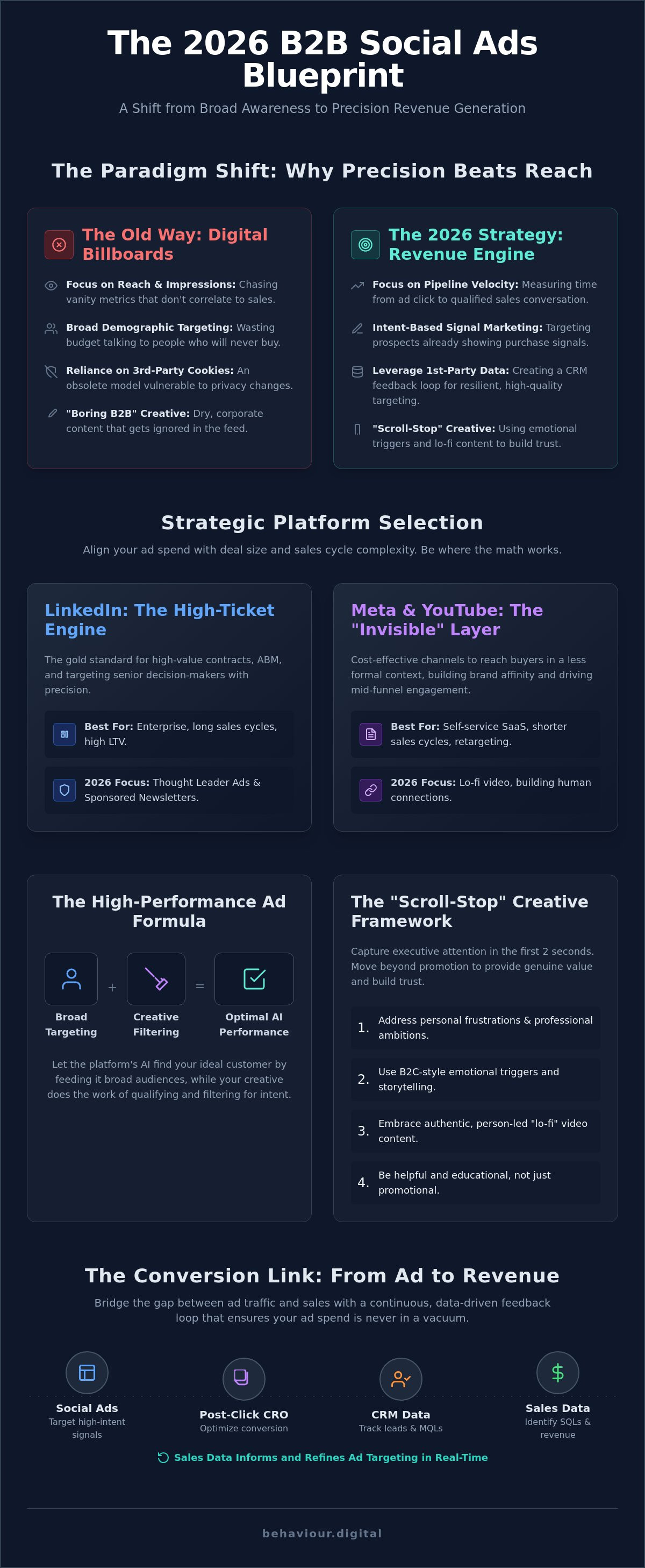
In 2026, hyper-targeting is often the quickest way to kill your campaign performance. While it seems logical to layer job titles, seniority, and industry filters, this approach often starves the ad platform's algorithm of the data it needs to optimise. A modern b2b social media advertising strategy relies on broad targeting combined with creative filtering. By providing the algorithm with more room to operate, you allow it to find prospects based on real-time behavioural signals rather than static profile data. Your creative content acts as the primary filter; those who engage are the qualified audience, and the AI learns from their specific interactions.
Integrating CRM data is non-negotiable for high-growth firms. By uploading your existing customer and lead lists, you can create high-value Lookalike Audiences based on actual revenue data rather than just job titles. You must also implement offline conversion tracking. This tells the platform what a "good" lead looks like by feeding back data on which ad clicks actually turned into qualified pipeline. This closed-loop system ensures your budget is automatically reallocated toward the signals that drive business growth, not just digital engagement.
Modern social platforms allow you to upload Target Account Lists (TALs) and match them directly to professional profiles. This allows for surgical precision at scale. You can personalise ad copy for specific industries or even individual high-value companies, making your message feel bespoke. Success here is measured by Account Engagement. Instead of tracking individual clicks, we look at whether multiple decision-makers within the same target account are interacting with your brand. This holistic view provides a much more accurate picture of how your b2b social media advertising strategy is influencing the complex buying committee.
Generic retargeting based on simple website visits is no longer sufficient. You must move toward signal-based sequences that react to specific high-intent actions. For example, a prospect who watches 75% of a technical demonstration video is far more qualified than someone who merely landed on your homepage. These signals should trigger specific follow-up content that addresses the next logical question in the buyer's journey. At Behaviour Digital, we manage these complex retargeting sequences to ensure no intent signal is wasted. If you are ready to stop guessing and start scaling with a data-driven partner, explore our Social Media Marketing services to build a predictable revenue engine.
The most sophisticated b2b social media advertising strategy will collapse if the post-click experience is neglected. Many agencies focus exclusively on the "front end" of the funnel, yet the actual value creation happens after the user leaves the social platform. If your landing page doesn't immediately validate the promise made in your ad, you're paying for bounces, not buyers. This is where Conversion Rate Optimisation (CRO) becomes the critical link. It ensures that every pound spent on traffic has the highest possible probability of turning into a sales-qualified lead. We don't just want traffic; we want a measurable impact on your pipeline.
Choosing the right lead capture method is a strategic decision based on friction. Native Lead Gen forms on platforms like LinkedIn offer a frictionless experience, often resulting in a lower Cost-Per-Lead because the user never leaves the app. However, website landing pages allow for deeper storytelling and more robust data integration. In 2026, we often recommend a hybrid approach. Use native forms for top-of-funnel assets like whitepapers and dedicated landing pages for high-intent demo requests. Don't waste the "Thank You" page either. This is the moment of highest intent. Use it to offer a direct calendar booking or a secondary, high-value asset to keep the momentum alive while your brand is top-of-mind.
Success on the landing page depends on absolute "Message Match." The headline must mirror the ad copy exactly to reduce cognitive friction. If your ad promised a specific industry solution, that solution must be the first thing the user sees. We also prioritise social proof. Integrating client logos and specific testimonials directly into the conversion path reduces perceived risk for the buyer. Since many B2B decision-makers scroll during their commute, every page must be built with a mobile-first architecture. A slow or clunky mobile experience is an immediate disqualifier for a busy executive.
Proving the value of social spend is complicated by "Dark Social," which includes untrackable shares in Slack, email, and private messages. To combat this, we move beyond last-click attribution. Using Multi-Touch Attribution (MTA) models allows us to see how social advertising influenced the entire journey, even if it wasn't the final touchpoint before a sale. Our Digital Strategy prioritises these bottom-line outcomes over superficial metrics like CPCs. By bridging the gap between the ad and the final revenue, you transform your b2b social media advertising strategy from a cost centre into a scalable growth engine. Success isn't about the click; it's about the pipeline that follows.
Success in the coming year requires a fundamental shift from chasing vanity metrics to achieving algorithmic alignment. We've established that a high-performance b2b social media advertising strategy depends on the synergy between signal-based targeting and high-impact storytelling. By moving away from restrictive hyper-targeting in favour of creative filtering and deep CRM integration, you allow real-world data to dictate your growth rather than guesswork. The final, most critical step is ensuring your conversion infrastructure is as robust as your ad creative.
Bridging the gap between the initial click and measurable revenue is what separates market leaders from those struggling with high acquisition costs. As Glasgow-based experts with a global reach, Behaviour Digital specialises in data-driven PPC and social management designed for professional sectors. We focus on the technical nuances of tracking and optimisation to ensure every pound of your ad spend contributes directly to your bottom line. Ready to scale your B2B revenue? Book a strategy call with Behaviour Digital today.
The transition to a precision-tooled advertising framework is a significant undertaking, but the results in pipeline velocity and lead quality are undeniable. Start refining your signals today and build the predictable growth engine your business deserves.
Calculate your budget by reverse engineering your revenue goals from your historical Customer Acquisition Cost (CAC). If you know your lead-to-close conversion rate and your target for new contracts, you can determine the necessary lead volume. Multiply this volume by the average Cost-Per-Lead in your sector to establish a baseline monthly spend that ensures statistical significance for the algorithm.
LinkedIn is worth the investment if your Customer Lifetime Value (LTV) justifies the higher Cost-Per-Click. For UK businesses selling high-ticket services, the precision of professional targeting reduces budget waste on unqualified audiences. While CPCs are higher than on Meta, the lead quality often results in a lower overall CAC because your sales team spends less time filtering out irrelevant inquiries.
Initial data signals usually appear within the first 14 to 30 days, but a b2b social media advertising strategy requires at least three months for full methodological optimisation. The first month focuses on the "learning phase" where the algorithm identifies high-intent users. Subsequent months involve refining creative assets and targeting based on the quantitative feedback from your CRM data.
LinkedIn remains the primary platform for high-intent lead generation, but the "best" channel depends on your specific deal size. Meta platforms are increasingly effective for top-of-funnel awareness and low-cost retargeting. In 2026, many high-growth firms also use TikTok for person-led thought leadership to reach younger decision-makers who prefer vertical video content over traditional whitepapers.
Organic social media builds long-term brand authority and nurtures existing followers, whereas paid strategy drives immediate, scalable pipeline. Organic reach is restricted by platform algorithms that often limit business page visibility. Paid advertising allows you to bypass these restrictions and place your value proposition directly in front of specific job titles and companies that don't yet follow your brand.
Track long-cycle conversions by integrating your CRM with your ad platforms via Offline Conversion Tracking. This allows you to pass data back to the ad account when a lead moves from a "form fill" to a "qualified opportunity" or "closed deal." Using multi-touch attribution models ensures you see how your b2b social media advertising strategy influenced the buyer at multiple stages over several months.
Vertical video and Thought Leader Ads are currently the highest-performing formats for professional audiences. These formats break the "boring B2B" mould by delivering authentic, person-to-person communication. Short videos that lead with a specific solution or a provocative industry insight capture attention within the first two seconds, which is essential for stopping the scroll in a crowded professional feed.
Use native lead gen forms for top-of-funnel assets to reduce friction and lower your CPL. These forms pre-fill user data, making it easier for prospects to convert on mobile devices. For high-intent actions like demo requests, send traffic to a dedicated website landing page where you can provide deeper context and social proof to ensure the lead is fully qualified before they reach your sales team.
Luke leads strategy across every Behaviour Digital account — building data-driven advertising systems for ambitious brands. When he's not auditing ad accounts, he's writing about what he found in them.
Get a free, tailored growth plan — we'll run our framework on your accounts and show you exactly what we'd do.
Get your free growth plan →