.webp) Online
OnlineNot sure which channel fits your business?View all services →
Three inputs. Instant KPIs. No spreadsheets.Open a calculator →
OnlineIf content shared by your employees earns 561% more reach than your corporate brand page, why is your budget still locked into a distribution model that the algorithm is actively deprioritizing? In 2026, a high-performing b2b social media strategy has transitioned from a "follow graph" to an "intere...

If content shared by your employees earns 561% more reach than your corporate brand page, why is your budget still locked into a distribution model that the algorithm is actively deprioritizing? In 2026, a high-performing b2b social media strategy has transitioned from a "follow graph" to an "interest graph." This means your visibility is no longer a guaranteed reward for your follower count. Instead, it's a reflection of your content's immediate relevance and its ability to capture dwell time. We understand the frustration of rising lead acquisition costs and the difficulty of proving social ROI to stakeholders who only care about the bottom line.
You're right to feel that the traditional playbook is broken. Relying on vanity metrics won't move the needle in complex industries where trust is the primary currency. This article provides a repeatable, data-driven framework designed to build brand authority and deliver measurable lead generation. We'll explore how to navigate LinkedIn's average $5.39 cost per click, leverage employee advocacy as a core distribution channel, and integrate your social media marketing with conversion rate optimization to ensure every interaction has a clear path to revenue.
• Understand why the shift to a "paid-first" mindset is mandatory for maintaining visibility in the 2026 interest-based algorithm.
• Discover the 4-step framework for mapping decision-maker triggers to specific quantitative business KPIs.
• Learn why a modern b2b social media strategy must balance LinkedIn’s professional authority with Meta’s retargeting capabilities.
• Move beyond likes to implement a first-party data strategy that provides clear attribution from social touchpoints to sales.
• Explore how the "Behaviour" methodology aligns social performance with measurable business outcomes and scalable growth.
The era of treating social media as a digital billboard is over. A successful b2b social media strategy in 2026 operates as a sophisticated multi-touch attribution ecosystem. It's no longer about a single viral post. Instead, success is defined by the cumulative weight of strategic touchpoints across the entire buyer's journey. Organic reach for corporate brand pages has reached a functional floor. Relying on it is a tactical error that wastes internal resources. A "Paid-First" social mindset is now the baseline requirement for entering the feed and staying there.
Stakeholders in 2026 have no appetite for vague "brand awareness" metrics. They demand demand generation. This requires a shift in how we define performance. We're moving from measuring clicks to measuring pipeline impact. You must also account for "Dark Social." This includes the Slack groups, private DMs, and peer communities where the majority of B2B decision-making happens. While these interactions are difficult to track directly, a robust strategy influences these private conversations by providing the data and insights that professionals want to share.
Professional confidence doesn't require dry, academic language. The most successful B2B brands have abandoned the corporate monotone in favor of human-centric narratives. We're seeing a massive surge in founder-led social selling and the rise of internal B2B influencers. These individuals act as the human face of the brand, building trust in ways a corporate logo cannot. By applying social selling principles, your team can transform from a broadcasting unit into a community-led growth engine. It's about earning attention through expertise, not just buying it through repetition.
Algorithms have completed their transition from "follow graphs" to "interest graphs." Your follower count is now a secondary metric. AI-driven feeds prioritize engagement depth and dwell time over simple likes or shares. If a user pauses to watch a video or read a long-form post, the algorithm rewards that content with more reach. Short-form vertical video has become the foundational format for professional platforms, allowing experts to break down complex technical concepts into 60-second insights. With LinkedIn CPCs averaging around $5.39, every second of engagement must be optimized for conversion. The 2026 B2B social landscape is a credibility-first environment.
A successful b2b social media strategy requires a shift from creative guessing to behavioral science. We begin with Step 1: identifying quantitative goals. This involves aligning social metrics directly with business KPIs like Sales Qualified Leads (SQLs) and customer acquisition costs. If your social data doesn't talk to your CRM, you aren't running a strategy; you're running a hobby. Step 2 involves mapping the Decision-Making Unit (DMU). Unlike B2C, B2B decisions involve multiple stakeholders with conflicting priorities. You must identify the gatekeeper who filters information, the influencer who shapes the opinion, and the final decision-maker who signs the contract.
Step 3 is Content Architecture. This is the structural blueprint for what you publish, ensuring a balance between brand authority and demand generation. Finally, Step 4 is continuous methodological refinement. We use rigorous A/B testing to isolate variables in ad copy and creative. This ensures your framework evolves alongside platform changes and buyer expectations. Success is the result of this constant adjustment.
Platform personas must reflect professional behavior rather than just broad demographics. Use LinkedIn insights to validate specific audience pain points. For example, if your data shows a high concentration of operations directors engaging with efficiency content, your strategy should pivot to address that specific trigger. Choosing B2B social media platforms effectively depends on where these distinct DMU members spend their dwell time. Remember that 94% of B2B buyers now use Large Language Models during their research. Your content must be authoritative enough to be cited by these AI tools.
Your content should follow a strict ratio. 70% of your strategy must focus on education and solving problems. This builds the necessary trust for high-ticket transactions. Case studies shouldn't be aggressive sales pitches. Position them as authority signals that demonstrate your methodology in action. Use facts and quantitative results to prove your value. For the remaining 30%, integrate Conversion Rate Optimization principles into your social ad copy. This ensures that when a prospect is ready to move, the friction is minimal. Every post serves a specific purpose in the broader funnel. If you need a partner to help build this architecture, our team at Behaviour Digital can align your social presence with your revenue goals.
LinkedIn remains the undisputed heavyweight for professional authority, generating 80% of all B2B social leads. Despite this dominance, a modern b2b social media strategy cannot be monolithic. YouTube has secured its position as the second most-used platform, offering unique searchability and long-term SEO value. While LinkedIn posts have a short shelf life, YouTube videos continue to drive high-intent traffic months after publication. Success in 2026 requires understanding how these platforms work in tandem rather than in isolation. You must map your presence to where your audience actually spends their dwell time.
Meta platforms, including Facebook and Instagram, have transitioned into essential retargeting layers. They offer a way to humanize your brand while maintaining professional credibility. By diversifying your channel mix, you reduce the risk of platform-specific algorithm shifts. A diversified approach also allows you to capture different psychological states of the buyer, from high-intent research on YouTube to passive discovery on LinkedIn.
LinkedIn Newsletters have become a critical tool for building recurring brand touchpoints. They bypass the standard feed algorithm by landing directly in subscriber inboxes. For Scottish B2B firms, employee advocacy is the most efficient way to scale reach without inflating your ad spend. Content shared by individuals earns 8 times more engagement than brand pages. We also utilize LinkedIn Ads for high-precision account-based marketing (ABM). This allows you to target the specific job titles and companies that represent your highest-value opportunities. With average CPCs around $5.39, this precision is vital for maintaining a healthy ROI.
TikTok is no longer just for B2C. It's the new frontier for B2B "edu-tainment" and high-level recruitment. Decision-makers often engage with professional content in informal settings. Reaching a CEO during their evening scroll can be more effective than fighting for attention in a crowded morning inbox. Meta platforms provide a high-performance retargeting layer. When a prospect interacts with your LinkedIn content, you can use Meta to stay top-of-mind at a significantly lower cost. Average CPMs on LinkedIn range from $30 to $50, making Meta a cost-effective way to reinforce your message. Effective Social Media Marketing Management Scotland requires this nuanced channel mix. It ensures your brand is present throughout the entire behavioral cycle of your target audience.
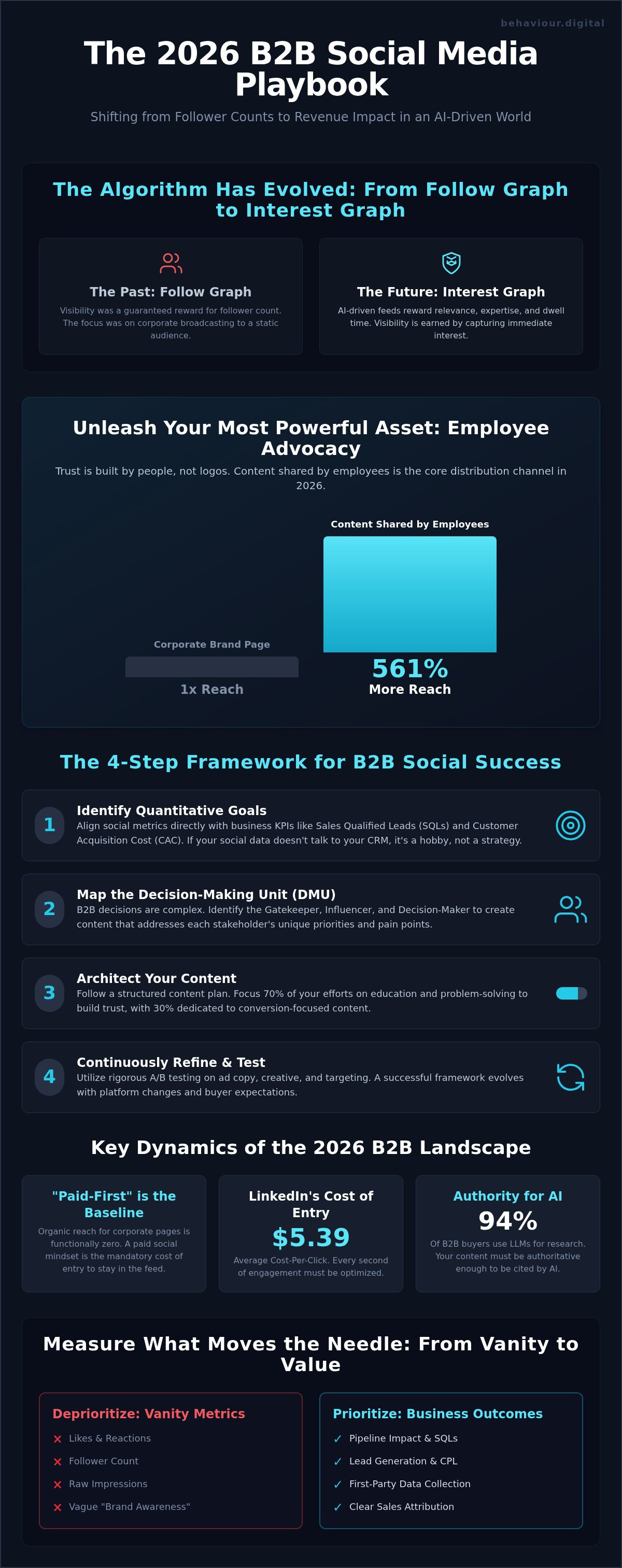
Measuring the success of a b2b social media strategy requires a total rejection of vanity metrics. Likes, shares, and follower counts are secondary indicators that rarely correlate with revenue. In 2026, we focus on tracking Marketing Qualified Leads (MQLs) and Sales Qualified Leads (SQLs) through every stage of the funnel. This transition is necessary because stakeholders demand quantitative proof of impact. You must implement a first-party data strategy to maintain visibility in a cookieless environment. This involves capturing user behavior on your owned assets and syncing that data directly with your CRM. By creating a closed-loop reporting system, you can see exactly which LinkedIn post or YouTube video initiated a high-value conversation. When you report social performance to the C-suite, speak the language of business value. Discuss pipeline velocity and customer acquisition costs rather than engagement rates. Executives care about how social media reduces the sales cycle, not how many people clicked a 'like' button.
Last-click attribution is a fundamental failure in B2B social media strategies. It ignores the reality that a decision-maker might engage with ten different touchpoints before converting. We advocate for multi-touch or linear attribution models that distribute credit across the entire journey. If a prospect first sees a video on TikTok, then reads a LinkedIn newsletter, and finally converts via a retargeting ad on Meta, every channel deserves credit. You should also incorporate self-reported attribution. Simply asking, 'How did you hear about us?' on your lead forms often reveals the hidden influence of dark social. This qualitative data bridges the gap that automated tracking tools can't reach. It provides the context behind the numbers, showing you where your brand is actually being discussed.
Shift your focus from Cost Per Acquisition (CPA) to Customer Lifetime Value (CLV). A high CPA is acceptable if the resulting client provides long-term recurring revenue and high profit margins. You should also measure your Share of Voice in niche B2B sectors. This helps you understand your brand's dominance relative to competitors within specific professional circles. Tracking this metric allows you to adjust your content volume and ad spend to maintain a competitive edge. Every social interaction must align with your broader Digital Strategy milestones. This ensures your social efforts contribute to scalable growth rather than operating in a vacuum. If you're struggling to connect your social data to your bottom line, partner with us to build a measurable attribution framework.
Executing a high-performance b2b social media strategy requires more than just scheduling posts. It demands a methodological approach that treats every impression as a data point for future optimization. At Behaviour Digital, our methodology is built on the intersection of user psychology and quantitative analysis. From our base in Glasgow's Red Tree Business Suites, we help brands navigate the complexity of international markets while maintaining a lean, results-focused operation. We don't believe in silos. There's a deep synergy between our PPC Management services and our social strategy. Paid search captures existing intent, while social media generates it. When these two forces work together, the result is a scalable growth engine that lowers your average cost per lead. We provide transparent reporting and recurring optimization as a standard part of our workflow.
Our approach is built on a strategic partnership model. We don't just provide a service; we integrate with your internal marketing team to align our efforts with your broader commercial goals. We focus on measurable business outcomes over creative fluff. Our work is grounded in behavioral advertising that targets the specific triggers of your decision-making unit. For example, by isolating high-intent behaviors on LinkedIn and retargeting those users on Meta, we've successfully driven B2B leads for clients in technically complex industries. This level of precision is what separates a professional strategy from a standard social media presence. We take responsibility for the results we deliver.
The first step toward scalable growth is a comprehensive professional audit. We examine your current data attribution, content performance, and channel mix to identify immediate opportunities for improvement. Following the audit, we establish a 90-day growth roadmap that provides a clear, actionable path to your KPIs. Success in 2026 isn't an accident. It's the result of conscious strategy and continuous methodological refinement. If you're ready to move beyond vanity metrics and build a predictable lead generation engine, book a strategic social media audit with our Glasgow team today. We'll help you turn your social presence into a measurable business asset.
Success in the 2026 landscape requires a total departure from traditional corporate broadcasting. A high-performance b2b social media strategy is no longer a secondary marketing task; it's a quantitative necessity for brands that want to maintain a competitive share of voice. By shifting your focus from vanity metrics to multi-touch attribution and prioritizing high-intent behavioral triggers, you transform your social presence into a predictable revenue driver. We've established that the decline of organic reach necessitates a paid-first mindset and that mapping content to the specific members of the Decision-Making Unit is the only way to capture dwell time in an interest-based feed.
As Glasgow-based strategic experts, we specialize in high-intent B2B lead generation through our data-driven behavioral methodology. We don't just manage platforms; we build scalable frameworks that align with your broader digital objectives. The complexity of the modern buyer journey demands a partner who understands the deep synergy between social touchpoints and final sales outcomes. It's time to stop guessing and start measuring. Drive your B2B growth with a data-driven social strategy and secure your position as a niche authority. Your roadmap to scalable growth starts with a single, data-backed decision.
LinkedIn remains the primary engine for lead generation because it captures professional intent more effectively than any other network. However, YouTube has become essential for building long-term SEO value and deep-funnel education. A modern b2b social media strategy uses LinkedIn for immediate precision and YouTube for searchability. Success depends on mapping content to the interest graph rather than just chasing followers.
Industry benchmarks suggest a minimum monthly budget of $2,000 to $5,000 for focused B2B campaigns to see measurable results. Enterprise programs often spend $15,000 or more to maintain dominance in competitive sectors. Your spend should be dictated by your customer acquisition cost targets and the lead volume required to hit your revenue goals. We focus on recurring optimization to ensure every pound spent contributes to pipeline growth.
ROI is measured by tracking the journey from the initial social touchpoint to a closed deal in your CRM. You must move beyond vanity metrics to monitor Sales Qualified Leads (SQLs) and pipeline velocity. By implementing multi-touch attribution, you can see how social interactions influence the final purchase decision. This data-driven approach allows you to justify your b2b social media strategy to the C-suite using revenue language.
Organic reach for company pages has reached a functional floor, but it's still effective when driven by employee advocacy. Content shared by team members earns significantly higher engagement than corporate accounts. Success requires shifting from brand broadcasting to individual thought leadership. High-quality, original content that solves specific technical problems can still gain traction through the interest-based algorithm.
Posting frequency should be dictated by your ability to provide genuine value. Two to three high-impact posts per week are more effective than a daily schedule of low-effort content. Algorithms prioritize engagement depth and dwell time. If your audience doesn't pause to read or watch, the frequency of your posts won't improve your visibility. Focus on content depth over post volume.
Multi-image carousels and native videos are currently the highest-performing formats for professional engagement. Data shows that native video earns significantly more engagement than text-only posts. B2B decision-makers respond best to content that breaks down complex industry problems or provides proprietary research. Using these formats allows you to capture attention quickly and keep users on the platform for longer periods.
TikTok is a viable B2B channel for recruitment and reaching decision-makers during their downtime. It's particularly effective for humanizing a brand and showcasing company culture. While it shouldn't replace LinkedIn, it serves as a powerful discovery tool for the top of the funnel. Short-form vertical video is now a foundational requirement across all platforms, and TikTok is where this format is most refined.
Alignment requires shared KPIs and a unified approach to social selling. Your social team should provide the insights and content that sales representatives need to build relationships. By integrating social data with your CRM, both teams can see which high-value accounts are engaging with your brand. This shared visibility ensures that social efforts directly support the sales pipeline rather than operating in a silo.

Luke leads strategy across every Behaviour Digital account — building data-driven advertising systems for ambitious brands. When he's not auditing ad accounts, he's writing about what he found in them.
Get a free, tailored growth plan — we'll run our framework on your accounts and show you exactly what we'd do.
Get your free growth plan →