.webp) Online
OnlineNot sure which channel fits your business?View all services →
Three inputs. Instant KPIs. No spreadsheets.Open a calculator →
OnlineWith specialist healthcare keywords in the UK reaching costs of £15.00 per click and digital video investment surging by 70% in early 2026, the margin for error in patient acquisition has vanished. You've likely experienced the frustration of soaring CPAs or ads being flagged under the updated April...

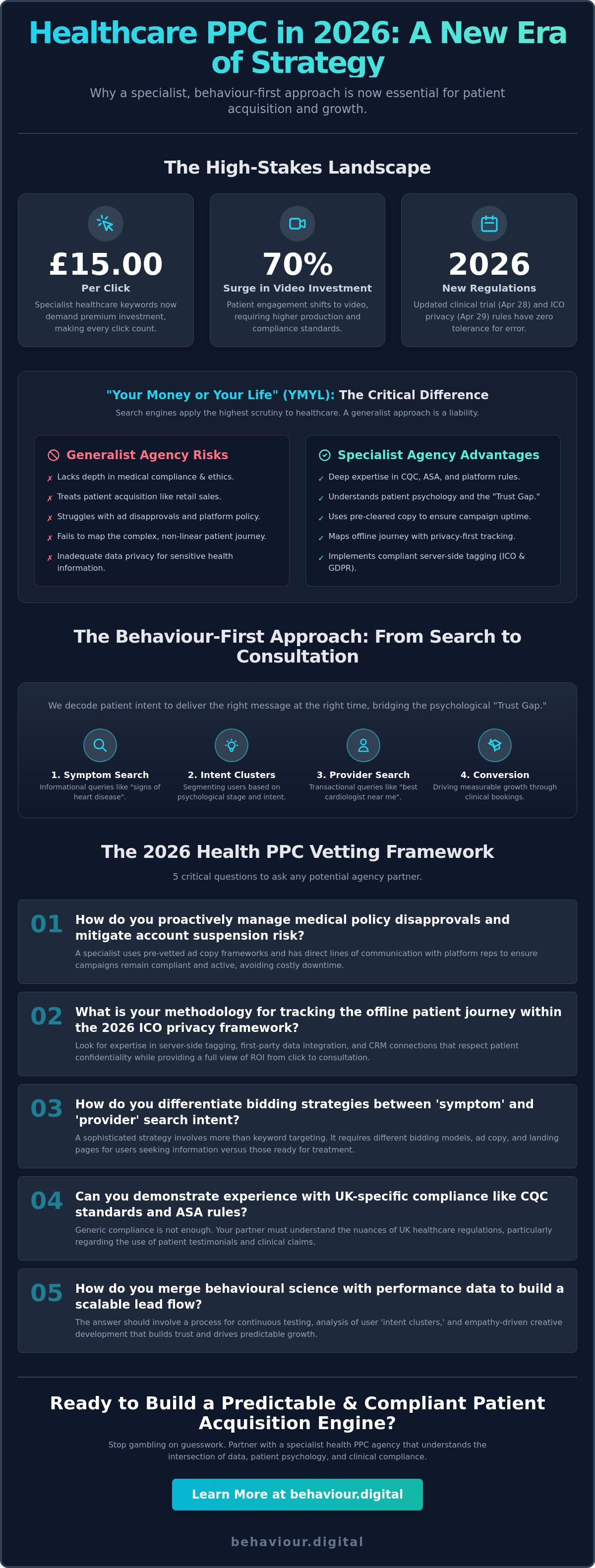
With specialist healthcare keywords in the UK reaching costs of £15.00 per click and digital video investment surging by 70% in early 2026, the margin for error in patient acquisition has vanished. You've likely experienced the frustration of soaring CPAs or ads being flagged under the updated April 28, 2026, clinical trial regulations. It's difficult to scale when you're constantly fighting medical policy disapprovals and trying to map an offline patient journey within the ICO’s April 29, 2026, privacy-first tracking framework.
Finding a specialist health ppc agency shouldn't feel like a gamble on your clinic's reputation. This guide provides the framework to identify a strategic partner that uses a behaviour-first approach to bridge the gap between strict clinical compliance and patient psychology. You'll learn how to lower your acquisition costs and build a scalable lead flow that respects CQC standards and the latest platform shifts. We'll examine the exact data points you need to demand from a partner to ensure your growth is driven by strategy. Sustainable success in 2026 requires data, not guesswork.
• Learn why the 'Your Money or Your Life' (YMYL) classification requires a specialist health ppc agency to navigate increased regulatory scrutiny and bridge the patient trust gap.
• Master the complexities of UK-specific compliance, including CQC standards and ASA rules on medical testimonials, to protect your brand and prevent account suspensions.
• Identify how to implement privacy-first tracking that aligns with 2026 ICO guidance without losing visibility on the offline patient journey.
• Utilize a strategic 5-question framework to vet a partner’s ability to handle medical policy disapprovals and demonstrate a deep understanding of patient intent.
• Understand the methodology of merging behavioural science with performance data to build a lead flow that scales predictably.
Healthcare marketing isn't just another vertical; it's a high-stakes 'Your Money or Your Life' (YMYL) category. Search engines and social platforms apply their most rigorous quality standards to medical content because the information directly impacts user well-being. A generalist agency might master retail or SaaS, but they often lack the technical depth to manage the 2026 regulatory environment. Success now requires a health ppc agency that understands the intersection of clinical accuracy and performance marketing.
The 2026 landscape has shifted decisively toward outcome-based marketing. Patients no longer respond to vague promises. They demand transparency and data-backed authority. Generalist agencies often fail because they treat medical ads like consumer goods, ignoring the complex ethical and legal layers that govern patient acquisition. We focus on measurable business growth by aligning your digital strategy with these heightened expectations. This ensures your budget isn't wasted on high-volume, low-intent traffic that never converts into a clinical booking.
Search intent in healthcare is rarely linear. We distinguish between 'symptom' searches, where users seek information, and 'provider' searches, where they seek treatment. Bidding strategies must pivot based on these intent signals. For example, emergency care keywords require aggressive, top-of-page positioning to capture immediate needs. Conversely, elective procedures like orthopaedic surgery require a nurture-heavy approach that prioritises long-term conversion rate optimisation. The Trust Gap represents the psychological distance between a patient's vulnerability and their confidence in a provider's clinical competence.
Google and Meta’s 2026 policies have become increasingly granular, particularly regarding Direct-to-consumer advertising (DTCA) for medicinal products and specialist services. Using non-compliant 'miracle cure' language or making unsubstantiated guarantees doesn't just lead to ad rejections; it risks permanent account suspension. We mitigate this risk by using 'pre-cleared' ad copy frameworks that have been vetted against the latest platform updates. This proactive approach ensures your campaigns remain active and compliant, avoiding the costly downtime that plagues less specialised agencies. In 2026, compliance is not a hurdle; it’s a competitive advantage that protects your brand’s digital equity.
Identifying a strategic partner goes beyond reviewing case studies with high return on ad spend. In the high-stakes medical sector, a successful health ppc agency must demonstrate a granular understanding of the path from initial symptom search to the final surgical consultation. This journey is rarely linear. It's often punctuated by periods of deep research, anxiety, and high friction. Your partner needs the technical infrastructure to manage multi-location 'near me' campaigns while maintaining strict adherence to the FTC's Health Products Compliance Guidance.
Managing data in 2026 requires more than a basic privacy policy. It demands expertise in HIPAA for US-facing campaigns and UK-GDPR for local operations. We ensure every tracking pixel and server-side event is configured to protect patient confidentiality. If an agency cannot explain their server-side tagging methodology, they aren't equipped to handle your patient data. For multi-site clinics, managing local search intent is critical. We deploy hyper-local bidding strategies that account for travel times and local competitor density. This ensures your budget is allocated where the probability of a physical visit is highest.
Behaviour Digital leverages specific user intent signals to categorize traffic into 'intent clusters.' We don't just target keywords like "knee pain." We identify clusters that distinguish between a patient seeking a quick fix and one ready for a total joint replacement. A patient searching for 'best cardiologist' is at a different psychological stage than one searching for 'signs of heart disease.' Our methodology treats these as distinct behavioral profiles with unique creative requirements. Empathy-driven creative then addresses the patient's specific stage of readiness, reducing the friction typically found in medical advertising.
Effective measurement in healthcare must bridge the gap between a digital click and an offline appointment. We integrate call-tracking and booking systems that sync with your CRM without exposing protected health information. This level of conversion rate optimization ensures that every landing page element is tailored to drive action. By attributing patient lifetime value (LTV) to specific campaigns, we move beyond vanity metrics to focus on real business growth. If you want to see how your campaigns could perform with better data, consider a performance-led strategy review to audit your current tracking setup.
Navigating the UK's regulatory landscape requires more than just a passing knowledge of Google Ads. For a health ppc agency, the challenge lies in balancing aggressive growth with the rigid standards set by the Care Quality Commission (CQC) and the Advertising Standards Authority (ASA). While the CQC focuses on clinical safety, their 'Well-Led' framework expects marketing to be transparent and non-misleading. The ASA is even more direct. They frequently ban ads that promise 'guaranteed' results or use testimonials that haven't been rigorously substantiated. In 2026, these bodies are more active than ever, scrutinising digital claims with the same intensity as traditional media.
Compliance starts with the UK guidance on advertising medicines. This MHRA resource is the foundation for any campaign involving medicinal products. It ensures that ad copy doesn't overstep legal boundaries or promote prescription-only medications (POMs) to the public, which is a common pitfall for generalist agencies. We don't just write copy; we engineer it to meet these specific legal requirements while maintaining high click-through rates. This dual focus protects your brand's reputation and ensures your ad account remains in good standing with platform moderators.
Clinical reality must lead your creative strategy. The ASA's CAP Code is particularly strict regarding 'before and after' imagery. You can't simply post a transformation photo without clear disclaimers about individual results and clinical context. As a PPC agency in Glasgow, we ensure local compliance is baked into every campaign. This includes adhering to specific Scottish health board nuances where they differ from national standards. We audit every headline against current MHRA and ASA rulings to prevent account flags before they happen. Performance shouldn't come at the cost of regulatory risk.
The April 29, 2026, ICO guidance on tracking technologies has fundamentally changed how we target patients. Traditional remarketing, which relied heavily on third-party cookies, is no longer viable for sensitive medical niches. We've shifted our focus to 'Contextual Targeting' and the secure use of first-party data. By implementing Server-Side tracking, we protect patient data by processing it on a private server before it ever reaches the ad platform. This isn't just about compliance; it's about building trust. Patients in 2026 are hyper-aware of their digital footprint. Using lookalike modeling based on anonymised, encrypted patient lists allows for scalable growth without compromising individual privacy. This ensures your health ppc agency partner is building a future-proof acquisition engine.
Selecting a health ppc agency is no longer a simple procurement task; it's a strategic decision that affects your clinical reputation and your bottom line. In 2026, the gap between a generalist and a specialist is measured in wasted ad spend and account suspensions. You need a partner that understands the technical nuances of the Medicines for Human Use Regulations 2004, which were further amended on April 28, 2026. Use this framework to vet potential partners during your discovery phase.
In early 2026, Google updated its healthcare policies to reintroduce limited HCP targeting. Your agency must have a documented process for manual appeals and policy exemptions.
Ask them to show how they distinguish between someone researching symptoms and someone ready to book a consultation. Intent mapping is the only way to lower CPA in a high-competition environment.
Data silos lead to inaccurate ROI. A competent partner must be able to sync offline patient arrivals with digital click data.
They should explain their server-side tracking methodology and how they audit ad copy against the latest CAP Code rulings.
• What is your methodology for digital strategy beyond just Google Ads? A siloed approach fails in 2026. Your PPC should work in tandem with social media and CRO to create a unified patient journey.
Demand a 'Compliance Audit' of your current account before signing a contract. A specialist agency will identify historical policy risks and tracking gaps that a generalist will likely miss. Ensure they've experience in your specific sub-vertical, whether it's dental, mental health, or med-tech. Their reporting should focus on patient arrivals and lifetime value, not just clicks or impressions. If they can't bridge the gap between a lead and a booking, they aren't a performance partner.
Be wary of any agency promising 'instant #1 rankings' for broad medical terms. In the YMYL category, authority is earned through consistent compliance and high quality scores. Lack of transparency regarding ad spend versus management fees is another critical warning sign. Finally, if an agency doesn't ask about your clinical credentials or CQC status, they don't understand the regulatory risks of your industry. If you're ready for a partner that prioritises data over promises, you can book a performance audit to see where your current strategy is leaking budget.
Behaviour Digital operates as a strategic partner for high-growth healthcare brands that require more than just technical execution. We recognise that a successful health ppc agency must bridge the gap between complex medical regulations and the psychological drivers of patient decision-making. Our 2026 methodology is built on this intersection, merging behavioural science with rigorous medical compliance. We don't settle for vanity metrics like impressions or clicks. Instead, our transparent reporting connects every pound of ad spend directly to patient volume and clinical arrivals. Success in this sector isn't the result of luck; it's the outcome of a conscious, data-driven strategy.
Our Glasgow-based team understands the UK healthcare market's unique pressures, from CQC audits to the specific nuances of the April 29, 2026, ICO tracking updates. This local expertise allows us to act as an extension of your team rather than a distant vendor. We take full responsibility for your business goals, ensuring your digital presence reflects your clinical excellence. By focusing on measurable business growth, we ensure your clinic remains competitive as digital video and CTV ad spend continue to rise across the industry.
Our process begins with a comprehensive Audit and Compliance Check. We identify the specific leaks in your current strategy, such as ads being flagged under the April 28, 2026, clinical trial regulations or tracking gaps that violate privacy standards. Once the foundation is secure, we implement Intelligent Intent Mapping. This allows us to reach patients at the exact moment they're ready to book, rather than wasting budget on top-of-funnel symptom research. To ensure long-term scalability, we apply continuous conversion optimisation. This data-driven approach systematically lowers your CPA by refining the user journey from the first click to the final booking confirmation.
Transitioning from a generalist provider to a specialist health ppc agency requires a structured approach. We handle the migration of your accounts with zero downtime, ensuring that historical data is preserved while new, compliant frameworks are implemented. We begin by conducting a tailored health PPC audit for your clinic. This audit provides a clear roadmap for growth, highlighting immediate opportunities for cost reduction and lead scaling. If you're tired of high CPAs and frequent ad disapprovals, it's time to move toward a performance-based partnership. Contact Behaviour Digital for a Data-Driven Health PPC Strategy and secure your clinic's growth for the remainder of 2026 and beyond.
Patient acquisition in 2026 is no longer about simple keyword bidding. It requires navigating the April 29, 2026, ICO tracking updates and the strict ASA standards for medical claims. You now understand that success requires a deep understanding of patient psychology and a server-side tracking infrastructure that protects sensitive data. Choosing the right health ppc agency means finding a partner that treats compliance as a competitive advantage rather than a hurdle.
Our Glasgow-based team combines global healthcare experience with a behaviour-first methodology to capture high-intent leads. We ensure your campaigns remain fully aligned with UK-GDPR and ASA regulations, protecting your clinical reputation while driving measurable growth. You can move beyond vanity metrics and start focusing on actual patient arrivals. It's time to transform your digital strategy into a predictable engine for expansion. Success is the result of a conscious strategy and continuous optimization.
Scale your patient acquisition with a specialist Health PPC Agency
A specialist agency navigates specific regulatory frameworks like the MHRA Blue Guide and Google’s stringent healthcare policies. Unlike generalist firms, a health ppc agency implements server-side tracking to handle sensitive patient data while maintaining strict clinical compliance. This expertise ensures your ads remain active without the constant risk of policy flags or account suspensions that plague unspecialised campaigns.
Budgets depend on your specific sub-vertical and local competitor density. Industry data from January 2026 shows the average monthly spend on PPC agency services is approximately $5,800. We recommend a budget that secures at least 100 high-intent clicks per month. This volume provides the statistically significant data needed to refine your strategy and lower your cost-per-acquisition over time.
Directly advertising POMs to the public is prohibited in the UK under MHRA regulations. However, you can legally promote the clinical service or the consultation for a specific condition. We ensure your ad copy focuses on the expertise of the clinician and the consultation process rather than the medication itself. This approach maintains compliance while still capturing patients searching for relevant treatment solutions.
Most disapprovals in 2026 stem from "Healthcare and medicines" policy violations or the reintroduction of limited HCP targeting rules. Google’s automated systems flag ads that make unsubstantiated clinical promises or mention restricted substances. If your landing pages don't meet the YMYL quality standards, your ads will be suppressed. We use pre-cleared frameworks to avoid these automated triggers and maintain consistent up-time.
Initial lead data usually appears within the first 48 hours, but meaningful scaling requires a 90-day optimization window. This period allows the platform's machine learning to process intent signals and for our team to refine your conversion rate optimization. By the end of the third month, you'll typically see a stabilized cost-per-acquisition and a predictable flow of patient bookings based on historical data.
UK private healthcare CPCs currently range from £1.20 to £15.00 as of March 2025. A "Private GP" search averages around £3.00, while highly competitive terms like "Harley Street Specialist" can reach the £15.00 mark. These high costs make it essential to partner with a health ppc agency that prioritises high-intent traffic over broad, expensive keywords that don't convert into clinical appointments.
Yes, we use server-side tracking and CRM integrations to attribute offline patient arrivals to specific digital touchpoints. This process allows us to see which ad groups are driving actual revenue rather than just phone enquiries. By mapping the full patient journey, we can allocate your budget toward the specific campaigns that deliver the highest clinical lifetime value without compromising patient privacy.
UK-GDPR treats health data as a "special category," requiring the highest level of encryption and consent. Following the ICO’s updated guidance on April 29, 2026, traditional third-party cookie tracking is no longer sufficient for medical niches. We implement privacy-first solutions that process data on secure servers. This ensures your patient acquisition remains fully compliant with the latest Data (Use and Access) Act 2025 requirements.

Luke leads strategy across every Behaviour Digital account — building data-driven advertising systems for ambitious brands. When he's not auditing ad accounts, he's writing about what he found in them.
Get a free, tailored growth plan — we'll run our framework on your accounts and show you exactly what we'd do.
Get your free growth plan →