.webp) Online
OnlineNot sure which channel fits your business?View all services →
Three inputs. Instant KPIs. No spreadsheets.Open a calculator →
OnlineWith the average UK e-commerce conversion rate sitting at just 2.6% in 2026, most businesses are essentially watching 97% of their paid traffic walk out the door. You've likely felt the pressure of rising Customer Acquisition Costs (CAC) and the increasing difficulty of justifying every pound spent...

With the average UK e-commerce conversion rate sitting at just 2.6% in 2026, most businesses are essentially watching 97% of their paid traffic walk out the door. You've likely felt the pressure of rising Customer Acquisition Costs (CAC) and the increasing difficulty of justifying every pound spent on PPC or social media. It's a common struggle in the current market, where simply driving traffic isn't enough to guarantee a sustainable bottom line. This article examines definitive cro case studies uk to show you how top-tier brands are moving beyond guesswork to secure measurable growth through precision testing.
We agree that stagnant conversion rates shouldn't be the ceiling for your digital strategy. You'll discover how to leverage behavioural data and the latest 2026 regulatory frameworks, such as the Data (Use and Access) Act, to build trust and increase revenue. We're going to provide a clear breakdown of CRO methodology, actionable testing ideas for your own site, and proof that conversion optimisation is the missing link that makes your entire marketing ecosystem more profitable. Success in this landscape isn't about luck; it's the result of a conscious, data-driven strategy.
• Understand why aligning user intent with business goals is essential for navigating the high-CAC environment of the 2026 UK market.
• Analyze real-world cro case studies uk to see how checkout simplification and form optimisation deliver double-digit growth.
• Shift your focus from vanity metrics to Revenue per Visitor (RPV) and Customer Lifetime Value to ensure sustainable ROI in a high-inflation economy.
• Implement a structured roadmap using the PIE framework to prioritise high-impact tests that integrate seamlessly with your existing PPC and social spend.
• Learn how a strategic partnership with a local expert bridges the gap between raw behavioural data and measurable business outcomes.
Conversion rate optimization (CRO) represents the strategic bridge between user intent and business objectives. In the 2026 UK digital landscape, this alignment is no longer optional. Rising Customer Acquisition Costs (CAC) and a projected e-commerce market size of up to £170 billion mean that every visitor carries a higher financial weight than ever before. Brands that fail to convert their existing traffic face a direct threat to their ROI as PPC and social spend become increasingly competitive. Success requires more than just traffic; it requires a systematic approach to turning that traffic into revenue.
Relying on US-centric benchmarks is a common mistake for British brands. The UK market possesses unique friction points, particularly regarding checkout flows and trust signals. By analysing cro case studies uk, we find that British consumers prioritise transparency and local relevance over aggressive sales tactics. Success in this region requires a deep understanding of local nuances, from the seamless integration of Apple Pay to compliance with the Digital Markets, Competition and Consumers Act (DMCCA). These factors are often overlooked in global strategies but are decisive for UK growth.
Mobile commerce now dominates the sector, with projections suggesting it will account for 62% of all retail sales by 2027. This shift has redefined conversion benchmarks; a site that isn't optimised for a mobile-first journey is effectively invisible to the majority of the market. Performance data indicates that for UK retailers, page load speed is a critical revenue driver, where even a 1-second improvement can trigger a 7% increase in total earnings. The "Skeptical British Shopper" is a persona characterised by a deep-seated caution toward digital claims, necessitating hyper-transparent trust signals and frictionless local payment options to prevent immediate site abandonment.
Generic best practices are often the enemy of genuine growth. They represent an average of what worked for someone else, not a tailored solution for your specific user base. To achieve superior ROI, businesses must move from tactical A/B testing to a comprehensive Behavioural Growth Framework. This methodology focuses on the psychological triggers that drive action rather than just changing button colours. Using cro case studies uk as a foundation provides the empirical evidence needed to secure stakeholder buy-in. It transforms CRO from a speculative expense into a documented driver of measurable business value, ensuring that your digital strategy remains resilient against shifting consumer trust.
Analyzing high-impact results requires looking past surface metrics. Real-world cro case studies uk reveal that significant growth often stems from removing invisible friction. In one instance, a UK retailer achieved a 15% reduction in cart abandonment by simplifying their checkout architecture. This wasn't a guess; it was a response to data showing that 60% of their users were browsing on mobile devices. According to UK e-commerce statistics for 2026, mobile-first strategies are no longer optional as the market approaches £170 billion in value. Every missed click on a mobile screen is a direct hit to the bottom line.
Integrating local payment providers like Apple Pay and Klarna directly into the product page has become a standard for high-performing UK sites. For many retailers, the gap between traffic and sales is bridged by providing the specific trust signals British consumers demand. You can explore more detailed breakdowns in our CRO Case Studies for UK E-commerce. These examples highlight how technical precision in the final stages of the funnel can rescue thousands of pounds in otherwise lost revenue. The focus remains on creating a frictionless path to purchase that respects the user's time and preferred payment habits.
In the B2B sector, the focus shifts from volume to value. A Scottish professional services provider recently increased form completions by 40% by introducing qualifying friction. Instead of a generic contact page, they used a multi-step form that segmented leads by budget and urgency. This approach ensured that the sales team only engaged with high-intent prospects. Social proof was also localized, replacing global logos with UK-based industry certifications and testimonials. This alignment with LinkedIn ad messaging ensured a consistent narrative from the first click to the final submission. High-quality leads are the result of a deliberate, data-backed qualification process.
Optimising the SaaS funnel involves a similar level of forensic analysis. By tracking micro-conversions like scroll depth, one platform identified that users weren't reaching their primary value proposition. Re-positioning the main CTA based on this data led to a 20% increase in engagement. For SaaS brands, the free-trial-to-paid conversion is the ultimate test of UX. If you're looking to refine your own funnel, a dedicated digital strategy can help identify these hidden bottlenecks. These cro case studies uk prove that small, data-backed adjustments frequently outperform radical, unproven redesigns.
Measuring success in 2026 requires a shift from binary "converted vs not converted" data to more nuanced financial indicators. Revenue per Visitor (RPV) has emerged as the definitive North Star metric for high-performing brands. It accounts for both conversion frequency and transactional value, providing a clearer picture of how effectively a site extracts value from its traffic. In a high-inflation market, focusing solely on the conversion rate can be misleading. A site might see a surge in low-value orders that actually erode profit margins due to shipping and acquisition costs. Successful cro case studies uk often highlight a deliberate trade-off where a slightly lower conversion rate leads to a significantly higher Average Order Value (AOV) and long-term Customer Lifetime Value (CLV).
Understanding the "why" behind these numbers involves tracking User Friction Scores. This metric quantifies the difficulty a shopper faces when trying to complete a task. Official UK consumer behaviour research indicates that British shoppers are particularly sensitive to unexpected costs and complex navigation. By identifying where these friction points occur, brands can make surgical adjustments that protect their bottom line. This level of forensic analysis is what separates market leaders from those just guessing at button colours.
Setting effective KPIs begins with a structured conversion rate optimization process that prioritises business impact over aesthetic changes. Many UK digital marketing reports still rely on vanity metrics like total page views or bounce rates, which rarely correlate with actual revenue growth. RPV is more valuable than standard conversion rate in 2026 because it provides a direct link between user behaviour and the financial health of the business. This focus ensures that every experiment is geared towards sustainable profitability rather than just inflating numbers for a monthly report.
Modern optimisation relies on a sophisticated stack of heatmaps, session recordings, and AI-driven eye-tracking to decode user intent. Integrating Google Analytics 4 (GA4) is now a standard requirement, but it must be configured to meet strict UK-specific privacy standards. These tools allow us to see exactly where a user hesitates or abandons a journey. Linking these behavioural insights directly to your PPC Management reports creates a feedback loop that informs better ad targeting. When you know which landing page elements cause friction, you can refine your paid campaigns to drive higher-quality traffic to more efficient funnels. This integrated approach is a recurring theme in the most successful cro case studies uk we've documented this year.
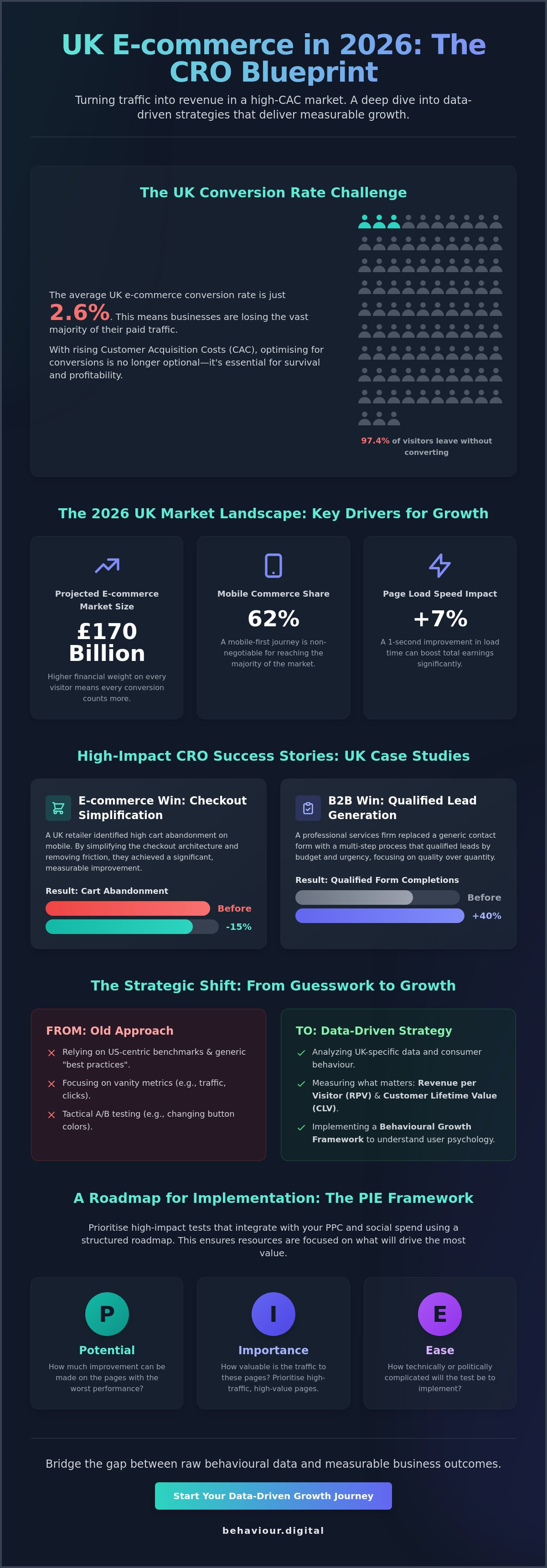
Turning raw data into a scalable growth engine requires a structured transition from analysis to execution. The most successful cro case studies uk demonstrate that results don't come from random tweaks but from a repeatable roadmap. This process begins with a Multi-Channel Audit, where you link PPC, social media, and on-page data to identify where the "message scent" breaks. If your LinkedIn ads promise a specific solution but your landing page remains generic, the user journey fails before it even begins. Once bottlenecks are identified, prioritise your testing backlog using the PIE (Potential, Importance, Ease) framework to ensure you focus on the highest-impact opportunities first.
Speed is a competitive advantage in the 2026 market. Instead of waiting months for a full site redesign, design a "Minimum Viable Test" to gather rapid behavioural data. This allows you to validate a hypothesis with minimal development resources. After the test concludes, analyse the results through the lens of behavioural science. Even a "failed" test provides critical evidence of what doesn't resonate with your audience, allowing you to iterate with higher precision in the next cycle. This systematic approach ensures that every change is a step toward measurable business improvement.
Conversion data should never exist in a silo. When you partner with a PPC agency Glasgow, your on-page wins must immediately inform your ad strategy. High-performing landing page copy often translates to more effective ad creative, which lowers your Cost Per Acquisition (CPA) on platforms like Meta and LinkedIn. This creates a powerful feedback loop; as your on-page conversion rate improves, your ad quality scores rise, effectively making your existing marketing spend more efficient. Precision on the page directly subsidises the cost of your traffic.
The Behavioural Growth Framework moves beyond surface changes by applying cognitive bias triggers like Scarcity, Social Proof, and Authority. In the UK market, where consumer skepticism is high, these triggers must be rooted in transparency. A successful Digital Strategy prioritises evidence over intuition. By documenting your findings through cro case studies uk, you build an internal knowledge base that protects your brand from making the same mistakes twice. Trust is the most effective conversion driver, and it is earned through consistent, data-backed optimisations.
If you're ready to stop guessing and start growing, partner with Behaviour Digital to implement a high-performance conversion roadmap tailored to your business goals.
Local expertise in the UK market provides a distinct advantage over generic global agencies. Consumers in Glasgow, London, or Manchester respond to different trust signals and cultural cues. Global agencies often apply a "one size fits all" template that fails to account for these nuances. Behaviour Digital bridges the gap between raw data and human behaviour. We don't just look at what happened; we investigate why it happened. By examining cro case studies uk, it's clear that results come from understanding the specific psychology of the British shopper. Our methodology ensures that our strategies reflect sustainable business growth rather than temporary spikes in engagement.
During the first 90 days of a partnership, we focus on forensic analysis and rapid validation. We begin with a deep-dive audit to identify technical friction and psychological barriers. By day 30, we've established a prioritised testing backlog. By day 60, the first round of "Minimum Viable Tests" is live. By day 90, we are iterating based on confirmed results. A Glasgow-based service provider recently used this exact framework to scale their operations. By focusing on mobile-first form optimisation and localized social proof, they achieved a documented increase in lead quality while reducing their cost per acquisition. This level of precision is a recurring theme in successful cro case studies uk.
Success requires a balance of quantitative data and qualitative user feedback. We use heatmaps and session recordings to see where users struggle, but we also look at the broader context of your digital presence. There is a critical synergy between Social Media Marketing and conversion. Traffic from social platforms has a specific intent; if your landing page doesn't honour that intent, your ROI will suffer. We take full responsibility for your business growth. We aren't interested in vanity metrics like clicks or impressions. Our focus remains on the measurable financial outcomes that drive your company forward.
Identifying the low-hanging fruit on your site is the first step toward a more profitable strategy. Often, significant gains are hidden in plain sight, such as a confusing checkout step or a slow-loading mobile menu. Requesting a comprehensive conversion audit allows you to see your site through the lens of behavioural science. We provide a clear roadmap of what to fix, what to test, and what to scale. This transparency ensures that every pound of your marketing budget is working toward a confirmed business goal. Don't leave your growth to chance. Book a discovery call with Behaviour Digital today to begin your transition to a data-driven strategy.
Success in the current landscape requires moving beyond surface-level changes to embrace a rigorous, behavioural growth framework. By shifting your focus from vanity metrics to Revenue per Visitor (RPV) and aligning your site triggers with British consumer psychology, you turn stagnant traffic into a scalable asset. The cro case studies uk we've analyzed demonstrate that measurable growth is the result of methodical testing rather than intuition. This alignment ensures that your existing PPC and social media spend delivers the highest possible ROI by creating a frictionless path to purchase.
As Glasgow-based strategic experts, we specialize in bridging the gap between quantitative data and human behaviour to deliver predictable business outcomes. Our proven track record in managing the synergy between PPC and conversion allows us to take full responsibility for your growth. It's time to stop guessing and start leveraging empirical evidence to outpace the competition. Drive measurable growth with a UK CRO strategy from Behaviour Digital. Your digital performance is a direct reflection of your strategy; let's make it your strongest asset.
Initial behavioural insights often emerge within the first 30 days of analysis. Measurable shifts in revenue or lead quality typically occur between 60 and 90 days as the first rounds of testing reach statistical significance. The exact timeline depends on your current traffic volume and the complexity of your conversion funnel. A structured roadmap ensures that quick wins are implemented while building toward long-term structural improvements.
Yes, conversion optimisation directly reduces your Cost Per Acquisition (CPA) by making your existing traffic more efficient. When a higher percentage of visitors complete a goal, your ad spend stretches further across your entire marketing ecosystem. Improved on-page engagement also signals higher relevance to ad platforms. This can lead to better quality scores and lower costs per click on Google and Meta over time.
High traffic allows for faster validation, but low-traffic sites can still achieve significant growth through qualitative research. Analysing cro case studies uk shows that brands with less traffic often focus on heuristic evaluations and session recordings instead of traditional A/B testing. This approach identifies critical friction points that don't require thousands of visitors to prove. We focus on high-impact changes that deliver clear results regardless of volume.
Specialist agencies provide immediate access to a cross-functional team of analysts, behavioural strategists, and designers. Hiring in-house often results in narrow "tunnel vision" and high overheads for a single specialist who may lack a broader perspective. An agency partnership offers objective, data-driven insights and a library of cross-industry benchmarks that internal teams rarely possess. This external expertise accelerates the testing cycle and ensures methodological precision.
Project costs vary based on the depth of the audit and the technical requirements of the testing phase. Most professional agencies offer tiered service levels or performance-based models tailored to specific business goals. It's essential to view these costs as a strategic investment in your site's efficiency rather than a standard overhead. You should request a custom audit to determine the specific resources required for your objectives.
The most frequent error is relying on generic "best practices" instead of primary behavioural data. Many UK brands copy competitor layouts without understanding the underlying user intent or local market nuances. This leads to aesthetic changes that fail to address the actual psychological barriers preventing a sale. Success requires a commitment to a rigorous testing process rather than relying on the personal intuition of stakeholders.
CRO is highly effective for B2B lead generation by streamlining complex qualification funnels and building brand authority. While e-commerce focuses on transactional friction, B2B optimisation centres on trust signals and form efficiency. Documented cro case studies uk demonstrate that B2B brands can achieve significant increases in lead quality by introducing strategic friction. This ensures your sales team only spends time on high-intent prospects.
Essential tools include Google Analytics 4 for quantitative tracking and session recording software for qualitative insights. In 2026, privacy-compliant first-party data collection is paramount for any UK brand. AI-driven eye-tracking and heatmaps are also critical for decoding visual hierarchy and user hesitation. These tools must integrate seamlessly to provide a holistic view of the user journey from the initial ad click to the final conversion.

Luke leads strategy across every Behaviour Digital account — building data-driven advertising systems for ambitious brands. When he's not auditing ad accounts, he's writing about what he found in them.
Get a free, tailored growth plan — we'll run our framework on your accounts and show you exactly what we'd do.
Get your free growth plan →