.webp) Online
OnlineNot sure which channel fits your business?View all services →
Three inputs. Instant KPIs. No spreadsheets.Open a calculator →
OnlineScaling is not a budget adjustment; it's a stress test of your entire conversion ecosystem. Many advertisers believe that doubling their daily spend will automatically double their revenue, but the reality is often a sharp spike in acquisition costs. Learning how to scale a successful ad campaign re...

Scaling is not a budget adjustment; it's a stress test of your entire conversion ecosystem. Many advertisers believe that doubling their daily spend will automatically double their revenue, but the reality is often a sharp spike in acquisition costs. Learning how to scale a successful ad campaign requires a methodology that respects platform algorithms rather than fighting them. You've likely felt the frustration of watching a high-performing set crumble into the learning phase or seeing audience fatigue drain your margins just as you're ready to grow.
We agree that unpredictable performance is the greatest barrier to business expansion. With Meta campaigns requiring 50 optimization events per week to stabilize and average Search CPCs reaching $5.26 in 2026, there's no room for unoptimized spend. This article provides a definitive strategic framework to master the transition from modest spending to high-volume dominance while keeping your CPA stable. You'll discover how to leverage AI-driven tools, protect your ROI during high-traffic periods, and build a repeatable system for predictable revenue growth.
• Understand why true scaling is a strategic expansion of a winning ecosystem, ensuring you don't just "scale your losses" with unoptimised campaigns.
• Master the mechanics of vertical scaling by applying the 20% Rule to protect your ROI and prevent resetting the platform's learning phase.
• Discover how to scale a successful ad campaign by shifting toward broad targeting and using creative signals to reach high-intent audiences.
• Implement the "Leakage Test" to identify conversion drop-offs, ensuring your infrastructure is ready to convert high-volume traffic efficiently.
• Move beyond passive management by adopting a data-first framework that treats scaling as a continuous, method-driven process for predictable growth.
Scaling is a performance multiplier. It's the transition from a proven pilot to a high-volume revenue engine. When you learn how to scale a successful ad campaign, you aren't just increasing a daily limit in a dashboard. You're expanding a profitable ecosystem. If the underlying campaign is flawed, spending more only accelerates your losses. True scaling requires finding the "Efficiency Frontier." This is the precise point where your ad spend and return on investment reach an optimal equilibrium. Beyond this point, diminishing returns usually take over.
We distinguish between scaling for volume and scaling for efficiency. Volume scaling focuses on capturing more market share and total sales. Efficiency scaling targets a lower CPA to maximize the profit of every individual conversion. A foundational Online advertising overview shows that these two goals often pull in opposite directions. Successful brands find a balance where they can grow spend without letting acquisition costs spiral out of control.
Scaling is a high-risk activity without a solid baseline. You need a statistically significant sample size. In 2026, most algorithms require at least 50 conversion events per week to exit the learning phase and provide predictable results. Without this data, the platform's AI cannot reliably find new buyers. Your CPA must also remain stable for at least 14 to 30 days. Significant fluctuations suggest the campaign isn't ready for more capital. Finally, audit your tracking. If your attribution models aren't 100% accurate, you'll be scaling based on ghost data.
Vertical scaling is the most direct method. You increase the budget of your existing high-performing ad sets. It's efficient but eventually limited by the size of the target audience. Horizontal scaling involves expanding into new territories. This might mean testing 5% Lookalike audiences, moving into new platforms, or introducing fresh creative formats. If your frequency is rising while your CTR drops, you've hit audience saturation. In this scenario, horizontal expansion is necessary. Understanding how to scale a successful ad campaign effectively means knowing when to switch between these two levers to keep your growth trajectory linear.
Vertical scaling is the process of injecting more capital into existing high-performing ad sets. It's the most direct path to growth, but it's also the most volatile. In 2026, platform algorithms are more sensitive than ever to sudden shifts in liquidity. If you increase a budget too aggressively, you risk triggering a "Significant Edit" status. This resets the learning phase, forcing the AI to restart its discovery process. When this happens, CPAs often spike by 20% to 50% as the system loses its previous optimization data.
The "20% Rule" remains the gold standard for budget management. By limiting budget increases to no more than 20% every 48 to 72 hours, you keep the campaign within its established parameters. This incremental approach allows the algorithm to find new pockets of the audience without losing its grip on current performance. When considering various Digital advertising factors, budget stability is often the difference between a profitable scale and a wasted investment.
Automated rules are essential for maintaining this discipline. Instead of manual adjustments, you should configure your dashboard to handle budget bumps based on real-time performance. For example, a rule could be set to increase spend by 15% only if the ROAS is 20% above your target over a trailing three-day window. If you're looking for a partner to build these precise execution frameworks, our digital strategy team specializes in high-growth campaign management. Eventually, every campaign hits a "Budget Ceiling." This is the point where the cost of the next conversion exceeds your allowable margin. Identifying this ceiling early prevents you from overspending into diminishing returns.
Modern bidding strategies like tCPA (Target Cost Per Acquisition) and tROAS (Target Return on Ad Spend) rely on historical data. Sudden budget injections disrupt the predictable flow of this data. You must allow at least 72 hours between adjustments for the platform to re-calibrate. For short-term traffic peaks, use "Seasonality Adjustments" in Google Ads. This tells the algorithm to expect a temporary surge in conversion rates without permanently altering its long-term bidding logic. This is a critical step in how to scale a successful ad campaign without breaking the underlying model.
Growth without guardrails is a liability. You must define "Upper Bound" CPA targets before you start scaling. If your acquisition cost hits this limit, the budget should freeze or retract immediately. A stop-loss rule is a pre-set threshold that automatically pauses or reduces spend when performance drops below a specific ROI. Implementing these safety nets ensures that how to scale a successful ad campaign remains a controlled, data-driven process rather than a gamble with your monthly advertising budget.
Horizontal scaling is the strategic move to reach new audiences once your primary segments hit saturation. While vertical scaling focuses on depth, horizontal scaling prioritizes breadth. You're no longer just asking the algorithm to find more of the same people; you're asking it to find different users who share the same intent. This often involves expanding Lookalike audiences from a restrictive 1% to broader 5% or 10% thresholds. In 2026, the most effective way to understand how to scale a successful ad campaign is through broad targeting. Here, you remove interest and demographic overlays; you let the creative itself act as the targeting signal.
The algorithm analyzes who interacts with your specific hooks and visuals, then finds similar users. This approach helps mitigate rising costs; Meta CPMs for e-commerce brands have increased by 20% since 2025. Cross-channel scaling is another pillar of this strategy. A winning video on Meta shouldn't stay there. Repurposing high-performing assets for TikTok or YouTube Shorts allows you to capture attention in different environments while maintaining a stable blended CPA. It's about maximizing the reach of every proven asset you own.
Creative fatigue is the silent killer of scaled campaigns. When your frequency climbs and your first-time impression ratio drops, it's a sign that your audience has seen your message too many times. To prevent performance dips, you need a robust creative pipeline. We recommend having 3 to 5 fresh variations ready for every winning ad at all times. Using dynamic creative optimization allows the platform to test these assets in real-time. It automatically finds the best match between specific visuals and individual users. This is essential for maintaining momentum during high-traffic periods.
Modern scaling relies heavily on automated campaign types like Google’s Performance Max and Meta’s Advantage+. These tools are powerful but require high-quality data signals to function. If you feed the AI poor conversion data, it will scale inefficiency. Success requires a cohesive Digital Strategy that ensures your brand voice remains consistent across platforms. When you understand how to scale a successful ad campaign using these AI tools, you shift your focus from manual adjustments to high-level asset management and signal optimization. This shift is what separates stagnant brands from those achieving predictable growth.
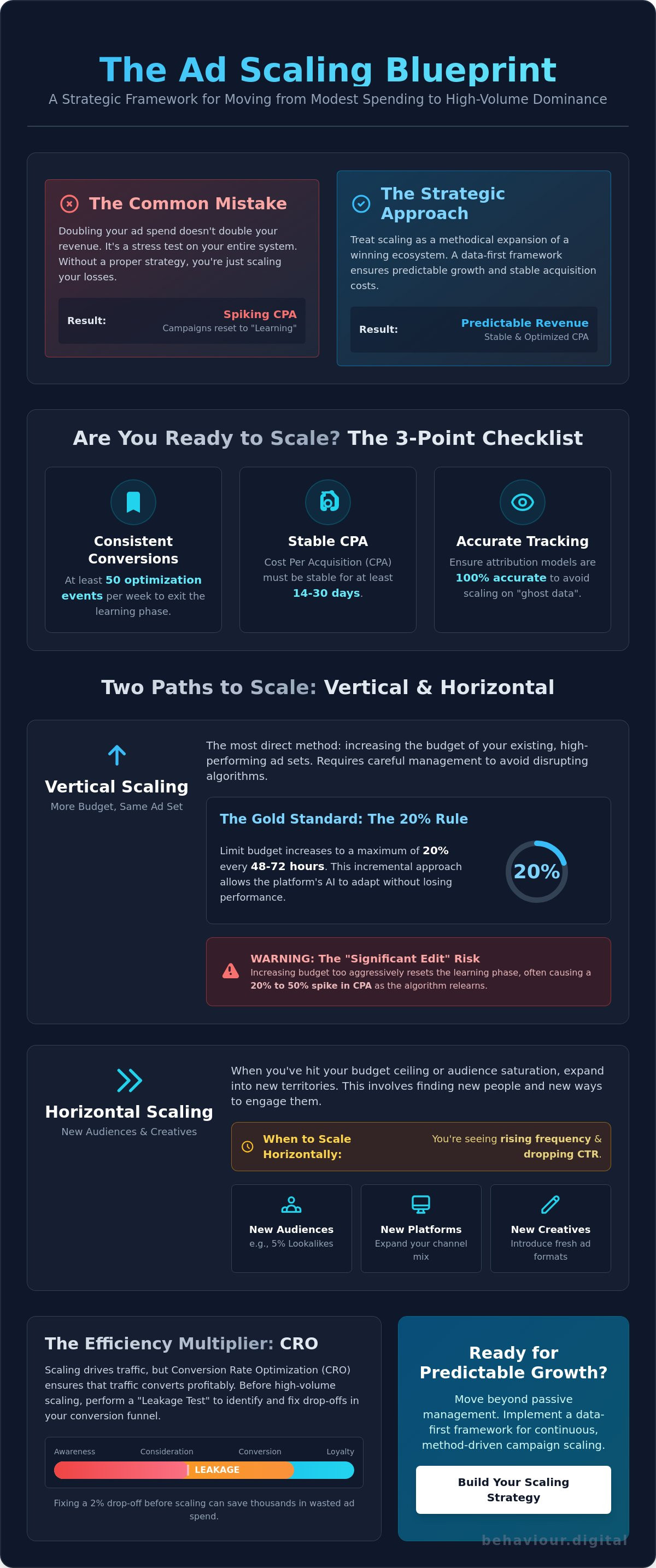
Scaling is often viewed through the lens of ad sets and bidding strategies, but the real growth engine is what happens after the click. Many advertisers treat the ad platform and the destination website as separate silos. This is a strategic error. If your conversion rate is 2% and you double your traffic, you simply double your existing inefficiencies. However, a 10% improvement in your conversion rate provides a compounding effect on ROI that a 10% budget increase cannot match. This is why conversion rate optimization is the most powerful lever in your scaling toolkit. It lowers your effective CPA by extracting more value from every dollar spent on traffic.
Before you commit to how to scale a successful ad campaign, you must perform a "Leakage Test." This diagnostic process identifies high-dropoff points in your conversion funnel. With cross-industry average Search CPCs reaching $5.26 in 2026, sending traffic to a leaky bucket is a recipe for financial exhaustion. You need to ensure that your post-click experience is frictionless. If your landing page doesn't convert at lower volumes, it will definitely fail under the pressure of aggressive scaling.
Surges in traffic reveal technical flaws that are often invisible at low spend. Site speed and mobile responsiveness are the first casualties of a scaled campaign. If your page takes longer than 2.5 seconds to load, your bounce rate will climb along with your budget. You also need a perfect "Message Match." The headline of your landing page must mirror the specific hook used in your scaled creative. Using heatmaps allows you to see how new, colder audiences interact with your offer. These users are less patient than your core fans, so your value proposition must be immediate and undeniable.
Scaling for revenue alone is a vanity play. You must calculate your "Break-even ROAS" to understand the exact point where growth becomes a loss. Unit economics must include the cost of the goods sold, shipping, and the ad spend to determine true scalability. As you push deeper into broader audiences, your CPA will naturally rise. Factoring in Lifetime Value (LTV) allows you to decide if a higher acquisition cost today is justified by the profit a customer generates over the next twelve months. If your site isn't ready for this volume, our team can help you build a high-performance Conversion Rate Optimization strategy to prepare your business for growth.
Scaling is a high-stakes operation that demands more than just technical proficiency. It requires a partner who treats your capital with the same rigour as their own. At Behaviour Digital, our Glasgow-based team utilizes proprietary data frameworks specifically designed to scale UK brands within the 2026 digital ecosystem. We don't rely on guesswork. We rely on quantitative analysis and the systematic stress-testing of every variable in your funnel. By the time we increase your spend, we've already validated the stability of your ROI and the resilience of your conversion path.
Many brands fall into the "set and forget" trap, assuming that platform AI will handle the heavy lifting. This is a costly misconception. While algorithms are powerful, they lack the strategic context required for long-term market dominance. Our approach to PPC Management involves active, daily oversight that balances algorithmic automation with human strategic intuition. This methodology is how we scaled a local Glasgow business by 300% in just 12 months. We identified the exact point where their unit economics allowed for aggressive expansion and executed a plan that protected their margins while capturing massive market share.
Mastering how to scale a successful ad campaign in the current climate means staying ahead of rapid regulatory shifts. In 2026, new laws in Oregon and Maryland have already banned GPS-based geotargeting within a 1,750-foot radius. Meanwhile, the New York AI in Advertising Law now requires conspicuous disclosure for synthetic performers. These complexities can derail a scaling campaign if not managed with precision. We ensure your growth remains compliant and uninterrupted, regardless of how the legal landscape shifts.
A strategic partner provides the infrastructure you need to grow without friction. We offer access to advanced attribution tools and first-party data strategies that standard business managers simply cannot provide. This level of insight is critical for reducing the risk of expensive mistakes during the scaling process. When you're spending thousands per day, a minor tracking error or an unoptimized landing page can result in significant wasted spend. We eliminate these vulnerabilities before they impact your bottom line.
Every industry has unique growth levers. Whether you're targeting a local audience or expanding globally, you need a PPC agency Glasgow brands can trust for transparent, results-driven execution. We don't hide behind vanity metrics; we focus on the numbers that drive your business forward. If you're ready to discover how to scale a successful ad campaign with a repeatable, data-backed framework, we're ready to lead the way. Contact Behaviour Digital for a Free Scaling Audit today and let's build your roadmap to predictable revenue growth.
Scaling is a systematic expansion, not a reckless budget increase. You've seen that success lies in the precise balance between vertical budget management and horizontal creative expansion. By prioritizing conversion rate optimization, you ensure that every new visitor has the highest probability of becoming a customer. This framework protects your margins while allowing you to push into broader, more lucrative market segments without the fear of a CPA collapse.
Mastering how to scale a successful ad campaign is the only way to achieve predictable, high-volume growth in the current digital landscape. Since 2022, our Glasgow-based team has helped UK brands navigate these complexities using a methodology focused strictly on ROI. We move beyond basic clicks to deliver measurable business results through precision PPC and Paid Social strategies. We understand the nuances of 2026 platform algorithms and the critical importance of maintaining a stable conversion ecosystem during periods of rapid growth.
Your business growth shouldn't be a gamble. Partner with Behaviour Digital to scale your growth and transform your advertising into a stable, high-performance revenue engine. We're ready to help you reach the next level of performance with clarity and confidence.
You should limit budget increases to no more than 20% at a time. This incremental approach keeps the campaign within its established parameters and prevents the algorithm from losing its previous optimization data. For instance, if your daily spend is $200, move to $240. This allows you to grow volume while protecting your ROI from sudden performance volatility and unpredictable cost spikes.
Aggressive scaling will trigger a "Significant Edit" status, which resets the learning phase and forces the AI to restart its discovery process. When this happens, your CPA can spike by up to 50% as the platform re-optimizes. Learning how to scale a successful ad campaign requires keeping budget changes small enough that the platform views them as minor adjustments rather than a total campaign overhaul.
Vertical scaling focuses on increasing the spend of your current high-performing ad sets to maximize their depth. Horizontal scaling involves expanding your reach by testing new audiences, platforms, or creative assets. You should typically exhaust your vertical scaling options before moving horizontally to capture new segments of the market. This dual approach ensures you don't hit an early growth ceiling during expansion.
Your campaign is ready when it reaches a statistically significant baseline of at least 50 conversions per week. You also need a stable CPA over a trailing 14 to 30 day window. If your tracking is accurate and your unit economics show a healthy margin above your break-even ROAS, you have the data-driven foundation necessary to begin increasing your investment with confidence.
Acquisition costs often rise during scaling because you're moving beyond your most intent-rich audience segments into broader, colder groups. These users often require more touchpoints before converting. Diminishing returns are a natural part of the process. To counter this, you must focus on conversion rate optimization to extract more value from every click as your traffic volume grows and your reach expands.
Creative fatigue accelerates as you scale because you reach your target audience more frequently. When users see the same ad too often, their engagement drops, which signals the algorithm to increase your costs. We recommend maintaining a pipeline of 3 to 5 fresh creative variations. This allows you to rotate assets proactively, maintaining high engagement levels even at significantly higher spend levels across multiple platforms.
Start with vertical budget scaling on your best-performing ad sets. This leverages the data the algorithm has already gathered about your winners. Once you notice your frequency rising or your ROI dropping, switch to horizontal scaling by expanding your audience targets. Knowing how to scale a successful ad campaign means recognizing the transition point where budget increases alone no longer drive profitable growth.
Maintain a window of 48 to 72 hours between every budget adjustment. Platforms like Meta and Google need this time to recalibrate their bidding logic based on the new liquidity. Making changes too frequently creates data instability. By waiting for the data to settle, you ensure that every subsequent increase is based on reliable performance trends rather than short-term noise or temporary fluctuations.

Luke leads strategy across every Behaviour Digital account — building data-driven advertising systems for ambitious brands. When he's not auditing ad accounts, he's writing about what he found in them.
Get a free, tailored growth plan — we'll run our framework on your accounts and show you exactly what we'd do.
Get your free growth plan →