.webp) Online
OnlineNot sure which channel fits your business?View all services →
Three inputs. Instant KPIs. No spreadsheets.Open a calculator →
OnlineIf your website is hovering around the 2026 global average lead generation conversion rate of 2.9%, you're leaving over 70% of your potential revenue on the table for competitors who have mastered behavioral science. High acquisition costs are draining your budget, yet the leads reaching your sales...

If your website is hovering around the 2026 global average lead generation conversion rate of 2.9%, you're leaving over 70% of your potential revenue on the table for competitors who have mastered behavioral science. High acquisition costs are draining your budget, yet the leads reaching your sales team often lack the intent required for a closed deal. Effective cro for lead generation websites isn't about guessing which headline looks better; it's about reducing the psychological friction of the "ask" through verifiable user data.
We understand the frustration of watching your PPC spend climb while your ROI remains stagnant. This article will teach you how to transform your site into a high-velocity lead engine by applying behavioral science and data-driven optimization. You'll learn to navigate the 2026 regulatory landscape, including the California DROP framework's one-to-one consent requirements, while building a system for predictable lead flow. We'll explore how hyper-segmentation and real-time visitor identification can lower your acquisition costs and finally align your marketing efforts with your sales team's bottom-line requirements.
• Understand the mathematical impact of a 1% conversion increase and how it scales annual revenue without increasing your current ad spend.
• Learn to identify and eliminate "Cognitive Load" on service pages to lower the psychological cost associated with high-friction lead forms.
• Implement a data-driven framework for cro for lead generation websites that combines quantitative GA4 metrics with qualitative behavioral insights.
• Discover how to use intentional friction points to filter out low-quality vanity leads, ensuring your sales team focuses only on high-intent SQLs.
• Move beyond generic best practices by adopting bespoke behavioral audits that align your optimization strategy with your broader digital strategy.
Lead generation in 2026 isn't a game of volume; it's a game of efficiency. While e-commerce optimization focuses on the immediate transaction, Conversion rate optimization (CRO) for service-based businesses centers on the psychological commitment required to start a relationship. You're not selling a commodity; you're selling a solution that requires long-term trust. This distinction is why cro for lead generation websites has evolved into a survival mechanism. Ad costs are no longer sustainable for brands that view their website as a passive brochure. You must shift your focus from simple traffic acquisition to aggressive revenue capture.
Consider the mathematical reality of your funnel. The global average lead generation conversion rate currently sits at 2.9%. If you drive 10,000 visitors to your site via paid channels, you're looking at 290 leads. By increasing that rate by just one percentage point through targeted behavioral shifts, you reach 390 leads. That 34% increase in lead volume happens without increasing your ad budget by a single dollar. In an era where customer acquisition costs are climbing across every channel, this efficiency is the difference between scaling and stagnating. Cro for lead generation websites ensures that every pound spent on traffic works twice as hard.
A robust Digital Strategy is built on data, not assumptions. CRO provides the quantitative evidence needed to stabilize your marketing efforts. Instead of relying on a "gut feeling" about which hero image works, we use a quantitative growth model to measure how specific changes impact brand authority. When your site performs predictably, you can forecast revenue with precision. This creates a feedback loop where every user interaction informs the next strategic pivot, moving your business away from reactive marketing toward a system of professional predictability.
The regulatory environment has shifted the focus toward first-party data and explicit consent. Frameworks like the California Digital Right of Privacy (DROP) and Colorado Senate Bill 26-174 have made deceptive lead practices a legal liability. Users now expect "instant value" before they'll even consider sharing their contact details. To meet this demand, top-performing websites are using AI to pre-qualify leads before they reach the form. This ensures that the leads you do capture aren't just numbers; they're high-intent prospects ready for a sales conversation. The role of the website has changed from a collection point to a qualification engine.
Successful lead generation in 2026 requires a shift from simple design changes to deep friction management. Every lead form carries a psychological cost. When a prospect encounters a request for their phone number or company revenue, they perform an internal cost-benefit analysis. If the cognitive load of the form outweighs the perceived value of the offer, they abandon the process. Professional cro for lead generation websites focuses on reducing this mental effort by streamlining service pages and clarifying the immediate reward of the interaction.
Social proof serves as the primary antidote to B2B buyer anxiety. In a landscape where buyers conduct extensive independent research before engaging sales, generic testimonials no longer suffice. You must utilize verified, data-backed case studies that mirror the prospect's specific challenges. We also leverage the Endowment Effect through interactive content. When a user spends three minutes using a custom calculator or assessment tool on your site, they develop a sense of ownership over the results. This psychological investment makes them significantly more likely to complete a high-friction conversion because they've already begun the problem-solving journey with your brand.
Not every visitor is ready for a discovery call on their first visit. We treat micro-conversions, such as scroll depth, whitepaper downloads, or video views, as critical intent signals. These interactions build a "Yes Ladder," a behavioral strategy where small, low-friction commitments prime the user for the eventual sales inquiry. By tracking these signals, you can identify high-intent segments that aren't yet visible in your CRM, allowing for more precise retargeting and nurturing.
User skepticism has reached a peak in 2026 due to increased awareness of data tracking and new regulations. Frameworks like the California Digital Right of Privacy (DROP) require one-to-one consent, meaning users are more selective about who they trust. You must offer a transparent value exchange. This means clearly stating how their data will be used and providing immediate utility in return. Trust signals, including ISO certifications and visible compliance with the Colorado Senate Bill 26-174, are no longer just legal boxes to check. They're essential components of a high-performing lead engine. If your current site isn't balancing these trust requirements with performance, a professional Conversion Rate Optimization audit can identify where your funnel is leaking qualified prospects.
Moving from behavioral theory to measurable growth requires a rigorous, repeatable methodology. Implementing a structured approach to cro for lead generation websites eliminates the guesswork that often plagues marketing budgets. We don't change button colors based on aesthetic preference; we execute changes based on a hierarchy of evidence. This framework blends quantitative data with qualitative insights to ensure every modification serves the bottom line.
Our process begins with the PIE framework to prioritize testing. We evaluate every potential change based on three metrics:
How much improvement can this page realistically see?
How valuable is the traffic reaching this specific page?
How much technical effort is required to implement the test?
By scoring these factors, we focus resources on high-impact areas first, ensuring your optimization budget generates the fastest possible ROI.We start by identifying the "leaky" stages in your digital marketing funnel. Using GA4, we pinpoint where users drop off, but tools like Hotjar or VWO tell us why. We analyze form abandonment rates by individual field to see where friction peaks. If 40% of users quit when asked for a phone number, that field is a primary candidate for testing. Heatmapping the "Decision Zone" around your CTA allows us to see if users are distracted by secondary links or redundant navigation elements. In 2026, integrating AI-driven personalization into this audit phase is essential. We look for opportunities to dynamically adjust form fields based on visitor firmographics, reducing the "ask" for known corporate entities.
When we move to execution, the primary debate is often copywriting versus layout. Experience shows that while layout affects navigation, copywriting drives the emotional "Yes." We test high-level value propositions before fine-tuning button placement. Successful cro for lead generation websites requires a balance between radical redesigns and iterative tweaks. A radical redesign can break a local maximum and find a new performance baseline, while iterative tweaks refine that baseline for peak efficiency. To avoid the trap of "false positives," we set strict sample sizes and wait for a 95% statistical significance level before declaring a winner. Testing without statistical rigor is just guessing with extra steps; we ensure every result is a permanent building block for your site architecture.
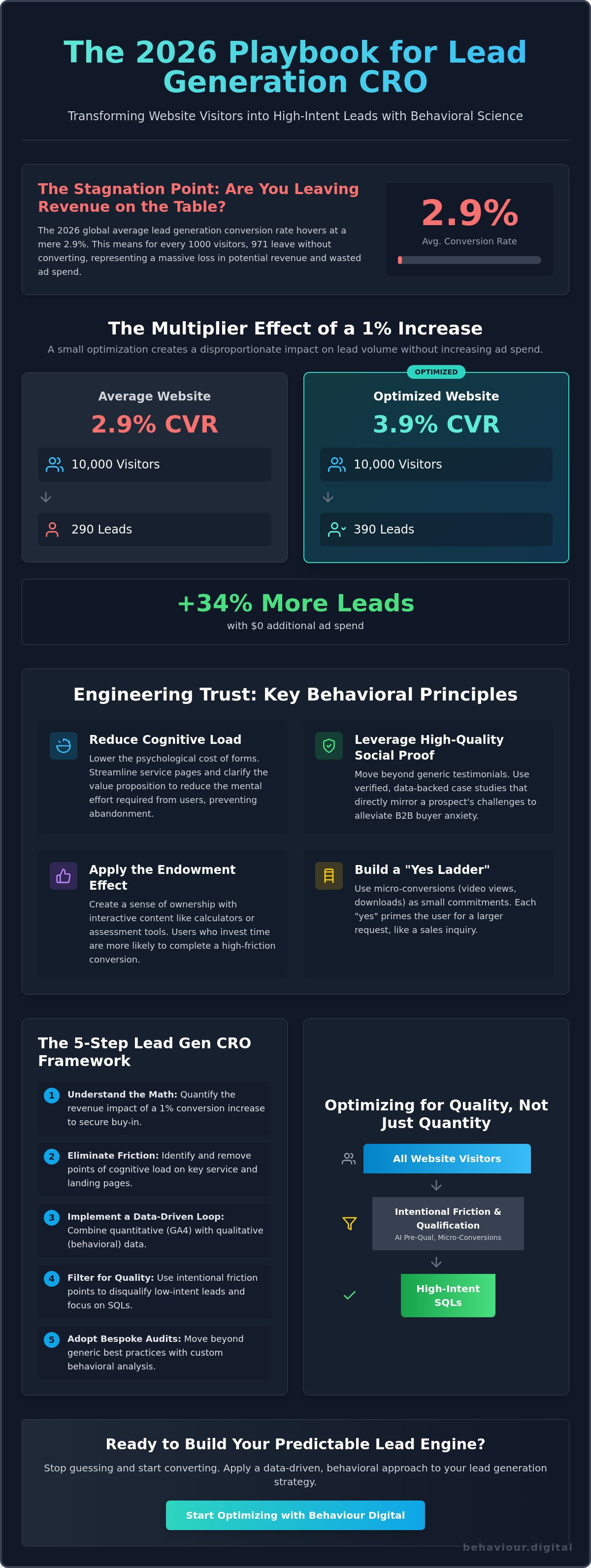
A high conversion rate is a deceptive metric if it doesn't translate into closed deals. In the context of cro for lead generation websites, chasing volume at the expense of intent leads to the "Vanity Lead" trap. If your sales team spends 80% of their time chasing prospects who lack the budget or authority to buy, your optimization strategy is failing. Professional CRO isn't just about making the form easier to fill; it's about making it harder for the wrong people to get through. We use strategic friction points to filter out unqualified traffic, ensuring that every lead delivered has a high probability of conversion to revenue.
Shifting your focus from Cost Per Lead (CPL) to Lifetime Value (LTV) requires a tight feedback loop between marketing and sales. We analyze which website behaviors correlate with your highest-value customers. If data shows that users who interact with your pricing page and download a technical whitepaper have a 50% higher close rate, we optimize the path to those specific actions. This alignment ensures that your digital presence acts as a pre-qualification engine, protecting your sales team's time and maximizing the ROI of your existing traffic.
In 2026, a "Qualified Lead" is defined by more than just a filled form. We implement lead scoring via behavioral triggers, such as repeated visits to high-intent pages or specific engagement with interactive tools. By adjusting form fields to include qualifying questions—like industry type or project timeline—we naturally increase lead intent. While this might slightly lower the total number of submissions, it significantly increases the ratio of SQLs. This methodological precision ensures your marketing spend is an investment in growth, not just a line item for database expansion. If you're struggling to bridge the gap between traffic and sales, a professional CRO strategy can refine your qualification process.
Immediate relevance is the primary driver of low bounce rates. Your landing page must fulfill the exact promise made in your ad copy. This is where PPC Management and CRO become inseparable. If an ad promises a "2026 Strategy Guide" but the landing page asks for a discovery call immediately, the cognitive dissonance causes abandonment. We ensure message match across the entire journey, from the first click to the final submission. By maintaining this continuity, we reduce the psychological friction of the transition, leading to higher quality engagements and better alignment between your paid acquisition and conversion goals.
Professional lead generation requires more than a checklist of industry best practices. While generic advice might suggest shorter forms or brighter buttons, true cro for lead generation websites demands a bespoke behavioral audit. We analyze the specific friction points unique to your user journey, moving beyond surface-level changes to address the underlying psychological triggers that drive or deter your prospects. By integrating our conversion expertise with the technical precision of a PPC Agency Glasgow, we ensure that your paid traffic lands on an environment engineered for high-intent capture. This holistic view prevents the common mistake of treating traffic and conversion as separate silos.
We prioritize compound growth over one-off wins. A single successful test is a data point; a series of successful tests is a competitive advantage. Our reporting is transparent and focused on measurable business impact, such as SQL volume and cost-per-acquisition, rather than vanity metrics. This results-oriented approach ensures that every optimization cycle contributes directly to your bottom line. We don't just deliver reports. We deliver a system of professional predictability that allows you to forecast revenue with confidence.
Amateur testing often leads to "Opportunity Loss." If a DIY test takes three months to reach significance but yields a false positive, you've lost ninety days of potential revenue growth. We provide access to high-level behavioral data and industry benchmarks that internal teams rarely possess. This allows us to handle the complex technical and analytical heavy lifting of cro for lead generation websites, freeing your internal team to focus on what they do best: closing the leads we deliver. Partnering with a specialist ensures your strategy is built on a foundation of methodology rather than trial and error.
In the first 30 days of optimization, we focus on deep data immersion. We set up the tracking infrastructure needed to define and monitor success metrics specific to your industry. We don't just look at conversion rates. We track lead quality and sales velocity to ensure alignment with the goals discussed in our previous sections. The goal is to establish a clear performance baseline from which we can scale your lead engine. If you're ready to stop guessing and start growing, book your behavioral lead gen audit with Behaviour Digital today. We act as your strategic partner, taking full responsibility for the performance and continuous refinement of your conversion engine.
Transforming your website into a high-velocity lead engine requires moving beyond superficial design tweaks. You've learned that the mathematical impact of even a 1% conversion increase can redefine your annual revenue trajectory. By aligning your optimization goals with actual sales feedback, you move beyond vanity metrics to focus on high-intent lead flow. Effective cro for lead generation websites ensures that your marketing spend isn't just generating clicks, but fueling a predictable pipeline of sales-qualified leads.
The 2026 landscape demands a partner who understands the intersection of privacy regulations and user psychology. As Glasgow-based strategic experts, we specialize in a data-driven behavioral methodology that delivers proven ROI across PPC and Social channels. We don't just optimize pages; we refine your entire revenue capture system to ensure long-term, sustainable growth.
It's time to stop leaving potential revenue on the table and start making every visitor count. Maximize your lead velocity with a professional CRO audit from Behaviour Digital and build a foundation for professional predictability. Your future success is the direct result of a deliberate, evidence-based strategy.
In 2026, the global average lead generation conversion rate is 2.9%, but top-performing sites achieve 10% or higher. A good rate is relative to your industry and profit margins. For B2B SaaS, 2-5% is typical, while software review sites can see 5-7%. Your goal shouldn't be to match an arbitrary number. Instead, focus on consistently outperforming your previous baseline through methodical testing and behavioral refinement.
Significant results usually manifest within 30 to 90 days. The timeline depends on your traffic volume and the magnitude of the changes implemented. High-traffic sites reach statistical significance faster, allowing for more rapid iteration. We prioritize high-impact changes first to ensure early wins, but sustainable growth comes from continuous, long-term testing and behavioral refinement rather than a single quick fix. Professionalism requires patience for data to mature.
You don't need massive traffic to begin, but the methodology shifts for lower-volume sites. Instead of high-velocity A/B testing, we focus on qualitative data like heatmaps, user session recordings, and heuristic evaluations. These insights allow us to identify and fix major friction points even with limited data. Professional cro for lead generation websites is about maximizing the value of every existing visitor, regardless of your current total volume.
Yes, CRO is the most effective way to lower your Google Ads Cost Per Lead without reducing your reach. By increasing the percentage of visitors who convert, you get more leads from the same ad spend. If you double your conversion rate, you effectively halve your CPL. This efficiency makes your PPC campaigns more competitive, allowing you to bid for high-intent keywords while maintaining a profitable ROI.
SEO focuses on driving traffic to your site, while CRO focuses on what happens after the user arrives. SEO is about visibility in search results; CRO is about the psychological journey toward a conversion. While SEO brings the prospect to the door, cro for lead generation websites ensures they walk through it. Both are essential components of a digital strategy, but they address different stages of the funnel.
We use the PIE framework to prioritize testing based on Potential, Importance, and Ease. We identify high-drop-off pages that receive the most qualified traffic. High-friction elements like lead forms and primary value propositions are usually the first candidates for optimization. This data-driven approach ensures we focus resources on the changes most likely to drive measurable revenue growth quickly, rather than wasting time on minor aesthetic tweaks.
Absolutely. CRO allows you to implement strategic friction points that filter out low-intent traffic. By adjusting form fields and refining your messaging, you can attract more Sales Qualified Leads (SQLs) and fewer vanity leads. This alignment ensures your sales team spends their time on prospects with a higher probability of closing, directly improving the overall efficiency and profitability of your lead generation engine and reducing wasted resource time.
A/B testing is a primary tool, but it's not the only method. We also use multivariate testing, heuristic analysis, and qualitative research like user testing and surveys. For sites with lower traffic, qualitative insights often provide the most immediate value. A comprehensive strategy uses a mix of these methods to understand both the what and the why behind user behavior, leading to more robust results and permanent site improvements.
Luke leads strategy across every Behaviour Digital account — building data-driven advertising systems for ambitious brands. When he's not auditing ad accounts, he's writing about what he found in them.
Get a free, tailored growth plan — we'll run our framework on your accounts and show you exactly what we'd do.
Get your free growth plan →