.webp) Online
OnlineNot sure which channel fits your business?View all services →
Three inputs. Instant KPIs. No spreadsheets.Open a calculator →
OnlineThe top 10% of B2B SaaS companies are currently achieving visitor-to-lead conversion rates of 15%, while the rest of the market remains stagnant between 1.5% and 2.5%. In a UK SaaS market that reached $18.5 billion in 2025, these margins represent the divide between aggressive scaling and terminal c...

The top 10% of B2B SaaS companies are currently achieving visitor-to-lead conversion rates of 15%, while the rest of the market remains stagnant between 1.5% and 2.5%. In a UK SaaS market that reached $18.5 billion in 2025, these margins represent the divide between aggressive scaling and terminal churn. You're likely facing a rising cost per acquisition fueled by the 2% Digital Services Tax and a 20% VAT on digital services. It's frustrating to watch high-intent traffic drop off during the first 30 days or see demo-to-trial rates plateau despite increased spend. Mastering cro for saas companies uk is no longer about changing button colours; it's about engineering a frictionless cognitive journey from problem awareness to product advocacy.
You're right to demand more than "best practice" guesses for your website changes. This guide promises to help you master the science of converting trials into long-term renewals using our expert UK-focused conversion rate optimisation framework. We'll provide the data-backed evidence you need to justify every strategic shift. You'll discover a scalable growth framework that improves your return on ad spend and aligns with the 2026 Digital Markets, Competition and Consumers Act requirements for subscription transparency.
• Understand why increasing traffic volume fails without a high-performance conversion engine to counteract rising UK acquisition costs.
• Identify critical drop-off points in the complex B2B sales cycle to improve cro for saas companies uk from initial trial to long-term renewal.
• Discover how to replace generic "best practices" with a behavioural audit that combines quantitative data and qualitative user insights.
• Learn to implement high-impact changes to pricing structures and onboarding flows that eliminate user friction and accelerate time-to-value.
• Explore the "Behaviour-First" methodology to move beyond simple A/B testing toward a scalable, data-backed growth framework.
The UK SaaS market reached $18.5 billion in 2025. It's projected to grow at a CAGR of 12.43% through 2034. This growth brings a surge of global competitors into the UK landscape, driving up bid prices and saturating traditional channels. Many software firms focus purely on volume. They pour budget into acquisition while ignoring the leaks in their funnel. This is a strategic error. Driving traffic without a high-performance conversion engine is like pouring water into a sieve.
The "Multiplier Effect" demonstrates that a mere 10% increase in your conversion rate doesn't just add 10% to your lead count; it compounds across your entire sales cycle. When you implement Conversion rate optimization (CRO), you're effectively protecting your PPC management investment. It acts as a risk-mitigation layer. It ensures that the high-cost clicks you buy, often taxed at the 2% Digital Services Tax rate, actually translate into measurable business value. Without this engine, your growth is tied to your budget; with it, your growth is tied to your efficiency.
Poor conversion rates do more than lose leads; they artificially inflate your Cost Per Acquisition (CAC). If your site converts at 1.5% while a competitor converts at 3%, you're paying double for the same customer. The "Conversion Gap" is the measurable distance between your current performance and the top 10% of the market, which typically sees rates of 8-15%. This gap directly erodes UK SaaS margins by forcing higher spend for lower returns. Effective cro for saas companies uk allows you to bid more aggressively in competitive search auctions because your site extracts more value from every visitor.
Conversion efforts shouldn't stop at the sign-up button. A robust digital strategy treats the entire logged-in experience as a conversion opportunity. Friction in the first 5 minutes of product usage is the primary driver of early churn. If a user can't find value immediately, they won't renew. Optimising the onboarding flow and in-app triggers ensures that the promise made on the landing page is fulfilled in the product. This focus on the full lifecycle transforms cro for saas companies uk from a tactical fix into a long-term retention engine that scales with your user base.
Conversion in the software sector is often mischaracterized as a single event. In reality, it's a marathon that spans the entire user lifecycle. For cro for saas companies uk, success depends on mapping the 2026 journey from the first touchpoint to the third renewal. Identifying "Drop-off Points" in complex B2B sales cycles is critical, especially when the average SQL-to-close rate sits between 20-25%. You must distinguish between Micro-conversions, like newsletter sign-ups that signal interest, and Macro-conversions, such as a booked demo that indicates high intent. Prioritising the "Aha! Moment"—the exact second a user perceives your product's core value—is the most effective way to shorten this cycle and secure long-term commitment.
Optimising high-intent landing pages requires a strategic choice between "Request a Demo" and "Start Free Trial." Data shows that top-performing B2B SaaS companies achieve visitor-to-lead rates of 8-15% by leveraging social proof from platforms like G2 and Capterra. Incorporating UK-specific testimonials builds immediate local trust and authority. Minimal form fields are non-negotiable for UK B2B leads because reducing friction at the entry point is the only way to maintain a competitive CAC in an increasingly expensive market. Relying on data-driven CRO marketing ensures these structural decisions are based on observed user behaviour rather than internal assumptions.
The middle of the funnel is where most revenue leaks occur. You can use in-app behavioural triggers to prompt upgrade conversations at the moment of highest engagement. Personalising the dashboard experience based on user intent data ensures that the features shown are the ones that solve the user's specific pain points. Understanding the psychology of "Loss Aversion" is also vital; reminding users of the specific data or progress they'll lose when a trial ends is a powerful motivator for conversion. If you're seeing stagnant growth during this phase, a targeted behavioural audit can pinpoint exactly where your trial users are disengaging.
Retention is the final frontier of cro for saas companies uk. Optimising billing and renewal pages reduces involuntary churn, which often stems from technical friction rather than a lack of product value. Upsell prompts should be placed naturally within the user workflow, appearing only when the user hits a usage limit or achieves a significant milestone. This holistic approach to conversion optimisation fuels a "Flywheel Effect" where existing customers drive scalable growth through expansion and advocacy, rather than relying solely on new acquisition.
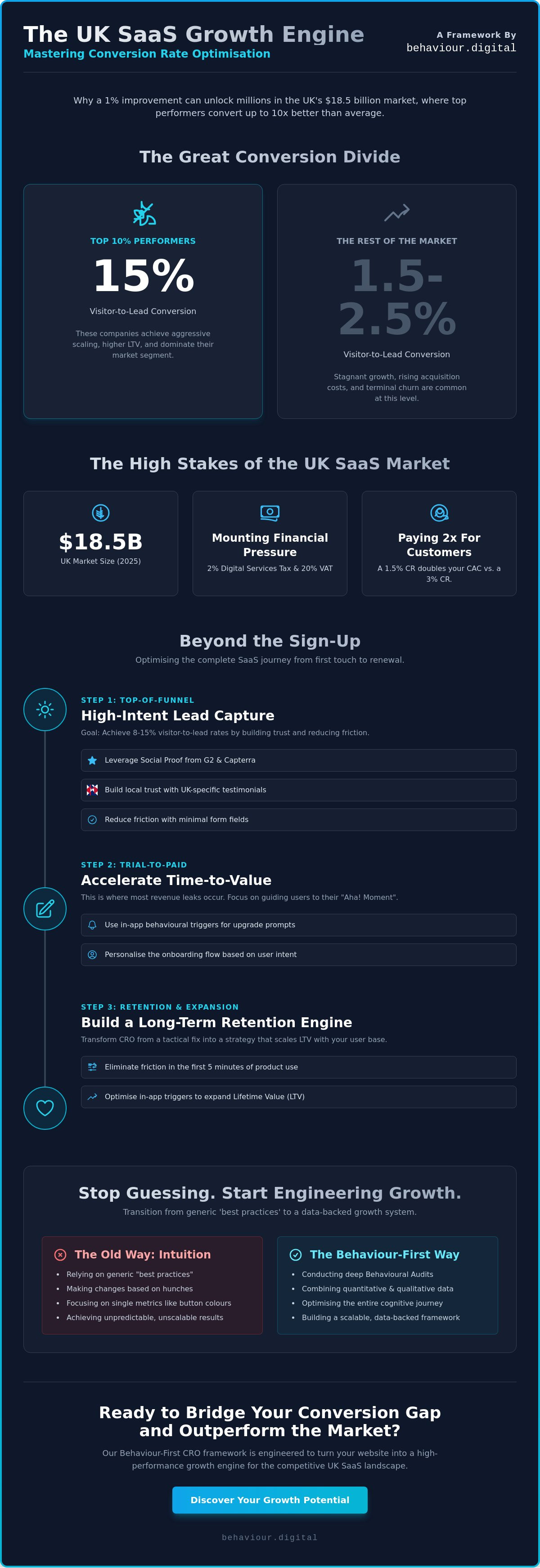
Relying on "best practices" is a gamble you can't afford in 2026. Most generic CRO advice is based on US consumer data or outdated B2C models that fail to account for the UK's unique regulatory and cultural landscape. UK B2B buyers are historically more risk-averse. They demand higher levels of transparency, especially regarding data handling under the UK GDPR and the upcoming 2026 Digital Markets, Competition and Consumers (DMCC) Act. Our approach to cro for saas companies uk replaces guesswork with a rigorous behavioural audit. We marry hard quantitative data with deep qualitative insights to build a roadmap based on how your users actually interact with your software, not how we hope they do.
Success in this market requires a systematic heuristic analysis. This involves evaluating your interface against established usability principles like clarity, friction, and urgency. It's critical that your conversion rate optimization strategy is rooted in user psychology. We look for cognitive biases that either help or hinder the decision-making process. For example, the "Endowment Effect" can be leveraged during a trial to make users feel like the data they've imported is too valuable to leave behind. Without this psychological foundation, your website changes are just aesthetic adjustments with no guaranteed business impact.
Quantitative analysis goes far beyond basic page views. We implement advanced event tracking in Google Analytics 4 to monitor SaaS-specific actions like "Feature Activation" or "First Data Import." With the average MQL-to-SQL conversion rate for B2B SaaS sitting between 32% and 40%, identifying where this flow breaks is essential. Heatmapping and scroll-mapping reveal where UK users lose interest; often, it's where technical jargon outweighs clear value propositions. Funnel visualisation allows us to find the exact screen where users abandon your process, providing the data-backed evidence needed for high-impact structural changes.
Numbers tell you what is happening; qualitative data tells you why. We conduct user testing with UK-based participants to identify regional friction points that automated tools might miss. This could be anything from confusing terminology to anxiety about the 20% VAT display. Exit-intent surveys are invaluable for uncovering hidden objections at the moment of abandonment. By watching session recordings of real users navigating your interface, we see the hesitation and confusion that leads to churn. This "Behaviour-First" methodology ensures every optimisation is a calculated move toward measurable growth.
Implementing effective cro for saas companies uk requires moving beyond surface-level design changes. In a market projected to reach $54.7 billion by 2034, your strategy must address the specific friction points of the British B2B buyer. Trust is the primary currency. This is why hyper-localisation is essential. Using £ sterling and UK-English terminology isn't just about grammar; it's about signal strength. British users are significantly more likely to abandon a checkout that doesn't clearly display the 20% VAT at the final stage. Strategic CTA placement further refines this journey. You must balance "hard" goals, like demo bookings, with "soft" conversion points to capture users who aren't yet ready for a sales conversation.
Your pricing page is often the final hurdle before conversion. Eliminating "Option Paralysis" is critical for complex software products. We recommend highlighting a single "Recommended" tier to leverage the psychology of the middle option. This anchors the user's expectations and simplifies the decision. When framing monthly versus annual billing, show the total yearly saving as a concrete figure rather than just a percentage. Transparent "Contact Sales" triggers for enterprise tiers are vital because they provide a clear path for high-value leads without obscuring the product's scalability. This approach ensures your cro for saas companies uk efforts focus on clarity rather than confusion.
The first five minutes of product usage determine your long-term churn rate. You must solve the "Empty State" problem immediately. A dashboard with no data feels like a chore, not a tool. Use dummy data or automated imports to show what success looks like from second one. Progress bars and gamification elements encourage users to complete their setup, tapping into the human desire for closure. Your social media marketing plays a vital role here too. It should reinforce product value post-signup through "how-to" content and success stories. If your trial-to-paid conversion is lagging, book a CRO audit with our team to identify the exact friction points in your user flow.
Choosing a strategic partner for your growth shouldn't be a leap of faith. We position ourselves as an analytical extension of your team, taking full responsibility for the measurable business impact of our work. Our "Behaviour-First" methodology moves beyond the limitations of simple A/B testing; we focus on the psychological drivers that influence a user's decision to stay or churn. If you're already working with a PPC agency Glasgow software firms rely on, you'll know that acquisition cost is only one part of the equation. Integrating cro for saas companies uk into your wider digital strategy ensures that your paid traffic lands on a platform engineered for maximum conversion. We provide total transparency through granular reporting, proving the ROI of every experiment with hard data.
We operate on a rigorous 4-stage process: Audit, Hypothesise, Test, and Analyse. This cycle ensures no change is made without a data-backed reason. During the Audit phase, we use the quantitative and qualitative tools discussed earlier to find friction points. We then formulate a hypothesis based on user psychology and UK-specific market trends. For low-traffic sites where traditional A/B testing might take months to reach statistical significance, we pivot to "Heuristic Wins." These are high-impact changes based on established usability principles and regional compliance requirements, such as the 2026 Digital Markets, Competition and Consumers (DMCC) Act. Once a winning test is confirmed, we scale that feature across the site, turning temporary gains into permanent revenue growth.
A professional consultation is the first step toward a scalable growth framework. During this initial audit, we examine your current visitor-to-lead and trial-to-paid conversion rates against the top 10% of industry performers. You'll receive a clear breakdown of where your funnel is leaking and a prioritised list of experiments designed to improve your ROAS. We don't believe in project-based flings; we aim for a growth-partner relationship where our success is tied directly to your renewals and expansion. This partnership ensures your software remains compliant with evolving UK regulations while maintaining a competitive edge in a crowded market. Book your SaaS CRO audit with Behaviour Digital today and start transforming your data into a predictable engine for growth.
The UK SaaS landscape is projected to reach $54.7 billion by 2034, but this growth is reserved for firms that prioritise efficiency over raw volume. You've seen how the "Conversion Gap" can double your acquisition costs if left unaddressed. Success in 2026 requires more than just high-intent traffic; it demands a frictionless journey from the first click to the final renewal. By implementing a behavioural audit and shortening your time-to-value, you transform your platform into a predictable revenue engine.
Effective cro for saas companies uk isn't a one-off project; it's a commitment to continuous, data-backed refinement. As a Glasgow-based agency specialising in UK B2B SaaS growth, we provide the transparent, performance-based reporting you need to scale with confidence. We replace guesswork with evidence, ensuring every site change contributes to your bottom line. It's time to align your digital strategy with the reality of the 2026 market.
Stop guessing and start growing—book your SaaS CRO audit now. Your data holds the roadmap to your next stage of growth; let's unlock it together.
Average visitor-to-lead rates sit between 1.5% and 2.5%, while the top 10% of B2B SaaS companies achieve 8-15%. These benchmarks vary by industry, but hitting the 5% mark is generally considered a strong performance for established firms. Your Marketing Qualified Lead (MQL) to Sales Qualified Lead (SQL) rate should ideally fall between 32% and 40% to maintain a healthy growth trajectory in the competitive UK market.
Initial results from heuristic wins and technical fixes often appear within 14 days of implementation. However, achieving statistical significance for complex A/B tests typically requires a cycle of 4 to 8 weeks. This timeline ensures the data accounts for weekly traffic fluctuations and provides a reliable foundation for permanent site changes. Long-term scalability is built on these incremental, data-backed improvements rather than overnight fixes.
You don't need massive traffic to begin cro for saas companies uk. While A/B testing requires volume, low-traffic sites benefit from qualitative audits, session recordings, and user testing. These methods identify regional friction points and cognitive biases without needing thousands of visitors. Focusing on "Heuristic Wins" allows startups to fix obvious conversion leaks before they invest heavily in paid acquisition.
UX design focuses on the overall user experience and satisfaction, whereas CRO is laser-focused on specific business outcomes. UX might make a dashboard easier to navigate; CRO ensures that navigation leads directly to a demo booking or a subscription renewal. Both disciplines overlap, but CRO uses performance-based metrics to prove the financial value of every design decision made on your platform.
Yes, CRO is a powerful tool for reducing churn by optimising the critical first 30 days of the user journey. By shortening the time-to-value and removing friction from the onboarding process, you ensure users reach their "Aha! Moment" faster. Data from 2025 shows that users who complete their setup within the first 5 minutes are 40% more likely to renew their annual contracts compared to those who stall.
A/B testing remains a core pillar of cro for saas companies uk, but it has evolved to include AI-powered personalisation. In 2026, we use testing to validate behavioural hypotheses rather than just comparing button colours. When combined with predictive lead scoring, A/B testing can provide a 10% uplift in conversions by delivering the right offer to the right user segment at the perfect moment.
Pricing for a CRO agency depends on the complexity of your software and the volume of experiments required. Most professional UK agencies operate on a performance-based or retainer model rather than a one-off fee. Instead of focusing on the cost, evaluate the potential ROI. Closing the "Conversion Gap" often pays for the service within the first quarter by significantly reducing your cost per acquisition.
You should focus on CRO alongside or before scaling your PPC spend. Pouring budget into a leaky funnel is an expensive mistake that artificially inflates your CAC. By optimising your landing pages first, you ensure that every pound spent on digital advertising has a higher probability of converting into a trial or demo. This approach protects your margins and improves your overall return on ad spend.

Luke leads strategy across every Behaviour Digital account — building data-driven advertising systems for ambitious brands. When he's not auditing ad accounts, he's writing about what he found in them.
Get a free, tailored growth plan — we'll run our framework on your accounts and show you exactly what we'd do.
Get your free growth plan →