.webp) Online
OnlineNot sure which channel fits your business?View all services →
Three inputs. Instant KPIs. No spreadsheets.Open a calculator →
OnlineA six-figure website redesign is often just an expensive way to move your existing conversion problems to a prettier interface. You're likely watching high-cost traffic from your paid campaigns bounce at a staggering rate, wondering if a "fresh look" will finally fix the leak in your bottom line. It...
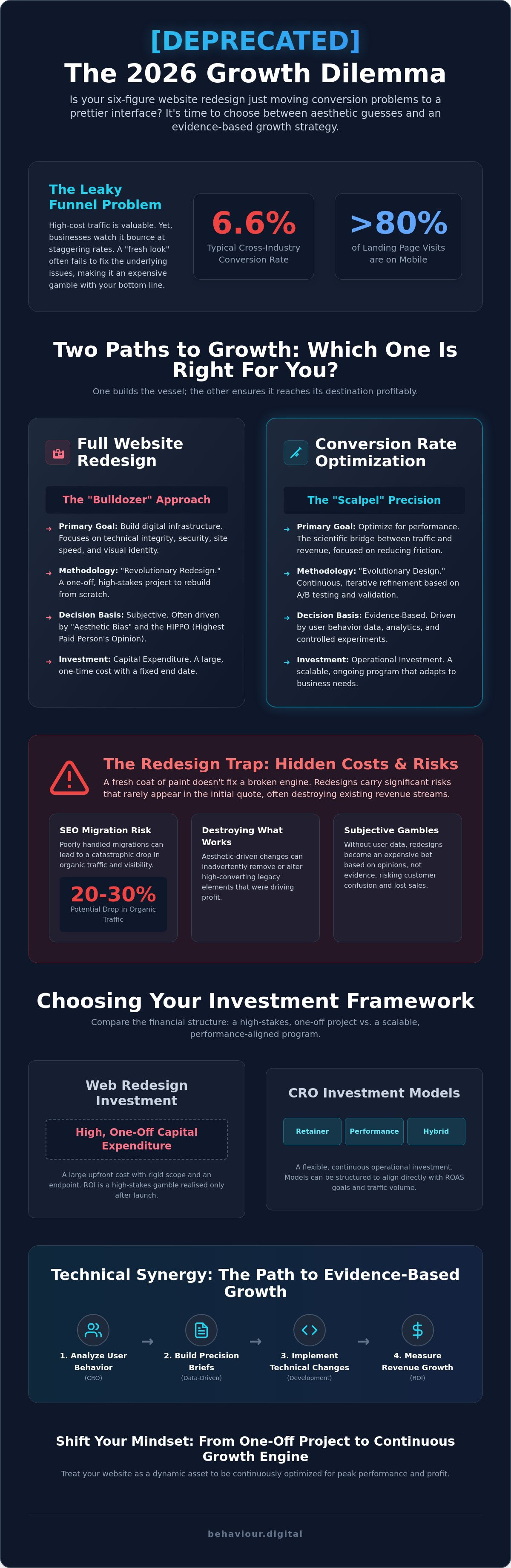
A six-figure website redesign is often just an expensive way to move your existing conversion problems to a prettier interface. You're likely watching high-cost traffic from your paid campaigns bounce at a staggering rate, wondering if a "fresh look" will finally fix the leak in your bottom line. It's frustrating to invest in premium traffic only to see cross-industry conversion rates hover around 6.6% while your competitors seem to scale effortlessly.
Before you commit to a bulldozer approach, you must understand how various cro pricing models compare to the heavy overhead and technical debt of a full-scale development project. This article will help you discover whether your business actually needs a total website overhaul or a strategic conversion rate optimisation program to maximise your ROI. We'll provide a clear framework for choosing between dev and CRO, backed by 2026 performance data. You'll learn how to move from aesthetic guesses to an evidence-based growth strategy that turns your current mobile and desktop traffic into measurable revenue.
• Distinguish between digital infrastructure and performance optimization to ensure your investment targets revenue growth rather than just aesthetic updates.
• Recognize the "Aesthetic Bias" trap where six-figure redesigns often fail to improve, and can even damage, your existing conversion rates through guesswork.
• Navigate various cro pricing models to find a scalable investment structure that aligns with your specific ROAS goals and traffic volume.
• Learn how to use conversion data to build high-precision development briefs, ensuring every technical change is an evidence-based move toward higher profit.
• Shift from a one-off project mindset to a continuous behavioral growth strategy that treats your website as a dynamic, evolving revenue engine.
Web development and CRO are often conflated, yet they serve distinct business functions. One builds the vessel; the other ensures it reaches its destination profitably. In 2026, the market is maturing. Decision-makers are moving away from the "bulldozer" approach of frequent website redesigns toward the "scalpel" precision of performance tuning. This shift is driven by a simple reality: a beautiful site that doesn't convert is a liability, not an asset. If your infrastructure is sound but your sales are stagnant, you don't have a technical problem. You have a conversion problem.
Think of your digital presence like a high-end retail store. Web development builds the physical structure, installs the lighting, and ensures the doors open smoothly. Conversion rate optimization (CRO) represents the expert sales staff who understand customer psychology, rearrange the displays based on foot traffic data, and actively close deals. You can have the most architecturally stunning store in the city, but if your staff can't sell, you're just paying rent on an expensive art gallery. Businesses are increasingly allocating budgets toward performance metrics because they offer a direct line to measurable growth.
Understanding different cro pricing models is essential when deciding how to distribute your 2026 capital. While development is often a one-off expenditure with a fixed end date, CRO is an operational investment in continuous refinement. It's the difference between buying a car and tuning the engine for peak performance.
Web development focuses on the technical integrity and visual identity of your digital home. Its primary goals are foundational. The focus remains on site speed, security, and mobile responsiveness across all devices. With mobile devices now accounting for over 80% of landing page visits, the technical architecture must be fluid. Additionally, developers ensure the CMS is scalable. This allows for future product growth without requiring a total system reboot every two years. It's about building a stable, secure, and fast environment that represents the brand’s visual identity.
CRO is the scientific bridge between your traffic and your revenue. It doesn't care about aesthetics for the sake of art; it cares about performance. The primary objective is reducing friction in the checkout or lead-generation funnel to increase efficiency. By using A/B testing, teams validate design hypotheses before full implementation. This reduces the risk of making changes that look good but actually hurt sales. Because CRO focuses on the "why" behind user behaviour, it provides the data necessary to choose between various cro pricing models that reflect the actual value generated for the business.
A fresh coat of paint doesn't fix a broken engine. Many businesses fall victim to "Aesthetic Bias," the mistaken belief that a modern visual interface automatically correlates with increased sales. It doesn't. In fact, a total website redesign often acts like a bulldozer, inadvertently destroying high-converting legacy elements that were actually driving your profit. When you rebuild from scratch based on visual trends rather than user data, you're essentially gambling with your existing revenue streams.
Total redesigns carry significant hidden costs that rarely appear in a standard development quote. SEO migration risks can lead to a 20% to 30% drop in organic traffic if not handled with surgical precision. Potential site downtime during the "go-live" phase further erodes ROI. Comparing these risks against various cro pricing models reveals a more sustainable path. While a redesign is a high-stakes, one-off event, CRO offers a controlled, iterative approach. Behaviour Digital advocates for "Evolutionary Design" over "Revolutionary Redesign" because it prioritises validated performance over subjective beauty.
Too many redesign projects are steered by the "HIPPO" (Highest Paid Person’s Opinion) rather than actual customer behaviour. For Scottish SMEs, this subjective approach is an expensive gamble. Without rigorous user testing before a single line of code is written, you risk building a site that makes sense to your board of directors but confuses your customers. Adhering to CRO best practices ensures that every design change is a response to a documented user pain point, not a creative whim.
Before changing a single pixel, you must identify what is currently working. Advanced analytics and heatmaps often reveal that "ugly" or "dated" elements are actually the strongest psychological triggers for your audience. A data-blind redesign might remove a high-performing call-to-action simply because it doesn't fit the new brand palette. Every change must align with the broader Digital Strategy already in place. By choosing cro pricing models that focus on continuous testing, you can protect these conversion assets while systematically improving the rest of the site. If you're unsure whether your current site needs a scalpel or a bulldozer, it's time to audit your conversion data before signing a development contract.
Most businesses treat web development and CRO as separate silos. This disconnect creates "Dev Waste," where technical teams spend hundreds of hours building features based on visual specs rather than user demand. In 2026, the most profitable brands use CRO data to write their development briefs. CRO identifies the "what" and "why" of user frustration, allowing developers to execute the "how" with surgical precision. When these disciplines align, every line of code serves a measurable business objective.
This integrated approach is often reflected in modern cro pricing models. Some retainers are structured specifically to include technical consultancy, ensuring that your development budget isn't squandered on low-impact changes. At Behaviour Digital, we don't offer full-scale development. Instead, we act as the strategic architect for your existing technical team. This objective partnership ensures that your developers focus on high-impact performance upgrades that move the needle on your revenue, not just your site's appearance.
Site speed is no longer just a technical checkbox. It's a psychological trigger. In 2026, mobile devices account for 82.9% of landing page visits. A delay of even 100 milliseconds can significantly spike bounce rates and erode your ROAS. Clean code is a prerequisite for valid experimentation. If your site's architecture is bloated, your A/B tests will produce "noisy" data that is difficult to interpret. Site speed is the unique development metric that doubles as a core conversion lever. It's the foundation upon which all other optimisations are built.
Think of conversion rate optimisation as your internal R&D department. Instead of commissioning a new feature because a competitor has it, you test a "minimum viable" version first. If the data shows user engagement, you move it into the development queue. If it fails, you've saved thousands in unnecessary coding costs. This feedback loop is essential for maintaining a flexible frontend. By building only what users have proven they want, you reduce technical debt and ensure your website remains a lean, high-performance revenue engine. This methodology transforms your site from a static brochure into a dynamic, evolving asset that responds to real-time market behaviour.
Misdiagnosing a website's poor performance leads to wasted capital. Many UK businesses mistake a conversion problem for a technical failure. If your site functions but fails to sell, a total redesign is a disproportionate response. You must first determine if the symptoms are technical or behavioral. For instance, with an average cart abandonment rate of 70.22% in 2026, most businesses are losing revenue at the final hurdle. This is rarely a coding issue; it's almost always a failure of user experience design.
Selecting the right cro pricing models is central to your budget allocation strategy. Unlike the fixed, high upfront cost of web development, CRO investments are designed for scalability. Common structures in 2026 include:
The standard for continuous, iterative testing and long term growth.
Fixed fee engagements to identify immediate friction points before a redesign.
Hybrid structures where agency fees are partially tied to the measured revenue lift.
This variety allows you to find a sweet spot between maintaining infrastructure and funding growth. UK businesses shouldn't commit to a redesign without a third party audit to validate which elements actually need replacing. A data-blind rebuild is just an expensive way to repeat the same mistakes in a different font.
Technical debt eventually requires a bulldozer approach. If you're managing security vulnerabilities, frequent site crashes, or unfixable backend bugs, your infrastructure is the bottleneck. When a CMS becomes end-of-life or impossible for your internal team to update, development is the only path forward. Similarly, if your site fails to meet 2026 accessibility standards or isn't fully mobile responsive, the core architecture is fundamentally flawed. In these scenarios, CRO cannot fix what is technically broken.
A performance gap is often invisible to the untrained eye. If your traffic is high but your conversion rate is stagnant, your site is underperforming. Many companies investing in PPC in Glasgow find that while their ad targeting is precise, their landing pages fail to close the deal. If user recordings show visitors are confused by the layout despite a modern look, you have a behavioral issue. Before you spend six figures on a new build, schedule a conversion audit to identify the specific friction points that are currently costing you sales.
Scaling a business in 2026 requires more than just increasing web traffic. While many agencies focus on the top of the funnel, Behaviour Digital prioritises "Behavioural Growth." This approach focuses on the psychological and technical levers that turn existing visitors into customers. By optimising the user journey, we ensure that every pound spent on acquisition works harder for your bottom line. This methodology is why our cro pricing models are structured around long-term value creation rather than one-off aesthetic changes.
Our 7-step process moves from an exhaustive data audit to validated implementation. This involves deep-dive analysis, hypothesis creation, and rigorous A/B testing before any permanent changes are made to your site. We don't guess; we use evidence to drive every decision. This Glasgow-based expertise is combined with a global perspective on 2026 digital trends, allowing us to serve as a strategic partner rather than just another vendor. By integrating CRO with your existing Social Media Marketing efforts, we close the loop between high-intent social traffic and revenue generation.
Quantitative data from GA4 provides the foundation, but qualitative user recordings provide the context. Numbers tell us what is happening; recordings tell us why visitors are hesitating. This dual approach allows us to identify friction points that standard analytics might miss, such as a confusing form field or a mobile button that's difficult to trigger. We embrace a "Small Wins" philosophy. A 1% improvement in your checkout flow might seem minor. However, when these gains compound across thousands of transactions and multiple touchpoints, they result in massive revenue growth. Transparency is a core pillar of our operation. Our reporting ensures you see the exact financial impact of every test we perform, providing total clarity on your ROI.
Strategic partnership defines our approach. We move beyond the traditional client-vendor relationship to become an extension of your team. Our goal is to de-risk your marketing spend. Continuous testing and evidence-based strategies remove the uncertainty that usually accompanies digital growth. By aligning our cro pricing models with these performance milestones, we ensure our goals are perfectly synced with yours. You no longer have to wonder which technical changes will impact your bottom line. We provide the data you need to make confident investment decisions. If you're ready to stop guessing and start growing with a partner that values results over aesthetics, book your 30-minute strategy consultation with Behaviour Digital today.
Distinguishing between technical infrastructure and performance optimisation is the first step toward a more profitable digital presence. While a full website redesign might seem like a solution for stagnant sales, it often introduces unnecessary risk and technical debt. Strategic conversion rate optimisation offers a more precise, evidence-based alternative. By evaluating various cro pricing models, you can find a structure that supports continuous growth without the high overhead of a redundant rebuild.
Our Glasgow-based experts focus on delivering data-driven results through the seamless integration of strategic PPC and CRO. We move beyond aesthetic changes to address the underlying psychological triggers that drive user action. This methodology ensures your marketing spend is always backed by validated performance metrics. Success isn't found in a prettier interface; it's found in a smarter strategy. Stop guessing and start growing, book your CRO strategy session today to align your digital assets with your revenue goals. We are ready to help you build a more predictable, scalable future.
CRO is significantly more cost-effective because it targets specific performance leaks rather than rebuilding your entire digital infrastructure. A full redesign involves high development costs and the inherent risk of breaking existing high-performing elements. CRO focuses on incremental, data-backed improvements that deliver a faster return on investment without the overhead of a six-figure development project.
You should perform CRO on your existing website before considering a new build. Testing your current interface reveals which elements your audience responds to and which they ignore. This data becomes the blueprint for any future development. Unless your site has critical security vulnerabilities or is completely non-responsive, the evolutionary approach of CRO is a safer investment than a revolutionary redesign.
The timeline for measurable results depends on your website traffic volume. High-traffic sites can reach statistical significance in A/B tests within weeks. For most UK businesses, a structured CRO program typically delivers validated insights and revenue improvements within 3 to 6 months. This duration allows for a complete cycle of auditing, hypothesis testing, and implementation.
Yes, a developer is required to permanently implement the winning variations identified during testing. While some testing tools allow for "no-code" visual changes during the experiment phase, these are temporary. For long-term site performance and clean code, your development team must hard-code the successful changes into your CMS once they are proven to increase revenue.
ROI varies by industry, but CRO often provides a higher return than simply increasing your ad spend. By improving your conversion rate from 2% to 3%, you effectively increase your revenue by 50% without spending more on traffic. In 2026, with cross-industry conversion rates averaging 6.6%, even minor percentage gains result in a substantial financial impact on your bottom line.
Professional CRO actually supports your SEO efforts. Search engines like Google prioritise sites with high user engagement and low bounce rates. By improving the user experience and site speed, you're aligning with the core metrics that search engines use to rank content. As long as you avoid cloaking and ensure your A/B testing tools are configured correctly, there's no risk to your organic rankings.
CRO directly improves your ROAS by ensuring more of your paid visitors complete a desired action. If you're running PPC campaigns in Glasgow, you're paying for every click. CRO optimises the landing page experience to reduce the cost per acquisition. This allows you to outbid competitors and scale your campaigns more aggressively because your site converts traffic more efficiently than theirs.
The most common cro pricing models in 2026 include monthly retainers, project-based audits, and performance-based structures. Retainers are ideal for continuous growth, while fixed-fee audits provide a one-off roadmap for improvement. Performance-based models often combine a base fee with a bonus tied to the revenue lift generated, ensuring the agency's incentives are perfectly aligned with your business success.
Luke leads strategy across every Behaviour Digital account — building data-driven advertising systems for ambitious brands. When he's not auditing ad accounts, he's writing about what he found in them.
Get a free, tailored growth plan — we'll run our framework on your accounts and show you exactly what we'd do.
Get your free growth plan →