.webp) Online
OnlineNot sure which channel fits your business?View all services →
Three inputs. Instant KPIs. No spreadsheets.Open a calculator →
OnlineIn a market where automated bidding strategies manage 78% of all Google Ads spend, simply showing up isn't enough to drive profit. You've likely noticed that your cost-per-acquisition continues to climb while the path to conversion becomes increasingly fragmented. It's frustrating to see a disconnec...
In a market where automated bidding strategies manage 78% of all Google Ads spend, simply showing up isn't enough to drive profit. You've likely noticed that your cost-per-acquisition continues to climb while the path to conversion becomes increasingly fragmented. It's frustrating to see a disconnect between high-intent ad copy and a landing page experience that fails to convert. Implementing customer journey mapping for ppc is no longer a luxury; it's the only way to ensure your message aligns with a buyer who researches products three or more times before a single click leads to a sale.
We understand that you want to move beyond vanity metrics and focus on measurable business growth. This article provides the strategic framework to align your paid advertising with the actual path your customers take, allowing you to increase ROAS and eliminate wasted spend. You'll learn how to categorize your PPC channels by journey stage and provide AI-driven systems like AI Max with the high-quality data they need to lower your CPA and drive sustainable performance.
• Understand why the shift to non-linear, AI-driven buyer paths in 2026 requires a move from static funnels to dynamic touchpoint identification.
• Identify and fix the "Message Match" problem to stop wasting ad spend on users who aren't ready to convert.
• Implement a data-driven 4-step framework for customer journey mapping for ppc using GA4 and CRM insights to audit every interaction.
• Learn how to strategically deploy Paid Social and Search across five distinct journey stages to capture high-intent users more efficiently.
• Discover how the synergy between PPC and Conversion Rate Optimization (CRO) transforms ad clicks into measurable business growth.
Customer journey mapping for ppc is the rigorous process of identifying every paid touchpoint a user interacts with before completing a conversion. Unlike traditional marketing maps that focus on broad brand sentiment, a PPC-specific map analyzes the technical and psychological transition between an ad impression and a final transaction. It tracks the sequence of events across diverse platforms, ensuring that each pound spent moves the user closer to a measurable business outcome rather than simply generating a hollow click.
The digital environment in 2026 has rendered linear funnels obsolete. Consumers no longer follow a straight path from awareness to purchase. Research indicates that users now engage with products three or more times across different devices and channels before making a decision. This fragmentation means your customer journey is often non-linear, unpredictable, and spread across various search, social, and video ecosystems. PPC journey mapping is the strategic alignment of ad intent with a user's psychological and behavioral state at the exact moment of engagement.
A generic marketing map might suggest a user wants "information," but a PPC-focused map identifies whether that user is searching for a high-level solution or comparing specific SKU specifications. This distinction is vital for bid-level precision. If your map doesn't account for the specific intent behind the keyword or the social interaction, you'll likely overbid on low-intent traffic or underbid on users ready to convert.
Successful customer journey mapping for ppc relies on three pillars. First, you must audit all touchpoints, including Google Search, Meta Ads, YouTube pre-roll, and remarketing banners. Second, you must categorize user intent. An informational query like "how to improve ROAS" requires a different ad response than a transactional query like "PPC agency Glasgow." Finally, you must identify friction points. These are the technical or messaging gaps where the transition from an ad click to a landing page fails, often causing users to abandon the path entirely.
Modern PPC management faces a transparency challenge. With automated "Smart Bidding" strategies now managing 78% of all Google Ads spend, platforms like AI Max consolidate targeting and bidding into a "black box." A journey-first approach allows you to feed these AI systems better signals by understanding which touchpoints actually drive value. Additionally, new state-level data privacy laws in Indiana, Kentucky, and Rhode Island have restricted third-party tracking. When you can't rely on cookies, understanding the logical path to purchase becomes your most valuable asset for attribution and strategy refinement.
PPC campaigns often fail because they treat every click as an isolated event. This lack of cohesion creates a "Message Match" problem. When an advertiser serves a "Buy Now" ad to a user in the early awareness stage, the result is almost always a high bounce rate and depleted ROAS. Without customer journey mapping for ppc, you're essentially guessing which stage of the PPC marketing funnel a user occupies. This leads to aggressive bidding on keywords that are purely informational, effectively paying a premium for traffic that has zero intent to convert in the current session.
Wasted ad spend is the most immediate consequence of a fragmented strategy. When Search and Social channels operate in silos, you risk redundant targeting. You might pay for a Meta impression and a Google Search click for the same user without realizing they've already moved past the consideration phase. This redundancy inflates your CPA and obscures the true path to purchase. Because customer journey mapping for ppc clarifies these transitions, it becomes the foundation for both ad spend efficiency and effective conversion rate optimisation. If you don't understand the user's previous touchpoints, you can't tailor the landing page experience to resolve their specific friction points.
High bounce rates are rarely just a design issue; they're a symptom of poor journey alignment. Keyword cannibalisation often occurs when different campaigns compete for the same user at different stages. For instance, your brand campaign might steal credit from a generic search term that actually did the heavy lifting. One-size-fits-all landing pages are a relic of the past. In 2026, a user expects a seamless transition from their specific search query to a page that addresses that exact need without friction.
Strategic mapping shifts your management from assumptions to quantitative behavioural data. It allows you to identify "low-hanging fruit," such as high-intent queries that are currently underserved by your ad copy. There's also a direct link between journey clarity and higher Quality Scores in Google Ads. When Google recognizes that your ad and landing page perfectly satisfy the user's intent, your costs decrease. If you're struggling to reconcile your spend with actual revenue, auditing your multi-channel strategy is the first step toward reclaiming your margins.
Effective customer journey mapping for ppc requires breaking down the path to purchase into five actionable phases. This structure ensures that your budget isn't just spent, but strategically invested where it has the highest probability of moving a user forward. A granular customer journey map must account for the psychological shifts a user undergoes from first discovery to long term loyalty.
At this stage, users aren't actively looking for your brand. Use Paid Social and Display to introduce a solution to a problem they haven't yet solved. The goal is to spark interest without forcing a premature sale.
Users begin searching for specific solutions. Capture high-intent Search queries as they compare features and read reviews.
The user knows the category but hasn't selected a provider. Retargeting and mid funnel content keep your brand top of mind during this critical evaluation period.
This is the final click. Focus on maximum efficiency by using brand search and high precision remarketing to close the deal.
PPC continues after the first sale. Use first party data for post purchase engagement and upselling, turning one time buyers into brand advocates.
Strategic alignment means selecting the right tool for the job. Awareness thrives on video ads and broad audience targeting on platforms like Meta or TikTok. Consideration requires more specific touchpoints, such as non brand Google Search and LinkedIn sponsored content. Finally, the conversion stage is dominated by high precision formats like Brand Search, Remarketing, and Dynamic Product Ads (DPA). If you use a conversion focused format for awareness, you'll likely see high costs and low engagement.
Your bidding strategy must reflect the user's intent at each touchpoint. Target CPA (tCPA) is most effective at the bottom of the funnel where conversion data is plentiful. At the top of the funnel, strategies like Maximize Clicks or Reach are more appropriate for building the initial audience. Successful customer journey mapping for ppc also involves tracking "Micro-Conversions"—such as newsletter sign ups or whitepaper downloads—to measure top of funnel success. Adjusting bid modifiers based on where the user sits in the map allows for the level of precision required to maintain a competitive ROAS in 2026.
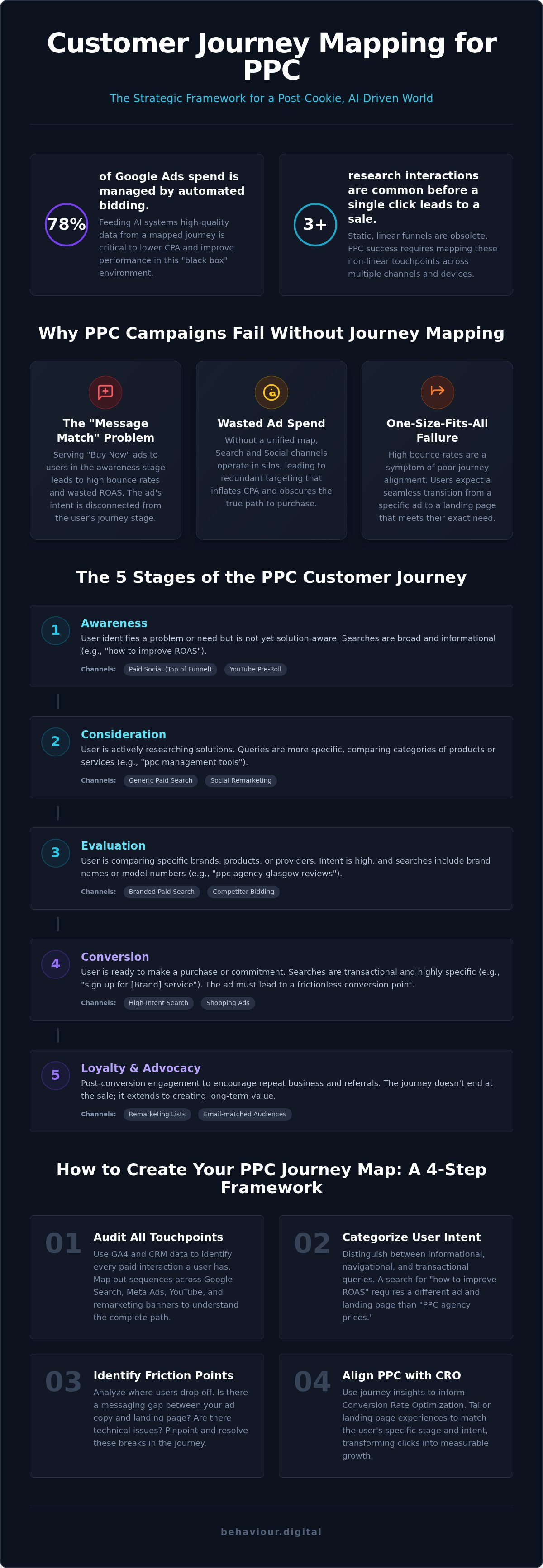
Execution is where strategy meets profitability. Creating a robust framework for customer journey mapping for ppc requires a shift from creative guesswork to data-driven precision. Follow these four steps to build a map that actually informs your bidding and creative decisions.
Use GA4 Path Exploration and your CRM data to identify every paid interaction. Look for the actual sequences users take. Do they start with a YouTube ad and end on a Brand Search click? Your data holds the answer.
Demographics are secondary to search intent. Group your audience by the problems they're trying to solve. A persona seeking "scalable PPC management" requires a different journey than one looking for a "one-off account audit."
Awareness ads should trigger curiosity or problem recognition. Conversion ads must trigger urgency, trust, or a sense of security. Match your messaging to the user's current psychological state.
Locate the stages where users click but don't progress. If your "Consideration" ads have a high CTR but a 90% bounce rate, there's a disconnect between your ad promise and the landing page reality.
With new state-level data privacy laws effective in 2026 in Indiana, Kentucky, and Rhode Island, relying on third-party cookies is a failing strategy. You must leverage first-party data to fill the visibility gaps. Lead magnets like industry reports or calculators are essential for capturing intent early. Combine this with conversion optimisation tools such as heatmaps and session recordings. These tools allow you to see exactly where a user stalls on the path to purchase, providing the qualitative data that GA4 might miss.
Don't let your map sit in a static document. Use tools like Miro or specialized CJM software to create a visual "Service Blueprint." This document should link every PPC ad to your internal sales processes and landing pages. A live map evolves with your campaign data. When AI-driven systems like AI Max shift your traffic patterns, your map should reflect those changes in real-time. If you're ready to stop guessing and start scaling, book a strategic audit with our team to align your journey with measurable growth.
Effective customer journey mapping for ppc isn't a one-time project; it's a living component of a high performance advertising ecosystem. At Behaviour Digital, we don't just set up campaigns and walk away. Our PPC agency Glasgow team integrates these maps into our monthly management cycle. We constantly verify that your ad spend aligns with the actual path your customers take. This rigorous oversight ensures that your budget is always directed toward the touchpoints that yield the highest business value.
The true power of our approach lies in the synergy between our PPC and CRO services. We map the ad to the click and, more importantly, the click to the sale. By analyzing the friction points identified in your journey map, we optimize the post-click experience to ensure your landing pages aren't just receiving traffic but are actively converting it. For UK based businesses, having a Glasgow based partner provides the strategic oversight necessary to navigate the specific nuances of the domestic market while maintaining a global performance standard.
Our methodology has proven its value across diverse sectors. For a prominent Scottish retailer, journey alignment was the key to reducing their cost per acquisition. By moving away from broad targeting and toward a stage specific strategy, we eliminated wasted spend and focused their budget on high conversion touchpoints. This level of precision is only possible when you treat the customer journey as a technical blueprint rather than a creative suggestion.
We prioritize measurable business growth over vanity metrics like CTR. High click through rates are meaningless if they don't result in revenue. Our reporting is transparent, showing you exactly how users move through the journey we've mapped. We focus on the quantitative data that proves your investment is working. This involves continuous fine tuning of the map based on real time campaign performance and emerging market trends to ensure your ROAS remains sustainable.
The first step toward a more efficient strategy is a deep dive audit of your current journey. We analyze your existing touchpoints, identify where your users are dropping off, and build a blueprint for improvement. Choosing a strategic partner over a "set and forget" freelancer ensures your campaigns receive the analytical attention they deserve. If you're ready to transform your paid media efficiency, Book a strategy session with Behaviour Digital today to start your journey towards scalable growth.
Success in 2026 isn't determined by who has the largest budget, but by who understands their audience's path with the most clarity. We've explored how aligning ad intent with the multi-channel buyer path eliminates the "message match" problem that drives up CPA. Transitioning to a journey-first model allows you to move beyond vanity metrics and focus on measurable business outcomes. Implementing customer journey mapping for ppc ensures every pound spent is a calculated move toward a conversion rather than a shot in the dark.
As Glasgow-based experts in data-driven PPC, Behaviour Digital specializes in ROAS-focused campaign management. We integrate CRO and Social Media strategies to bridge the gap between the initial click and the final sale. Our team works as a strategic partner to ensure your paid media ecosystem is lean, targeted, and consistently profitable. It's time to stop paying for clicks that don't convert and start building a strategy based on how your customers actually buy. Master your paid search strategy with Behaviour Digital. Your growth is the result of a conscious strategy and continuous refinement.
A marketing funnel is a linear, top-down model that assumes every user follows a predictable path from awareness to conversion. Customer journey mapping for ppc acknowledges that the actual path is non-linear and fragmented. It focuses on specific touchpoints, emotional triggers, and the cross-platform interactions that drive a user toward a transaction rather than a theoretical flow.
Developing a robust map typically requires two to four weeks. This timeframe includes the essential audit of GA4 and CRM data, persona identification based on intent, and the strategic alignment of ad copy with specific journey stages. The complexity of your multi-channel ecosystem and the volume of historical data available will ultimately determine the total duration.
Specialized software isn't a requirement, although visualization tools like Miro or Lucidchart can improve clarity. The most important assets are your existing data sources, such as GA4, CRM platforms, and session recording tools. These provide the quantitative behavioral insights needed to build a map based on real user actions rather than assumptions.
Review and update your map at least once per quarter. It's also vital to refresh your strategy when major platform changes occur, such as the full migration to AI Max in late 2026. Regular updates ensure that your bidding thresholds and messaging remain synchronized with evolving consumer behaviors and new privacy regulations across different regions.
Yes, it reduces costs by improving your Quality Score through enhanced relevance. When customer journey mapping for ppc allows you to match ad copy perfectly with a user's specific intent at their current stage, engagement rates increase. Google's algorithm rewards this high relevance with lower costs per click and more prominent ad positioning.
B2B journeys are usually longer and involve multiple stakeholders, requiring a heavy emphasis on informational intent and lead nurturing over several months. B2C journeys tend to be more transactional and compressed. While B2C mapping focuses on immediate emotional triggers, B2B strategy prioritizes building technical authority across a more fragmented and cautious path to purchase.
The most frequent error is treating the map as a static document rather than a live strategic tool. Many advertisers also ignore the post-purchase phase or fail to integrate data between Search and Social silos. A map that doesn't directly inform your bidding modifiers or creative assembly won't deliver the measurable business growth you're targeting.
Luke leads strategy across every Behaviour Digital account — building data-driven advertising systems for ambitious brands. When he's not auditing ad accounts, he's writing about what he found in them.
Get a free, tailored growth plan — we'll run our framework on your accounts and show you exactly what we'd do.
Get your free growth plan →