.webp) Online
OnlineNot sure which channel fits your business?View all services →
Three inputs. Instant KPIs. No spreadsheets.Open a calculator →
OnlineGlobal display advertising spending is projected to reach $266.6 billion in 2026, yet many brands still burn through their $3.12 average CPM on audiences that have developed total banner blindness. It's a common frustration to see high spend with low visible return while navigating a programmatic ec...

Global display advertising spending is projected to reach $266.6 billion in 2026, yet many brands still burn through their $3.12 average CPM on audiences that have developed total banner blindness. It's a common frustration to see high spend with low visible return while navigating a programmatic ecosystem that feels increasingly like a black box. You're likely struggling to attribute a specific click to a final conversion in a world where new privacy laws, like those effective January 1, 2026, in Indiana and Kentucky, have fundamentally shifted the targeting landscape.
We agree that the old brand awareness approach is no longer sufficient for serious growth. This article will show you how to master the mechanics and creative strategies of display advertising to turn digital impressions into measurable business results. You'll gain a clear framework for building high-performing campaigns that leverage first-party data and contextual targeting. We'll preview how the August 2026 EU AI Act impacts your creative optimization and how to build a synergy between display, search, and conversion rate optimization for a truly scalable strategy.
• Understand how modern display advertising spans the open web, apps, and social platforms to create a unified visual-first digital strategy.
• Master the programmatic engine and the role of Demand-Side Platforms (DSPs) to automate high-precision ad buying at scale.
• Shift from basic demographics to behavioral intelligence to predict purchase intent and engage users based on their actual digital actions.
• Apply the "3-Second Rule" and optimized ad specs to capture user attention before they scroll past your message.
• Move beyond misleading click-through rates by implementing View-Through Conversion (VTC) metrics to measure the true business impact of your campaigns.
Global spending on display advertising is projected to reach $266.6 billion in 2026. This figure represents a fundamental shift in how brands communicate. It's no longer just about static banners on a sidebar; it's a visual-first strategy that integrates high-impact creative across the open web, mobile applications, and social platforms. For a foundational understanding, digital display advertising encompasses the technical and creative infrastructure used to deliver these visual messages to targeted audiences.
Success in 2026 relies on three core pillars: creative assets, placement networks, and behavioral triggers. Unlike paid search, which captures existing demand through keyword intent, display advertising focuses on behavioral influence. It builds brand salience by reaching users before they even know they need a solution. While critics cite "banner blindness" as a reason to avoid the format, the data suggests otherwise. High-impact and interactive formats have rendered the blindness myth obsolete for brands that prioritize engagement over simple impressions.
The industry has come a long way since the first AT&T banner launched in 1994. By May 2026, the landscape is dominated by AI-driven dynamic creative. We've transitioned from static JPEGs to HTML5 animations and high-definition video ads that adapt in real-time to user preferences. The New York "Synthetic Performer" Law, effective June 9, 2025, now requires us to disclose AI-generated likenesses, adding a layer of transparency to these advanced formats. Interactive elements, such as mini-quizzes or shoppable galleries, are now essential to break through digital noise and drive measurable engagement.
Native advertising is designed to mimic the form and function of the host site's content, appearing as "recommended reading" or sponsored articles. It's seamless. In contrast, display advertising is purposefully distinct from the editorial content, using visual hierarchy to command attention. While native ads excel at building trust through long-form storytelling, display ads are superior for rapid brand recall and retargeting. Use native for top-of-funnel education; use display for high-frequency behavioral conversion and precision retargeting across the programmatic ecosystem.
The distinction between these formats is critical for your 2026 strategy. A well-structured campaign doesn't choose one over the other; it utilizes the "disruptive" power of display to keep the brand top-of-mind while using native to provide deeper context. This synergy ensures your message reaches the right user at the exact moment their behavior indicates a high probability of conversion.
The programmatic engine is the silent force behind every impression. It connects four distinct entities in a fraction of a second: the advertiser, the publisher, the ad exchange, and the end user. When a user lands on a webpage, the publisher sends a signal to the ad exchange. This exchange hosts a lightning-fast auction where Demand-Side Platforms (DSPs) bid on behalf of advertisers based on behavioral data and budget parameters. This process, known as Real-Time Bidding (RTB), ensures that display advertising inventory is sold at its true market value in less than 100 milliseconds.
DSPs act as the strategic brain for the advertiser. They automate the purchase of inventory across multiple exchanges, allowing for granular control over where and when an ad appears. Understanding these mechanics is vital for any growth-focused brand. A comprehensive Display Advertising Guide can help clarify the technical nuances of setting up these systems for maximum efficiency. In 2026, brand safety is no longer a luxury; it's a requirement. The IAB released a modernized legal framework for direct digital advertising contracts in February 2026 to address these concerns. This update, the first major change since 2010, provides a standardized approach to transparency and fraud prevention in an increasingly complex ecosystem.
The Google Display Network remains the most accessible entry point for many organizations. With an average CPC of $0.67, it's a cost-effective way for local Glasgow businesses to reach 90% of internet users quickly. However, enterprise-level growth often requires the scale of a specialized DSP. While GDN limits you to Google-owned sites and partner apps, a DSP provides access to the entire open web. This includes premium publishers and private marketplaces that aren't available through standard ad networks. Scaling your reach often means moving beyond the "walled garden" of a single network to find your specific audience wherever they consume content.
AI has moved beyond simple automation into the realm of predictive account activation. Machine learning algorithms now analyze thousands of signals to predict which user is most likely to convert before a bid is even placed. This predictive capability reduces wasted ad spend by avoiding low-probability impressions. Automated bidding strategies have effectively replaced manual placement selection, allowing strategists to focus on high-level behavioral triggers rather than micro-managing individual site lists. If you want to maximize your ROI, it's time to audit your programmatic strategy for these AI-driven efficiencies.
By leveraging these automated systems, brands can achieve a level of precision that was impossible just a few years ago. The focus has shifted from simply buying space to buying the right moment in a user's journey. This transition from manual oversight to algorithmic precision is what defines the most successful campaigns in the current market.
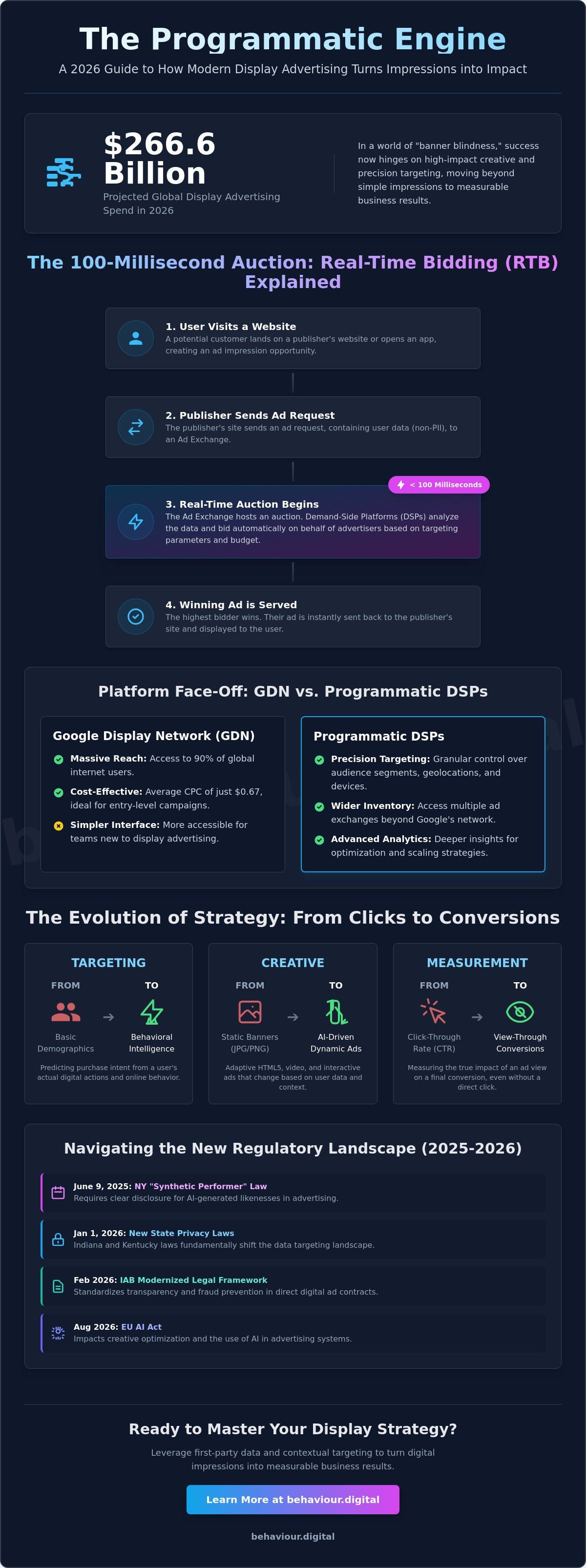
Demographic targeting is a relic of the past. High-growth brands in 2026 don't care about broad categories like age or gender; they care about intent. A user's behavior provides a high-fidelity signal that demographics simply can't match. By analyzing touchpoints across the digital ecosystem, display advertising now functions as a predictive engine. It identifies patterns in how users interact with content to determine where they sit in the sales funnel. This shift is mandatory because the deprecation of third-party cookies has forced a reliance on first-party data and sophisticated behavioral modeling. Global retail media network display ad spending is projected to exceed $75.1 billion in 2026, proving that advertisers are following the data to where users are actively engaged.
The synergy between display and search behavior is where the most significant gains are made. When a user searches for a specific solution, their intent is clear. Following that search with a strategically timed display ad reinforces the brand at the exact moment the user is evaluating options. This multi-touch approach ensures your brand isn't just seen; it's remembered as the logical choice when the purchase decision is finalized.
Natural Language Processing (NLP) has transformed contextual targeting from simple keyword matching into a deep understanding of sentiment and topic. It's about reaching users in the right mindset without needing personal identifiers. For instance, a Scottish B2B engineering consultancy can use contextual ads to appear on industry-specific news sites exactly when a user is reading about infrastructure policy or renewable energy trends. The ad isn't an intrusion. It serves as a relevant resource that aligns with the user's current professional focus, leading to higher quality engagement and better brand alignment.
Retargeting remains a critical tool for re-engaging users who have already shown interest but haven't converted. If a user abandons a cart or spends several minutes on a high-value service page, they've signaled high intent. However, driving traffic back to a broken experience is a waste of budget. We consider Conversion Rate Optimization a non-negotiable prerequisite for successful retargeting campaigns. Once your funnel is watertight, lookalike modeling allows you to scale by finding new users whose digital behaviors mirror your existing high-value clients, effectively expanding your market with precision.
Transparency is the foundation of performance. Under UK-GDPR and the evolving regulatory landscape of 2026, advertisers must adopt privacy-first technologies. Tools like the Privacy Sandbox allow for effective targeting by grouping users into interest-based cohorts rather than tracking individuals. This approach maintains user anonymity while allowing for the behavioral precision required for ROI. Brands that prioritize data transparency while using these advanced technologies will outperform those still clinging to invasive, outdated methods. It's about respecting the user while delivering the value they expect.
Creative excellence is the final bridge between data-driven targeting and measurable business growth. In the competitive display advertising environment of 2026, your assets must perform under the "3-Second Rule." This psychological threshold is the window you have to capture attention before a user continues scrolling. To maximize reach across premium publishers, focus on the four most effective ad sizes: the Leaderboard (728x90), the Mid-Page Unit (300x250), the high-impact Half-page (300x600), and the Mobile Interstitial (320x480). These formats account for the vast majority of available inventory and provide the canvas needed for a clear visual hierarchy.
Every high-performing ad follows a logical structure. Your brand logo establishes immediate trust. The value proposition answers "what's in it for me?" in five words or less. A high-quality visual anchors the eye, while a prominent Call-to-Action (CTA) directs the user's next step. With U.S. mobile display ad spending expected to reach $38.1 billion in 2026, a trend mirrored across the UK, your design must be mobile-first. This means large, legible fonts and thumb-friendly buttons that function perfectly on the smaller screens used by millions of UK consumers every day.
Vague commands like "Click Here" are ineffective. Modern CTAs must be intent-based to align with the user's current funnel stage. High color contrast between the button and the background is non-negotiable for visibility. Consider these three examples for different stages:
"See the Data"
"Get Your Strategy"
"Start Your Trial"
Strategic placement and psychological alignment turn a passive viewer into an active lead.Personalization at scale is only possible through Dynamic Creative Optimization. DCO uses machine learning to automatically swap headlines, images, and offers based on the individual's behavioral profile. This ensures that a returning visitor sees a retargeting message while a new prospect sees an introductory value prop. DCO effectively eliminates creative fatigue by keeping the message fresh and relevant to the user's specific journey. As the EU AI Act becomes fully applicable in August 2026, ensuring your DCO processes are transparent and non-manipulative is essential for compliance and long-term ROI. If your current assets aren't converting, it's time to request a creative performance audit to identify where you're losing potential revenue.
The transition from static images to these intelligent, adaptive formats is what separates market leaders from those just burning budget. By prioritizing the user's visual experience and intent, you turn a simple impression into a meaningful step toward a transaction.
Click-through rate (CTR) is a flawed indicator of success for display advertising. In a landscape where users are bombarded with visual stimuli, a lack of immediate clicks doesn't equate to a lack of influence. Most users don't click on ads; they consume them. This makes View-Through Conversions (VTC) the primary metric for measuring the silent impact of visual branding. VTC tracks users who were exposed to an ad and later converted through a different channel, such as direct traffic or organic search. It's the only way to capture the full value of your reach.
For high-spend advertisers, Marketing Mix Modeling (MMM) provides the macro-view. This statistical approach determines how various channels contribute to the bottom line, stripping away the biases of platform-specific reporting. It's a critical element of a robust Digital Strategy focused on long-term, scalable growth. Measuring the true ROI requires moving past the last-click bias that plagues most analytics setups. The industry standard has shifted toward incremental lift studies and data-driven attribution models that recognize the value of an impression. This is particularly vital as retail media networks continue to grow, with spending projected to exceed $75.1 billion globally in 2026.
Display ads often act as the "assist" player in the customer journey. A user might see a high-impact leaderboard, ignore it initially, but later perform a branded search. This is the "Halo Effect." It significantly boosts branded search volume and lowers overall acquisition costs. Tracking this full journey requires multi-touch attribution tools that look beyond the last click to assign value where it's actually created. Without these frameworks, you risk cutting budgets for the very top-of-funnel activities that feed your conversion engine.
Scaling your campaigns requires precision. We utilize the "20% Rule." By increasing budgets by no more than 20% every 14 days, we allow programmatic algorithms to optimize without destabilizing the cost-per-acquisition (CPA). This controlled growth is managed through expert PPC Management, ensuring that your search and display efforts work in a single, cohesive machine. If your current campaigns are underperforming, it's time for a professional intervention. Contact Behaviour Digital for a data-driven display strategy audit to turn your digital impressions into measurable business growth.
Success in the $266.6 billion global display advertising market requires a shift from passive awareness to active behavioral influence. You've seen how the programmatic engine drives efficiency and how behavioral intelligence replaces outdated demographic targeting. By prioritizing View-Through Conversions over misleading click metrics, you gain a transparent view of your actual ROI. This level of precision is essential as retail media network spending exceeds $75.1 billion globally this year. It's about owning the full customer journey rather than just renting space on a screen.
As Glasgow-based experts in behavioral growth, we specialize in the synergy between multi-channel PPC and CRO. We don't settle for vanity metrics; we build scalable frameworks that drive real business impact. Whether you're navigating the July 2026 compliance deadline for IAB Europe standards or optimizing for mobile-first consumers, a data-driven strategy is your only path to sustainable growth. The success of your next campaign isn't left to chance; it's the result of continuous optimization and a commitment to transparency.
Ready to scale your business with data-driven display advertising? Let’s talk strategy.
Display advertising remains a high-precision engine for growth; global spending is projected to reach $266.6 billion in 2026. Its effectiveness has increased as brands move away from broad awareness toward behavioral influence. By using AI to predict user intent, advertisers now deliver relevant creative that bypasses traditional banner blindness and drives measurable business impact.
Costs vary by platform, but industry benchmarks provide a clear baseline for your budget. The average CPM for Google Display Network ads is $3.12, with an average CPC of $0.67. For B2B targeting on LinkedIn, costs are significantly higher, reaching an average CPC of $5.26. Your final investment depends on audience competition and the complexity of your programmatic bidding strategy.
Banner ads are a specific subset of the broader display advertising category. While "banner" usually refers to static or animated images in standard sizes like 300x250, display advertising includes all visual-first formats. This encompasses video ads, interactive rich media, and shoppable units used across the open web, mobile applications, and social platforms.
You must utilize inclusion lists and strict brand safety parameters within your DSP or ad network. The modernized IAB legal framework released in February 2026 provides updated contract standards to ensure transparency and placement quality. By auditing your placement reports and excluding low-quality domains, you protect your brand and focus spend on high-intent environments.
A standard CTR for display is often between 0.1% and 0.5%, but this is frequently a misleading metric for success. In 2026, we prioritize View-Through Conversions (VTC) to measure the impact of ads that were seen but not clicked. High-performing campaigns focus on how display influences branded search volume rather than chasing direct clicks.
Retargeting now relies on first-party data and privacy-preserving technologies like the Google Privacy Sandbox. Since the deprecation of third-party cookies, we use behavioral cohorts and contextual signals to re-engage users. New state laws effective January 1, 2026, also require more transparent data handling; this makes first-party strategies the only sustainable option for modern advertisers.
Display is a powerful tool for Account-Based Marketing (ABM) and top-of-funnel influence. By targeting professional behavioral triggers rather than just job titles, you stay top-of-mind during long sales cycles. It generates a "Halo Effect" that increases the efficiency of your direct sales and search efforts; it's essential for building professional trust at scale.
Start with GDN for accessibility, but scale with a specialized DSP for premium inventory and deeper targeting. Specialized DSPs provide access to private marketplaces and retail media networks, which are projected to exceed $75.1 billion in 2026. If you require advanced behavioral targeting and cross-device connectivity, a specialized programmatic platform is the superior choice.

Luke leads strategy across every Behaviour Digital account — building data-driven advertising systems for ambitious brands. When he's not auditing ad accounts, he's writing about what he found in them.
Get a free, tailored growth plan — we'll run our framework on your accounts and show you exactly what we'd do.
Get your free growth plan →