.webp) Online
OnlineNot sure which channel fits your business?View all services →
Three inputs. Instant KPIs. No spreadsheets.Open a calculator →
OnlineDid you know the median website conversion rate in 2026 is just 2.35%, while the top performers convert at 11.45% or higher? If you're seeing thousands of visitors but your revenue remains flat, you don't have a traffic problem; you have a behavioral science problem. Scaling your budget without a de...

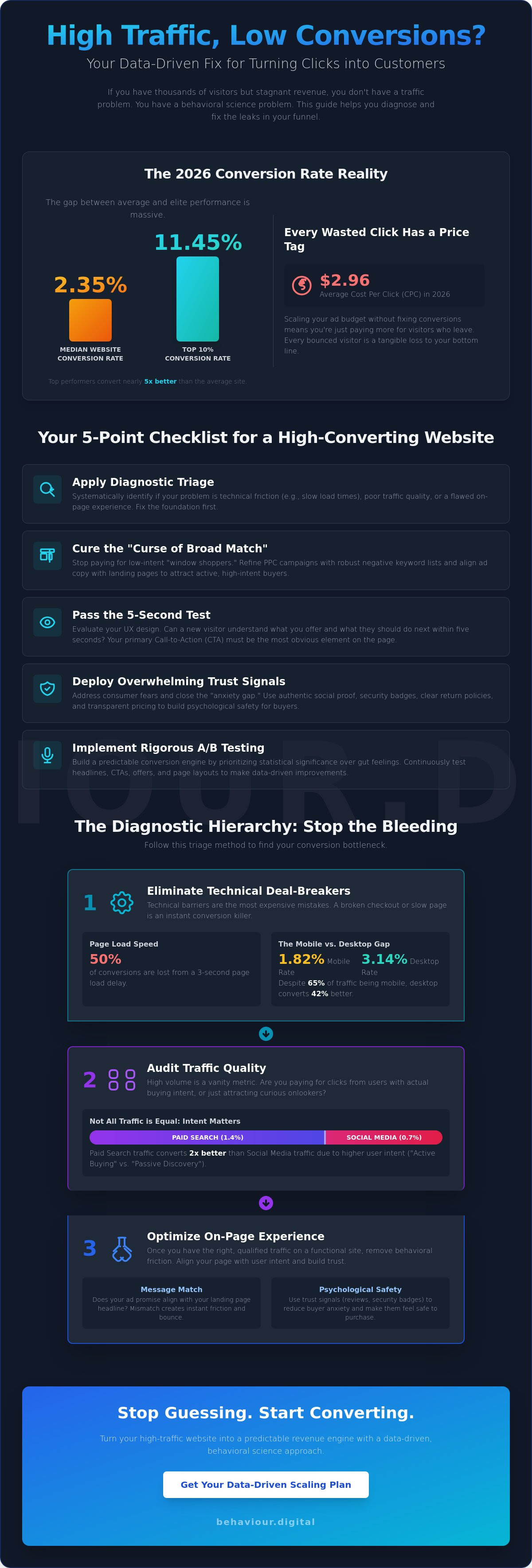
Did you know the median website conversion rate in 2026 is just 2.35%, while the top performers convert at 11.45% or higher? If you're seeing thousands of visitors but your revenue remains flat, you don't have a traffic problem; you have a behavioral science problem. Scaling your budget without a definitive high traffic but low conversions fix is simply subsidizing ad platforms while your ROI stagnates. With average CPCs climbing to $2.96 this year, every bounced visitor represents a tangible loss to your bottom line.
We understand the pressure of explaining to stakeholders why record traffic hasn't translated into profit. It's easy to feel lost in complex GA4 reports while watching ad spend vanish. This guide will help you stop the leak. We'll identify the exact bottlenecks in your marketing funnel and implement data driven fixes to turn your site into a predictable conversion engine. You'll gain a clear checklist to improve your ROAS and align your digital strategy with measurable business growth.
• Apply a diagnostic triage method to determine if your performance issues stem from technical friction, poor traffic quality, or on-page experience.
• Identify and eliminate the "Curse of Broad Match" in your PPC campaigns, ensuring your high traffic but low conversions fix focuses on high-intent active buyers.
• Utilize the 5-second test to evaluate your UX design and confirm that your primary call to action is the most obvious element on the page.
• Close the anxiety gap by deploying specific trust signals that address digital consumer fears and leverage the power of authentic social proof.
• Implement a rigorous A/B testing framework that prioritizes statistical significance over gut feelings to build a scalable and predictable conversion engine.
High traffic often acts as a smoke screen. It creates an illusion of success that hides deep structural flaws in your digital strategy. If your dashboard shows thousands of sessions but stagnant revenue, you need a high traffic but low conversions fix that follows a logical hierarchy. We utilize a triage method to stop the bleeding: first, eliminate technical friction; second, audit traffic quality; and third, optimize the on-page experience. This systematic approach ensures you aren't wasting resources on aesthetic changes when your checkout button is technically broken.
Success starts with differentiating between Top of Funnel (TOFU) awareness and Bottom of Funnel (BOFU) intent. If your acquisition strategy focuses solely on volume, you're likely attracting users who aren't ready to commit. Professional Conversion rate optimization requires precise tracking to distinguish these groups. With Google Analytics 4 enforcing a 37-month data retention policy for granular performance data as of June 2026, your historical benchmarks must be accurate. You need to know if your data is reflecting real human behavior or just bot activity and misconfigured events.
Technical barriers are the most expensive mistakes in any marketing funnel. Data shows a 3-second delay in page load can kill 50% of your potential conversions. If the site doesn't load instantly, the user journey ends before it begins. Mobile responsiveness is equally critical. While mobile accounts for 65% of all traffic in 2026, it converts at a mere 1.82% compared to 3.14% on desktop. This 42% gap suggests most checkouts aren't "thumb-friendly" or lack proper mobile payment integration. We also verify browser compatibility and broken scripts. A single JavaScript error on a lead form can render a high-budget PPC campaign worthless.
You can't fix what you haven't measured against industry reality. The median website conversion rate across all sectors currently sits at 2.35%. If your performance is significantly below this, your break-even point is likely out of reach. We look beyond the final sale to analyze micro-conversions like add-to-carts, newsletter signups, and scroll depth. These data points reveal exactly where users lose interest. Identifying these specific drop-off points is the first step in a high traffic but low conversions fix that relies on facts rather than intuition. Understanding these benchmarks allows us to build a strategy rooted in quantitative business growth.
Raw visitor volume is a vanity metric that often masks deep inefficiencies in your acquisition strategy. If your analytics show a surge in sessions without a corresponding lift in revenue, you're likely paying for the wrong audience. With the average cost per click in Google Ads rising to $2.96 in 2026, a 12% increase from the previous year, the cost of low-intent traffic has never been higher. A sustainable high traffic but low conversions fix requires shifting focus from broad reach to precise intent alignment.
The "Curse of Broad Match" remains a primary driver of wasted ad spend. While automated bidding strategies like Performance Max now drive 78% of Google Ads spend, they often pull in irrelevant queries if not strictly governed by a robust negative keyword list. You aren't just competing for clicks; you're competing for qualified attention. Social media traffic typically converts at just 0.7%, while paid search averages 1.4%. This gap exists because social media users are often "window shoppers" in a passive discovery mode, whereas search users demonstrate active buying intent. Relying on social volume without a secondary digital strategy to capture that intent leads to high bounce rates and exhausted budgets.
Message match is the baseline for retention. If your ad headline promises a specific solution but your landing page H1 delivers generic brand fluff, the user will leave within seconds. We see a significant performance divide between informational and transactional intent. Sending a user searching for "how to optimize ads" to a "Buy Now" checkout page creates immediate friction. Intent match is the strategic alignment of a user's specific problem with your immediate, visible solution.
First-time visitors rarely convert on their initial session. Without sophisticated retargeting, you're essentially letting 97% of your paid traffic walk away forever. Professional PPC Management involves filtering for high-intent demographics and excluding "Ghost Traffic"—the bot clicks and accidental mobile taps that inflate your metrics. By isolating users who have already engaged with your brand, you can serve tailored creative that addresses their specific stage in the funnel. Implementing a rigorous digital strategy ensures your budget is reserved for humans with the highest statistical probability of becoming customers.
Securing high-intent visitors is only half the battle. Once a user lands on your site, every pixel either facilitates a transaction or creates a barrier. Friction is the invisible force that prevents revenue growth. If your interface feels like a maze, users will leave regardless of how well your ads are targeted. A sustainable high traffic but low conversions fix requires a clinical look at User Experience (UX) design. You must ensure the 'Next Step' is the most visually dominant and logically obvious element on the page.
The 5-Second Test serves as a primary filter for clarity. If a visitor cannot identify what you sell and how to buy it within five seconds, your messaging has failed. We use heatmaps and session recordings to observe where users hesitate, scroll past critical information, or get stuck in dead-end loops. These tools provide the qualitative context that standard analytics lack. For example, simplifying lead forms is a direct lever for performance. Each additional field introduces cognitive load; reducing a form from six fields to three can significantly improve submission rates by removing unnecessary hurdles.
Generic buttons like 'Submit' or 'Click Here' are missed opportunities for value communication. Effective CTAs are value-based and action-oriented, such as 'Get My Strategy Audit' or 'Start Scaling Today.' We utilize visual hierarchy to guide the eye toward these conversion points. By leveraging high-contrast colors, strategic white space, and size differentiation, we ensure the user's path is unmistakable. Placement also matters. While 'above the fold' real estate is vital for immediate impact, repeating the CTA at the end of the page captures users who have finished consuming your supporting evidence.
Efficiency in the funnel is measured by the number of clicks required to reach a 'Thank You' page. Every extra step is a chance for a user to reconsider or get distracted. Mandatory registration is a notorious conversion killer that adds significant friction to the checkout process. Implementing a guest checkout option allows users to complete their purchase with minimal resistance. We rely on conversion optimisation to test these flow variations. By isolating variables in the checkout sequence, we can identify and remove the specific friction points that are currently suppressing your ROI.
Even with perfect technical performance and high-intent traffic, your revenue will stall if you fail to bridge the anxiety gap. Digital consumers are naturally skeptical. Every interaction involves a subconscious risk assessment where the user weighs the potential benefit against the risk of a bad investment. If your site doesn't feel safe, visitors will bounce before even reading your offer. A robust high traffic but low conversions fix must account for these unspoken fears by providing immediate, verifiable proof of competence and security.
We prioritize a realistic social proof hierarchy. Ten average, authentic reviews often carry more weight than a single, suspiciously perfect testimonial. Modern users look for patterns of reliability rather than curated perfection. Beyond reviews, authority signals like industry certifications, awards, and "As Seen In" logos further validate your market position. Risk reversal is the final piece of this psychological puzzle. Transparent pricing, clear return policies, and explicit guarantees remove the final barriers to commitment. When you eliminate the fear of a "wrong" decision, you clear the path for a seamless conversion.
Perception is reality in the digital sector. Implementing a professional Digital Strategy elevates your brand from a simple vendor to a trusted strategic partner. We move beyond vague promises by utilizing data-heavy case studies that document actual business outcomes. Social proof is the psychological shortcut to trust that bypasses logical resistance. By showcasing real-world results, you demonstrate that your solution isn't just a theory, it's a proven methodology for success.
Analytical data shows that "About Us" pages are frequently the second most visited page on a site before a conversion occurs. Users want to know the people behind the brand before they commit their budget. Visible contact information and live chat functionality prove there are real humans behind the interface, which is critical for building long-term confidence. We also recommend a pre-emptive FAQ section to address common objections before they become deal-breakers. Addressing concerns about data privacy, especially with new 2026 regulations regarding neural data and automated decision-making, is now a mandatory part of building psychological safety. To see how these elements fit into your broader growth plan, you should evaluate your current digital strategy for trust gaps.
Scaling a digital presence requires more than just a larger ad budget. It requires methodological precision. Many brands treat A/B testing as a one-off project, but it's actually a marathon of continuous refinement. Relying on gut feelings leads to erratic results and wasted resources. In contrast, focusing on statistical significance ensures that every change to your site is backed by quantitative proof. In 2026, companies utilizing AI-driven A/B testing platforms achieve statistically significant results 31% faster than those relying on traditional tools. This speed is vital for a high traffic but low conversions fix that actually moves the needle before your ad spend evaporates.
The transition from 'fixing' a broken funnel to 'scaling' a successful one marks the difference between a struggling business and a market leader. A professional conversion rate optimization agency pays for itself within months by reclaiming lost opportunities. We don't just look for surface-level changes. We analyze the underlying behavioral patterns that dictate how users interact with your brand. This analytical approach transforms your website from a passive brochure into a proactive sales tool that works around the clock.
Our methodology begins with a deep-tier data audit. We examine your GA4 configurations to ensure your "AI Assistant" channel and referral data are accurately captured. We prioritize Revenue per Visitor (RPV) over simple conversion percentages. This focus ensures that we aren't just getting more clicks, but more valuable ones. Our process moves from data collection to hypothesis testing and final implementation with surgical precision. Continuous monitoring is the final step. Digital markets are volatile, and what worked last quarter may require fine-tuning today to maintain peak performance.
You can implement quick wins in the next 24 hours. Start by auditing your mobile checkout flow and removing any non-essential form fields. Check your ad account for broad match keywords that are draining your budget on irrelevant searches. While these steps provide immediate relief, long-term growth requires a comprehensive digital strategy. It is time to stop guessing why your visitors aren't buying and start using data to drive your decisions. Request a professional audit of your current ad accounts to identify hidden bottlenecks. Let Behaviour Digital fix your funnel and turn your high-traffic site into a predictable revenue engine.
High traffic is a liability if it doesn't convert into revenue. You've learned how to audit your technical foundations, align search intent with landing page content, and bridge the anxiety gap with authentic trust signals. These aren't just cosmetic adjustments; they're structural improvements that protect your marketing budget from rising acquisition costs. Implementing a high traffic but low conversions fix is the critical difference between stagnant growth and a truly scalable business model.
As Glasgow's leading data-driven PPC experts, we have a proven track record of scaling ROI through methodological Conversion Rate Optimization. We offer transparent, monthly management with no hidden fees, ensuring your strategy remains focused on measurable results. It's time to stop guessing and start relying on a strategic partner that takes full responsibility for your performance goals. Your growth is a choice made through data and precision.
Stop wasting ad spend—Get a free Conversion Audit from Behaviour Digital and start building the high-performance funnel your business deserves. You're ready to turn every click into a measurable step toward sustainable success.
A good conversion rate is relative to your industry, but the median benchmark across all sectors is 2.35% as of June 2026. Websites in the top 10% of their respective industries achieve conversion rates of 11.45% or higher. If your performance remains below 2%, your digital strategy likely requires a structural audit to identify underlying friction points.
High bounce rates typically signal a disconnect between the user's intent and the landing page experience. This occurs when your ad creative promises a specific outcome that the page fails to deliver within the first few seconds. Technical barriers, such as slow load times or intrusive pop-ups, also contribute to high bounce rates by frustrating users before they can engage with your offer.
Analyze your engagement metrics to isolate the source of the failure. If visitors from high-intent search terms have a high scroll depth but don't convert, the problem is likely your offer or checkout process. If your traffic comes from broad, non-specific keywords and leaves the site almost immediately, your acquisition strategy is pulling in an unqualified audience that has no intention of buying.
Page speed is a critical determinant of revenue because users associate performance with professional reliability. A delay of just three seconds can result in a 50% reduction in conversion rates. High-performance websites prioritize technical optimization to ensure that load times don't become an invisible tax on their marketing spend and ROI.
PPC is the superior choice for rapid results because it allows for immediate targeting of high-intent search queries. While organic search is a valuable long-term asset, paid channels provide the instant data necessary for a high traffic but low conversions fix. You can validate offers and landing page designs through paid traffic in a fraction of the time it takes to see organic shifts.
Initial improvements from technical fixes and messaging clarity can be observed within weeks. However, achieving statistical significance for A/B testing usually requires one to three months, depending on your session volume. CRO is a continuous methodology of refinement rather than a one-time event, as user behavior and competitive landscapes shift constantly.
Poor mobile design is frequently the primary cause of conversion failure, given that mobile traffic represents 65% of all web visits in 2026. Mobile traffic currently converts at 1.82%, which is significantly lower than the 3.14% seen on desktop. If your mobile interface lacks thumb-friendly navigation or integrated payment options, you're losing the majority of your potential customers at the final stage.
You require a stack that combines quantitative analytics with qualitative behavioral data to implement a high traffic but low conversions fix. Google Analytics 4 is essential for tracking the new AI Assistant channel and baseline performance metrics. Complement this with heatmaps and session recordings to identify exactly where users hesitate, as companies using these data-driven tools achieve results 31% faster than those relying on intuition.

Luke leads strategy across every Behaviour Digital account — building data-driven advertising systems for ambitious brands. When he's not auditing ad accounts, he's writing about what he found in them.
Get a free, tailored growth plan — we'll run our framework on your accounts and show you exactly what we'd do.
Get your free growth plan →