.webp) Online
OnlineNot sure which channel fits your business?View all services →
Three inputs. Instant KPIs. No spreadsheets.Open a calculator →
OnlineYour Google Ads account is either a precision-engineered growth tool or a silent drain on your capital. With the July 1, 2026, Terms of Service update shifting full liability for AI-generated content onto advertisers, the stakes for oversight have never been higher. Most brands realize that "set and...

Your Google Ads account is either a precision-engineered growth tool or a silent drain on your capital. With the July 1, 2026, Terms of Service update shifting full liability for AI-generated content onto advertisers, the stakes for oversight have never been higher. Most brands realize that "set and forget" is a relic of the past, yet they still struggle with inconsistent reporting and budget leaks. Learning how to audit a google ads account is no longer a seasonal maintenance task; it's a necessary strategic defense against rising jurisdiction-specific fees and tracking gaps.
We understand the frustration of seeing ad spend climb while attribution becomes murkier due to the June 15, 2026, consent management changes. This guide provides a rigorous, data-driven framework to reclaim control over your performance. You'll master a professional methodology to eliminate wasted spend on irrelevant terms and ensure your tracking signals are accurate. We'll walk through a comprehensive checklist that covers everything from GCD audits to Performance Max product reporting, transforming raw data into a clear roadmap for scalable revenue and business growth.
• Shift your focus from vanity metrics like CTR to intent-to-revenue alignment by establishing your critical Break-Even ROAS.
• Learn how to audit a google ads account by evaluating campaign architecture and identifying where Broad Match might be siphoning your budget.
• Bridge the gap between ad clicks and revenue by auditing your "Message Match" and landing page conversion efficiency.
• Transform raw audit findings into a 90-day strategic roadmap using the 70/20/10 budget allocation rule for sustainable scaling.
High click-through rates and millions of impressions feel like progress, but they often mask systemic inefficiencies. In the 2026 landscape, a superficial glance at the Google Ads platform interface isn't enough. A true audit is a forensic investigation into how every pound spent translates into bottom-line revenue. If you aren't connecting your bidding strategies to Customer Acquisition Cost (CAC) and Lifetime Value (LTV), you aren't auditing; you're just proofreading.
The 2026 audit methodology focuses on intent-to-revenue alignment. This means looking past what Google calls "success" and examining your internal sales data. Platform optimism is a real risk. Google’s automated recommendations often prioritize volume over profitability, pushing advertisers toward broader reach that dilutes ROI. To understand how to audit a google ads account effectively, you must treat platform data as a starting point, not the final verdict.
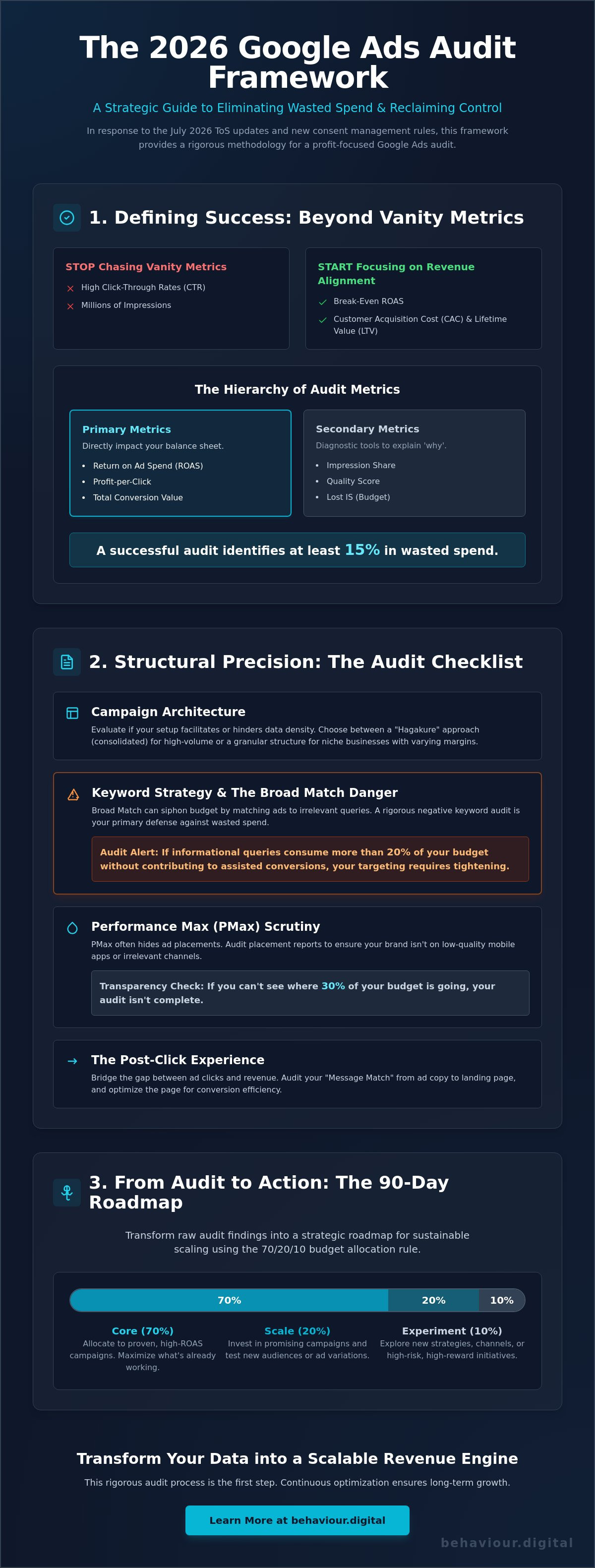
Success requires a clear distinction between what drives profit and what merely describes activity. Your audit must prioritize financial outcomes over technical delivery. We categorize these into two distinct layers:
ROAS (Return on Ad Spend), Profit-per-click, and total Conversion Value. These directly impact your balance sheet.
Impression share, Quality Score, and Lost IS (Budget). These are diagnostic tools that explain why your primary metrics are fluctuating.
A successful audit is one that identifies at least 15% in wasted spend.
National averages often fail to capture the nuances of regional competition. When conducting your 2026 audit, UK-specific CPC trends provide the necessary context for your performance. For businesses targeting a Scottish market, local search intent and regional cost fluctuations can significantly alter your baseline. You can't scale what you haven't benchmarked accurately.
Use historical data to identify seasonal performance anomalies that might skew your current view. An audit must account for these cycles to ensure your 90-day roadmap is based on sustainable growth rather than temporary market spikes. By establishing a rigorous baseline, you ensure that every optimization is a step toward a more scalable revenue engine.
The architecture of your account determines how effectively Google’s AI can optimize for your goals. When evaluating how to audit a google ads account in 2026, the first structural question is whether you're using a "Hagakure" approach or a granular, intent-based structure. Hagakure leverages machine learning by consolidating data into fewer, high-volume ad groups. However, if your business serves distinct niches with varying margins, a more granular approach remains superior for precise budget control. You must determine if your current setup facilitates or hinders data density.
Auditing keyword match types is your primary defense against wasted spend. Broad Match has become increasingly aggressive. It often matches your ads with queries that are only tangentially related to your service. You must cross-reference search term reports with conversion data to ensure Broad Match isn't stealing your budget from high-performing Exact Match terms. A rigorous negative keyword audit is the only way to plug these leaks. Identifying "leaking" queries that drain your ROAS should be a weekly priority, not a monthly afterthought.
Performance Max (PMax) requires specific scrutiny because it often hides where your ads actually show. You need to audit placement reports to ensure your brand isn't appearing on low-quality mobile apps or irrelevant YouTube channels. Transparency is the antidote to platform-driven inefficiency. If you can't see where 30% of your budget is going, your audit isn't finished.
A deep dive into search term reports reveals the gap between what you think you're buying and what users are actually typing. Categorize queries into high-intent and informational buckets. If informational queries consume more than 20% of your budget without contributing to assisted conversions, your targeting needs tightening. Proper PPC Management ensures this structural hygiene is maintained constantly to prevent performance decay.
Location targeting is a frequent source of budget waste in the UK market. Performance often varies wildly between regions. If your Glasgow-based campaigns are showing ads in London but converting at half the rate, you're overspending. Audit your geographic reports and apply bid modifiers or exclusions to prioritize your highest-value territories. If you want to stop the drain, our digital strategy experts can help align your structure with your specific growth targets.
Responsive Search Ads (RSAs) are the standard, but "Good" or "Excellent" strength ratings from Google don't guarantee revenue. You must audit your creative assets for actual resonance. Are your headlines addressing the specific pain points of your target audience? High ad relevance directly lowers your CPC by improving your Quality Score. Don't rely on automated suggestions; ensure your ad extensions are actually enhancing the user journey rather than just taking up space.
The click is only the beginning. If your audit stops at the Google Ads interface, you're ignoring 50% of the conversion equation. A comprehensive approach to conversion optimisation is essential to ensure that the traffic you've paid for actually performs. When you evaluate how to audit a google ads account, you must assess the "Message Match" between your ad copy and your landing page headlines. Disconnects here cause immediate bounces. If an ad promises a "Data-Driven 2026 Audit" but the landing page discusses general marketing services, the user's cognitive load increases, and your conversion rate plummets.
GA4 provides the forensic data needed to bridge this gap. Audit your Bounce Rate and Average Session Duration specifically by traffic source and campaign. High bounce rates on specific ad groups usually signal a mismatch in intent or a technical failure on the page. Identifying these friction points allows you to stop paying for high-intent clicks that have zero chance of converting. Data doesn't lie; if users spend less than ten seconds on your page, your ad targeting or your landing page is failing.
Mobile experience is no longer a secondary concern. Audit your site speed and UX for "thumb-friendly" navigation. If your page takes longer than 2.5 seconds to load on a 4G connection, you're losing money before the user even sees your offer. The synergy between conversion rate optimization and Google Ads success is absolute. Your audit should map the entire funnel to identify where users drop off, whether it's a complex lead form or a confusing checkout process.
User behavior in 2026 is non-linear. Most prospects don't convert on their first interaction with your brand. Your audit must account for how other channels, such as Social Media Marketing, support your search conversions through assisted pathways. Evaluate the effectiveness of your remarketing lists and audience signals. Are you retargeting users with the same message they already ignored, or are you moving them down the funnel with fresh, relevant creative? Understanding how to audit a google ads account involves looking at the account as a piece of a larger, integrated ecosystem where every touchpoint must be justified by data.
Platform data is often a curated version of reality. When you investigate how to audit a google ads account, your first priority is reconciling platform-reported ROAS with your actual bank balance. Google Ads doesn't factor in your cost of goods sold, shipping, or regional taxes. A reported 400% ROAS might look impressive, but if your margins are thin, you could actually be losing money on every sale. You must calculate your "Real ROAS" by exporting transaction data and cross-referencing it with total ad spend, including any jurisdiction-specific fees introduced in July 2026.
Establishing your Break-Even ROAS is the most critical step in this financial forensic process. Without this number, you're bidding in the dark. If your gross margin is 40%, your break-even ROAS is 2.5. Anything below this is a net loss. This figure dictates your entire bidding strategy. It allows you to identify which campaigns are genuine revenue engines and which are merely expensive hobbies. High Customer Lifetime Value (LTV) can justify a higher initial CPA, but only if your data proves that these customers return without further ad spend.
The June 15, 2026, update to consent management changed the rules of tracking forever. Google Ads now relies entirely on your website’s consent banner as the single source of truth. This shift makes "Last Click" attribution completely obsolete. A professional PPC agency Glasgow will instead audit for Data-Driven or modeled attribution. You must ensure your server-side tracking is correctly configured to capture signals that client-side cookies now miss. The focus has moved from simple tracking to complex behavioral modeling.
Relying solely on ROAS is a common mistake. You should also audit your Marketing Efficiency Ratio (MER), which measures total revenue against total ad spend across all channels. This provides a holistic view of your growth. Calculating the "Cost of Inaction" is equally vital. If your audit reveals £2,000 in monthly wasted spend, that’s £24,000 a year you’re handing to competitors. Break-even ROAS is the foundation of any scalable Digital Strategy. If your current account isn't hitting these financial benchmarks, book a professional performance audit to stop the bleed immediately.
Data without execution is merely overhead. Once you understand how to audit a google ads account, your focus must shift immediately to a 90-day optimisation roadmap. You shouldn't attempt to fix every sub-optimal setting at once. Instead, prioritise the high-impact leaks identified in your financial and structural review. This phased approach ensures that you're recouping wasted spend in the first 30 days, which can then be reinvested into higher-performing segments. A professional audit provides the clarity needed to stop guessing and start architecting growth.
We recommend the 70/20/10 budget rule to maintain stability while driving innovation. Allocate 70% of your capital to proven, high-ROAS campaigns that hit your break-even benchmarks consistently. Dedicate 20% to "near-win" opportunities that require further testing or landing page refinement. The final 10% is your experimental budget, used to test new audience signals or the latest Performance Max features. This structure prevents the stagnation that often occurs when accounts are managed without a clear, data-driven framework.
Sometimes, an audit reveals that a campaign structure is fundamentally broken. If your Broad Match terms are consistently matching with irrelevant intent despite an extensive negative list, or if your CPA remains double your LTV, it's time to pivot. Recognising these failures early is a sign of strategic strength, not weakness. It allows you to reallocate resources toward channels or structures that actually align with your business goals.
Scaling requires more than just increasing daily budgets. It demands a holistic Digital Strategy that integrates search data with your broader commercial objectives. Post-audit, you must implement transparent, real-time reporting dashboards. These tools allow you to identify "Winner" campaigns instantly, ensuring you can scale budgets during peak performance windows rather than waiting for end-of-month reviews. Accurate data visibility is the only way to maintain a competitive edge in the 2026 landscape.
There's a significant difference between "managing" an account and "architecting" growth. When evaluating a Glasgow-based agency, look for an audit suite that prioritises net profit and business value over platform-reported vanity metrics. A strategic partner takes responsibility for the entire funnel, from the first search query to the final conversion. If you're ready for a professional perspective that transforms raw data into a scalable revenue engine, book a comprehensive Google Ads audit with Behaviour Digital today. Let's align your ad spend with your 2026 growth targets.
A rigorous account review is the only way to ensure your capital works as hard as your strategy. By shifting focus from vanity metrics to break-even ROAS and bridging the post-click behavioral gap, you move beyond simple management into true growth architecture. You've seen how to audit a google ads account through the lens of financial truth and structural precision, ensuring every pound spent is accounted for in a privacy-first, modeled attribution environment.
Success in 2026 requires a partner that prioritizes profit over platform optimism. Our specialist PPC and Social Media team in Glasgow delivers transparent, performance-focused reporting that links raw data directly to your bottom line. With a proven track record in Conversion Rate Optimisation and behavioral growth, we don't just find budget leaks; we build the systems that prevent them from returning. Scale your growth with a data-driven Digital Strategy and turn your advertising into a predictable, high-margin revenue engine. The path to scalable growth starts with a commitment to data-driven precision.
Comprehensive audits should be conducted quarterly to identify long-term structural trends and strategic misalignments. High-spending accounts benefit from lighter monthly hygiene checks to catch immediate budget leaks or search term anomalies. Quarterly reviews provide enough data density to make statistically significant decisions about your 90-day roadmap and experimental budget allocations.
A successful ROAS is defined by your specific gross margins and break-even point, not industry averages. While many UK retailers aim for a 400% return, a business with thin margins might require 600% to stay profitable. You must calculate your break-even ROAS first to determine if your current performance supports sustainable growth or merely covers platform costs.
Discrepancies usually stem from differing attribution models and the June 2026 consent management updates. Google Ads often attributes revenue to the date of the last ad click, while Shopify records it on the transaction date. Furthermore, privacy-restricted tracking means some conversions are modeled based on aggregate data rather than directly tracked, leading to unavoidable reporting gaps between platforms.
Quality Score functions as a multiplier that either discounts or penalizes your actual CPC. A high score of 8 to 10 proves your ad’s relevance to the search intent, allowing you to secure top positions at a lower cost than competitors with poor relevance. Improving this score is one of the most effective ways to lower your acquisition costs without reducing your bid.
Yes, though PMax requires more advanced forensic techniques than standard search campaigns. You must analyze placement reports to exclude low-quality mobile app traffic and use the June 2026 API updates to review product-level performance across all networks. Auditing PMax is about finding where the automation is overreaching and pulling it back to high-intent signals.
CPA measures the cost of a specific lead or sale within the Google Ads interface, while CAC accounts for the total cost of acquiring a customer across all touchpoints. Your audit must distinguish between these to ensure your digital strategy remains profitable when accounting for overheads and agency fees. High-LTV customers can often justify a higher CPA that might initially look inefficient.
The Auction Insights report is your primary tool for identifying which competitors are aggressive on your core keywords. Combine this data with the Google Ads Transparency Center to analyze their creative messaging and landing page offers. This reveals gaps in their strategy, such as poor "Message Match" or weak calls-to-action, that your campaigns can exploit for better market share.
Start by verifying conversion tracking integrity to ensure your data is reliable. Second, dive into the search term report to identify and exclude irrelevant queries that are draining your budget. Finally, check your campaign settings for "Platform Optimism" defaults like the Display Network expansion. These three steps are the foundation of how to audit a google ads account for immediate financial impact.

Luke leads strategy across every Behaviour Digital account — building data-driven advertising systems for ambitious brands. When he's not auditing ad accounts, he's writing about what he found in them.
Get a free, tailored growth plan — we'll run our framework on your accounts and show you exactly what we'd do.
Get your free growth plan →