.webp) Online
OnlineNot sure which channel fits your business?View all services →
Three inputs. Instant KPIs. No spreadsheets.Open a calculator →
Online58% of companies still make critical website changes based on gut feelings rather than hard data, even as global e-commerce sales approach $8.1 trillion in 2026. You're likely tired of watching marketing budgets burn through low-converting pages while trying to explain why subjective opinions don't...

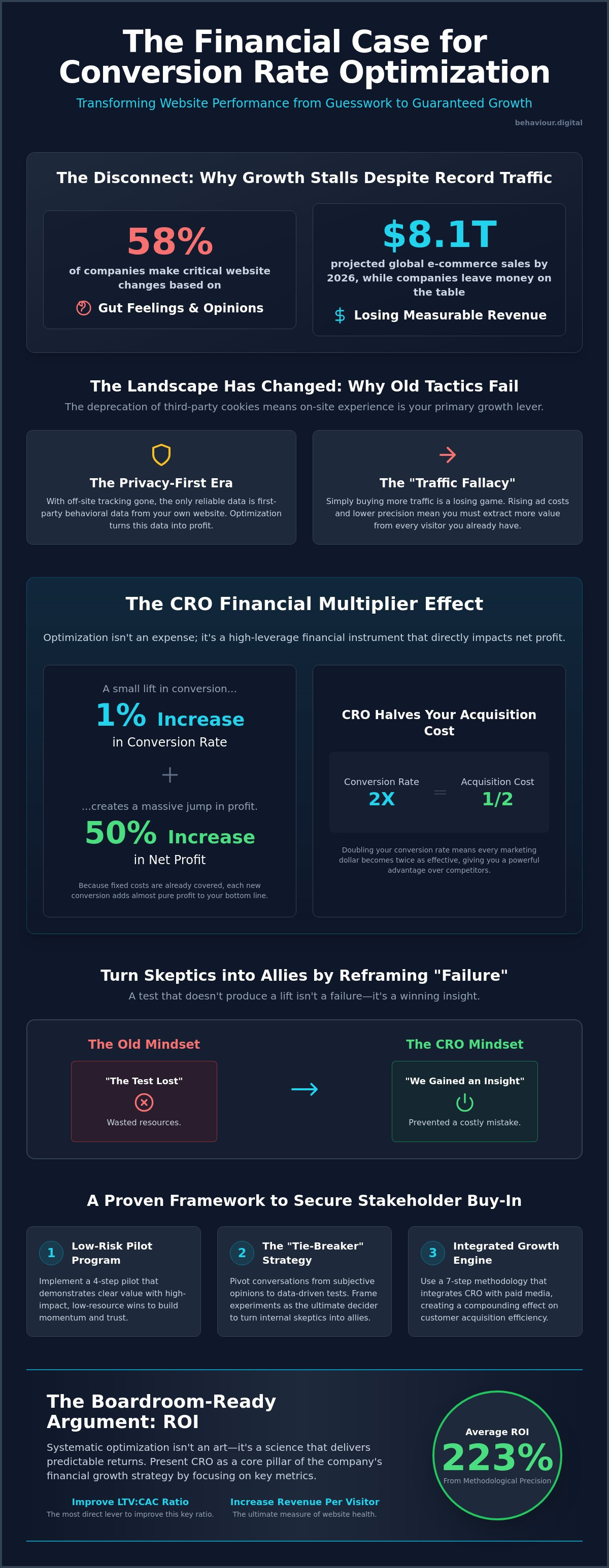
58% of companies still make critical website changes based on gut feelings rather than hard data, even as global e-commerce sales approach $8.1 trillion in 2026. You're likely tired of watching marketing budgets burn through low-converting pages while trying to explain why subjective opinions don't scale business growth. It's a common frustration. Securing executive buy-in feels impossible when you can't translate experimentation into a financial forecast that the CFO respects.
Learning how to convince stakeholders to invest in cro requires moving past technical jargon to focus on measurable value. This guide provides the data-driven frameworks and psychological tactics you need to master the boardroom strategy. We'll show you how to present CRO as a vital hedge against rising software inflation and privacy-driven acquisition costs. You will gain a clear business case template and the evidence needed to prove that a 223% ROI is the result of methodological precision, not luck. We'll also cover specific strategies to handle difficult stakeholders who prioritize intuition over evidence, ensuring your optimization roadmap becomes a core pillar of the company's financial growth.
• Translate technical optimization into executive-level language by demonstrating how a 1% conversion increase can drive a 50% rise in net profit.
• Navigate the 2026 privacy landscape by leveraging on-site behavioral data as your most reliable lever for sustainable, first-party growth.
• Implement a low-risk, 4-step pilot program that demonstrates how to convince stakeholders to invest in cro through high-impact, low-resource wins.
• Deploy the "Tie-Breaker" strategy to pivot from subjective opinions to data-driven tests, turning internal skeptics into strategic allies.
• Discover a 7-step methodology that integrates conversion efforts with paid media to create a compounding effect on customer acquisition efficiency.
The CRO Adoption Gap represents a systemic failure in modern digital strategy. It's the disconnect where marketing teams generate record-breaking traffic, yet the bottom-line profit remains flat. In the boardroom, this often manifests as a reluctance to pivot budget away from visible acquisition channels. Understanding What is Conversion Rate Optimization? is the first step toward closing this gap. It's not about superficial design changes. It's about aligning user psychology with business objectives through rigorous testing.
By July 2026, the digital environment has shifted fundamentally. The final deprecation of third-party cookies means that granular off-site tracking is a relic of the past. First-party data and on-site behavioral analysis are now the only reliable growth levers left. Despite this, many stakeholders suffer from the "Traffic Fallacy." They default to increasing PPC spend because it's easy to measure, even if the returns are diminishing. They view optimization as complex or risky. This hesitation usually stems from three barriers: perceived technical complexity, a fear of "failed" experiments, and a lack of immediate ROI visibility.
UK marketing costs have reached a tipping point. For Glasgow SMEs, simply buying more traffic is no longer a sustainable strategy. Ad platforms are more expensive and less precise than they were two years ago. This is where conversion rate optimization changes the equation. Instead of paying more to reach a broader audience, you extract higher value from the users you already have. CRO acts as a multiplier. If your conversion rate doubles, your acquisition cost effectively halves, making every other marketing channel more profitable.
A significant hurdle in how to convince stakeholders to invest in cro is the fear of losing. In a traditional mindset, a test that doesn't produce a positive lift is seen as a waste of resources. We must reframe this. A "losing" A/B test is actually a winning insight. It prevents the company from making expensive, permanent mistakes based on an executive's gut feeling. Even null results provide clarity on what does not influence your customers. When you build a culture where experimentation is celebrated as a data-gathering exercise, you remove the emotional weight of failure and replace it with a systematic path to success.
To master how to convince stakeholders to invest in cro, you must stop discussing design elements and start presenting financial instruments. Optimization is not an aesthetic choice; it is a structural necessity for protecting your margins. The math is undeniable. Since your fixed overheads and initial ad spend are already paid, a 1% increase in your conversion rate doesn't just result in a 1% revenue bump. It often leads to a 50% or higher increase in net profit. This leverage exists because every additional sale generated through optimization carries almost zero incremental cost.
This creates a compounding effect that makes every future PPC pound work harder. When your website converts at a higher rate, your Customer Acquisition Cost (CAC) drops significantly. This allows you to bid more aggressively in competitive auctions while maintaining higher profitability than your rivals. The Efficiency Frontier in digital marketing is the point where CRO and PPC spend are perfectly balanced for maximum ROI. Partnering with a performance-driven strategic partner ensures you reach this frontier by treating optimization as a core financial pillar rather than a series of isolated tests.
Executive teams care about the relationship between Lifetime Value (LTV) and CAC. CRO is the most direct lever to improve this ratio. While acquisition teams struggle with rising platform costs, optimization increases the Revenue Per Visitor (RPV), which is the ultimate metric for measuring site health. You must also present the Opportunity Cost. Calculate the specific revenue your business loses every month by maintaining its current conversion rate. If the global e-commerce market is hitting $8.1 trillion in 2026, the cost of inaction is a measurable financial drain that no CFO can ignore.
Beyond growth, optimization serves as insurance against catastrophic errors. Traditional "Big Rebrands" are notoriously risky and often lead to sudden drops in performance. Data-driven testing replaces these high-stakes gambles with incremental, verified improvements. Using a documented digital strategy allows you to align every test with long-term business goals. This prevents gut-feeling decisions from dictating the company's future. In a landscape where companies using CRO tools see an average ROI of 223%, sticking to opinions is no longer just inefficient; it's a fiduciary risk.
Stakeholders often reject optimization because they perceive it as an expensive, months-long commitment with no guaranteed return. You can bypass this institutional resistance by using a Minimum Viable CRO (MVCRO) approach. This framework is designed to generate proof of concept with minimal resources, answering the question of how to convince stakeholders to invest in cro through visible action rather than abstract theory. By starting small, you replace skepticism with curiosity.
The first step involves identifying 'Low-Hanging Fruit.' Focus on high-intent pages with high bounce rates or checkout processes where users drop off at specific fields. Once identified, move to step two: running a 'Paint Test.' This is a simple A/B test targeting a single, high-impact variable like a primary headline or a call-to-action button. The goal isn't a total site overhaul. It's validation of a specific hypothesis.
Step three is documenting the 'Ah-ha' moment. This occurs when you uncover a friction point stakeholders were previously unaware of, such as a mobile button that's unclickable on certain devices or a form field that confuses users. Finally, present the 'Calculated Scale.' Show the executive team the mathematical reality of what happens to the annual bottom line if the 5% lift seen in the pilot were applied across all traffic site-wide. It's much harder to ignore a verified revenue projection than a design suggestion.
Heatmaps and session recordings are essential for uncovering 'obvious' fixes that don't require complex engineering. A Five-Second Test can quickly prove if your messaging aligns with user intent or if visitors are leaving because they don't understand your offer. Focus your initial conversion optimisation efforts on your most expensive PPC landing pages. Since these pages already have a high cost-per-click, even a minor improvement in conversion rate provides an immediate, measurable boost to your return on ad spend.
Data alone can feel dry in a boardroom. Use the power of the 'Video Highlight' by showing a 30-second clip of a real user struggling to complete a purchase. This creates an emotional connection to the problem that spreadsheets cannot replicate. When presenting the numbers, translate 'statistical significance' into 'business confidence.' Tell your stakeholders that the data gives you 95% confidence that this change will increase revenue. This sets the stage for a more comprehensive partnership with a PPC agency Glasgow businesses trust to integrate traffic acquisition with iterative conversion scaling.
Boardroom resistance is rarely about the technology itself. It's almost always a byproduct of psychological biases and misaligned incentives. To master how to convince stakeholders to invest in cro, you must diagnose the specific archetype of resistance you're facing. The HiPPO (Highest Paid Person's Opinion) is perhaps the most frequent obstacle. They rely on intuition and past success. Instead of challenging their authority, use 'The Tie-Breaker' strategy. Propose an experiment that pits their intuitive idea against a data-backed alternative. This shifts the dynamic from a personal disagreement to a neutral, scientific inquiry where the data makes the final decision.
The Cheapskate requires a different tactical approach. They view every line item as a cost to be minimized rather than an investment to be optimized. You must reframe CRO as a saving mechanism. Highlight the specific volume of ad spend currently being wasted on landing pages that fail to convert. When you demonstrate that optimization is a hedge against wasted budget, the conversation moves from 'spending more' to 'wasting less.' For the Pixel Perfectionist, who prioritizes aesthetics over performance, use heatmaps to prove that 'pretty' designs often create friction. Show them that 'ugly' pages with clear hierarchies often convert better because they respect the user's cognitive load. Finally, keep 'The Ghost'—the absent stakeholder—engaged with automated, impact-focused reporting that connects testing wins directly to quarterly profit targets.
Effective persuasion relies on loss aversion. Research suggests that the pain of losing is twice as powerful as the joy of gaining. Frame your proposal around the revenue the company is currently losing to competitors in the Scottish market who have already adopted a culture of experimentation. Use social proof by citing industry leaders who use CRO to maintain their market share. You can also build emotional investment by inviting stakeholders to 'guess the winner' of an upcoming A/B test. This simple involvement makes them curious about the results and more supportive of the methodology.
Low-traffic sites actually have a higher strategic need for optimization. When every visitor comes at a premium, you cannot afford to let a single conversion opportunity slip through the cracks. If your traffic volume doesn't allow for high-velocity A/B testing, pivot to qualitative methods like heuristic analysis and session recording reviews. These tools provide deep insights into user friction without requiring massive data sets. CRO is about quality of insight over quantity of data. If you want to stop guessing and start growing, consult with a strategic partner who can turn your existing traffic into a high-performing revenue engine.
The Behaviour Digital difference is rooted in the structural integration of Conversion Rate Optimization into our core service offerings. Most agencies treat traffic acquisition and on-site performance as separate silos. We don't. By embedding CRO directly into our PPC and Social Media management, we ensure that every click we buy is directed toward a page that has been scientifically prepared to convert. This eliminates the common disconnect where high-quality traffic is wasted on low-performing assets.
Our 7-step optimization process provides the methodological precision required for boardroom confidence. We move from a deep-dive audit and heuristic evaluation to hypothesis building, technical implementation, and iterative scaling. This systematic approach ensures that every change is backed by quantitative data rather than subjective preference. When you present a partnership proposal to your board, you're not just asking for a budget; you're presenting a transparent, shared-success model designed for measurable business growth.
We combine global digital standards with the "Glasgow Advantage." Understanding the specific nuances of the Scottish market allows us to tailor user experiences that resonate locally while leveraging world-class testing technology. This dual focus helps our partners maintain a competitive edge in an increasingly crowded digital landscape.
Managing PPC Management and CRO under one roof is the most efficient way to scale. It eliminates the "blame game" often found when multiple agencies handle different parts of the funnel. When acquisition and conversion teams work as a single unit, the feedback loop is instantaneous. We've helped Glasgow businesses double their lead volume without increasing their ad spend by simply identifying and fixing the friction points in their existing funnel. The data from your paid campaigns feeds the CRO experimentation loop, creating a self-optimizing growth engine.
If you're still navigating how to convince stakeholders to invest in cro, a structured 30-day roadmap can help clear the path. Week one is dedicated to the Audit, where we identify the most significant revenue leaks. In week two, we launch a Pilot test to validate our initial findings. Week three involves the Presentation of results, where we translate data into the financial language your board understands. By week four, we move to Scale, applying winning insights across the entire site.
You don't have to build the business case alone. We offer a free CRO consultation to help you identify your highest-impact opportunities and draft a proposal that wins executive approval. Contact Behaviour Digital to build your CRO business case today and start turning your website into a high-performance asset.
Success in 2026 requires moving beyond the "Traffic Fallacy" to embrace a culture of rigorous experimentation. You've seen that how to convince stakeholders to invest in cro isn't about winning design debates; it's about presenting a documented financial hedge against rising acquisition costs. By implementing a Minimum Viable CRO pilot and reframing technical data into boardroom metrics like Revenue Per Visitor, you turn internal skeptics into strategic allies. The focus must remain on the compounding value of a site that extracts maximum profit from existing traffic.
As Glasgow-based data experts, we specialize in bridging the gap between traffic acquisition and bottom-line profit. Our proven 7-step optimization framework and integrated PPC and CRO strategy ensure that every pound of ad spend works harder for your business. Don't let your growth be dictated by gut feelings or outdated design trends. Secure your boardroom 'Yes' with a Behaviour Digital CRO Audit and start building your business case with a partner committed to your measurable success. Your path to a higher conversion rate begins with a single, data-backed decision.
Focus on the relationship between fixed acquisition costs and variable profit margins. You should explain that while ad spend is a linear expense, optimization provides a multiplicative effect on revenue without increasing the media budget. Demonstrate how a marginal lift in conversion rate significantly lowers the Customer Acquisition Cost (CAC), directly expanding the company's net profit margins. Presenting CRO as a financial hedge against rising platform costs is the most effective way regarding how to convince stakeholders to invest in cro during budget reviews.
The primary barrier is usually a lack of immediate ROI visibility combined with a preference for visible acquisition metrics. Many executives suffer from the "Traffic Fallacy," believing that more visitors automatically lead to more growth. They often view optimization as a vague design project rather than a rigorous financial strategy. You can overcome this by framing the lack of optimization as a measurable daily loss of revenue rather than a missed future opportunity.
Yes, low-traffic sites can and should prioritize optimization to maximize the value of every expensive visitor. While high-velocity A/B testing requires significant data, low-traffic environments benefit from qualitative research methods. You should use heuristic analysis, session recordings, and user testing to identify and fix friction points. These methods provide high-quality insights that allow you to make impactful changes based on user behavior rather than just statistical volume.
Initial insights and "low-hanging fruit" wins can often be identified and implemented within the first 30 days of a pilot program. However, a mature optimization strategy typically requires three to six months to produce statistically significant, site-wide revenue growth. This timeline allows for multiple testing cycles and the compounding effect of incremental improvements to manifest in the quarterly financial reports.
UX research focuses on the quality of the user experience and general usability, while CRO is strictly focused on commercial outcomes. UX is the methodology used to understand "how" a user interacts with a site, whereas CRO uses those insights to drive the "how much" in terms of revenue and conversions. They are complementary disciplines, but CRO is the one that directly aligns with the boardroom's focus on bottom-line growth.
You should pivot the conversation from subjective opinions to objective experimentation using the "Tie-Breaker" strategy. Instead of saying "no," propose a split-run test that pits the stakeholder's idea against a data-backed alternative. This approach respects their input while allowing the users' actual behavior to dictate the final decision. It's much easier to how to convince stakeholders to invest in cro when you let the data act as the neutral arbiter of success.
Optimization is a continuous methodology, not a one-off project with a fixed end date. Digital markets, user behaviors, and competitor strategies evolve constantly, meaning a page that converts well today may underperform in six months. Ongoing optimization ensures that your website remains at the "Efficiency Frontier," where your acquisition spend and conversion rates are perfectly balanced for maximum long-term profitability.
A modern pilot program requires a stack that prioritizes privacy compliance and first-party data. You need a robust A/B testing platform, heatmapping software, and session recording tools that honor Global Privacy Control (GPC) signals. Additionally, AI-enhanced behavioral analytics are now essential for identifying patterns in user friction that traditional analytics might miss. Starting with these core tools allows you to gather the evidence needed to justify a larger, more permanent investment.

Luke leads strategy across every Behaviour Digital account — building data-driven advertising systems for ambitious brands. When he's not auditing ad accounts, he's writing about what he found in them.
Get a free, tailored growth plan — we'll run our framework on your accounts and show you exactly what we'd do.
Get your free growth plan →