.webp) Online
OnlineNot sure which channel fits your business?View all services →
Three inputs. Instant KPIs. No spreadsheets.Open a calculator →
OnlineWhat if the biggest risk to your company's growth in 2026 isn't the money you're spending on ads, but the revenue you're leaving on the table by underfunding them? It's a common challenge; leadership often views digital advertising as a line item expense rather than a scalable investment. You've lik...

What if the biggest risk to your company's growth in 2026 isn't the money you're spending on ads, but the revenue you're leaving on the table by underfunding them? It's a common challenge; leadership often views digital advertising as a line item expense rather than a scalable investment. You've likely struggled with how to justify ppc budget to my boss when attribution feels complex and the fear of budget cuts looms despite your solid performance.
We're going to change that narrative. This guide provides the exact framework you need to transform your PPC accounts from a cost center into a high performance growth engine. You'll learn how to leverage data, such as the 200% average ROI seen in well managed campaigns, to build a bulletproof case for your strategy. We'll walk through a clear pitch deck structure and provide the technical confidence to present ROI data that secures approval for higher monthly spend. It's time to move past defensive reporting and start presenting PPC as the primary driver of your firm's measurable business development.
• Learn to translate technical metrics like CTR and CPC into high-level business outcomes such as Customer Acquisition Cost (CAC) and Lifetime Value (LTV).
• Identify the "Cost of Inaction" to demonstrate how reducing spend leads to "Data Decay" and a permanent loss of competitive positioning in the auction.
• Utilize a structured 4-step framework for how to justify ppc budget to my boss by modeling conservative, target, and aggressive performance scenarios.
• Discover how strategic management and advanced 2026-era technology can eliminate waste and transform ad spend into a predictable revenue engine.
Leadership skepticism usually stems from a lack of transparency. If a budget holder doesn't see a direct line from a pound spent to a pound earned, they'll categorize the activity as a "cost center." This is the primary hurdle when you're figuring out how to justify ppc budget to my boss. Traditional media often relies on vague "awareness" metrics that are difficult to quantify. In contrast, the Pay-per-click (PPC) advertising model allows for granular tracking. Every click is a data point; every conversion is a measurable business outcome. When you frame PPC as a "Revenue Engine," you shift the conversation from "how much are we spending?" to "how much can we profitably grow?"
Intent-based PPC targets users who are actively seeking a solution. This is fundamentally different from awareness-based spending where you're essentially hoping to be noticed by a broad audience. With PPC, you're paying for a seat at the table exactly when the customer is ready to buy. This predictability is why a well-tuned account can turn £1 into £5 with mathematical precision. Transparency builds the trust that traditional media cannot match. In 2026, we have the tools to see exactly where every penny goes. If a campaign isn't performing, we see it instantly and pivot. This level of accountability removes the "black box" mystery that often surrounds marketing budgets.
Most decision makers prioritize risk mitigation. They aren't necessarily against growth; they're against waste. To bridge this gap, present PPC as a series of controlled experiments with a strictly capped downside. You aren't asking for a blind check. You're asking for an investment in a system that provides real-time feedback. Align your goals with the company’s 2026 fiscal year objectives. If the firm needs to increase market share by 12% by Q4, show how PPC intent signals provide the fastest route to that target. Bosses appreciate a strategic partner who speaks the language of the balance sheet, not just the marketing dashboard.
You don't need to explain Quality Score or Broad Match modifiers to get a budget increase. Instead, explain "The Auction" as a competition for digital real estate. High intent searches are a finite resource. If your business isn't there, your competitors are. Buying data is just as critical as buying leads during the initial phases of a campaign. This data informs your entire digital strategy, from landing page optimization to product development. However, effective execution requires precision. Utilizing professional PPC Management is often the most efficient way to reduce wasted spend. It ensures that the "Revenue Engine" doesn't stall due to technical oversight or outdated bidding strategies. By focusing on the value of the information gathered, you position PPC as a strategic asset that benefits every department.
Your boss doesn't care about your Click-Through Rate (CTR). High CTR might indicate compelling ad copy, but on a balance sheet, it's just a precursor to an expense. To successfully address how to justify ppc budget to my boss, you must translate platform specific metrics into financial outcomes. This means moving from Cost Per Click (CPC) to Customer Acquisition Cost (CAC) and, ultimately, to Lifetime Value (LTV). When you present a PPC budget, you're essentially asking for permission to purchase customers at a discount. If your LTV is £5,000 and your CAC via PPC is £500, the argument for increasing spend becomes a simple mathematical certainty rather than a marketing request.
Return on Ad Spend (ROAS) is the primary acronym that resonates in the boardroom. It provides a direct ratio of revenue generated for every pound spent on advertising. However, you must also address the "Incremental Growth" question. Leaders often fear that PPC simply cannibalizes organic traffic they would have received anyway. You can counter this by presenting "lift" data. Show how total revenue increases when PPC is active compared to when it's paused. When you're determining how much your marketing budget should be, grounding your request in these bottom-line figures removes the emotional bias from the decision making process.
Reporting on vanity metrics like impressions or "engagement" often triggers more skepticism than support. These numbers don't pay the bills. Instead, focus on "Bottom-Line Impact." Track how many qualified leads actually turned into signed contracts or closed sales. By integrating conversion rate optimization into your strategy, you demonstrate a commitment to efficiency. You aren't just asking for more money to buy more clicks; you're actively working to multiply the value of the traffic you already have. This shows professional maturity and a deep alignment with the company's profitability goals.
The PPC landscape in 2026 is dominated by AI and automation. Verified data shows that 78% of all Google Ads spend is now managed by Smart Bidding strategies. These algorithms require a consistent, healthy budget to "learn" and optimize effectively. If you cut the budget, you're essentially starving the machine of the data it needs to perform. Use historical data to forecast future performance, but be transparent about the "Diminishing Returns" curve. Every market has a sweet spot where spend and profit are perfectly balanced. Identifying this point proves you aren't just spending for the sake of it, but are focused on maximizing the marginal return on every pound. For a more detailed look at these numbers, you might find our performance analysis tools helpful in visualizing your next quarterly projection.
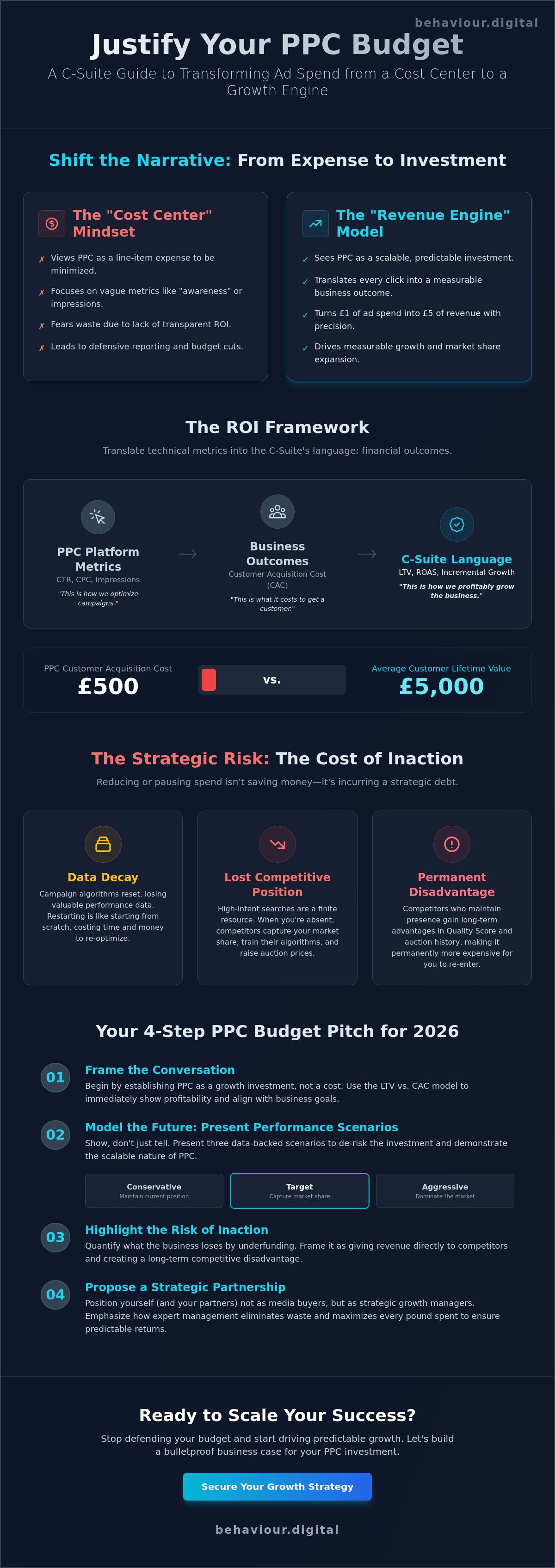
Slashing a PPC budget might look like a quick win for the quarterly balance sheet, but it often creates a strategic deficit. This "Cost of Inaction" (COI) is usually more expensive than the original investment. When you stop bidding, you don't just stop spending; you surrender your digital real estate to rivals. In a winner takes all auction, once you lose your position, winning it back requires a significantly higher spend to overcome the momentum your competitors have built. Understanding this risk is essential when you're evaluating how to justify ppc budget to my boss during periods of financial scrutiny.
Brand protection is another critical factor. If you don't bid on your own brand terms, your competitors certainly will. They'll appear at the very top of the page when potential customers are searching specifically for your business. This isn't just a loss of a click; it's a loss of a high intent customer who was already at the bottom of the funnel. Choosing The Right Metrics For Each Channel helps illustrate that PPC acts as a defensive shield for your brand equity. Surrendering this space to a rival is a strategic error that goes beyond simple marketing costs.
Think of the Search Engine Results Page (SERP) as limited shelf space in a prime retail location. Your presence there is a finite resource. When you exit the auction, you aren't just saving money; you're allowing competitors to lower their own CPCs because there's less competition. They'll use your absence to aggressively capture your market share at a discount. For businesses operating in specific regions, our PPC agency Glasgow guide provides deeper insights into how local market dynamics shift when major players stop bidding.
In 2026, PPC accounts rely on a continuous flow of data to feed AI bidding models. Research shows that 78% of all Google Ads spend is now managed by Smart Bidding. Stopping a campaign causes "Data Decay," where the algorithm loses the historical context needed to bid efficiently. When you eventually restart, you'll face a "re-learning" phase. This period is notoriously inefficient and makes future leads more expensive. This hidden cost is a powerful argument for how to justify ppc budget to my boss. You aren't just buying traffic; you're maintaining a refined, data driven machine that becomes more expensive to rebuild every day it stays offline.
Data provides the foundation, but a narrative wins the budget. When you're preparing how to justify ppc budget to my boss, you need a structured approach that mirrors a financial business case rather than a marketing report. Leadership responds to clarity, risk management, and projected growth. This four step template moves the conversation from "spending more" to "scaling faster."
Start with a transparent review of current performance. Acknowledge where the budget was spent efficiently and, more importantly, where it wasn't. Brutal honesty builds the credibility needed for the next three steps.
Don't present a single number. Instead, model three scenarios: Conservative, Target, and Aggressive. This allows your boss to choose their preferred risk level while seeing the potential rewards of each.
Show exactly how you will improve efficiency. This might involve a more refined Digital Strategy or a focus on conversion rate optimization to lower your lead costs.
Be specific. State the exact monthly spend required and the expected return based on your target scenario. Vague requests for "more budget" are usually met with a "no."
A spreadsheet that visualizes ROI at different spend levels is your most powerful tool. The "Conservative" scenario should focus on maintaining current performance or reaching a break-even point to reduce the fear of loss. This is your safety net. The "Aggressive" scenario, however, should highlight untapped market potential. Use competitor data to show what your rivals are currently capturing and what the business is missing by staying at the current spend level. This contrast makes the "Target" scenario feel like a logical, balanced middle ground.
PPC doesn't exist in a vacuum. To strengthen your case, prove that your leads are "sales-ready." High-intent search traffic often converts faster than other channels. Use testimonials from the sales team to back up your data; if they're closing the leads you provide, they'll be your biggest allies in the budget meeting. Draft a single, punchy sentence that ties your requested PPC spend directly to the CEO’s primary goal. If the company wants to dominate a specific vertical, show how PPC is the fastest way to gain that foothold. If you need help modeling these outcomes, you can request a performance audit to validate your projections before the big meeting.
Professional management isn't an added expense; it's a mechanism for waste reduction. When you're analyzing how to justify ppc budget to my boss, the most compelling argument is often the "Agency ROI." An expert partner identifies and eliminates inefficient spend that internal teams might miss. In 2026, click fraud is estimated to cost advertisers $42 billion globally. A strategic partner uses advanced tools to mitigate these risks, ensuring your budget reaches genuine prospects. This precision transforms your ad spend into a lean, high performance asset that pays for its own management through improved efficiency.
Access to 2026-level technology is another significant advantage. Proprietary AI tools and cross platform analytics suites carry heavy subscription costs for individual businesses. By partnering with a specialist, you gain the benefits of these advanced systems without the overhead. We focus on continuous optimization because "set it and forget it" strategies are the fastest way to lose budget approval. Markets shift daily. Our approach at Behaviour Digital is rooted in transparency and quantitative data. We don't just manage clicks; we manage your bottom line by ensuring every campaign remains aligned with your shifting business objectives.
A strategic partner views your marketing through a wider lens. We don't just look at the ad; we analyze the entire conversion optimisation funnel. If your landing pages aren't converting, even the best PPC campaign will fail. We provide weekly reporting that speaks "Boss Language." This means we focus on revenue, profit margins, and market share rather than technical jargon. By handling the complex day to day adjustments, we significantly reduce the management burden on your internal staff, allowing them to focus on high level company strategy.
The most effective way to start your pitch is with an objective baseline. You can request a free PPC audit to identify immediate opportunities for improvement. This audit serves as the factual foundation for how to justify ppc budget to my boss. Be prepared for the inevitable "What about SEO?" question. A balanced Digital Strategy uses PPC for immediate, high intent results while organic efforts build long term equity. Ready to build your business case? Book a strategy session with Behaviour Digital to turn your data into a winning presentation.
Mastering the art of how to justify ppc budget to my boss requires a pivot from technical reporting to strategic business alignment. You've seen how translating platform metrics into Customer Acquisition Cost (CAC) and Lifetime Value (LTV) changes the conversation from an expense to an investment. By highlighting the Cost of Inaction, you demonstrate that maintaining a presence in the auction isn't just about leads; it's about protecting your digital real estate and market share in 2026.
To build a bulletproof case, you need precise data and expert insights. Our Glasgow-based expert team uses 2026 data-driven strategies and transparent ROI reporting to ensure every pound is accounted for. Get a Professional PPC Audit to Back Your Budget Pitch and walk into your next meeting with total confidence. The right framework turns skepticism into support. It's time to stop defending your budget and start scaling your results.
Explain Return on Ad Spend (ROAS) as a simple revenue multiplier. If you spend £1,000 and generate £5,000 in sales, your ROAS is 5x. It's the most direct way to show how effectively your budget is being converted into gross revenue. This metric is far more persuasive than technical data because it speaks the language of the balance sheet.
High organic traffic doesn't guarantee you're capturing all available high-intent searches. PPC allows you to dominate more digital real estate and protect your brand from competitors who may be bidding on your name. It also provides a way to test new keywords and offers instantly, providing data that can eventually refine your long term digital strategy.
A monthly budget is essential for modern advertising. Since 78% of Google Ads spend is now managed by Smart Bidding, the algorithms require a consistent flow of data to optimize performance. Project-based spending creates "data gaps" that force the AI back into inefficient learning phases. This consistency is a vital part of how to justify ppc budget to my boss as it ensures long term stability.
While some leads appear immediately, a campaign typically needs two to four weeks to move past the initial learning phase. On average, a well-managed PPC campaign can deliver an ROI of 200%. You should look for stable performance trends within the first 90 days as the system gathers enough conversion data to bid with precision.
Shift the conversation from the cost of the click to the value of the customer. A high Cost Per Click (CPC) is a secondary concern if the Customer Acquisition Cost (CAC) remains profitable. If a £15 click results in a contract worth thousands, the individual click cost is irrelevant. Focus on the final margin rather than the entry price.
PPC leads are based on active intent, while social media is based on interruption. A user searching for a specific service on Google is further down the sales funnel than someone browsing a social feed. You can prove this by comparing the "close rate" of leads from both channels; search intent almost always results in higher quality prospects.
The Cost of Inaction is the financial penalty for staying out of the market. When you stop bidding, you lose historical data momentum and surrender market share to rivals. This is a powerful angle for how to justify ppc budget to my boss. It shows that the price of winning back a lost customer later is often much higher than the cost of keeping them now.
Focus on transparency and a rigorous "As-Is" audit. Previous failures often stem from a lack of clear strategy or poor reporting. Present a roadmap that includes specific KPIs and real-time data access. By showing a methodical, result-oriented framework, you demonstrate that your current plan is built on measurable business development rather than vague promises.

Luke leads strategy across every Behaviour Digital account — building data-driven advertising systems for ambitious brands. When he's not auditing ad accounts, he's writing about what he found in them.
Get a free, tailored growth plan — we'll run our framework on your accounts and show you exactly what we'd do.
Get your free growth plan →