.webp) Online
OnlineNot sure which channel fits your business?View all services →
Three inputs. Instant KPIs. No spreadsheets.Open a calculator →
Online78% of all Google Ads spending is now driven by AI, yet average CPAs have climbed by 12% this year to reach $23.74 across most industries. If you feel like you're fighting a losing battle against rising platform competition and wasted spend on low-intent clicks, you aren't alone. The most effective...

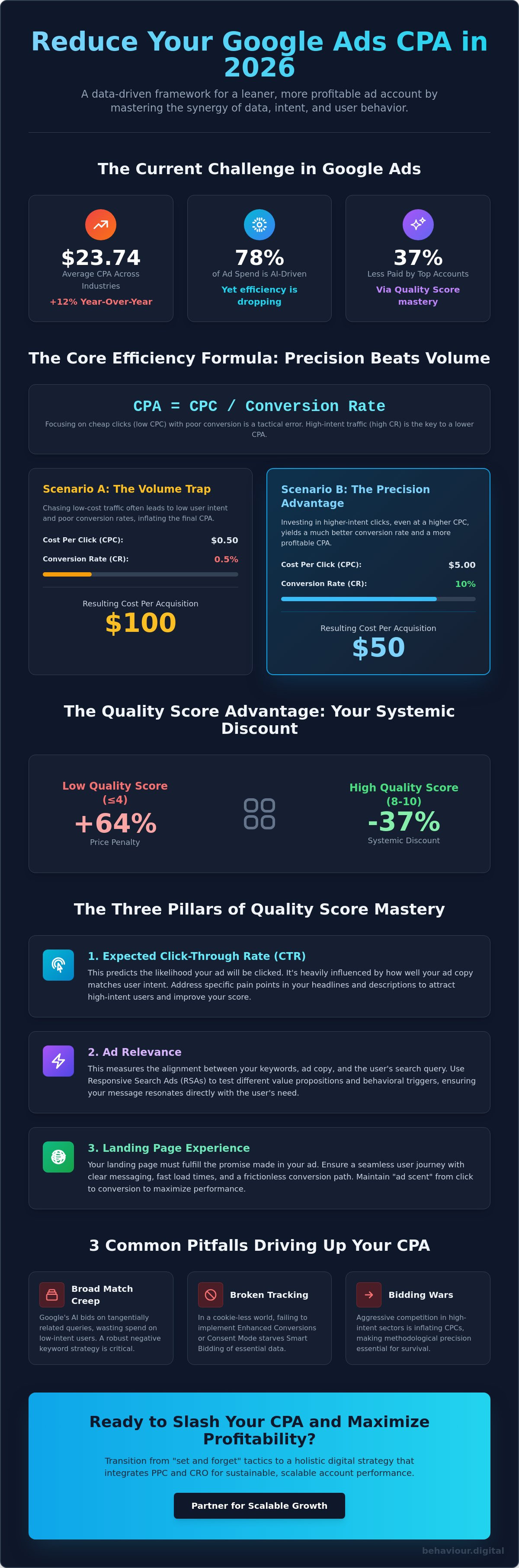
78% of all Google Ads spending is now driven by AI, yet average CPAs have climbed by 12% this year to reach $23.74 across most industries. If you feel like you're fighting a losing battle against rising platform competition and wasted spend on low-intent clicks, you aren't alone. The most effective way to reduce cost per acquisition google ads in 2026 isn't simply letting the algorithm take the wheel. It requires a precise marriage of quantitative data and behavioral alignment to ensure you're only paying for clicks that actually convert.
You've likely noticed that high-volume keywords no longer guarantee high-value leads, especially as Google prioritizes user intent over exact matching. We've designed this guide to help you discover the data-driven frameworks and behavioral optimisations required to slash your Google Ads CPA without sacrificing lead quality. You'll learn how to leverage Quality Scores to pay 37% less than the median, how to navigate the new 37-month data retention policy, and how to align your PPC strategy with landing page performance for a leaner, more profitable account.
• Differentiate between CPA and CAC to accurately measure campaign efficiency against broader business profitability and lifetime value.
• Optimize the three pillars of Quality Score—Expected CTR, Ad Relevance, and Landing Page Experience—to secure a systematic discount on your ad spend.
• Implement robust data tracking to ensure Smart Bidding models have the high-quality signals necessary to reduce cost per acquisition google ads.
• Leverage behavioral science and Conversion Rate Optimization (CRO) to eliminate friction and maintain "ad scent" from the initial click to the final conversion.
• Transition from "set and forget" tactics to a holistic digital strategy that integrates PPC and CRO for sustainable, scalable account performance.
Cost Per Acquisition (CPA) is the definitive metric for performance marketing efficiency. It represents the total campaign cost divided by the number of successful conversions. While it measures the direct cost of an action within Google Ads, it differs from Customer Acquisition Cost (CAC). CAC is a broader business metric that incorporates sales salaries, CRM costs, and offline overheads. Understanding this distinction is vital for accurate financial modeling. To reduce cost per acquisition google ads, you must first accept that CPA is a reflection of your entire funnel, not just your bidding strategy.
In 2026, the average cross-industry CPA has climbed to $23.74. This 12% year-over-year increase is driven by platform saturation and a fundamental shift toward privacy-first tracking. Advertisers often chase "cheap clicks" in an attempt to lower costs, but this is a common tactical error. Low-cost traffic frequently lacks intent, leading to poor conversion rates that actually drive your CPA higher. If a click costs $0.50 but converts at 0.5%, your CPA is $100. If a high-intent click costs $5.00 but converts at 10%, your CPA is only $50. Precision always beats volume.
The efficiency of your account relies on a simple formula: CPA = CPC / Conversion Rate. If your Cost Per Click is the current industry average of $2.96 and your conversion rate is 5%, your CPA is $59.20. If you double your conversion rate through better behavioral alignment, your CPA drops to $29.60 even if your CPC remains unchanged. Focusing solely on CPC is a mistake because it ignores the quality of the traffic. High-performing accounts prioritize "Value Per Acquisition" to ensure every lead justifies the investment.
Several technical shifts are making efficiency harder to maintain. You're likely facing these specific challenges:
Google's AI increasingly bids on queries that are only tangentially related to your service, leading to wasted spend on low-intent users.
In a cookie-less world, failing to implement Enhanced Conversions or Consent Mode starves Smart Bidding of the data it needs. When the algorithm can't see who converted, it defaults to broader, more expensive targeting.
In high-intent business sectors, aggressive competition is inflating CPCs by 12% annually, making methodological precision a requirement for survival.
Success in this environment requires moving beyond basic adjustments. It demands a strategy that treats data quality and landing page experience as equal partners to the ads themselves.
Quality Score acts as a systemic discount on your advertising costs. In 2026, data shows that accounts with scores between 8 and 10 pay 37% less per click than the median. Meanwhile, those with scores of 4 or below suffer a 64% price penalty. This massive gap is where most businesses lose their budget. To reduce cost per acquisition google ads, you must treat Quality Score as a strategic priority rather than a technical footnote. It's the most direct lever you have to lower costs while maintaining high-intent traffic.
The transition from simple keyword matching to intent matching is the most significant shift in modern PPC. It's no longer enough to include the search term in the headline. You must align the ad's messaging with the user's stage in the buying journey. High-intent users don't want a definition; they want a solution. By refining your digital strategy to address specific pain points, you naturally improve the three pillars of Quality Score: Expected CTR, Ad Relevance, and Landing Page Experience.
Ad relevance is the bridge between search query and solution. It measures how closely your ad matches the user's intent. Using Responsive Search Ads (RSAs) allows you to test multiple behavioral triggers simultaneously. Instead of just repeating keywords, test different value propositions to see which hooks resonate with your target audience. Ad assets also play a critical role here. They increase your visual real estate on the SERP and provide immediate proof of value. This filters out low-quality clicks and improves overall click quality, which is essential to reduce cost per acquisition google ads over time.
Negative keywords are your primary defense against "budget burners." Many accounts waste significant spend on informational searches, such as "how to" or "free," when they should be targeting transactional intent. Identifying these patterns requires more than a casual glance at search term reports. We recommend using N-Gram analysis to find hidden waste across thousands of queries. By identifying specific word combinations that never lead to conversions, you can build shared negative lists. These lists protect your entire account, ensuring your budget is reserved for high-intent traffic that actually converts.
AI-powered bidding now accounts for 78% of all Google Ads spending. This shift isn't just a trend; it's the new operational standard. Advertisers who successfully leverage Smart Bidding report a 22% lower cost per conversion on average compared to manual CPC. However, automation is not a substitute for strategy. To reduce cost per acquisition google ads, you must move beyond the "set and forget" mentality. The effectiveness of Google's algorithms is entirely dependent on the quality of the signals you provide. If you feed the system "garbage" data, you'll receive "garbage" results in the form of inflated costs and low-quality leads.
Choosing between Target CPA (tCPA) and Target ROAS (tROAS) depends on your specific business objectives. While tROAS is ideal for eCommerce brands focusing on high-margin products, tCPA is the surgical tool of choice for lead generation and service-based businesses. It forces the system to prioritize cost efficiency over pure conversion volume. Implementing Enhanced Conversions and Consent Mode is essential here. These tools ensure your tracking remains accurate in a privacy-first world, providing the algorithm with the granular data it needs to bid aggressively for high-intent users while ignoring those unlikely to convert.
Portfolio Bidding offers another layer of control for complex accounts. By grouping multiple campaigns under a single bidding strategy, you increase data density. This allows the algorithm to learn faster by seeing patterns across your entire account rather than waiting for individual campaigns to hit conversion thresholds. It's a highly effective way to stabilize performance and maintain a leaner CPA across diverse service lines.
Target CPA bidding requires a stable foundation of historical data to function. We recommend a minimum threshold of 30 conversions over the last 30 days before transitioning from manual bidding or Maximize Conversions. Setting your initial tCPA based on your actual 30-day historical average, rather than an aspirational goal, prevents the algorithm from stalling. To avoid the disruptive "Learning Phase," keep your target and budget adjustments under 20% at any one time. This incremental approach ensures the system continues to reduce cost per acquisition google ads without sacrificing lead flow.
First-party data is your most valuable competitive asset in 2026. Uploading Customer Match lists allows you to guide Google's AI toward users who mirror your most profitable clients. This predictive intent matching is far more effective than keyword targeting alone. Integrating your CRM with Google Ads for offline conversion tracking further refines this process. By feeding data about which leads actually turned into sales back into the platform, you train the AI to bid for value, not just clicks. This closes the gap between digital marketing metrics and real-world business growth.
Most advertisers treat a high CPA as a bidding problem, but it's frequently a conversion problem. The landing page is the single most powerful lever you have to reduce cost per acquisition google ads. A click only represents potential; the actual value is realized when a user takes action on your site. If your landing page fails to deliver on the ad's promise, you're essentially subsidizing Google's revenue at your own expense. Maintaining "ad scent" is non-negotiable. This means the headline, offer, and visual style of your ad must be mirrored exactly on the destination page to prevent cognitive dissonance and immediate bounces.
Friction is the silent killer of profitability. Every unnecessary form field or confusing navigation element acts as a tax on your conversion rate. By applying behavioral principles like social proof, scarcity, and authority, you can build the trust necessary to drive action. High-performing pages don't just ask for information. They provide a clear, low-friction path to a solution. For a deeper dive into these tactical frameworks, see our comprehensive guide to conversion optimisation. Reducing the psychological cost of converting is just as important as reducing the financial cost of the click.
The "Above the Fold" rule is more critical than ever in a high-speed digital market. You have under 3 seconds to communicate your value proposition and primary call to action before a user decides to leave. Design must be mobile-first by default. Verified data shows that mobile devices account for 65% of all Google Ads clicks, yet conversion rates on mobile remain 35% lower than desktop. Closing this performance gap is the fastest way to reduce cost per acquisition google ads without increasing your budget. If you want to scale your account effectively, professional Conversion Rate Optimization ensures your traffic results in measurable business growth.
Strategic testing should prioritize high-impact elements like headlines and primary hooks over minor layout adjustments. Headlines often provide the "big wins" because they directly address the user's search intent. We use heatmaps to identify exactly where users lose interest or drop off in the funnel, allowing for surgical improvements to the user journey. A 1% increase in conversion rate can reduce CPA by 20-30% depending on traffic volume. This mathematical reality makes continuous, methodology-driven testing an essential part of any results-oriented digital strategy.
Managing a Google Ads account in 2026 isn't a passive task. Static campaigns quickly succumb to rising CPCs and shifting algorithm behaviors. Our Glasgow-based team moves beyond the "set and forget" model, focusing instead on continuous methodology refinement. We integrate PPC, Social Media Marketing, and Conversion Rate Optimization into a single, cohesive unit. This holistic approach ensures your digital strategy isn't just about buying traffic, but about owning the entire path to conversion. By synchronizing intent signals from search with behavioral data from social channels, we create a more resilient acquisition engine.
Transparency is the foundation of our partnership. We don't hide behind vanity metrics like impressions or simple click counts. Instead, we provide data-driven reporting that links every pound spent to a measurable business outcome. To reduce cost per acquisition google ads, you need a partner who views your account through the lens of profitability, not just platform performance. As your account stabilizes, our focus shifts from purely reducing costs to scaling profitable acquisition across your most valuable segments. This transition is where true market leadership is established.
Tactics are the individual levers you pull; strategy is the roadmap that tells you when and why to pull them. Before making any changes, we conduct a deep-dive audit to identify immediate "low-hanging fruit" where budget is being wasted. This often involves finding tracking gaps or misaligned intent signals discussed in previous sections. You can read about choosing the best PPC agency in Glasgow to see how our specific process prioritizes long-term growth over short-term fixes. We focus on the business fundamentals that drive sustainable success.
Achieving a leaner account requires a disciplined 30-day roadmap. We begin with a comprehensive Audit to find waste, followed by a Cleanse of low-intent traffic, and finally, a phase of continuous Optimise. This structured flow is how we consistently reduce cost per acquisition google ads for our partners. We look at everything from the technical tracking setup to the behavioral triggers on your landing pages. If you're ready to move away from guesswork and toward a data-driven growth model, our strategic team is ready to analyze your current performance. You can scale your growth with Behaviour Digital by requesting a performance audit today.
Achieving a sustainable competitive advantage in 2026 requires more than just aggressive bidding. It demands a surgical focus on data quality and user psychology. By optimising your Quality Score for systematic discounts and ensuring your Smart Bidding models are fed by accurate, first-party data, you create a foundation for long-term efficiency. The landing page remains your most significant lever; reducing friction there is often faster and more impactful than any campaign-level adjustment. To reduce cost per acquisition google ads, you must treat every click as a psychological commitment that needs to be fulfilled with methodological precision.
Navigating these complexities doesn't have to be a solo effort. Our Glasgow-based specialist team brings a proven track record in high-competition sectors, helping businesses transition from wasted spend to scalable growth. We focus on behavioral growth and CRO to ensure your account is built for profitability, not just volume. If you're ready to move beyond generic tactics and implement a results-oriented approach, we're here to help. Book a Data-Driven PPC Audit with Behaviour Digital today to uncover the hidden inefficiencies in your funnel. Success is the result of a conscious strategy and continuous refinement.
You should expect a stabilization period of 14 to 30 days after implementing major structural changes. Google's machine learning models require this specific window to process new behavioral data and exit the learning phase. Making further adjustments during this time resets the algorithm; this leads to temporary performance dips and prevents the system from achieving its intended efficiency and stability.
Lowering your Target CPA bid often leads to a direct reduction in ad impressions. This happens because the algorithm excludes your ad from auctions where the predicted cost to convert exceeds your new, lower threshold. If your target is set too far below your historical averages, you risk losing visibility in high-intent auctions that are essential for maintaining your overall lead volume.
A "good" CPA is relative to your industry's average profit margins and lifetime customer value. In the UK market, sectors like Legal and Technology frequently see CPAs exceeding £100, while eCommerce search ads often hover around £35. To reduce cost per acquisition google ads, you must define your own benchmark based on the maximum amount you can spend while remaining profitable.
Broad match should only be used in conjunction with Smart Bidding and a mature negative keyword list. While it can find relevant queries that exact match misses, it also risks capturing low-intent traffic that inflates costs. For businesses focused on cost reduction, starting with phrase match provides more control before scaling into broader intent categories once the account has stabilized.
Quality Score acts as a multiplier in the ad auction. A higher score allows you to achieve better ad placements at a lower cost per click. Since your acquisition cost is a direct function of what you pay for traffic, improving your score is one of the most effective ways to lower your financial overhead without reducing your overall lead volume or quality.
While you can refine your targeting to reduce cost per acquisition google ads, ignoring your landing pages is a tactical error. The website is where the actual conversion happens. If the user experience is poor or the messaging is inconsistent, no amount of ad optimization can compensate for a low conversion rate. Holistic growth requires both traffic and destination to be aligned.
Negative keyword management is your primary tool for eliminating wasted spend. By excluding informational or irrelevant search terms, you ensure your budget is reserved for users with high transactional intent. This increases the overall conversion rate of the account, which naturally drives down the cost of each successful acquisition. It's a continuous process that requires regular review of search term reports.
You should monitor performance data weekly to identify anomalies, but avoid making structural bid changes more than once every 14 days. Google's AI needs a consistent environment to optimize effectively. Frequent changes keep campaigns in a perpetual learning state, which destabilizes performance and often results in higher, more volatile acquisition costs that hurt your long-term profitability.

Luke leads strategy across every Behaviour Digital account — building data-driven advertising systems for ambitious brands. When he's not auditing ad accounts, he's writing about what he found in them.
Get a free, tailored growth plan — we'll run our framework on your accounts and show you exactly what we'd do.
Get your free growth plan →