.webp) Online
OnlineNot sure which channel fits your business?View all services →
Three inputs. Instant KPIs. No spreadsheets.Open a calculator →
OnlineAn average of 70.22% of e-commerce shoppers abandon their carts before completing a purchase. This represents over $260 billion in recoverable revenue across the US and EU markets. For brands navigating rising customer acquisition costs and 2026 revenue targets, the mandate to reduce shopping cart a...

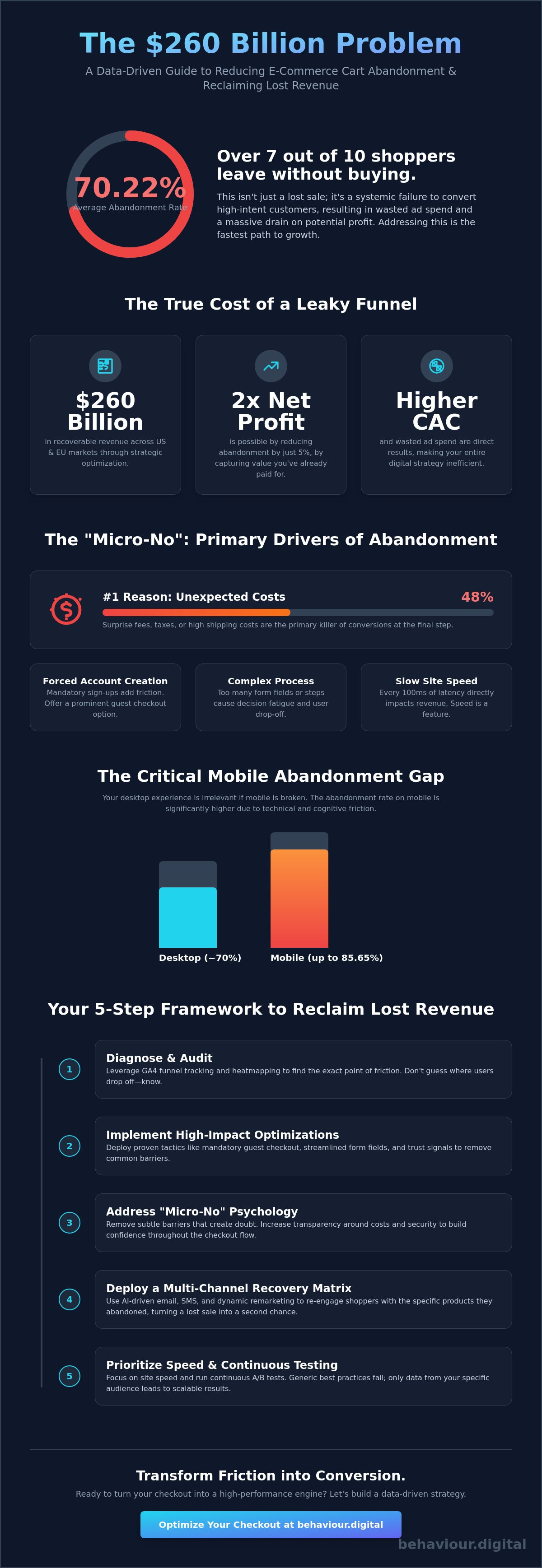
An average of 70.22% of e-commerce shoppers abandon their carts before completing a purchase. This represents over $260 billion in recoverable revenue across the US and EU markets. For brands navigating rising customer acquisition costs and 2026 revenue targets, the mandate to reduce shopping cart abandonment is a matter of survival. It's a significant drain on resources when high-intent traffic fails to convert due to minor technical friction or a lack of transparency.
You understand that a generic checkout flow can't compete in an era of hyper-personalization and strict new mandates like the EU AI Act. This guide provides the data-driven framework and technical optimisations required to turn your checkout into a high-conversion engine. You'll master the specific behavioural strategies and AI-powered recovery tactics needed to reclaim lost revenue, lower your abandonment rates, and drive a measurable increase in your return on ad spend.
• Identify hidden friction points by leveraging GA4 funnel tracking and heatmapping to see exactly where users hesitate during the checkout process.
• Implement high-impact technical optimisations, such as mandatory guest checkout and streamlined form fields, to effectively reduce shopping cart abandonment and improve conversion rates.
• Address the psychology of the "Micro-No" by removing subtle barriers that turn high-intent interest into final-stage abandonment.
• Deploy a multi-channel recovery matrix using AI-driven email, SMS, and dynamic remarketing to re-engage shoppers with the specific products they left behind.
• Prioritise site speed and continuous A/B testing over generic best practices, acknowledging that every 100ms of latency directly impacts your total revenue.
In 2026, the average shopping cart abandonment rate stands at 70.22%. This isn't just a baseline metric; it's a systemic failure to bridge the gap between consumer interest and a completed transaction. While many retailers view this as a minor technical glitch, it's actually the result of a psychological "Micro-No." This is the precise moment a user's intent is derailed by a subtle lack of trust, a sudden realization of friction, or a perceived lack of value. To reduce shopping cart abandonment, you must first acknowledge that your checkout process is a series of micro-conversions, not a single event.
The financial implications are staggering. Meta-analysis shows that $260 billion in lost orders are recoverable through better design and strategic intervention. If you can achieve even a 5% reduction in your abandonment rate, the compounding effect on your bottom line can often double your net profit. This is because the traffic has already been paid for. You are simply capturing value that you've already earned. However, you must distinguish between "Intentional Abandonment," where users use the cart as a wishlist, and "Friction-Based Abandonment," where users genuinely want to buy but are stopped by your interface. Addressing the latter is the fastest path to growth.
Every abandoned cart represents wasted capital from your PPC and Social Media Marketing campaigns. When users drop off at the final stage, your customer acquisition cost (CAC) spikes, rendering your digital strategy inefficient. This leakage also skews your conversion rate optimization data. Without granular tracking, you might incorrectly assume your ads or landing pages are failing, when the actual bottleneck is the checkout. This erosion of efficiency has a long-term impact on Customer Lifetime Value (CLV), as a failed first purchase often prevents any future relationship with the brand.
Modern shoppers are conditioned to treat the cart as a "Save for Later" tool. Comparison shopping is the default state. Unexpected costs remain the primary killer of conversions. Research from June 2026 confirms that 48% of shoppers exit due to surprise fees, taxes, or shipping costs. Decision fatigue also plays a critical role. If your checkout requires too many redundant choices or presents a cluttered interface, the cognitive load becomes too high. The user doesn't just choose a different option; they choose to leave entirely. Implementing specific technical and behavioural strategies to reduce shopping cart abandonment directly impacts your ability to scale profitably in a competitive market.
To effectively reduce shopping cart abandonment, you must move beyond guesswork and rely on granular data. A professional audit begins with setting up precise funnel tracking in Google Analytics 4 (GA4). You need to see exactly where the momentum stalls. Is it the shipping calculation stage? The payment method selection? By tagging every interaction, you transform a vague "drop-off" into a specific technical or behavioural hurdle. Quantitative data tells you where the leak is, but qualitative tools like heatmapping and session recordings tell you why it's happening. Watching a user repeatedly click a non-functional button or hesitate at a complex form field provides the clarity required for a successful intervention.
Your desktop checkout experience is largely irrelevant if it hasn't been audited for mobile users first. As of June 2026, mobile cart abandonment rates remain significantly higher than desktop, reaching as high as 85.65% in some sectors. This "mobile abandonment gap" is often the result of technical friction, such as slow-loading elements or poorly scaled input fields. However, you must also account for cognitive friction. This occurs when a user feels overwhelmed or loses trust in the security of the transaction. A strategic Digital Strategy prioritises the removal of these mental barriers to ensure a frictionless path to purchase.
A systematic audit follows three distinct phases to uncover hidden barriers. First, perform a quantitative analysis to identify the exact page or step with the highest exit rate. Second, implement qualitative measures like exit-intent surveys. Asking a departing user "What stopped you from finishing your order today?" yields insights that no spreadsheet can provide. Third, conduct a heuristic evaluation. This involves measuring your checkout against industry standards to reduce cart abandonment rates through proven usability principles.
Once you've identified forty different issues, you need a framework to decide what to fix first. We use the PIE Framework, which ranks tasks based on their Potential for improvement, their Importance to the total business volume, and the Ease of implementation. This ensures that high-impact, low-effort changes, such as fixing a broken mobile button, take precedence over complex site-wide overhauls. Deep conversion optimisation turns raw audit data into a prioritised, strategic roadmap. By distinguishing between device-specific bugs and broader site-wide issues, you can allocate resources where they'll generate the highest measurable return on investment.
In 2026, the debate between single-page and multi-step checkouts has shifted from personal preference to performance data. While single-page flows reduce perceived effort, multi-step checkouts often perform better for complex orders by categorising information and reducing cognitive load. The choice depends on your specific user behaviour and product category. Regardless of the structure, guest checkout is no longer optional. Forcing account creation remains a primary barrier that prevents users from completing their purchase. High-performing brands now treat registration as a post-purchase benefit rather than a pre-purchase requirement, allowing the user to focus entirely on the transaction.
Transparency is your most effective tool to reduce shopping cart abandonment. Since 48% of shoppers exit due to unexpected costs, you must display shipping fees, taxes, and delivery timelines as early as the product page. This "Transparency Principle" prevents the sticker shock that occurs at the final step. Additionally, your interface must be designed for "thumbing." With mobile abandonment rates reaching as high as 85.65%, every interactive element should be accessible for one-handed use. This means placing primary call-to-action buttons within the natural reach of a user's thumb to minimise physical friction and streamline the path to purchase.
Biometric payments have revolutionised the final stage of the funnel. Integrating Apple Pay and Google Pay allows for a 1-click revolution, bypassing the need for manual data entry. This is critical for mobile users who often abandon due to the difficulty of typing card details on small screens. Buy Now, Pay Later (BNPL) options have also evolved into essential conversion tools. Offering BNPL can reduce cart abandonment by an average of 20% for orders over $100. By 2026, these options are expected by consumers as a standard flexibility, making them a core component of any modern Digital Strategy and Conversion Rate Optimization roadmap.
Trust is built through specific, real-time evidence rather than generic security badges. Using social proof at the point of purchase, such as "42 people bought this in the last hour," validates the user's choice and provides social confirmation. Your micro-copy should be precise; "Free Returns" often carries more weight than a generic "Money-Back Guarantee" because it addresses a specific logistical fear. Real-time stock indicators create a sense of urgency, but these must be authentic to maintain brand integrity. Using scarcity without being manipulative encourages the user to act before the opportunity disappears, ensuring that intent is converted into a completed sale before decision fatigue sets in.
Recovery operations begin the moment a user exits the funnel. A robust strategy to reduce shopping cart abandonment relies on a multi-channel matrix that includes email, SMS, and push notifications. In 2026, AI-driven recovery emails demonstrate a conversion rate of 8.17%, which is double the performance of standard template-based sequences. The "Golden Hour" is a critical window; users are most likely to return if re-engaged within sixty minutes of abandonment. Personalisation at scale ensures that recovery offers are tailored to cart value, preventing unnecessary discounting on low-margin items while aggressively pursuing high-value conversions.
Dynamic remarketing on Meta and Google allows you to display the exact product left behind. This visual reminder bypasses generic brand messaging and speaks directly to the user's recent intent. High-intent remarketing requires frequency capping to maintain visibility without causing brand fatigue. If you need a partner to manage these complex technical deployments, our team provides expert Social Media Marketing and PPC management to ensure your recovery efforts yield a measurable return on ad spend.
A professional PPC agency in Glasgow structures remarketing lists based on specific behavioural triggers. Rather than treating all abandoners equally, campaigns are segmented by the objection encountered. For instance, users who exited at the shipping stage receive ads highlighting free delivery, while those who spent significant time on the security page see trust-focused creative. This surgical approach ensures your ad spend is allocated to the segments with the highest probability of conversion.
A disciplined recovery sequence follows a logical progression of value and persuasion. Every touchpoint has a specific objective within the first 72 hours:
The "Helpful Reminder." This message assumes a technical glitch or distraction and offers a direct link to the saved cart.
The "Social Proof." This email leverages user-generated content and reviews for the specific items in the cart to build confidence.
The "Final Offer." This is the last attempt to capture the sale, often including a time-sensitive incentive or a BNPL reminder.
Relying on industry best practices is a plateau, not a strategy. While generic checklists provide a baseline, they don't account for the unique friction points of your specific user base. To truly reduce shopping cart abandonment, you must commit to a culture of continuous A/B testing. This methodology allows you to validate hypotheses with actual user data rather than relying on subjective intuition. Every incremental gain in your checkout flow compounds over time. This leads to a significant and measurable increase in your total revenue that static "quick fixes" simply cannot replicate.
Site speed is a direct driver of abandonment. In the high-velocity e-commerce environment of 2026, every 100ms of latency can lead to a quantifiable drop in conversion. Performance isn't just a technical metric; it's a core component of the user experience. A fast, responsive checkout signals professionalism and reliability. It reduces the cognitive load on the shopper and keeps them focused on the transaction. Measuring the long-term ROI of these optimisations requires looking beyond the immediate sale. You're building a frictionless infrastructure that lowers your blended customer acquisition cost and improves the efficiency of every marketing dollar spent.
DIY attempts at Conversion Rate Optimization often fail because they lack a holistic view of the customer journey. A professional partner integrates Digital Strategy with technical execution. This ensures your checkout isn't just optimised in a vacuum. Instead, it works in harmony with your Pay Per Click and social media efforts. When you work with a performance-driven agency, you move from reactive troubleshooting to a proactive growth roadmap. This partnership focuses on sustainable, data-backed results rather than vanity metrics.
The landscape is shifting toward "Agentic Commerce." AI-powered shopping assistants and voice-activated interfaces are beginning to browse and purchase on behalf of consumers. This requires your checkout to be technically accessible for both humans and AI agents. The focus is also moving from simple conversion to long-term retention. Turning a one-time buyer into an advocate is the ultimate way to reduce shopping cart abandonment. When trust is already established, the "Micro-No" disappears.
Final Checklist: 5 Actions for Immediate Impact
• Implement guest checkout to remove the account creation barrier immediately.
• Audit your mobile checkout specifically for one-handed "thumb" accessibility.
• Verify all shipping costs and taxes are visible on product pages, not just at the end.
• Enable 1-click biometric payment options like Apple Pay or Google Pay.
• Review your GA4 funnel data to identify and fix the single highest exit point in your flow.
The path to a high-converting e-commerce ecosystem requires moving beyond static fixes and embracing a system of continuous refinement. Success in 2026 depends on technical agility. By aligning your digital strategy with granular behavioural audits and multi-channel recovery sequences, you transform your checkout from a point of exit into a source of competitive advantage. You've seen that capturing the "Micro-No" is the key to bridging the gap between intent and transaction.
A commitment to data-driven methodology ensures that every adjustment to your flow is backed by quantifiable evidence. This rigorous approach is what allows modern brands to effectively reduce shopping cart abandonment and reclaim lost revenue. As Glasgow-based strategic experts, we specialise in delivering proven results across PPC and CRO by turning complex user data into scalable growth. Our methodology focuses on measurable business outcomes; we ensure that your acquisition costs are never wasted at the final step.
Stop losing sales today; explore our Conversion Rate Optimisation services to secure your 2026 revenue targets. Your future growth is a direct result of the strategic choices you implement now.
The average e-commerce shopping cart abandonment rate is 70.22% as of June 2026. This figure is a meta-analysis of over 50 different studies and serves as the global benchmark for digital retailers. While this is the mean, mobile-specific rates are often higher, frequently reaching 85.65%. Monitoring your performance against these benchmarks is essential for identifying whether your checkout friction is an outlier or an industry-standard challenge.
Eliminating shipping costs is one of the most effective ways to reduce shopping cart abandonment because 48% of shoppers cite unexpected extra fees as their primary reason for leaving. High-performing retailers often bake shipping costs into the product price to maintain transparency from the start. This strategy removes the "sticker shock" that occurs at the final stage, ensuring the user's intent isn't derailed by sudden financial surprises.
Data suggests that the quality of the steps is more critical than the quantity. While single-page checkouts reduce physical clicks, multi-step flows often perform better for complex or high-ticket items by categorising information and reducing cognitive load. The goal is to eliminate every non-essential field. Whether you choose a one-page or three-page layout, a clear progress indicator is required to manage user expectations and maintain momentum.
Guest checkout is no longer optional for brands that prioritse conversion over data collection. Mandatory account creation remains a top reason for abandonment, as it forces users to stop their purchase to manage passwords or verify emails. You should allow the transaction to finish as a guest and offer account creation on the "Thank You" page. This approach captures the sale first and the customer relationship second.
Biometric payment options like Apple Pay and Google Pay are the most effective at removing physical friction, especially on mobile devices. Additionally, offering Buy Now, Pay Later (BNPL) options can reduce abandonment by an average of 20% for orders over $100. By providing one-click payment solutions, you bypass the need for manual data entry, which is the stage where most technical and physical errors occur.
Granular funnel tracking in Google Analytics 4 (GA4) is the standard method for identifying the exact point of exit. By tagging every interaction, from "Proceed to Checkout" to "Payment Confirmed," you can see which specific page or form field causes the highest drop-off. Supplementing this quantitative data with session recordings allows you to see if the issue is a technical bug or a confusing piece of micro-copy.
The first recovery email should be sent within 30 to 60 minutes of the abandonment event. This period is known as the "Golden Hour," where the user's intent and brand recall are at their peak. A disciplined multi-channel strategy follows this with a second message at 24 hours and a final, incentive-based offer at 72 hours. This cadence ensures you stay top-of-mind without becoming intrusive to the shopper.
AI significantly improves recovery rates by personalising the timing and content of recovery communications. AI-driven recovery emails currently convert at 8.17%, which is more than double the performance of standard template-based sequences. Beyond email, AI can be used to dynamically adjust trust signals or offer real-time chat support when the system detects a user is hesitating at a critical stage of the checkout process.

Luke leads strategy across every Behaviour Digital account — building data-driven advertising systems for ambitious brands. When he's not auditing ad accounts, he's writing about what he found in them.
Get a free, tailored growth plan — we'll run our framework on your accounts and show you exactly what we'd do.
Get your free growth plan →