.webp) Online
OnlineNot sure which channel fits your business?View all services →
Three inputs. Instant KPIs. No spreadsheets.Open a calculator →
Online78% of all Google Ads spend is now managed by automated bid strategies, yet many brands still struggle to translate this automation into actual profit. The debate over in-house vs agency ppc management has shifted from a simple cost comparison to a critical evaluation of strategic agility. You've li...

78% of all Google Ads spend is now managed by automated bid strategies, yet many brands still struggle to translate this automation into actual profit. The debate over in-house vs agency ppc management has shifted from a simple cost comparison to a critical evaluation of strategic agility. You've likely seen your ad spend drift toward inefficient AI "black boxes" while your internal resources struggle to keep pace with 12% year-over-year CPC inflation. It's difficult to maintain performance when privacy regulations and AI search results constantly move the goalposts.
We've developed this definitive guide to help you choose the right management model based on quantitative data and measurable business growth. You'll learn how to navigate the technical complexities of privacy-first marketing and first-party data integration without bloating your operational overhead. We'll provide a clear decision-making framework that compares the fully-loaded costs of internal teams against the performance-driven scale of an agency partner. This analysis covers the impact of "keyword-less" search and provides the roadmap you need to maximize your Return on Ad Spend in the 2026 digital environment.
• Analyze the fundamental shifts in the 2026 landscape to understand how different management models handle increasing technical complexity and AI-driven search.
• Identify the hidden operational costs and "Single Point of Failure" risks inherent in the in-house vs agency ppc management debate to protect your long-term stability.
• Leverage the "Multiplier Effect" to gain a competitive edge by applying cross-industry insights and shared high-end automation tools to your specific campaigns.
• Use our strategic decision framework to determine if your current budget and attribution requirements necessitate a dedicated internal resource or an agile agency partner.
• Learn how to transform your paid media efforts into a scalable growth engine by aligning ad performance with a broader digital strategy and measurable business outcomes.
The digital advertising environment has reached a point of extreme technical complexity. Success no longer depends on who can manually adjust bids the fastest, but on who can best architect data systems to feed platform algorithms. Choosing between in-house vs agency ppc management requires understanding these two distinct operational models. In-house PPC involves a dedicated internal resource focusing exclusively on your brand's specific nuances. Conversely, an agency model utilizes a team of specialists providing Monthly PPC Management Fees and broader strategic oversight across multiple verticals.
The 2026 market shift has fundamentally redefined the value proposition of Pay-per-click (PPC) management. With 78% of all Google Ads spend now managed by automated bidding strategies, the "manual button-pushing" of the past is obsolete. Technical expertise has become more valuable than ever because human oversight is required to steer AI-driven campaign types like Performance Max. The core dilemma for leadership is balancing the deep brand intimacy of an internal hire against the cross-industry technical knowledge an agency provides.
The role of a PPC manager has transitioned from keyword bidding to data science. In a cookieless world, your first-party data strategy is the only sustainable competitive advantage. You can't rely on third-party signals anymore; you must integrate CRM data and offline conversions directly into the ad platforms. For scaling Scottish businesses, "set and forget" models have become a recipe for wasted spend. High-growth brands now require constant methodological fine-tuning to combat 12% year-over-year CPC inflation. You need a partner who understands how to leverage the fact that 37% of queries now include AI Overview results, which has significantly altered traditional click-through patterns.
Your management choice dictates your long-term scalability. Internal teams often suffer from "tunnel vision," where they become so immersed in a single account that they miss broader market shifts. Agencies, while possessing horizontal data, can sometimes fall into an "echo chamber" of their own internal processes. The right choice depends on your Digital Strategy and how quickly you need to scale budgets. While an internal specialist offers immediate access to stakeholders, an agency allows you to benchmark your Google Ads cost UK against industry-wide performance data. The modern PPC management goal is the intersection of behavioral data and automated efficiency.
Building an internal team offers the allure of deep brand integration. An in-house specialist lives and breathes your product, attending every internal meeting and understanding the subtle nuances of your customer base. This immediate access to stakeholders allows for rapid pivots in messaging. However, the debate over in-house vs agency ppc management often ignores the structural fragility of the internal model. The "Single Point of Failure" risk is a significant threat to business continuity. If your sole PPC manager leaves for a competitor, they take years of account history, custom script knowledge, and strategic intuition with them. This often leaves the brand in a state of paralysis during a three month recruitment cycle.
The financial reality of internal management extends far beyond the base salary. In the UK market, a mid-level manager's base pay is only the foundation. You must account for National Insurance, pension contributions, and the significant cost of a modern software stack. A professional PPC environment requires premium tools for automated bid management, landing page testing, and cross-channel reporting. These subscriptions can easily exceed £1,000 monthly. When you factor in these overheads, the true cost of an in-house hire is often 1.5x their base salary when accounting for overheads. If you aren't prepared for these recurring expenses, it's often more effective to partner with a specialized team that absorbs these operational costs.
Hiring internally is rarely the most efficient path for small or mid-sized enterprises. This model typically makes sense only when monthly ad spend exceeds £100,000 or when the business relies on highly proprietary data that cannot leave the internal network. Recruiting top-tier talent in the current market is difficult. The best specialists often prefer agency environments where they can work across diverse challenges. Smaller firms frequently find that an in-house specialist becomes stagnant or unmotivated because they lack a peer group for technical collaboration. Forbes offers a useful framework for deciding when to keep operations internal based on your core business competencies.
Managing a technical specialist creates a unique burden for leadership. If the Marketing Director isn't a PPC expert, they can't effectively audit the manager's work or identify when an account is underperforming. This lack of oversight leads to technical debt where campaigns aren't updated to reflect new features. Staying ahead of Google Ads AI shifts is a full-time job. Internal resources often experience a lag time in implementing new formats, such as the latest Performance Max updates, because they don't have the benefit of seeing those features tested across dozens of other accounts. This delay in adoption directly impacts your competitive edge and your ability to scale budgets rapidly in response to market demand.
The most significant advantage of an agency model is the "Multiplier Effect." While an internal specialist focuses on a single account, an agency team applies learnings from dozens of diverse campaigns to your specific business. This cross-pollination of data allows agencies to identify emerging trends, such as shifting click-through rates in AI Overview results, long before an isolated manager would notice the pattern. When evaluating in-house vs agency ppc management, you aren't just comparing headcounts; you're comparing the depth of the data pool that informs your strategy.
Agencies also provide a level of technological leverage that is often cost-prohibitive for individual brands. They spread the high monthly costs of premium scripts, AI-driven bid management tools, and advanced attribution software across their entire client base. This means you gain access to a sophisticated tech stack without the £1,000 monthly overhead mentioned in our previous cost analysis. This resource-sharing is a core component of any comprehensive guide to in-house vs. agency PPC, as it directly impacts your ability to compete in high-CPC verticals.
A true strategic partner doesn't just manage clicks; they focus on the final business outcome. This requires a deep integration of conversion rate optimisation to ensure that the traffic you've paid for actually transforms into measurable revenue. Without this synergy between ad creative and landing page performance, your ROAS will inevitably stagnate. Agencies provide the necessary scalability to ramp up activity for seasonal peaks or product launches without the friction of recruiting and training new staff.
A specialized PPC agency Glasgow offers a unique blend of local market insights and global best practices. This external perspective is vital for challenging internal assumptions about the customer journey that often lead to "tunnel vision." By leveraging multi-channel expertise, an agency can synchronize your search efforts with broader Social Media Marketing initiatives. This creates a unified digital presence where every pound spent on one platform supports the performance of the others.
Google Partner status isn't just a badge; it provides tangible operational benefits that internal teams can't replicate. This includes direct access to dedicated support teams and early entry into beta features that can give your brand a first-mover advantage. If an account is flagged for an audit or experiences a suspension, agency-level support typically prevents weeks of downtime and lost revenue. In the context of in-house vs agency ppc management, the "Agency Multiplier" is the process of cross-pollinating winning tactics from diverse industries to accelerate your growth. This ensures your account is always benefiting from the most current, verified methodologies in the digital sector.
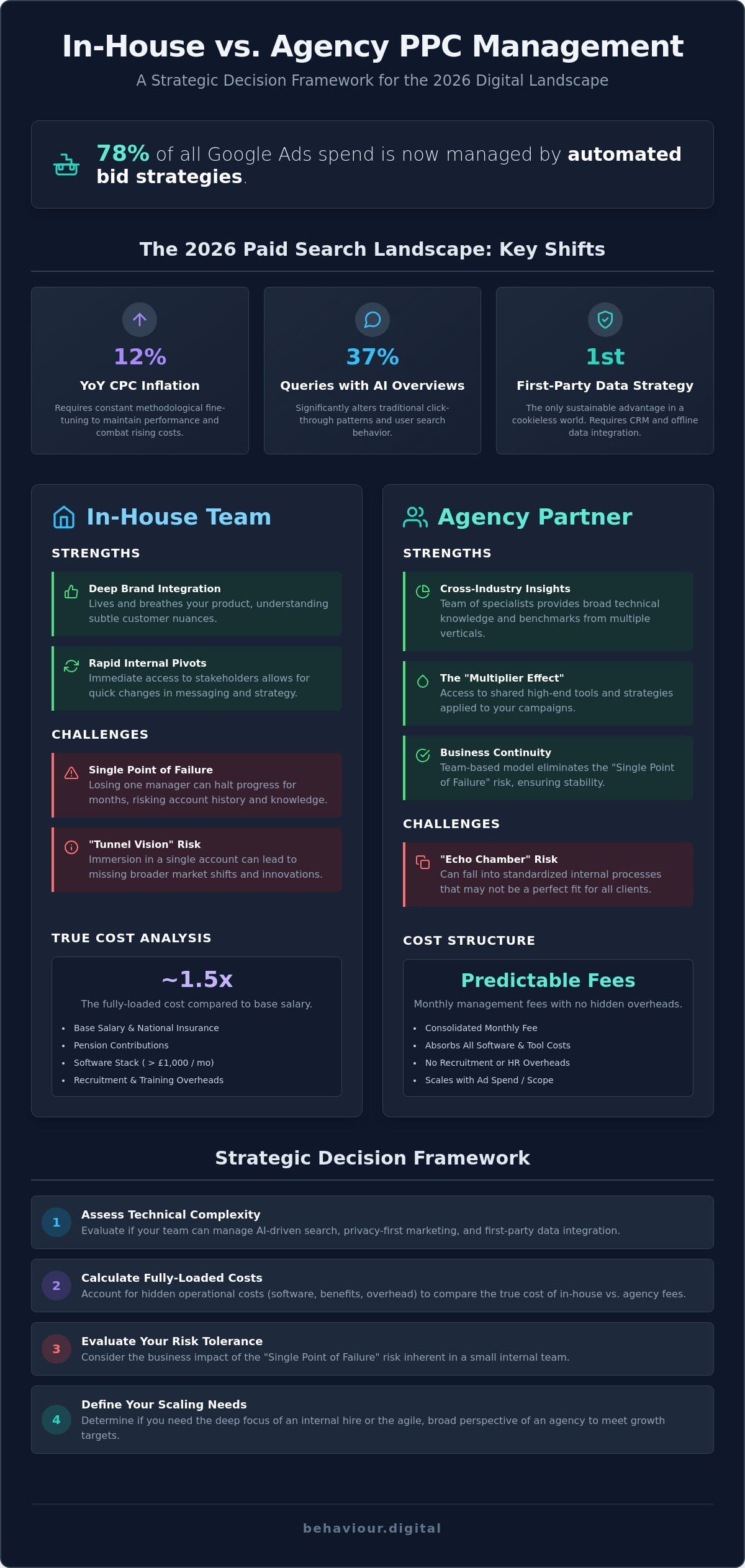
Selecting the optimal path between in-house vs agency ppc management is a calculation of operational economics rather than a simple preference. For businesses with annual revenues under $30 million, research indicates that partnering with an agency is typically 40-50% less expensive than maintaining an equivalent internal department. The decision hinges on your specific growth velocity and the technical infrastructure required to support it. If your monthly spend is between $25,000 and $50,000, a hybrid model often provides the best balance; this involves retaining an internal lead for high-level strategy while utilizing an agency for specialized execution and technical troubleshooting.
Building a dedicated internal team generally only yields a positive return on investment when monthly marketing spend exceeds $50,000. For accounts below this level, the overhead of salaries and benefits outweighs the potential performance gains. You should benchmark your current Google Ads cost UK against these economic realities.
Does your current team possess a dedicated data scientist and a CRO specialist? Modern PPC requires more than just ad copy; it requires deep technical integration with your CRM and advanced attribution modeling to navigate the cookieless landscape.
Enterprise-level bid management software and AI automation tools carry significant monthly costs. Agencies absorb these expenses across their client base, whereas an in-house team must justify these costs on a single-brand budget.
Consider how quickly your organization can pivot. If a new platform like TikTok Ads or a major Google algorithm update becomes critical to your growth, an agency provides instant "on-tap" capacity to execute, while an internal hire may require months of additional training.
Many executives hesitate to choose an agency because they fear a loss of control over their brand narrative. This is a misconception that confuses physical proximity with strategic alignment. In 2026, control is defined by data transparency, not by where the manager sits. Real control comes from owning your ad accounts and having 24/7 access to real-time reporting dashboards that track every pound spent. Ensuring you maintain full ownership of your data and account history is the only way to prevent vendor lock-in. If you want to identify the inefficiencies in your current setup, contact us for a strategic performance review to see how an agile partnership can accelerate your results without the internal overhead.
The transition from a "vendor" relationship to a true strategic partnership relies on this transparency. When you have clear visibility into the quantitative data and the methodology behind every optimization, the need for a manager in the next office evaporates. This allows your leadership team to focus on high-level business development while specialists handle the granular technical execution required to maximize your Return on Ad Spend.
Choosing between in-house vs agency ppc management is a pivot point for your company's growth. At Behaviour Digital, we reject the traditional vendor-client dynamic in favor of a strategic partnership. We operate as an extension of your internal team, aligning our technical execution with your broader business objectives. This ensures that every campaign we launch is rooted in a comprehensive Digital Strategy designed for scalable growth. We don't measure success by clicks or impressions; we measure it by the measurable business development we generate for our partners.
Our methodology prioritizes the destination as much as the source. Buying traffic is simple. Converting that traffic into revenue requires rigorous Conversion Rate Optimization. We analyze the user's journey from the first ad interaction to the final checkout or lead submission. This holistic view prevents the common performance gap found in many internal setups where the PPC manager and the web team work in silos. By integrating CRO directly into our management process, we ensure your ad spend is never wasted on underperforming landing pages. Our reporting is data-driven and free from unnecessary marketing fluff, focusing strictly on quantitative growth.
We leverage user behavior analysis to move beyond basic demographic targeting. Our team identifies the specific friction points in your funnel, allowing us to refine ad copy and visual assets based on actual user interactions. For Scottish brands with a global outlook, our Glasgow-based team provides a unique advantage by combining local market nuance with international best practices. This dual perspective is reflected in how our Monthly Social Media Marketing Management Fees are structured. We focus on long-term scalability, ensuring our partnership remains profitable as your budgets grow and your market presence expands.
The choice between in-house vs agency ppc management ultimately comes down to your desire for strategic agility. Transitioning from an internal model to an agency partner doesn't have to result in a performance dip. Our audit process begins by identifying low-hanging fruit; these are the immediate technical inefficiencies and wasted spend in your current campaigns. We handle the migration of account data and tracking systems with methodological precision. This ensures business continuity while we implement the advanced AI-driven strategies and privacy-first targeting required in the 2026 landscape. If you're ready to move beyond vanity metrics and focus on actual business value, book a strategy session with Behaviour Digital to audit your current PPC performance.
The decision regarding in-house vs agency ppc management is no longer a simple matter of headcount. It's a choice between maintaining high operational overhead and embracing strategic agility. Success in 2026 demands a sophisticated understanding of privacy-first targeting and the technical nuances of AI-driven bidding. To maintain a competitive edge, your organization must move beyond manual optimizations and focus on the quantitative relationship between user behavior and automated performance. This requires a infrastructure that many internal teams simply cannot sustain alone.
Our Glasgow-based team acts as a strategic extension of your business, replacing traditional vendor relationships with results-oriented partnerships. We specialize in integrated CRO and PPC strategies that ensure every click is a step toward measurable growth, not just a surface-level metric. By removing the technical debt of internal management, you're free to focus on high-level strategy while we handle the granular execution. Maximize your ROAS with Behaviour Digital’s expert PPC management and transform your paid search into a predictable revenue driver. Your growth is the result of conscious strategy and methodological precision. We look forward to helping you scale.
Hiring an agency is typically 40-50% less expensive for businesses with annual revenues under $30 million when evaluating in-house vs agency ppc management costs. While a mid-level in-house manager's base salary averages $80,000, the fully loaded cost including benefits and taxes ranges from $80,000 to $107,000. Agency fees are generally a fraction of this cost, especially when you consider the shared expense of a professional software stack.
The primary advantage is the "Multiplier Effect," where agencies apply cross-industry insights from dozens of accounts to your specific campaign. You gain access to a full team of specialists, including data scientists and CRO experts, rather than relying on a single individual. This structure eliminates the "Single Point of Failure" risk where performance drops if an internal employee leaves suddenly.
Yes, a hybrid model is often the ideal solution for businesses with a monthly marketing spend between $25,000 and $50,000. In this setup, an internal marketing lead handles brand strategy and stakeholder communication while a specialized agency manages technical execution and platform-specific optimizations. This approach balances deep brand intimacy with the technical agility required to navigate 2026's AI-driven search environment effectively.
Your business is ready for an agency partnership when your monthly ad spend exceeds $5,000 or when internal resources can no longer keep pace with 12% year-over-year CPC inflation. If your current ROAS has stagnated despite increasing budgets, you need the specialized technical oversight that only a dedicated team can provide. Readiness is defined by your need to scale without adding significant operational overhead.
Agencies utilize enterprise-level bid management software, advanced attribution modeling tools, and proprietary scripts that typically cost over $1,000 per month. These tools allow for real-time performance adjustments and deeper data visualization than standard platform dashboards provide. Because agencies spread these costs across multiple clients, you get the benefit of a $10,000+ annual software stack without paying the full subscription fees yourself.
Agencies use a structured onboarding process that includes deep-dive discovery sessions and brand persona workshops to align with your specific messaging. We treat the partnership as a strategic extension of your team, utilizing collaborative communication channels for real-time feedback on ad creative. This ensures that technical performance never comes at the expense of your brand's unique identity or market positioning in the digital sector.
While results vary by industry, advertisers using agency-managed Smart Bidding strategies report an average 14% higher conversion rate compared to unoptimized internal campaigns. The ROI difference stems from an agency's ability to minimize wasted ad spend through continuous methodological fine-tuning and integrated CRO. An agency focus on business growth over vanity metrics typically results in a more sustainable and scalable Return on Ad Spend.
You should always maintain full ownership of your Google Ads accounts and the associated first-party data. Professional agencies operate with complete transparency, managing your campaigns within your own accounts rather than "black box" proprietary systems. This ensures you retain your entire account history and data assets even if you choose to transition the in-house vs agency ppc management model in the future.
Luke leads strategy across every Behaviour Digital account — building data-driven advertising systems for ambitious brands. When he's not auditing ad accounts, he's writing about what he found in them.
Get a free, tailored growth plan — we'll run our framework on your accounts and show you exactly what we'd do.
Get your free growth plan →