.webp) Online
OnlineNot sure which channel fits your business?View all services →
Three inputs. Instant KPIs. No spreadsheets.Open a calculator →
OnlineWith the cross-industry average cost-per-click hitting $5.42 this year, the margin for error in digital advertising has effectively vanished. Many owners are rightly questioning: is ppc worth it for small business 2026? You've likely noticed that automation doesn't always translate to efficiency. Wa...

With the cross-industry average cost-per-click hitting $5.42 this year, the margin for error in digital advertising has effectively vanished. Many owners are rightly questioning: is ppc worth it for small business 2026? You've likely noticed that automation doesn't always translate to efficiency. Watching your budget get swallowed by low-intent traffic while CPCs rise 12% year-over-year is a reality that demands a shift in strategy. It's no longer enough to just be present on the search results page; you need a system that prioritizes business value over vanity metrics.
We've built this guide to help you move beyond buying clicks and start engineering conversions using a data-driven ROI framework. We'll explore how to navigate the 2026 AI-driven ecosystem, from Microsoft's AI Max pilot to Google's updated data retention policies. You'll gain a clear roadmap to compete with larger competitors locally and scale your paid search profitably through precise, methodology-based optimization. This is about transforming your ad spend from a monthly expense into a predictable growth engine.
• Determine if ppc is worth it for small business 2026 by calculating your break-even ROAS based on Customer Lifetime Value and total acquisition costs.
• Fix the "Broken Bucket" syndrome by ensuring your landing pages are optimized for conversion before deploying significant ad spend.
• Compete with larger national budgets by prioritizing hyper-local targeting and long-tail keywords that capture specific, high-intent user signals.
• Shift from manual campaign tweaking to strategic data management to leverage 2026's AI-driven bidding environments effectively.
• Scale profitably by transitioning from initial testing phases to a structured growth roadmap backed by precise digital strategy and performance monitoring.
The digital landscape in 2026 is no longer defined by simple keyword matching. AI-integrated search engines have fundamentally altered user behavior, prioritizing conversational intent over fragmented search terms. For many entrepreneurs, the question remains: is ppc worth it for small business 2026? The answer depends entirely on your ability to harness intent-based signals rather than chasing raw volume. While Pay-per-click (PPC) remains a powerful tool, the promise of "instant traffic" has become a myth for those without high-intent precision. Success now requires a deep understanding of audience signals and the effective use of first-party data to combat the limitations of privacy-first tracking.
Modern campaigns have shifted toward a model where audience signals outweigh traditional keyword bidding. This transition means businesses must focus on three core pillars to remain competitive:
Identifying users based on their stage in the buying journey rather than just the words they type.
Using first-party data from your CRM to train AI algorithms on what a high-value lead looks like.
Navigating stricter regulations that make traditional cookie-based tracking less reliable.
Relying on a single marketing channel is a significant risk in 2026. PPC serves as a critical bridge, providing immediate visibility and testing grounds for high-converting messaging while your organic authority matures. This hybrid approach ensures you don't lose market share during the months required for search engine rankings to stabilize. By integrating these paid insights into a broader digital strategy for scalable growth, you create a feedback loop where ad performance informs content creation. This methodology transforms short-term spend into long-term business intelligence.
Platforms like Performance Max and Smart Bidding have democratized access to complex algorithms, theoretically leveling the playing field for smaller budgets. However, these tools often present a "Black Box" problem. Without strict parameters, AI systems may prioritize low-intent traffic to meet volume targets, effectively wasting a limited budget on vanity metrics. With CPC inflation rising 12% year-over-year in competitive verticals, there's no room for inefficient spending. Human oversight is the highest-value asset in this environment. It's your responsibility to feed the AI high-quality conversion data and set realistic guardrails. Is ppc worth it for small business 2026? It is, provided you act as the strategic pilot rather than a passive observer of the automation.
Profitability in digital advertising is a mathematical certainty, not a marketing guess. For an entrepreneur, determining is ppc worth it for small business 2026 requires a cold look at unit economics. The "Worth It" formula is simple: your Customer Lifetime Value (LTV) must exceed the sum of your Customer Acquisition Cost (CAC) and operational overheads. If your LTV is high, a $5.42 average CPC is a manageable entry cost. If you're selling low-margin, single-purchase items, the math might not work. High CPCs are irrelevant if your conversion value remains significantly higher. Focus on the delta between spend and revenue, not the cost of the individual click.
CAC calculation differs between sectors. For a service-based business, CAC is the total ad spend divided by the number of signed contracts. For e-commerce, it's the cost per transaction. In the 2026 UK market, benchmarks suggest that high-intent leads in professional services may cost more upfront, but their LTV justifies the investment. Setting a break-even Return on Ad Spend (ROAS) target allows you to identify exactly when a campaign moves from a testing phase into a profitable growth engine. Refining your performance tracking ensures every pound spent is an investment rather than a cost.
Small budgets often suffer from "data starvation." A £500 monthly budget frequently fails because it doesn't generate enough conversion signals for AI algorithms to learn. In contrast, a £1,500 budget reaches the "statistical significance" threshold faster, allowing for rapid optimization. Low-intent clicks are expensive at any price if they result in high bounce rates. DIY campaigns often lead to budget leakage through broad-match keywords and poor negative keyword management. Partnering with a professional PPC agency in Glasgow prevents this waste by applying methodological precision to every campaign layer. Professional management fees are typically offset by the elimination of wasted spend on non-converting traffic.
Successful scaling is about data density. AI-driven systems require at least 30 to 50 conversions per month to function effectively. When you starve the system of budget, you're essentially paying for the AI to guess. By investing at a level that provides sufficient data, you enable the platform to find your ideal customers with surgical accuracy. This shift from "cheap" to "effective" is what separates profitable small businesses from those that view PPC as a failed experiment.
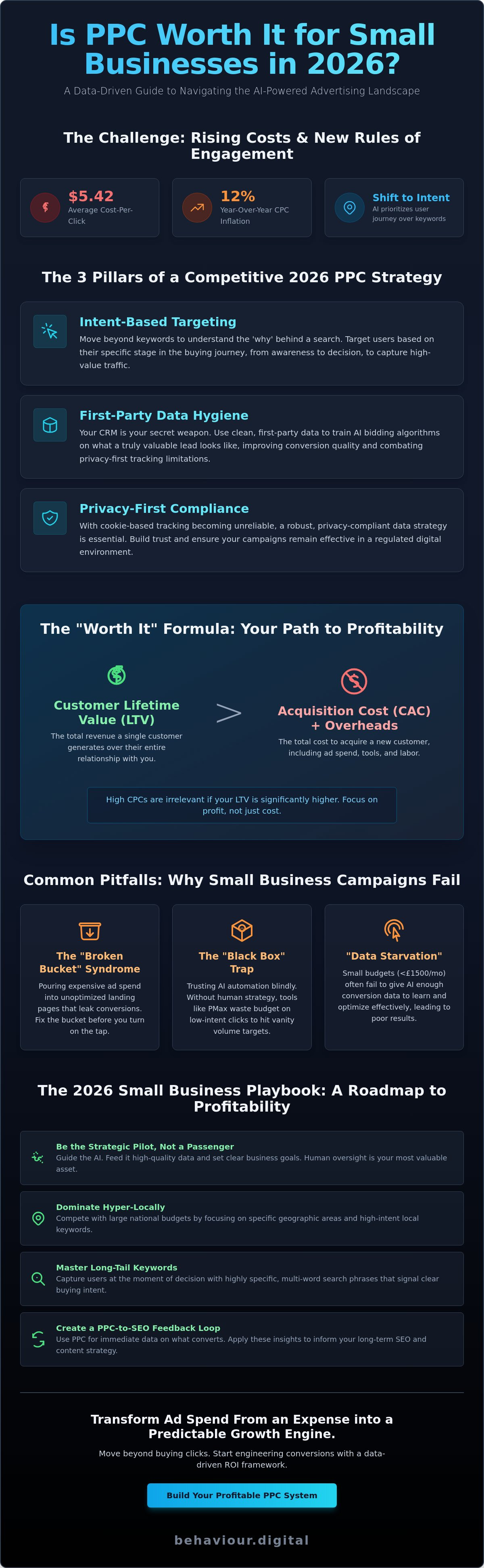
Failure in paid search is rarely a result of the platform's inherent limitations. It's usually a structural breakdown in the conversion funnel. Many business owners conclude that is ppc worth it for small business 2026 is a negative, simply because they're pouring capital into a "Broken Bucket." This happens when you pay for high-quality traffic but direct it to a destination that isn't engineered to convert. If your website's infrastructure isn't aligned with your advertising goals, you aren't investing; you're subsidizing the platform's revenue at your own expense.
Most unsuccessful campaigns share several common technical and strategic flaws:
Using "hooky" ad copy that promises a solution your landing page doesn't immediately deliver.
Relying on AI-driven broad match without a rigorous, daily negative keyword strategy to filter out low-intent queries.
Ignoring "near me" intent and hyper-local signals, which causes small budgets to be spread too thin across non-relevant areas.
Slow load times or complex forms that discourage mobile users who expect immediate results.
Your homepage is almost always the worst place to send paid traffic. It's designed for exploration, not the surgical precision required for a high-intent conversion. In 2026, mobile speed is a non-negotiable ranking and conversion factor. You need dedicated, single-purpose landing pages that eliminate distractions. Message Match is the methodological alignment between the user's specific query, the ad's unique value proposition, and the landing page's direct call-to-action. Without this level of consistency, your bounce rates will inevitably climb, destroying your Return on Ad Spend (ROAS).
Conversion blindness prevents you from seeing which specific assets are actually driving revenue. Many small businesses still rely on basic client-side tracking, which is increasingly blocked by 2026 browser privacy restrictions. This lack of data makes it impossible for automated bidding strategies to function correctly. Implementing server-side tracking is now a requirement for accurate attribution. By linking your PPC performance directly to conversion optimisation, you move beyond vanity metrics like clicks and focus on the data points that actually impact your bottom line. Precision in measurement is the only way to prove that your ad spend is generating a tangible profit.
Success with limited capital requires a transition from broad exposure to surgical precision. When asking is ppc worth it for small business 2026, the answer lies in your ability to bypass expensive bidding wars for generic terms. Instead, focus on long-tail keywords that signal specific, immediate intent. These queries may have lower volume, but they often carry higher conversion rates and lower costs. By layering this with aggressive remarketing, you ensure that the visitors you've already paid for aren't lost to a competitor's offer. Capturing 'lost' traffic is the most cost-effective way to lower your overall acquisition costs.
Modern budget management also relies on the intelligent use of first-party data. By uploading your existing customer lists, you can build lookalike audiences that mirror your most profitable clients. This allows AI algorithms to find new prospects with similar behavioral patterns, reducing the time spent in the "learning phase." Coupled with continuous A/B testing of your ad headlines and creative assets, this iterative approach ensures your campaign evolves based on quantitative evidence rather than subjective preference.
For businesses operating in Glasgow and Edinburgh, geographic precision is a primary competitive advantage. Radius targeting and location-based bid modifiers allow you to prioritize users within a specific distance of your physical location or service area. Local Service Ads (LSAs) have become indispensable for trades and professionals in 2026, offering a "Google Screened" badge that builds immediate trust. Glasgow-based businesses should specifically prioritize 'near me' intent. These users are often at the final stage of the decision-making process and represent the highest immediate value for a local service provider.
Creative assets are the primary lever for performance in an automated environment. Video assets are no longer optional; they're the standard for capturing attention in social and display networks. You don't need a cinematic production budget to succeed. Leveraging User-Generated Content (UGC) provides an authentic perspective that often outperforms polished corporate advertisements. AI tools can now generate dozens of creative variations from a single source, allowing you to test different visual hooks without high production costs. This technological shift enables small businesses to maintain a fresh, engaging presence that rivals much larger competitors.
Precision in execution is the only way to ensure a positive return on investment. If you're ready to move beyond basic settings and implement a high-performance digital strategy, the time to refine your approach is now. Methodological testing and local expertise will always outperform raw spending power.
Transitioning from a testing phase to a scalable growth model is the point where the initial question—is ppc worth it for small business 2026—finds its definitive answer. Scaling isn't about simply increasing your daily budget. It's about maintaining efficiency as you capture a larger share of the market. This requires a strategic partner who understands the nuances of the 2026 AI shifts. Algorithms now handle the execution, but human expertise is required to define the objectives and interpret the results. We focus on behavioral data because a click is merely a signal of interest; the actual business value is generated by what the user does after they arrive.
The compounding value of your advertising investment is unlocked when you combine high-precision PPC with conversion rate optimization. Without this synergy, scaling your ad spend often leads to diminishing returns. By analyzing how users interact with your landing pages, we identify friction points that prevent a lead from becoming a customer. This methodological approach ensures that every additional pound spent on traffic is met with a high-performance environment designed to maximize its value. Success in 2026 is reserved for those who view digital marketing as an integrated ecosystem rather than a series of isolated tactics.
Static monthly PDFs are obsolete in a high-velocity digital economy. We provide live, data-driven performance dashboards that allow you to monitor your ROI in real time. This transparency ensures that strategy pivots happen based on immediate market shifts rather than historical data. We align our management focus with your actual revenue goals, ensuring that our success is tied directly to your growth. This partnership model moves beyond the traditional service provider relationship, positioning us as an analytical extension of your business.
To determine if your current approach is viable, start with a critical audit of your existing infrastructure. Is ppc worth it for small business 2026 for your specific niche? It is if you follow these steps:
Review your site speed and mobile user experience to ensure you aren't losing traffic to technical friction.
Clearly distinguish between top-of-funnel leads and direct sales to optimize bidding strategies.
Contact Behaviour Digital for a data-led session to map out your roadmap for profitable scaling.
A deliberate, data-backed strategy is the only way to navigate the complexities of the modern search landscape. By focusing on measurable outcomes and continuous refinement, you transform your advertising from a cost center into a predictable engine for business expansion. Success is the result of conscious strategy and constant methodological fine-tuning.
Navigating the current advertising landscape requires a fundamental shift from buying clicks to engineering conversions. We've established that is ppc worth it for small business 2026 only when you prioritize unit economics over vanity metrics. By aligning your Customer Lifetime Value with precise audience signals and hyper-local targeting, you transform a rising cost-per-click into a manageable acquisition cost. The most successful small businesses this year are those that bridge the gap between high-intent traffic and optimized landing page experiences.
As Glasgow-based PPC experts, we specialize in data-driven behavioral strategies that deliver proven ROI for UK small businesses. We don't just manage budgets; we act as a strategic partner to ensure your ad spend scales predictably. If you're ready to move beyond testing and start seeing measurable business growth, it's time to refine your methodology. Get a Data-Driven PPC Strategy for Your Small Business today and turn your digital presence into a high-performance growth engine. Your path to sustainable profitability begins with a single, data-led decision.
A £500 monthly budget is generally insufficient in 2026 because it fails to generate the data density required for effective automation. With the average cross-industry CPC reaching $5.42, this budget only buys roughly 100 clicks per month. This volume doesn't provide the 30 to 50 monthly conversions needed for AI-driven bidding models to optimize your targeting effectively. You'll likely spend your entire budget before the algorithm learns how to find your ideal customers.
Expect a standard optimization window of 90 days to achieve a stable, positive ROI. The first 30 days focus on data acquisition and filtering out low-intent traffic through rigorous negative keyword management. By the third month, the system has enough conversion data to lower your acquisition costs. Determining is ppc worth it for small business 2026 requires looking at this 90-day performance trend rather than individual weekly fluctuations.
PPC is the superior starting point because it provides an immediate feedback loop on which keywords actually drive revenue. Organic authority takes months to establish and offers no control over immediate lead flow. By starting with paid search, you gain the data necessary to inform a long-term content strategy while generating cash flow today. Use the insights from your paid campaigns to identify the high-value terms worth pursuing through other channels later.
A healthy conversion rate typically ranges between 3% and 5% for most UK service sectors. High-performance campaigns that utilize dedicated landing pages and precise message match can often push this figure above 10%. Don't look at this number in isolation. A high conversion rate is only valuable if your cost per acquisition remains below the lifetime value of the customer.
Management fees in the UK generally follow two structures: a percentage of ad spend or a fixed monthly retainer. Most agencies charge between 10% and 20% of the total spend, though smaller accounts often attract a flat fee to cover the technical overhead. These costs reflect the strategic expertise required to manage complex Performance Max campaigns and maintain server-side tracking compliance. Expert management is an investment that usually pays for itself by eliminating wasted spend on non-converting traffic.
While you can manage your own ads, the "Black Box" nature of 2026's AI automation makes DIY a high-risk approach. Small errors in tracking or broad-match settings can lead to rapid budget depletion without any tangible return. Professional agencies provide the methodological precision and human oversight needed to keep AI algorithms on track. Hiring an expert ensures your budget is used to engineer conversions rather than simply buying clicks.
AI-integrated search results have moved ads into conversational overviews, making intent-based targeting more critical than ever. Traditional keyword matching is less effective than capturing the specific "audience signals" that AI platforms now prioritize. To stay visible, your ads must align perfectly with the conversational nature of modern search queries. This shift makes is ppc worth it for small business 2026 a question of how well you can adapt to these new, integrated ad formats.
Stopping your ads abruptly causes an immediate loss of lead flow and resets the algorithm's learning phase. When you eventually restart, the AI must begin the data collection process from scratch, which often results in higher initial acquisition costs. If you need to scale back, it's more efficient to reduce your daily budget than to deactivate campaigns entirely. Maintaining a baseline level of activity keeps your tracking data fresh and your market presence stable.

Luke leads strategy across every Behaviour Digital account — building data-driven advertising systems for ambitious brands. When he's not auditing ad accounts, he's writing about what he found in them.
Get a free, tailored growth plan — we'll run our framework on your accounts and show you exactly what we'd do.
Get your free growth plan →