.webp) Online
OnlineNot sure which channel fits your business?View all services →
Three inputs. Instant KPIs. No spreadsheets.Open a calculator →
OnlineWith ad costs climbing by 25% since 2024 and Meta CPMs averaging $11.20, your 2026 social media budget is likely under intense scrutiny. Many marketing managers in Glasgow and across the UK are struggling because measuring social media marketing roi still feels like chasing a ghost in the machine. Y...

With ad costs climbing by 25% since 2024 and Meta CPMs averaging $11.20, your 2026 social media budget is likely under intense scrutiny. Many marketing managers in Glasgow and across the UK are struggling because measuring social media marketing roi still feels like chasing a ghost in the machine. You've likely felt the pressure to do more with less as platforms become more expensive and attribution becomes more complex. It's a common pain point: you know your strategy works, but "engagement" doesn't satisfy a board focused on the bottom line.
We're moving past the era of vanity metrics and into a period of methodological precision. This guide provides the exact framework you need to translate social interactions into boardroom-ready financial outcomes. You'll learn how to calculate Customer Acquisition Cost (CAC) and Lifetime Value (LTV) specifically through social touchpoints, allowing you to prove that your spend is a revenue driver, not a cost center. We'll outline how to build a data-driven business case that secures the approval you need to scale your 2026 marketing efforts with confidence.
• Transition from vanity metrics to financial outcomes by translating social performance into boardroom-ready data like Customer Acquisition Cost (CAC) and Lifetime Value (LTV).
• Adopt a multi-touch attribution framework to accurately capture the 70% of the buyer journey that occurs before a user ever reaches your website.
• Master the methodology for measuring social media marketing roi to protect your budget against rising ad costs and justify strategic scaling for 2026.
• Learn how to leverage the synergy between social media and Conversion Rate Optimization (CRO) to eliminate efficiency gaps and maximize return on ad spend.
• Discover a structured presentation framework that starts with high-level business objectives to secure long-term buy-in from CFOs and stakeholders.
By mid-2026, the social media environment has reached a state of extreme fragmentation and AI-driven saturation. Digital feeds are no longer linear; they're algorithmically curated based on micro-behaviors that shift in real-time. Relying on traditional last-click attribution to justify spend is now a strategic error. It ignores the complex, multi-touch reality where a user might encounter a brand multiple times across TikTok, LinkedIn, and Instagram before ever performing a direct search. Measuring social media marketing roi requires a fundamental shift from surface-level engagement metrics to incremental lift. This metric isolates the actual impact of your social campaigns by comparing the behavior of exposed audiences against a control group. It's the only way to prove that social media is driving revenue that wouldn't have occurred otherwise. Understanding the broader Return on Marketing Investment allows your team to align social spend with the CFO's expectations for tangible, top-line growth.
AI-driven creative testing has transformed from a luxury to a necessity for maintaining budget efficiency. In 2026, automated systems identify high-performing visual hooks and copy variations within hours, which drastically reduces wasted ad spend on underperforming assets. Predictive analytics now play a central role, allowing us to forecast performance with high accuracy before a single pound is committed. Forward-thinking brands are now allocating a dedicated Innovation Fund within their budgets. This capital is specifically reserved for testing emerging AI-driven tools that automate community management or personalize ad creative at scale. It's about staying ahead of the curve rather than reacting to it.
The UK digital landscape is currently facing record-high Customer Acquisition Costs (CAC). For businesses in Glasgow and across Scotland, the challenge is two-fold: you're competing against global giants for the same local attention. Generic strategies no longer cut through the noise. Success in this environment requires a hyper-localised, data-centric approach. Utilizing Social Media Marketing Management Scotland provides the regional relevance needed to lower CAC while maintaining high intent. We've found that brands focusing on behavioral growth, influencing the buyer's intent long before they reach a search engine, are the ones securing their budgets for the long term. Social media in 2026 isn't just a distribution channel; it's the primary engine for demand generation.
To secure a 2026 budget, you must stop talking about likes and start talking about EBITDA. Your social presence is a core component of your firm's wider Digital Strategy, serving as both a demand generation engine and a market expansion tool. When you present to the board, frame social media as a revenue driver. The board doesn't care about followers; they care about growth. If you reduce spend, you don't just lose clicks. You lose market share to competitors who are actively capturing the buyer journey where it begins. Effective measuring social media marketing roi means linking every pound spent to a specific stage of the customer lifecycle.
The CFO cares about the efficiency of capital. They want to see how social media spend compares to other acquisition channels in terms of scalability. This requires a data-driven guide to social media ROI that accounts for the long-term value of the customers you acquire. You must also identify the cost of inaction. Withdrawing from social creates a dark period where competitors steal brand salience. This gap is often more expensive to close later than it is to maintain through consistent, strategic investment.
Focus on the LTV to CAC ratio. A healthy social channel should deliver a ratio of at least 3:1 over time. Share of Voice (SOV) is another critical metric. It's a proven leading indicator of market share. If your SOV drops, your future revenue is at risk. Brand sentiment acts as a barometer for brand equity, predicting sales volume shifts before they appear in your CRM. These numbers provide the financial context the board needs to approve increased spend. They transform social media from a discretionary expense into a strategic asset.
Social media provides a real-time feedback loop that most R&D departments can only dream of. By analyzing community engagement and social listening data, you can identify product friction points or market gaps without expensive surveys. This reduces R&D costs and improves customer service efficiency. You're not just buying ads; you're buying market intelligence. Using these insights to refine your approach is exactly how a strategic partner helps you turn social data into business growth. Real-time feedback allows for rapid pivots that protect your bottom line and ensure your strategy remains relevant in a volatile market.
Last-click attribution is a relic of a simpler digital age. In 2026, data indicates that 70% of the buyer journey occurs before a user ever touches your website. Potential customers are researching, watching short-form video, and discussing your brand in private messaging apps like WhatsApp or Slack. This "Dark Social" traffic often masquerades as direct traffic in your analytics, effectively hiding the true source of the lead. To stop underestimating your social impact, you need a framework that accounts for these invisible touchpoints. Strategic conversion optimisation ensures that once these users finally arrive, the transition from social browser to buyer is seamless. However, the initial spark usually happens off-site.
Effectively measuring social media marketing roi requires implementing Marketing Mix Modelling (MMM). This statistical technique correlates shifts in social spend with total business revenue, providing a holistic view that channel-specific dashboards often miss. By looking at the big picture, you can see how social media investment influences the entire sales funnel. This approach is essential for a measuring social media ROI strategy that satisfies the modern CFO. It moves the conversation away from clicks and toward incremental revenue growth.
First-Touch models are excellent for tracking brand awareness, while Time-Decay models provide a more realistic view of the final nudge toward a purchase. Linear models offer a balanced view but can sometimes dilute the impact of high-performing ads. We recommend monitoring Assisted Conversions in Google Analytics 4 and Meta Events Manager to see exactly where social played a supporting role. Multi-Touch Attribution is the analytical lens through which the true, distributed value of social media interactions is finally revealed.
Social media doesn't exist in a vacuum. High-frequency social exposure directly boosts the performance of your PPC Management efforts by increasing Click-Through Rates (CTR) on search ads. When users recognize your brand from their feed, they're more likely to click your paid search result. In the UK, we've observed a strong correlation between social activity and branded search volume. For example, a Glasgow-based retailer recently cut their social budget and experienced a 20% decline in sales from branded search within 30 days. This proves that social media is the fuel for your entire digital ecosystem, driving intent before the search even begins.
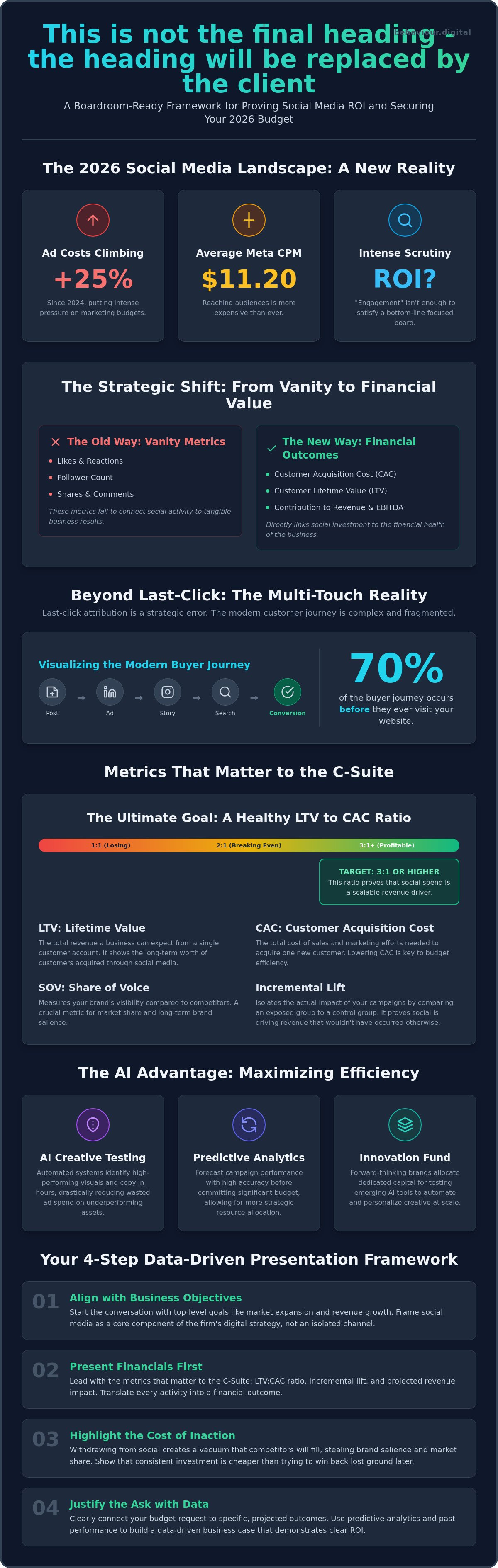
Data is your strongest ally when measuring social media marketing roi. To secure your 2026 budget, you must present a narrative that aligns with corporate goals rather than platform-specific trends. Start with the business objective. Don't lead with the latest algorithm change or follower growth. Instead, lead with how social media will contribute to the company's annual revenue targets. Next, address the efficiency gap. Explain how your current spend is being maximized through conversion rate optimization. This shows the board you aren't just asking for more money; you're actively making every pound of existing spend work harder.
Use comparative benchmarking to provide context. How does your digital footprint compare to other UK competitors? If you're falling behind in Share of Voice, your future market share is at risk. Present a growth scenario: specifically outline what an extra 10% investment would yield in projected revenue based on current performance data. Finally, frame social spend as risk mitigation. In a volatile market, a robust social presence protects your brand from being drowned out by aggressive competitors. It's a defensive and offensive necessity for long-term survival.
Map your activities to the Awareness, Consideration, and Conversion stages. Use clear data visualisations to demonstrate the flow of users from social discovery to the final sale. When speaking to a CFO, stop using the word "engagement." Use "Customer Intent Signals" instead. A like or a share isn't just a vanity metric. It's a quantifiable data point indicating a potential customer's progression through the sales funnel. Highlighting these signals as precursors to revenue makes the value of top-of-funnel spend undeniable.
If you face resistance, pivot the conversation from "Cost" to "Investment." Traditional media often carries high fixed costs and limited scalability. Paid social is a precision lever you can pull with total control. If the board remains hesitant, propose a Pilot Program strategy. Secure a smaller, ring-fenced budget to prove a specific hypothesis over a 90-day period. Proving success on a small scale makes the case for a full-scale 2026 budget much easier to approve. For expert help in building a bulletproof business case, partner with a strategic digital agency that prioritizes financial outcomes over surface-level metrics.
The speed of algorithmic evolution in 2026 leaves no room for guesswork. In-house teams often find themselves reacting to changes rather than anticipating them, which leads to inefficient spend and missed opportunities in the buyer journey. We position Social Media Marketing as a core component of your revenue infrastructure. By treating social as a managed growth engine, we provide the technical depth required for precise measuring social media marketing roi. Our methodology moves beyond superficial vanity metrics to deliver the hard financial data your board demands. This level of insight is the only way to justify and scale your 2026 budget with total confidence.
Most internal departments are stretched too thin to manage the granular data analysis needed for sustainable growth. At Behaviour Digital, we bridge this gap by combining methodological precision with creative excellence. We don't just post content; we engineer campaigns that align with your firm's specific EBITDA goals. Our approach ensures that every campaign is backed by quantitative data, providing the transparent reporting that boards and CFOs actually trust. We take the complexity of 2026 social platforms and translate it into a clear, boardroom-ready business case.
Success isn't found in a single campaign. It's the result of continuous, incremental gains. Our data-first management process involves high-frequency testing cycles where we identify winning creative hooks and high-intent audience clusters within hours. This speed is critical for maintaining a competitive ROAS in the saturated UK landscape. We also emphasize the synergy between social traffic and website performance. By aligning our social efforts with your wider digital strategy, we ensure that the traffic we generate actually converts into measurable profit. Our weekly performance calls keep you informed of these business outcomes, skipping the jargon to focus on growth.
Geography still matters in a digital world. A Glasgow-based strategic partner offers more than just proximity; we offer a deep understanding of the specific economic pressures and consumer behaviors unique to the Scottish market. This local context allows us to tailor global strategies for maximum regional impact. You won't be dealing with a generic account manager. You'll have direct access to senior strategists who are actually moving the needle for your business. We take full responsibility for the performance of your campaigns, acting as an extension of your own team. If you're ready to secure your 2026 budget with a data-driven business case, speak to our Glasgow PPC and Social experts today.
Transitioning your social media strategy from a perceived expense to a verified revenue driver is the only way to protect your budget in 2026. By moving beyond last-click attribution and adopting a multi-touch framework, you reveal the true impact of the buyer journey that happens off-site. This methodological shift is essential for measuring social media marketing roi in a way that satisfies the financial scrutiny of the board. You don't have to navigate these technical complexities alone.
Since 2022, Behaviour Digital has acted as a strategic partner for businesses across the UK. We provide the boardroom-ready data and quantitative insights needed to justify and scale your digital investment. Our Glasgow-based experts in PPC and Social Media are ready to help you turn fragmented social data into a bulletproof business case. It's time to stop defending your budget and start scaling your success with a partner focused on your bottom line.
Secure your 2026 growth with a professional Social Media Audit from Behaviour Digital. We'll help you build the data-driven foundation your business needs to lead the market.
Utilize multi-touch attribution and assisted conversion data to reveal the hidden value of social touchpoints. Since approximately 70% of the buyer journey happens off-site in 2026, tracking direct sales alone ignores the majority of your influence. Focus on incremental lift to demonstrate revenue that wouldn't have occurred without social exposure, proving the channel's impact on total business growth.
Most high-growth UK businesses allocate between 15% and 25% of their total marketing budget to social media in 2026. This figure varies based on your specific Customer Acquisition Cost (CAC) and current business stage. The priority is ensuring the spend is scalable and maintains a healthy Lifetime Value (LTV) to CAC ratio that satisfies financial stakeholders.
Organic social media's value lies in community intelligence and reducing customer service overheads. It acts as a real-time focus group, providing insights that lower R&D costs and inform product development. You can prove its worth by tracking how organic engagement correlates with branded search volume and long-term brand sentiment, which are leading indicators of future sales.
for a CFO requires focusing on LTV, CAC, and Contribution Margin. Avoid vanity metrics like likes or shares. Instead, present these as "Customer Intent Signals" that predict future revenue. Show how social spend directly supports the firm's top-line growth objectives and protects your market share from aggressive competitors.
Social brand awareness creates a halo effect that increases Click-Through Rates (CTR) on your PPC ads and boosts branded SEO traffic. When users recognize your brand from their social feeds, they're more likely to click your search results. Data from 2026 indicates that cutting social spend often leads to a measurable drop in search conversion efficiency within 30 days.
AI justifies budgets by providing predictive analytics that forecast campaign performance with high precision before capital is committed. It also demonstrates operational efficiency by reducing the time and cost required for creative testing. Use AI-driven data to show the board how you're optimizing spend and mitigating the risk of underperforming assets through automated, real-time adjustments.
ROAS measures the gross revenue generated specifically from ad spend, while ROI accounts for the total profitability of the channel. ROI includes all operational costs, such as agency fees, content production, and software. Measuring social media marketing roi provides a more accurate picture of the channel's actual contribution to the company's EBITDA and shareholder value.
Strategic reporting to the board should occur quarterly, focusing on high-level business objectives and market share. Monthly reports are better suited for marketing leadership to track tactical performance and campaign-level ROAS. Quarterly reviews allow for a longer-term view of brand equity and the overall effectiveness of your digital strategy in a volatile market.

Luke leads strategy across every Behaviour Digital account — building data-driven advertising systems for ambitious brands. When he's not auditing ad accounts, he's writing about what he found in them.
Get a free, tailored growth plan — we'll run our framework on your accounts and show you exactly what we'd do.
Get your free growth plan →