.webp) Online
OnlineNot sure which channel fits your business?View all services →
Three inputs. Instant KPIs. No spreadsheets.Open a calculator →
OnlineWhile the average cost per click on Google Search reached $2.96 in the first quarter of 2026, 87% of industries faced even steeper price hikes. In this high-stakes environment, identifying the right paid advertising kpis for small business is no longer just a technical task; it's a survival requirem...

While the average cost per click on Google Search reached $2.96 in the first quarter of 2026, 87% of industries faced even steeper price hikes. In this high-stakes environment, identifying the right paid advertising kpis for small business is no longer just a technical task; it's a survival requirement for your profit margins. It's a common struggle to feel like you're wasting budget on ads that don't convert while trying to decipher complex performance reports that fail to show a clear return on investment to your stakeholders.
This article provides a definitive growth framework to master the essential metrics that transform raw ad spend into measurable, scalable business outcomes. We'll move past the noise to define the specific benchmarks that actually matter for your cash flow this year. You'll gain a clear list of metrics to track, a deep understanding of current industry performance data, and the strategic confidence required to scale your advertising spend without wasting capital. From navigating Google's latest AI-powered campaign updates to optimizing your conversion rate, we focus on the data that drives real results.
• Distinguish between vanity metrics and actionable indicators to ensure your advertising strategy aligns with core business objectives.
• Prioritize financial KPIs like Return on Ad Spend to verify that your marketing engine is producing a profitable yield.
• Implement a structured framework for paid advertising kpis for small business to benchmark your performance against 2026 market data.
• Transition from guesswork to data-driven decision making by setting targets based on historical performance and specific conversion goals.
• Leverage strategic interpretation and conversion rate optimization to transform raw data into a scalable roadmap for business growth.
In the current 2026 market, where the average cost per click has risen significantly to $2.96, small businesses can no longer afford to treat their marketing budget as an experimental fund. Success depends on precision. What are Paid Advertising KPIs exactly? Key Performance Indicators (KPIs) are the specific, quantifiable metrics that demonstrate whether your advertising strategy is meeting its core business objectives. They move beyond raw data to provide a clear verdict on your profitability.
For a small business, the distinction between vanity metrics and actionable KPIs is the difference between a failing campaign and a scalable one. Vanity metrics, such as impressions or social media likes, might look impressive on a report, but they don't correlate directly with revenue. Actionable paid advertising kpis for small business focus on outcomes like lead generation and sales. In 2026, efficiency must take precedence over volume. You don't need the most clicks; you need the most profitable clicks. Clear KPIs allow you to make surgical decisions with limited budgets, ensuring every dollar spent is an investment rather than an expense.
A metric is simply a number that tracks a specific process. A KPI is a metric with a specific business goal attached to it. For example, "total clicks" is a metric, while "cost per acquisition" is a KPI because it directly impacts your bottom line. Many small teams fall into the trap of tracking every available data point. This leads to analysis paralysis, where the sheer volume of information obscures the path to growth. Focus on a few high-impact indicators to maintain clarity and speed in your decision-making process.
Your KPIs shouldn't exist in a vacuum. They must align perfectly with your broader Digital Strategy. When your advertising goals are synced with your business roadmap, these indicators act as an early warning system. If a campaign's performance dips below your established benchmarks, you can pivot before the budget is depleted. This methodology creates a foundation for sustainable scaling. By mastering paid advertising kpis for small business, you move from reactive spending to proactive growth, ensuring your business remains competitive even as auction costs continue to climb across major platforms.
Financial health is the non-negotiable bedrock of any growth framework. Small businesses operate on thinner margins than enterprises, meaning every pound of ad spend must yield a quantifiable return. Tracking The 'Big Three' Financial KPIs ensures you aren't just buying traffic; you're purchasing profit. Without these metrics, you're flying blind, unable to distinguish between a campaign that's scaling your business and one that's quietly draining your capital.
When evaluating paid advertising kpis for small business, you must prioritise the "engine's" profitability over secondary engagement numbers. If the financial core is broken, no amount of creative optimization will save the account. We focus on three specific levers: Return on Ad Spend (ROAS), Cost Per Acquisition (CPA), and Return on Investment (ROI).
ROAS is the primary efficiency metric for e-commerce and direct-sales businesses. The formula is simple: Gross Revenue from Ads / Total Ad Spend. Recent 2025 data shows the median ROAS for e-commerce dropped by 10.03% to 3.68. While a 4:1 ratio was once the gold standard, a "good" ROAS in 2026 depends entirely on your product margins. If your cost of goods is high, a 3.68 ROAS might actually represent a net loss. Don't let high revenue numbers mask a lack of actual profit. Strategic oversight from a partner like Behaviour Digital helps ensure your ROAS targets align with your actual overhead.
Cost Per Acquisition (CPA) measures what it costs to "buy" a new customer. You calculate this by dividing your Total Spend by the Number of Conversions. In 2026, the average Cost Per Lead (CPL) across Google Ads sits at $66.69. To stay solvent, you must determine your Maximum Acceptable CPA. This is the absolute ceiling where the cost of acquiring a customer equals the profit from their first purchase. If your CPA exceeds this number, your "growth" is actually costing you money.
While ROAS and CPA track campaign performance, ROI provides the final verdict on business viability. ROI is the net profit of an investment relative to its cost. It accounts for all operational expenses, agency fees, and management time. By maintaining a strict focus on these paid advertising kpis for small business, you move from speculative spending to a model of predictable, sustainable expansion. This financial clarity is what allows you to scale ad spend with total confidence.
Financial metrics provide the final verdict on profitability, but performance data provides the diagnostic insight into why those results occur. To understand the engine room of your digital presence, you must analyze Performance KPIs: Measuring the Health of Your Campaigns. These indicators don't just track spending; they reveal the technical and creative health of your account. In 2026, managing auction inflation is a primary concern. With the average cost per click (CPC) rising to $2.96 in Q1 2026, simply buying more traffic isn't a sustainable path to growth. You must maximize the efficiency of every interaction to protect your margins.
Focusing on paid advertising kpis for small business requires a shift from volume to relevance. High costs are often a symptom of poor ad alignment rather than just market competition. By monitoring the relationship between your creative appeal and your landing page performance, you can identify exactly where your budget is being utilized effectively and where it's being wasted on low-intent traffic.
Click-Through Rate (CTR) serves as your primary indicator of ad relevance and creative appeal. The average CTR across Google Ads has reached 6.64% this year. Achieving or exceeding this benchmark requires more than just clever copy. Google's June 2026 update to its "Limited ad serving" policy means that generic or unbranded ads may see restricted impressions. High CTRs are often the hallmark of a sophisticated PPC Agency Glasgow partnership. When your ads are relevant, your Quality Score improves. This directly lowers your CPC, creating a virtuous cycle where better ads lead to lower costs and higher ad rankings.
Conversion Rate (CR) is where the promise of an ad meets the reality of your user experience. While the average CR for 2026 is approximately 8.18%, your specific focus should be on continuous conversion rate optimization. A high-performing ad is useless if the landing page contains friction points that prevent a lead from finalizing a purchase. Furthermore, proper conversion tracking is now mandatory for Google's AI-driven bidding systems. Without accurate data, the AI will optimize for clicks rather than business results. By identifying where users drop off, you can refine the journey and ensure your paid advertising kpis for small business reflect actual growth rather than digital noise.
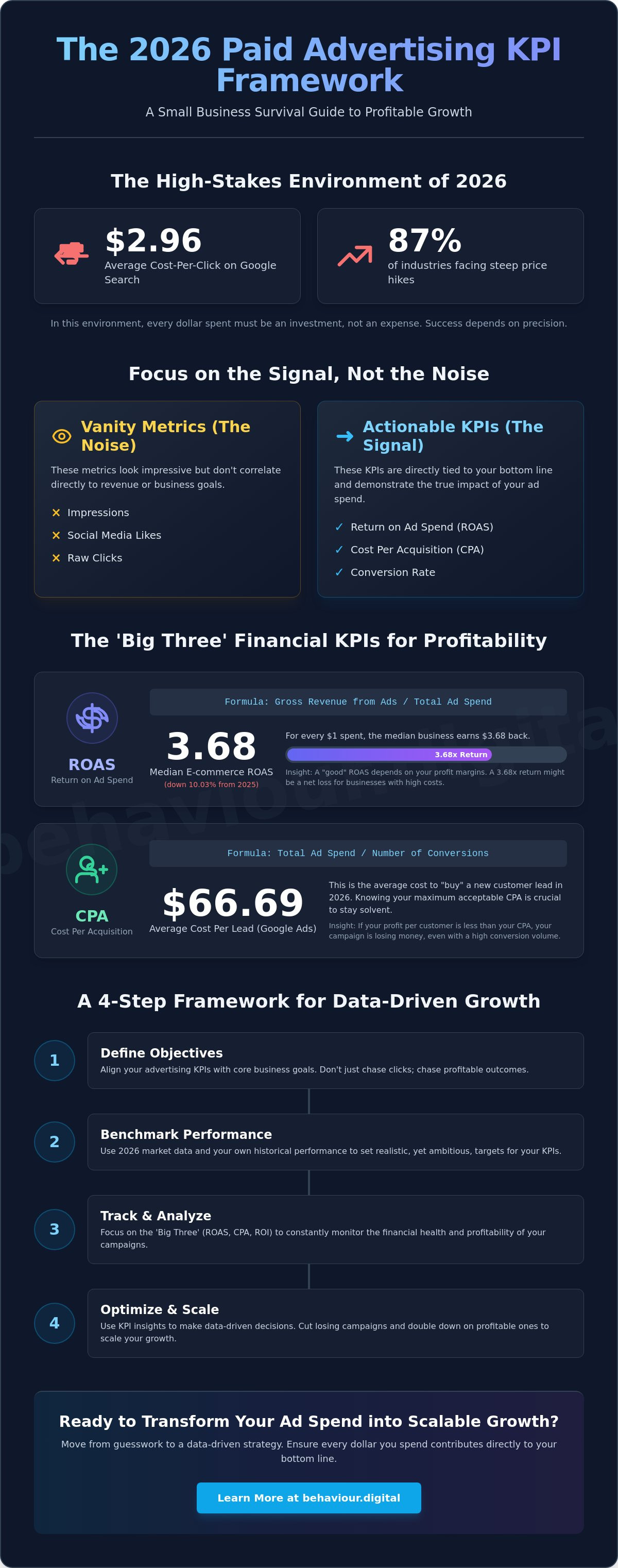
Setting paid advertising kpis for small business is a methodical exercise in data analysis, not a creative guessing game. Precision is mandatory. To scale effectively, you must follow a structured framework that links your ad spend to tangible business growth. This process begins with defining a primary objective, such as lead generation or direct sales, rather than chasing vague awareness metrics. Once your objective is clear, you must audit your historical performance to establish a baseline. Without knowing your past conversion rates or cost per lead, you cannot set realistic targets for the future.
Integrating 2026 market data into your planning is the next critical step. For instance, knowing that the average cost per lead in Google Ads has reached $66.69 allows you to build a budget that reflects current auction realities. Every goal you set should follow the SMART framework: Specific, Measurable, Achievable, Relevant, and Time-bound. Finally, implement automated reporting. Real-time data allows you to monitor the 30 to 60 day learning period inherent in AI-driven campaigns, ensuring you don't cut spend prematurely before the system optimizes.
Small businesses often fail by tracking too many indicators at once. You should identify one "North Star" KPI for each campaign to maintain strategic focus. If your goal is growth, choosing between lead volume and lead quality is essential. While a high volume of leads looks good on a spreadsheet, poor lead quality will waste your sales team's time and inflate your actual acquisition costs. Avoid the temptation to change your primary KPI mid-campaign. Constant shifts reset the platform's learning algorithms and prevent you from gathering statistically significant data. To align your metrics with a high-performance roadmap, partner with a strategic agency that prioritizes profit over vanity.
Reliable benchmarking requires a blend of industry standards and internal data. While cross-industry averages provide a useful starting point, your own historical data remains the most accurate predictor of future success. In the Scottish market, you must also account for seasonal fluctuations that can skew performance data during specific quarters. Industry-specific CPCs vary wildly; for example, legal services often face costs exceeding $15.00, while e-commerce remains more accessible at $1.50 to $4.00. Use these benchmarks to set your expectations, but focus your optimization efforts on outperforming your own previous month's results. This commitment to incremental improvement is what drives sustainable scaling.
Raw data is a commodity. In 2026, every advertiser has access to the same Google Ads dashboards and Meta reporting tools. The true competitive advantage doesn't come from seeing the numbers; it comes from the strategic interpretation of what those numbers signify about human behaviour. Successfully navigating paid advertising kpis for small business requires a transition from passive tracking to active execution. At Behaviour Digital, we move beyond surface-level metrics to understand the intent behind every interaction. We don't just report on what happened; we engineer what happens next.
Our methodology, known as 'Behavioural Growth,' focuses on the 'why' behind the data. If your cost per acquisition is rising, we don't just suggest a higher budget. We analyze the user journey to identify psychological friction points that prevent conversions. This results-oriented approach is the hallmark of a high-tier PPC Management partner. We treat your ad spend as our own, ensuring that every methodology is refined to produce measurable business development rather than just digital vanity.
We identify hidden opportunities that standard dashboards often overlook. By correlating user reactions with quantitative data, we uncover the specific variables that drive high-intent traffic. A critical component of this process is Conversion Optimisation. Even the most efficient ad campaign will fail if the landing page experience doesn't align with the user's expectations. We bridge this gap by ensuring your digital presence is both technically sound and psychologically persuasive. Transparency is our core principle; you'll always know exactly how your paid advertising kpis for small business are performing and what specific actions we're taking to improve them.
Competing with larger corporations doesn't require an infinite budget. It requires superior efficiency and a more agile strategy. As a specialist Glasgow agency, we help small businesses punch above their weight by focusing on the 'North Star' metrics that link directly to cash flow. We don't hide behind technical jargon or complex reports. Instead, we provide a clear roadmap to growth based on facts and measurable outcomes. If you're tired of wasting budget on campaigns that don't convert, it's time to shift your focus to a performance-first framework. Book your strategic performance audit with Behaviour Digital today.
Mastering paid advertising kpis for small business is the definitive boundary between a drain on capital and a scalable growth engine. By prioritizing the financial "Big Three" and bridging the gap between ad relevance and landing page performance, you create a foundation that survives rising auction costs. Success in 2026 requires moving beyond standard dashboards to execute a strategy rooted in quantitative facts and behavioural intent. You've learned that a profitable campaign isn't built on vanity metrics; it's built on the methodical alignment of your business objectives with current market benchmarks.
You don't have to navigate these technical complexities alone. As Glasgow-based specialists in behavioural growth, we provide transparent, data-led reporting that focuses on your actual ROI, not just superficial clicks. It's time to stop guessing and start growing with a methodology that treats every pound of ad spend as a strategic investment. Scale your business with a data-driven PPC strategy from Behaviour Digital and transform your advertising into a predictable path for expansion. Your business has the potential to outperform the competition; you just need the right framework to unlock it.
The most critical metric when launching paid advertising kpis for small business is your Cost Per Acquisition (CPA). This number tells you exactly how much you're paying to secure a customer. While traffic and clicks are necessary, they don't sustain a business. You must ensure your CPA remains below your profit margin on a first purchase to maintain solvency during the initial growth phase.
You should review your KPIs on a weekly basis to identify trends without reacting to daily fluctuations. New campaigns require a learning period of 30 to 60 days where data can be volatile. Checking too frequently often leads to premature changes that reset the platform's AI optimization. Focus on a 7-day or 30-day window to make informed strategic adjustments based on statistically significant data.
A "good" Return on Ad Spend (ROAS) typically starts at a 4:1 ratio, but the 2025 median for e-commerce was 3.68. For a UK small business, your target should be defined by your specific overhead and cost of goods. If your margins are thin, you might need a 5:1 or 6:1 ROAS just to break even. Always calculate your break-even ROAS before setting performance targets.
A high Click-Through Rate (CTR) combined with a rising CPA usually indicates a disconnect between your ad's promise and your landing page's reality. Your creative is attracting interest, but the user experience is failing to convert that interest into a sale. This often happens due to technical friction, such as slow loading times, or a lack of conversion rate optimization on the destination page.
You can track essential paid advertising kpis for small business using the native reporting tools provided by Google Ads and Meta. These platforms offer robust, free analytics that cover 90% of a small business's needs. When paired with a properly configured Google Analytics 4 (GA4) account, you have all the necessary data to measure ROI without investing in third-party enterprise software.
If you aren't hitting your targets, you must perform a systematic audit of your conversion funnel. Start by checking if the traffic is relevant, then evaluate if the landing page is persuasive. If both are healthy but your CPA is still too high, your offer or pricing may not be competitive enough for the current market auction. Incremental testing of your creative and offer is usually the path to recovery.
Privacy updates in 2026, including Google's limited ad serving policy, make first-party data more valuable than ever. Tracking is becoming less about individual user paths and more about modeled conversions. Advertisers must now rely on server-side tracking and robust conversion signals to give AI bidding systems the data they need to optimize effectively. Clear, unbranded ads may also face impression limits under new policies.
For brand awareness, Cost Per Mille (CPM) is the standard metric because it prioritizes reach and impressions. However, small businesses should still monitor CPC to ensure that the "awareness" is actually driving some level of engagement. If your CPM is low but nobody is clicking, your brand message isn't resonating with the target audience, regardless of how many people see the ad.

Luke leads strategy across every Behaviour Digital account — building data-driven advertising systems for ambitious brands. When he's not auditing ad accounts, he's writing about what he found in them.
Get a free, tailored growth plan — we'll run our framework on your accounts and show you exactly what we'd do.
Get your free growth plan →