.webp) Online
OnlineNot sure which channel fits your business?View all services →
Three inputs. Instant KPIs. No spreadsheets.Open a calculator →
OnlineWith the CMA now empowered to levy fines of up to 10% of global turnover for consumer protection breaches, the margin for error in dental advertising has effectively disappeared. Successful ppc for dentists uk isn't just about bidding on high-volume keywords anymore; it's about surgical precision in...

With the CMA now empowered to levy fines of up to 10% of global turnover for consumer protection breaches, the margin for error in dental advertising has effectively disappeared. Successful ppc for dentists uk isn't just about bidding on high-volume keywords anymore; it's about surgical precision in a highly regulated, high-CPC environment. You've likely seen your budget drained by low-intent NHS enquiries when you're actually seeking high-value private patients for implants or orthodontics. It's a common frustration to pay over £20 per click only to realize the campaign isn't aligned with the latest GDC ethical advertising standards or the 2026 pricing transparency requirements.
We understand that sustainable growth requires more than just traffic; it demands a measurable return on investment and total regulatory compliance. This article provides a definitive roadmap to dominate local search results and secure high-value patients using data-driven strategies tailored for the UK market. We'll examine the "Behaviour-First" methodology for lead qualification, the impact of the ongoing CMA market study into private dentistry, and the exact steps to lower your cost-per-acquisition while maintaining a consistent stream of private patient leads through fully managed, compliant campaigns.
• Learn how treatment-specific campaign segmentation improves Quality Scores and ensures budget allocation aligns with high-margin clinical goals.
• Understand how to navigate GDC and ASA regulations to maintain ethical compliance without compromising on ad performance or lead volume.
• Discover why sending traffic to a homepage is a strategic error and how dedicated landing pages significantly lower your cost-per-acquisition.
• Deploy a data-driven framework for ppc for dentists uk that captures both immediate emergency needs and long-term cosmetic patient intent.
• Identify the critical role of transparent data management and account ownership in achieving a measurable return on your advertising spend.
In the context of a modern dental surgery, Pay-per-click (PPC) functions as a high-precision surgical tool rather than a broad marketing net. It allows practices to capture local intent at the exact moment a patient searches for specific treatments. While organic search efforts are vital for building long-term authority, they lack the immediacy required to fill empty chairs next week. Effective ppc for dentists uk bypasses the months of waiting associated with other digital channels, placing your practice directly in front of active searchers who are ready to book.
Mobile devices now dominate dental search behavior and booking patterns. Patients looking for "emergency dentist near me" or "Invisalign London" rarely scroll past the first three results. Dominating this top-of-page real estate isn't just a luxury; it's a requirement for survival in a mobile-first environment. With the increasing volatility of AI-driven search results, paid ads remain the only way to guarantee visibility regardless of algorithm updates or layout changes on the search engine results page.
Efficiency is the core metric for 2026. As detailed in our analysis of Google Ads cost UK 2026, rising competition has inflated average CPCs across the board. Success no longer comes from simply outspending the clinic down the road. It comes from out-optimizing them through data-led strategies. Every pound spent must be tied to a specific clinical outcome, ensuring that ad spend translates into high-value chair time rather than empty clicks.
Many UK practices are actively transitioning away from high-volume, low-margin NHS work toward specialized private treatments. PPC provides a sophisticated filter for this transition. By using negative keywords to exclude terms like "NHS dentist" or "free checkup," you stop wasting budget on enquiries that don't fit your business model. Ad extensions allow you to highlight private-only benefits, such as 0% financing or weekend appointments, positioning your practice as a premium provider before the user even clicks your ad.
In saturated markets like London, Birmingham, or Glasgow, organic competition is often too dense to penetrate quickly. Local Services Ads (LSAs) have become a critical component of ppc for dentists uk, appearing even above traditional search ads with a "Google Screened" badge. This immediate trust signal is difficult to replicate through other marketing channels. The true ROI of dental PPC is defined by the total lifetime value of a patient, where a single successful implant lead can generate thousands in revenue over several years of clinical care.
Segmentation is the foundation of high-performance ppc for dentists uk. A generic "dentist near me" campaign often results in low-quality leads and wasted spend. To maximize your Quality Score and lower your cost-per-click, you must split your traffic into distinct behavioral categories. We use the "Pain vs. Gain" framework to distinguish between patients seeking immediate relief and those looking for elective cosmetic transformations. This ensures that your ad copy and landing pages align perfectly with the user's emotional state and intent.
Google's Smart Bidding has become increasingly sophisticated, but it requires the right data to be effective. Your PPC Management strategy must prioritize lead quality over raw quantity. By feeding the algorithm information about which clicks turned into actual consultations, you train the system to find more high-value patients. This data-led approach prevents the budget bleeding often seen in poorly managed accounts where "cheap" clicks fail to convert into chair time.
Cosmetic leads are "Desire-Driven." These patients aren't in pain; they're seeking a lifestyle improvement. Ad copy should be aspirational and lifestyle-focused while strictly adhering to UK Advertising Standards. Image extensions are vital here to showcase results, but they must remain within GDC guidelines for ethical advertising. Because the consideration period for cosmetic work can be long, we utilize remarketing to keep your practice top-of-mind as the patient moves through their decision-making process.
Restorative treatments like dental implants require a high level of authority. Keywords such as "cost of dental implants UK" signal a user who is ready to buy, whereas "what are implants" is purely educational. Your ads should address common fears and emphasize the longevity of the solution. Highlighting 0% finance options directly in the ad extensions can significantly lower the barrier to entry for these high-ticket procedures. If you're looking to scale these high-margin services, our team can help you build a performance-led digital strategy tailored to restorative care.
Emergency patients have the highest intent and the shortest decision window. They don't want to browse a website; they want to speak to a professional immediately. Call-only campaigns are the most effective tool for "Pain-Driven" searches like "emergency dentist open now." We use aggressive bidding strategies for these queries, combined with 24/7 ad scheduling or clear "out of hours" messaging to ensure you don't pay for clicks when your practice cannot answer the phone. This immediate response strategy is essential for capturing high-intent leads before they call the next clinic on the list.
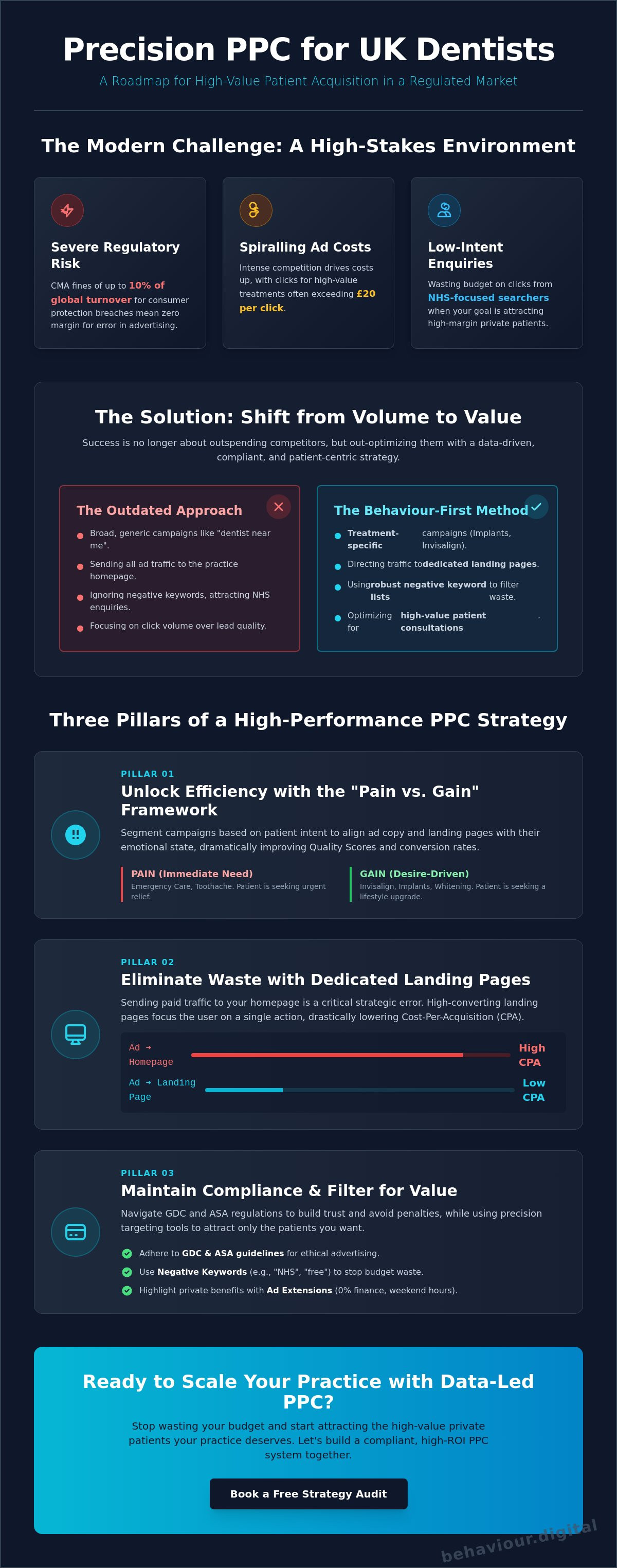
Compliance in dental advertising is no longer just a matter of professional ethics; it is a legal necessity with significant financial implications. As of April 2025, the CMA has the authority to directly impose fines of up to 10% of a company's global turnover for breaches of consumer protection law. Executing compliant ppc for dentists uk requires a deep understanding of the General Dental Council (GDC) standards and the Advertising Standards Authority (ASA) requirements. Every ad must be legal, decent, honest, and truthful. Failure to adhere to these principles can lead to public ASA rulings that damage your reputation and trigger GDC fitness-to-practise investigations.
One of the most frequent mistakes in dental ad copy is the use of superlatives. Terms like "The Best Dentist in London" or "Painless Treatment" are considered misleading because they cannot be objectively proven. The GDC requires that all information is backed up by facts. If you claim to be "award-winning," you must specify the exact award and the year it was won. Similarly, pricing transparency is a major focus for the ASA. If your ad mentions a price, it must be clear and include any "starting from" qualifiers. Hidden costs or unrealistic "lead-in" prices that most patients won't qualify for will result in your ads being flagged and removed.
Managing patient reviews and testimonials also requires a compliant approach. While social proof is a powerful conversion tool, the GDC mandates that testimonials must be genuine and represent the patient's actual experience. You cannot selectively edit reviews to change their meaning or omit negative feedback that provides a balanced view of the clinical risks. Every claim made in a testimonial becomes your responsibility once you use it in your marketing materials.
In the cosmetic sector, "guaranteed results" is a major red flag for UK regulators. Clinical outcomes in dentistry can never be 100% guaranteed due to biological variability. Your landing pages must include a clear disclaimer stating that all treatments are "subject to clinical assessment." This ensures patients understand that a consultation is required to determine suitability. Additionally, professional designations must be used accurately. Only those on the GDC specialist list can call themselves a "Specialist" in ad extensions; everyone else must use "Dentist with an interest in" to avoid misleading the public.
Lead generation for dental practices involves handling sensitive health data, making GDPR compliance non-negotiable. Your lead forms must include a clear privacy policy and an active opt-in for marketing communications. Secure data handling is the cornerstone of patient trust; ensuring that dental leads are processed through encrypted channels and stored in a secure CRM is essential for maintaining both legal compliance and professional integrity. Google Ads also enforces strict health-in-personalized-advertising policies, which limit how you can retarget patients based on specific health conditions or treatments.
Directing paid traffic to your practice homepage is a strategic error that consistently results in budget bleeding. A homepage serves as a general directory; a high-performing landing page serves as a conversion engine for a specific clinical need. When a user clicks an ad for ppc for dentists uk, they expect to land on a page that immediately validates their search intent. If they have to navigate a menu to find the treatment they just clicked on, they will bounce. This friction directly increases your cost-per-acquisition and reduces the overall efficiency of your ad spend.
Our "Behavioural Growth" methodology focuses on the psychological state of the patient. A restorative patient needs reassurance regarding clinical outcomes and longevity, while a cosmetic patient responds better to lifestyle imagery and aesthetic transformations. By integrating Conversion Rate Optimization, we systematically remove the cognitive barriers that prevent a click from becoming a consultation. This isn't about subjective design; it's about using quantitative data to refine every headline, button, and form field for maximum impact.
In the UK dental market, trust is a measurable asset. Strategic placement of your latest CQC rating and live Google Reviews provides the immediate third-party validation that patients require. Video testimonials are particularly effective here. They humanise the clinical experience and build a rapport with the patient before they even step into the surgery. Displaying high-quality photography of the actual dental team, rather than generic stock images, further reduces patient anxiety and establishes professional authority.
Mobile users represent the majority of dental search traffic, meaning your booking process must be frictionless on small screens. Long forms with unnecessary fields are a primary cause of lead abandonment. We recommend mobile-optimised forms that only capture essential data or direct-to-calendar tools like Software of Excellence or Calendly. For patients in immediate need, the "Click-to-Call" button is the most critical element on the page. It provides a direct path to your reception team, capturing high-intent leads at the peak of their interest. If your current pages aren't converting at a 10% or higher rate, it's time to audit your dental conversion funnel for hidden friction points.
Achieving a sustainable return on ppc for dentists uk requires a shift from superficial metrics to deep-funnel data analysis. Many practices see a high volume of "conversions" in their Google Ads dashboard that never translate into actual clinical revenue. We solve this by tracking qualified leads. This means we distinguish between a general enquiry and a high-value patient ready for a consultation. By closing the loop between the ad click and the patient management system, we ensure your budget is allocated to the treatments that drive the most profit for your surgery.
Transparency is the foundation of our strategic partnerships. Unlike agencies that withhold access to your own data, we operate a "Transparent Management" model. You own your accounts, your data, and your intellectual property. This level of accountability is why choosing a specialized PPC Agency in Glasgow provides a competitive advantage for UK-wide scaling. We combine local market knowledge with advanced bidding strategies to dominate high-competition areas, ensuring your practice remains visible where it matters most.
Our approach goes beyond keyword bidding to analyze the "why" behind every patient interaction. We don't just guess which ad copy will work; we use continuous A/B testing to refine our messaging against industry benchmarks. This methodology focuses on the psychological triggers that drive a patient to choose one clinic over another. Our monthly performance deep-dives bypass vanity metrics like impressions or average position. Instead, we focus on the numbers that impact your bottom line: cost-per-qualified-lead and total return on ad spend.
The first step toward scaling is identifying the inefficiency in your current setup. Most dental accounts we audit have significant wasted spend, often due to broad-match keywords or poorly configured tracking. During our initial strategy session, we perform a forensic analysis of your account to find these leakages. We then build a roadmap based on your specific clinical capacity and growth targets. If you're ready to move beyond basic advertising and implement a performance-led strategy, book your data-driven PPC strategy session with Behaviour Digital today. We'll show you exactly how to turn ppc for dentists uk into a predictable engine for private patient acquisition.
The landscape of ppc for dentists uk has evolved into a discipline where technical precision and regulatory expertise are non-negotiable. Success in 2026 isn't defined by the volume of traffic but by the clinical value of the patients you acquire. By segmenting high-intent treatments like Invisalign and implants from general enquiries, and ensuring every landing page is a frictionless conversion engine, you transform your ad spend from a cost into a high-yield investment. Maintaining strict adherence to GDC and ASA standards is no longer just about ethics; it's a critical safeguard for your practice's long-term reputation and financial stability.
Sustainable growth requires a strategic partner who understands the nuances of the UK dental sector and prioritises Data-Driven Lead Quality Tracking over vanity metrics. We combine Specialist UK Dental PPC Experience with GDC & ASA Compliant Strategies to ensure your practice captures the right patients at the right time. It's time to stop guessing and start scaling with a methodology that tracks every pound back to the dental chair. Scale your patient acquisition with our expert PPC management and secure your practice's position as a local leader. Your clinical excellence deserves a digital strategy that matches its caliber.
Yes, because it allows small practices to compete directly with larger dental groups by dominating specific local searches. Effective ppc for dentists uk ensures that your surgery appears at the top of results for high-value treatments like Invisalign or implants, regardless of your organic ranking. It's the most efficient method for filling gaps in your diary with private patients who have immediate clinical needs.
Your monthly allocation depends on your local competition, target location, and the specific treatments you want to promote. A practice in central London will naturally require a higher budget to maintain visibility compared to a surgery in a smaller town. We recommend a budget that allows for enough click volume to feed the machine-learning algorithms, ensuring your campaign has sufficient data to optimize for qualified leads rather than just impressions.
The cost-per-acquisition for specialist restorative treatments typically ranges between £120 and £200. This figure reflects the high level of competition for implant-related keywords in the UK market. While the initial lead cost is higher than general dentistry, the high lifetime value of an implant patient makes this one of the most profitable areas for paid search investment when managed with a focus on lead quality.
Yes, you can precisely target your ads to specific postcodes or a set radius around your dental practice. This prevents your budget from being wasted on users who are outside of a reasonable commuting distance. For practices in major cities, this granular targeting is essential for reaching the right demographic and ensuring your ad spend is focused on your primary catchment area.
You must implement a robust list of negative keywords to filter out users seeking NHS services. By excluding terms like "NHS," "exempt," or "free checkup," you ensure your ppc for dentists uk strategy only captures searches for private clinical care. This is a critical step for practices looking to transition away from high-volume NHS work toward more profitable private treatments.
Yes, using dedicated landing pages for each treatment is a requirement for achieving a high Quality Score and a low cost-per-click. A patient searching for emergency care has a different psychological intent than someone looking for cosmetic bonding. Providing a tailored experience that matches the user's specific search query significantly increases the likelihood of a conversion and reduces budget leakage.
You'll see an immediate increase in visibility and traffic as soon as your campaign is launched. However, the data-led refinement process typically takes between 30 and 90 days to achieve peak efficiency. During this initial phase, we analyze user behavior and conversion data to fine-tune your targeting, ensuring your cost-per-acquisition decreases as the campaign matures.
Google Ads is generally superior for capturing high-intent patients who are actively searching for a solution to a problem, such as tooth pain or missing teeth. Facebook Ads is an effective secondary tool for building awareness for elective cosmetic treatments through visual storytelling. For most practices, Google Ads remains the primary engine for consistent, high-value patient acquisition due to its ability to capture active search intent.

Luke leads strategy across every Behaviour Digital account — building data-driven advertising systems for ambitious brands. When he's not auditing ad accounts, he's writing about what he found in them.
Get a free, tailored growth plan — we'll run our framework on your accounts and show you exactly what we'd do.
Get your free growth plan →