.webp) Online
OnlineNot sure which channel fits your business?View all services →
Three inputs. Instant KPIs. No spreadsheets.Open a calculator →
OnlineIn 2026, a single misconfigured broad-match keyword in the UK wealth management sector can burn £28 of your budget in one click before you've even qualified the lead. This is the brutal reality of ppc for financial services uk where the margin for error has effectively vanished. You're likely facing...

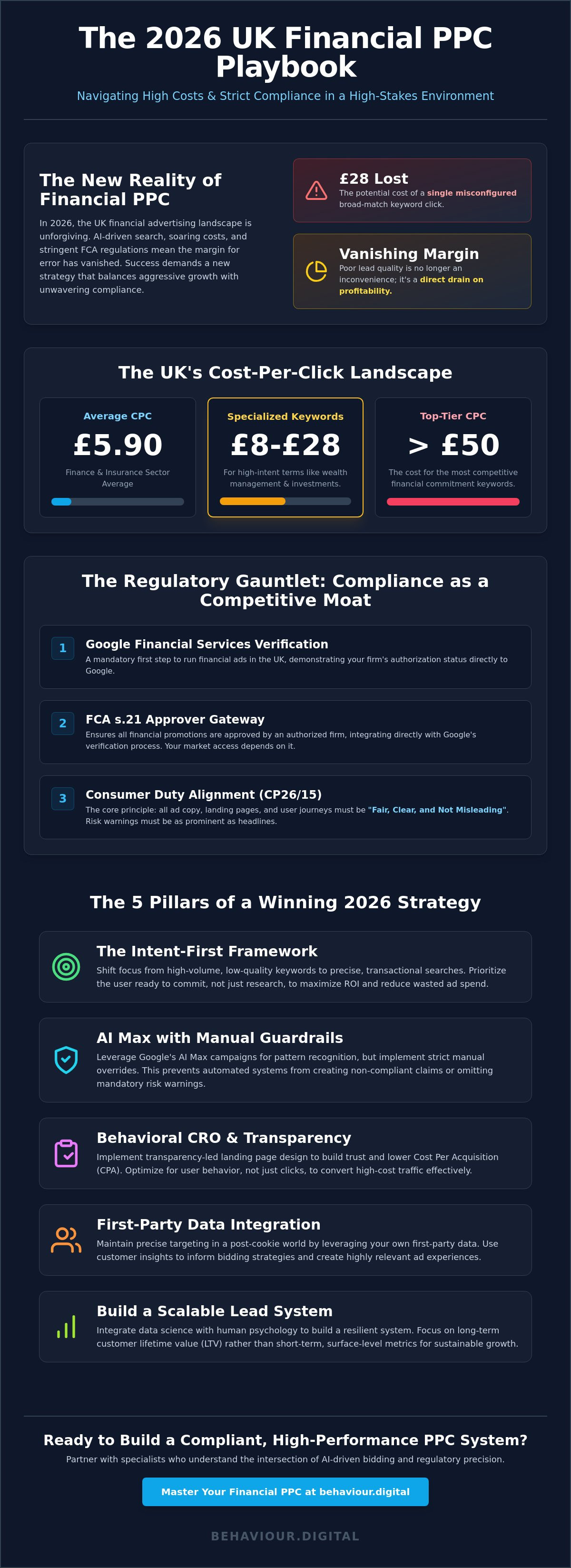
In 2026, a single misconfigured broad-match keyword in the UK wealth management sector can burn £28 of your budget in one click before you've even qualified the lead. This is the brutal reality of ppc for financial services uk where the margin for error has effectively vanished. You're likely facing the dual pressure of exorbitant CPCs and the constant anxiety of FCA non-compliance under the latest CP26/15 simplified rules. It's a high-stakes environment where poor lead quality isn't just an inconvenience; it's a direct drain on your firm's bottom line.
We've built this performance playbook to help you regain control and master the intersection of AI-driven bidding and regulatory precision. You'll learn how to deploy a data-driven strategy that balances aggressive growth with 100% compliant ad creative and landing pages. We'll break down how to leverage Google's AI Max system, navigate the specialized s.21 approver gateway, and use first-party data to lower your CPA in a world without third-party cookies. It's time to move beyond surface-level metrics and build a scalable lead generation system that thrives under the scrutiny of the Consumer Duty.
• Navigate the 2026 FCA promotion rules and Google’s mandatory verification process to maintain an uninterrupted market presence.
• Shift from high-volume waste to an intent-first framework that prioritizes transactional searches for ppc for financial services uk.
• Implement behavioral CRO and transparency-led landing page design to lower your CPA in high-cost auctions.
• Master the transition to AI Max campaigns while using first-party data to maintain targeting precision in a post-cookie landscape.
• Build a scalable lead generation system by integrating data science with human psychology for long-term customer lifetime value.
Financial PPC is no longer just about buying traffic. It's the strategic application of Pay-per-click (PPC) models to capture high-intent users within the banking, insurance, and investment sectors. In 2026, the landscape has shifted from simple keyword matching to a sophisticated battle of data signals. AI-driven search engines now process financial queries with an emphasis on immediate, personalized advice, meaning your ads must reflect a deep understanding of the user's specific financial journey. Generic agencies often fail here because they treat financial services like standard e-commerce. They don't account for the high cost of learning on the job. In a sector where a single click for high-value keywords can exceed £50, there's no room for "test and learn" strategies that burn through capital without delivering qualified intent.
Success in 2026 requires a pivot from the quantity of clicks to the quality of intent. The UK financial market is saturated with broad searches that lead to dead ends. Winning means identifying the thin line between a user researching a topic and a user ready to commit to a mortgage or pension transfer. This distinction is the foundation of effective ppc for financial services uk.
The financial sector remains the most expensive vertical in the UK search market. Current data shows the average CPC for the Finance and Insurance sector sits at £5.90, but this figure is deceptive. For wealth management and specialized investment keywords, costs frequently range between £8 and £28. When you factor in the Search Generative Experience (SGE), which provides AI-summaries at the top of the SERP, your ad must offer more than just a link. It must offer a solution. Navigating these regional nuances requires local accountability. Partnering with a PPC agency Glasgow ensures your campaigns aren't just managed by a global algorithm but are tuned to the specific regulatory and cultural landscape of the UK market.
Paid search has evolved beyond a bottom-of-funnel conversion tool. In 2026, it's a primary driver for brand authority and trust-building. Because users are more skeptical of financial products, seeing a compliant, well-structured ad at the moment of search builds immediate credibility. PPC data doesn't exist in a vacuum; it's a critical feedback loop that informs your broader Digital Strategy. By analyzing which high-intent queries convert, you can scale your growth with mathematical certainty. The current state of UK financial PPC is a surgical balance of algorithmic precision and unwavering regulatory compliance.
Compliance is often viewed as a barrier to entry, but for sophisticated advertisers, it's a competitive moat. In the high-stakes environment of ppc for financial services uk, regulatory precision is the only way to protect your ad spend and brand reputation. Google’s mandatory financial services verification, which has been in effect since 2021, now integrates directly with the FCA’s s.21 approver gateway. This means your market access depends entirely on your ability to demonstrate authorization. Beyond simple verification, the 2026 regulatory landscape is defined by the FCA’s CP26/15 consultation, which simplifies rules but aligns them strictly with the Consumer Duty. Your ad copy must be more than just persuasive; it must be "Fair, Clear, and Not Misleading" at every touchpoint.
The rise of Google’s "AI Max" campaigns has introduced a new layer of risk. While these systems excel at finding patterns in user behavior, they lack the legal nuance required for financial promotions. Automated ad generation can inadvertently create "guaranteed" claims or omit mandatory risk warnings, leading to immediate account suspension. To maintain a compliant strategy, you must implement manual regulatory guardrails that override AI-generated suggestions. Adhering to the FCA guidance on financial promotions regarding the prominence of risk warnings is non-negotiable. If your risk disclosure isn't as visible as your headline, you're inviting a regulatory audit.
Obtaining Google Ads financial verification requires a precise alignment between your FCA Firm Reference Number (FRN) and your Google account identity. Common rejections stem from mismatched business addresses or landing pages that fail to display the required statutory status disclosures. At Behaviour Digital, we manage this compliance-data tightrope by conducting pre-flight audits on all creative assets. We ensure your "Fair, Clear, and Not Misleading" standards are met before the algorithm even sees the ad, preventing the cycle of disapprovals that kills campaign momentum.
Modern bidding has shifted from "Conversion Volume" to "Value-Based Bidding." In a post-cookie environment, your first-party data is your most valuable asset. By feeding your CRM data back into the AI Max system, you can train the algorithm to bid higher for users with a high Customer Lifetime Value (CLV) rather than just cheap leads. However, this automation requires a human-in-the-loop approach. You must consistently audit the search terms the AI targets to ensure they don't drift into prohibited or non-compliant territory. Precision in ppc for financial services uk is achieved when you use machine learning to scale what works while human experts maintain the ethical and legal boundaries.
Volume is often a vanity metric that masks significant waste. In the competitive arena of ppc for financial services uk, chasing high-volume keywords like "mortgages" or "investments" without a strict intent filter is a fast track to budget depletion. In 2026, successful campaigns prioritize the psychology behind the search. We categorize user intent into three distinct tiers: Research, Comparison, and Transactional. A user searching for "what is a SIPP" is in a research phase and unlikely to convert immediately, while someone searching for "open a SIPP account" demonstrates clear transactional intent. Aligning your bids with these stages ensures you aren't overpaying for clicks that have zero probability of near-term conversion.
Negative keyword sculpting is your primary tool for capital preservation. You must aggressively exclude terms like "free," "jobs," or "news" to prevent your ads from appearing to non-commercial audiences. Crucially, your keyword strategy must also align with the latest FCA guidance on financial promotions. If your intent clusters drift into areas where you aren't authorized to provide advice, you risk both ad suspension and regulatory fines. Precision isn't just about saving money; it's about staying within the legal boundaries of the UK financial market.
Match types have evolved, but their strategic application remains vital for controlling costs in high-premium auctions. Use this framework to guide your selection:
| Match Type | Strategic Use Case | Risk Level |
|---|---|---|
| Exact Match | High-premium transactional terms (e.g., "buy life insurance") | Low |
| Phrase Match | Capturing specific user questions and comparison queries | Medium |
| Broad Match | Discovering new fintech trends or niche search patterns | High |
Exact match serves as your safety net. It allows you to bid aggressively on the keywords that drive your most profitable leads without the "close variant" creep that often plagues broader settings. Conversely, broad match should only be used in isolated "discovery" campaigns with strict budget caps to identify emerging search trends before your competitors do.
Keywords only tell half the story. In 2026, we integrate behavioral data to add a layer of qualification. For B2B financial services, LinkedIn data integration allows you to layer professional seniority and company size over your Google Ads campaigns. For B2C, we target "Life Events" such as buying a home or reaching retirement age. This ensures your ppc for financial services uk strategy reaches a user not just when they search, but when their life circumstances dictate a genuine need for your product. Intent-mapping is the single most effective way to lower your CPA.
Generating traffic is only half the battle. In a sector where wealth management clicks reach £28, you cannot afford a leaky funnel. While many agencies focus solely on the ad side, 90% of failures in ppc for financial services uk occur after the click. When your average search CPA is $92, every percentage point of improvement in your conversion rate directly compounds your ROI. Implementing conversion rate optimization is the only sustainable way to win in high-CPC auctions without simply outspending the competition. It's about moving the needle from the industry average conversion rate of 5.9% toward a high-performance benchmark that justifies aggressive bidding.
The anatomy of a high-converting financial landing page focuses on trust signals, transparency, and the systematic reduction of friction. Financial users are inherently risk-averse. They need to see evidence of stability and compliance before they share sensitive data. A/B testing in this sector requires a specialized approach; you often can't change the legal disclaimers, but you can test their placement, the hierarchy of information, and the complexity of your lead capture forms. Reducing "form friction" through multi-step logic allows you to collect necessary data without overwhelming the user during their initial interaction.
Credibility is your primary currency. Your FCA status disclosure shouldn't be hidden in the footer; it should be positioned to reinforce your authority at critical decision points. We integrate social proof, such as Trustpilot ratings and industry awards, to build immediate rapport. At Behaviour Digital, we use behavioral data to refine layouts, ensuring that trust signals are prominent enough to reassure the user without distracting from the primary conversion goal. Transparency isn't just a legal requirement under the Consumer Duty; it's a powerful conversion driver that differentiates you from low-quality lead aggregators.
Performance metrics are non-negotiable. With 72% of UK Google searches now conducted on mobile devices, a slow-loading page is a terminal campaign flaw. A 1-second delay in the financial sector costs more than in almost any other industry because it triggers immediate distrust. Your mobile journey must be optimized for the "on-the-go" investor who expects a frictionless experience. You can find more technical implementation details in our Conversion Optimisation guide. If you want to stop the bleed in your ad spend, you need to optimize your financial sales funnel with our data-driven methodology.
We don't just manage ad accounts; we engineer growth. The "Behavioural Edge" is our unique framework that bridges the gap between raw data science and the complex psychology of financial decision-making. In 2026, success in ppc for financial services uk requires more than just algorithmic bidding. It demands a partner who understands how users react to financial stress, opportunity, and risk. Our approach is built on quantitative data and measurable business evolution. We've stripped away the marketing fluff to focus on what actually moves the needle for your firm.
Based in Glasgow, our team provides global reach with strict, UK-specific accountability. We understand the nuances of the regional market that offshore or generic agencies often overlook. We reject vanity metrics like impressions or simple click-through rates. If a metric doesn't contribute to your bottom line, it doesn't belong in our reports. Our transparent reporting system uses real-time dashboards to show your actual ROI and cost-per-acquisition. You'll always know exactly how your capital is working to secure new clients.
Our management process is a cycle of continuous refinement. We perform daily bid adjustments and keyword sculpting to stay ahead of the volatile CPCs common in the ppc for financial services uk sector. Proactive compliance monitoring is a core component of our service. We constantly audit your ad creative against the latest FCA standards to protect your account from sudden suspensions. To ensure a cohesive brand journey, we often integrate Social Media Marketing into our broader strategy. This holistic approach captures intent on search engines while building authority on social platforms.
You need a partner who speaks the language of your industry. We understand the structural differences between a SIPP and an ISA, and we know how to target the specific audiences for each. This niche expertise allows us to write copy that resonates with high-net-worth individuals and retail investors alike. Our methodology has a track record of delivering results, including reducing the CPA for UK financial clients by 40% through aggressive waste elimination and intent-mapping. We don't just deliver clicks; we deliver a scalable system for long-term growth. Ready to scale your financial leads? Book a strategy call with Behaviour Digital today.
Success in the UK financial market now depends on your ability to synthesize FCA-grade compliance with AI-driven bidding precision. You've seen how intent-first frameworks and behavioral CRO can transform a high-CPC environment into a scalable lead generation engine. It's no longer enough to just buy clicks; you must own the entire journey from the first search to the final conversion. This playbook has outlined the shift from broad-match waste to surgical, intent-based targeting that protects your margins while adhering to the highest regulatory standards.
Mastering ppc for financial services uk requires a transition from reactive bidding to proactive, behavioral precision. As Glasgow-based specialists in high-compliance sectors, we provide the data-driven methodology needed to outpace competitors who still rely on outdated, generic strategies. We're committed to your growth through transparent reporting and a relentless focus on ROI rather than vanity metrics. The path to dominance in the financial sector is paved with data and strategic refinement, not guesswork. We're ready to help you build a competitive moat that lasts.
Request a Data-Driven PPC Audit for Your Financial Brand and start building your competitive advantage today.
PPC remains the most direct channel for customer acquisition because it captures high-intent users at the exact moment of search. With Google holding over 90% of the UK search engine market share, your brand needs a presence where the majority of financial research begins. Success in 2026 isn't about just being present; it's about using behavioral data to outbid competitors for the most profitable segments of that traffic.
The FCA regulates ads through the Financial Promotion rules, ensuring communications are fair, clear, and not misleading. Since 2021, Google has enforced a strict verification policy requiring firms to prove their FCA authorization. This regulatory layer protects consumers from fraud while creating a higher barrier to entry for advertisers. Your creative assets must also align with the Consumer Duty standards to avoid account suspension or legal action.
A sustainable CPA is relative to your specific financial product's lifetime value and profit margins. While the broad search average for the sector is approximately $92, specialized niches like mortgage brokerage or equity release often see higher figures. You should focus on your Value-Based Bidding targets. A good CPA is one that allows for scalable growth while maintaining a healthy return on ad spend.
You can use AI for initial asset generation, but human oversight is mandatory for compliance. Google's AI Max systems are powerful, yet they lack the legal nuance to ensure every risk warning meets FCA prominence requirements. Relying solely on automation is a significant risk in the financial sector. Human experts must review every headline and description to ensure they don't make unauthorized or misleading claims.
Initial data and traffic appear within hours of launching, but true performance maturity typically requires 30 to 90 days. This timeframe allows for the learning phase of AI-driven bidding and the collection of enough conversion data to make informed adjustments. During this period, we refine keyword intent and landing page performance to stabilize your cost-per-lead and ensure the system is scalable.
Costs are driven by the high commercial value of the leads and intense market competition. When a single client can represent thousands of pounds in revenue, firms are willing to bid aggressively for top positions. This auction dynamic pushes CPCs for wealth management and insurance keywords into the double digits. Winning requires a strategy that prioritizes conversion quality over simple click volume to justify these high entry costs.
Dedicated landing pages are essential for maintaining high Quality Scores and maximizing your conversion rate. When you're investing in ppc for financial services uk, sending traffic to a generic homepage is a recipe for budget waste. Each ad group should lead to a page that mirrors the specific search intent of the user. This relevance reduces bounce rates and significantly lowers your overall cost-per-acquisition.
You must complete the verification process through your Google Ads account by providing your FCA Firm Reference Number (FRN). Google cross-references this with the FCA Register to confirm your status or your relationship with an authorized s.21 approver. This process is the first critical step in any ppc for financial services uk strategy. Without this verification, your ads won't be eligible to serve to UK audiences.

Luke leads strategy across every Behaviour Digital account — building data-driven advertising systems for ambitious brands. When he's not auditing ad accounts, he's writing about what he found in them.
Get a free, tailored growth plan — we'll run our framework on your accounts and show you exactly what we'd do.
Get your free growth plan →