.webp) Online
OnlineNot sure which channel fits your business?View all services →
Three inputs. Instant KPIs. No spreadsheets.Open a calculator →
OnlineWhat if your biggest client walked away with your proprietary bidding strategy tomorrow because your agreement lacked basic intellectual property protections? In 2026, a vague service agreement isn't just unprofessional; it's a high-risk liability that could cost your agency its reputation and its b...

What if your biggest client walked away with your proprietary bidding strategy tomorrow because your agreement lacked basic intellectual property protections? In 2026, a vague service agreement isn't just unprofessional; it's a high-risk liability that could cost your agency its reputation and its bottom line. You've likely felt the frustration of scope creep or the anxiety of managing significant budgets without a clear legal shield. Implementing a rigorous ppc management contract template is no longer optional if you want to professionalise your partnerships and define exactly where your responsibility ends and the client's liability begins.
We agree that a strategic partnership should be built on transparency and measurable business growth rather than legal ambiguity. This article provides the definitive framework for mastering essential clauses, fee structures, and the legal protections required to secure your ad spend. We'll explore the architecture of professional agreements, from navigating compensation models to mitigating risks in an era of aggressive data privacy enforcement and AI-driven automation.
• Establish a legally sound framework that aligns agency operations with client business goals to ensure long-term scalability and predictable results.
• Implement a precise "Scope of Services" to eliminate scope creep and maintain profitability across all digital advertising campaigns.
• Adopt the industry standard of direct-to-platform ad spend payments to mitigate financial liability and enhance financial transparency for both parties.
• Utilise a comprehensive ppc management contract template to explicitly define intellectual property rights and account ownership before the engagement begins.
• Integrate robust data privacy clauses that address 2026 regulatory changes, protecting your agency from evolving legal and compliance risks.
A professional agreement functions as a strategic roadmap rather than a static legal barrier. When you deploy a ppc management contract template, you aren't just signing a piece of paper; you're establishing a living document designed to facilitate sustainable business growth through conscious strategy. High-stakes Pay-per-click (PPC) campaigns involve significant capital and complex technical implementations. Generic service agreements often fail in this sector because they lack the granular detail required to manage ad spend liability or intellectual property ownership. For UK-based partnerships, using British English precision ensures that legal terms align with local jurisdiction and commercial standards. This clarity removes the ambiguity that often leads to costly disputes.
The primary purpose of this architecture is threefold: aligning expectations, protecting proprietary methodologies, and defining liability limits. Without these pillars, agencies risk scope creep that erodes profit margins, while clients risk losing access to vital campaign data. A well-structured contract serves as a performance framework that evolves alongside the account's complexity. It ensures that success is a result of methodical finetuning rather than luck.
Precision begins with identifying who is involved. The contract must explicitly define the "Client" and the "Contractor" while establishing an independent contractor status. This distinction is vital to avoid unintended employment law complications or tax liabilities. A robust ppc management contract template will also specify the exact digital platforms under management. Whether you're focusing on Google Ads, Meta, or LinkedIn, the agreement should leave no room for interpretation regarding which channels the agency is responsible for optimising. It's about creating a clear boundary where the agency acts as a strategic partner, not an internal department.
The "Term" section dictates the lifecycle of the partnership. Agencies often debate the merits of month-to-month rolling contracts versus fixed-term commitments. While rolling contracts offer the client flexibility, fixed terms of six to twelve months provide the stability needed for deep methodological finetuning and long-term strategy execution. This duration allows for the collection of enough quantitative data to make informed adjustments. Setting these boundaries early prevents the friction that occurs when expectations regarding timelines aren't synchronised from day one.
Key elements to include in this section:
The specific calendar date when the legal obligations and protections start.
The day management and optimisation work actually begins, which may differ from the signing date.
A standard 30 to 90-day notice period balances the client's need for agility with the agency's need to manage resources and staffing effectively.
A professional agreement lives or dies by the specificity of its clauses. It's not just about a ppc management contract template being a legal necessity; it's about setting the operational boundaries that ensure profitability for both parties. One critical element is the Mutual Indemnification clause. This protects both the agency and the client from third-party claims, ensuring that liability is clearly assigned if ad copy inadvertently infringes on a trademark or copyright. Without this, a single error can lead to catastrophic financial consequences.
Platform access is another non-negotiable requirement. The agency must have the necessary administrative permissions to execute changes, install tracking pixels, and audit historical data. Denying or delaying this access prevents the methodical finetuning required for success. Effective management relies on the agency having the tools to succeed from the first day of the engagement. Precision is the catalyst for trust. By defining these standards early, you transform the relationship from a simple transaction into a strategic alliance.
Defining the scope prevents the scope creep that erodes agency margins and creates client frustration. You must explicitly list deliverables such as keyword research, bid management, and ad copy creation. It's equally important to state what is NOT included. If a client expects full-scale web development or traditional SEO, the contract must clarify these are separate engagements. This alignment is foundational to a high-performing Digital Strategy designed for scalable growth. Precise boundaries allow the agency to focus on quantitative performance rather than administrative distractions. When you use a structured ppc management contract template, you ensure that every hour billed is an hour spent on value creation.
Data-driven updates are the pulse of the partnership. The agreement should define how often the client receives performance updates and the specific benchmarks used to measure success. Transparency is a core pillar when choosing the best PPC agency in Glasgow or any other competitive market. Agencies must also ensure their reporting and creative processes adhere to the FTC online advertising guidelines to remain compliant with federal standards. To maintain efficiency, set limits on consultation hours and unscheduled meetings. This ensures that the strategist's time is spent on account optimisation rather than redundant communication. If you are looking to refine your current approach, exploring our Conversion Rate Optimization services can help maximise the value of your existing traffic.
Distinguishing between management fees and ad spend is the most critical financial boundary in any agency partnership. A professional ppc management contract template must establish that these are two separate capital flows. While management fees compensate the agency for its strategic expertise and methodological precision, ad spend is the raw capital paid directly to advertising platforms. This separation ensures financial transparency and prevents the agency from being viewed as a lending institution for the client's marketing budget.
The "Golden Rule" of digital advertising remains constant. Clients should pay their ad spend directly to platforms like Google, Meta, or LinkedIn using their own payment methods. This structure eliminates the risk of the agency carrying significant debt and ensures the client maintains full ownership of their billing history. It's a fundamental principle that protects the agency's cash flow while providing the client with direct control over their investment. When these lines blur, disputes over liability and late payments inevitably follow.
Fee structures have evolved to prioritise results and scalability. Flat-fee models remain a popular choice for businesses seeking predictable costs in their PPC management. This model incentivises efficiency rather than simply encouraging higher spend. However, many sophisticated partnerships now utilise hybrid models. These combine a base retainer with a performance bonus tied to specific KPIs, such as a target ROAS or lead volume. This alignment ensures the agency is directly invested in the client's business growth. When structuring these, incorporating performance-based service contracting best practices helps create a fair incentive framework. Percentage-of-spend models are still used but must be clearly capped or tiered to avoid potential conflicts of interest where an agency might recommend higher budgets without a corresponding increase in value.
The contract must explicitly state that the client bears sole responsibility for platform billing. If a client's credit card fails or a platform account is suspended due to billing issues, the agency's role is to notify the client, not to cover the costs. Procedures for pausing campaigns during payment failures should be clearly outlined to prevent wasted management hours on inactive accounts. The agency acts as a steward of the advertising capital; it doesn't provide credit. To maintain a healthy partnership, include "Automatic Retainer Adjustments." These allow the management fee to scale logically as the ad budget grows, ensuring the agency has the resources to manage the increased complexity of a larger account without renegotiating the entire ppc management contract template every quarter.
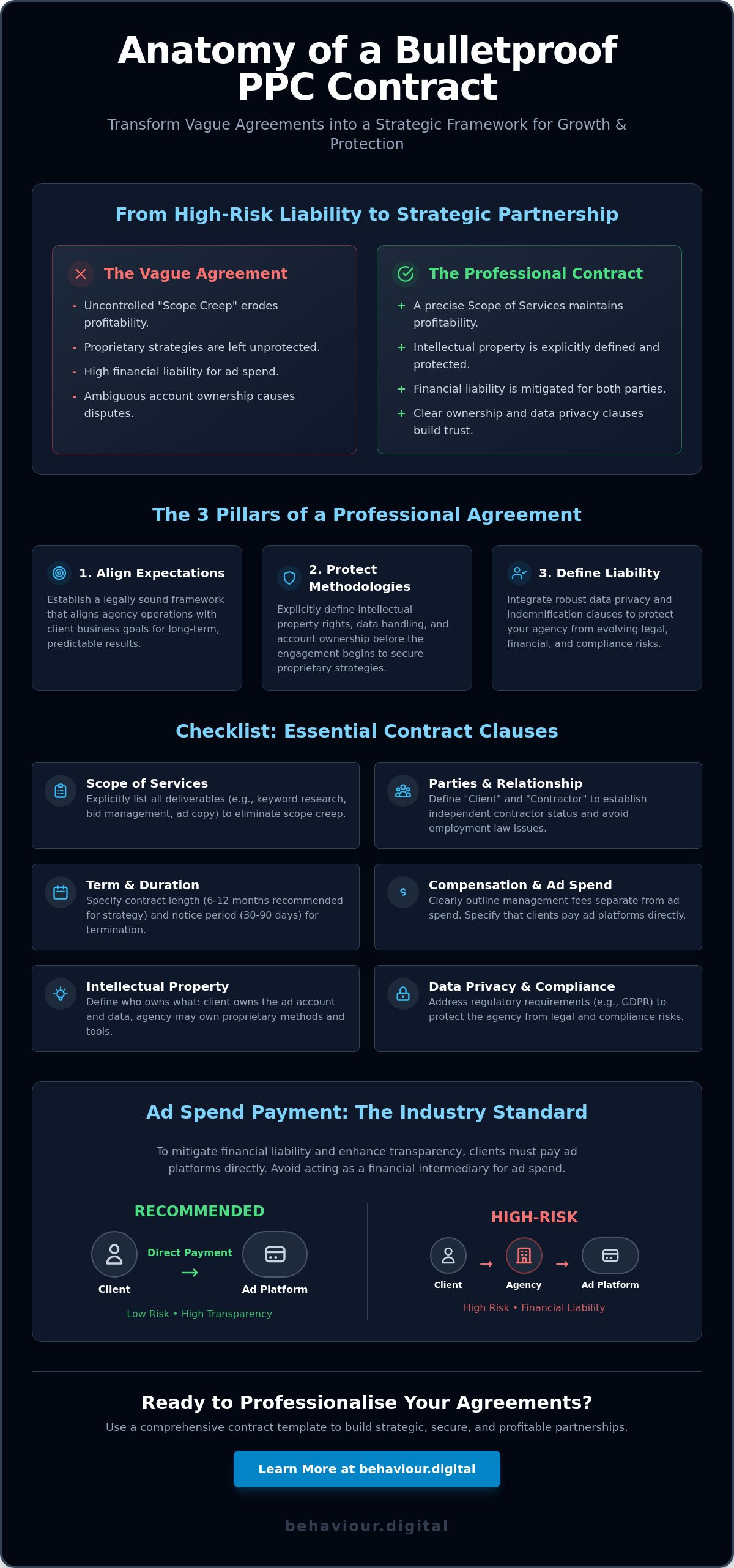
Protecting proprietary assets and maintaining regulatory compliance are the two most complex challenges in digital advertising. A robust ppc management contract template must clearly delineate between client-owned assets and agency-owned methodologies. In high-stakes environments, the risk of data leaks or intellectual property disputes can overshadow even the most successful campaign results. Methodical precision in these clauses ensures that both parties can focus on business growth without the threat of legal friction. This section establishes the boundaries required to safeguard your agency’s "secret sauce" while ensuring the client maintains control over their core accounts.
Confidentiality remains a pillar of professional partnerships. Agencies often gain access to sensitive trade secrets, profit margins, and internal sales data. The contract must enforce strict non-disclosure obligations that survive the termination of the agreement. Equally, non-solicitation clauses are essential to protect your agency’s talent pool. These terms prevent clients from bypassing the agency to hire individual strategists directly, preserving the integrity of your operational team and the value of your human capital.
Clarity regarding account ownership prevents the "hostage" scenario that often occurs during contract termination. The client must retain full ownership of their Google Ads accounts, historical data, and creative assets. However, the agency must protect its proprietary management scripts, custom AI workflows, and unique bidding strategies. Your ppc management contract template should specify that while the client owns the results, the agency retains the rights to the underlying methodologies used to achieve them. We also recommend a "Promotional Use" clause. This secures your right to use anonymised performance data for conversion rate optimization case studies, which are vital for demonstrating your strategic value to future partners.
The 2026 regulatory landscape has introduced aggressive enforcement of privacy laws. In several jurisdictions, the definition of data "sharing" now includes transferring consumer data to platforms like Meta or LinkedIn for lookalike audience creation. Your agreement must include mandatory Data Processing Agreements (DPAs) for any first-party data handling. UK GDPR compliance requires that clients have a compliant privacy policy on their website and explicit opt-in consent for sensitive personal data, such as precise geolocation. As of early 2026, many states and regions also legally require businesses to honour Global Privacy Control (GPC) signals. Ensuring these requirements are met is a shared responsibility that must be documented with legal precision. If you are concerned about your current compliance status, our team can provide a professional Digital Strategy audit to align your tracking with modern privacy standards.
A signed contract is the catalyst for operational execution. While a ppc management contract template provides the structural integrity needed for a partnership, it shouldn't be treated as a rigid, finished product. It's a starting point. Legal review is essential to ensure the document reflects the specific nuances of your digital strategy. High-stakes campaigns require bespoke terms that account for unique business goals and market conditions. Blindly following a template without professional oversight can leave gaps in liability or performance expectations.
Executing the agreement requires modern precision. Digital signatures provide a secure, timestamped record of consent, which is vital for compliance and audit trails. Version control is equally important. It ensures that any subsequent adjustments to the scope of work or fee structures are documented and mutually accepted. This creates a clear record of the partnership's evolution. Once the agreement is executed, the focus shifts to onboarding. This phase converts legal clauses into campaign actions. It's where the agency integrates with the client’s systems and begins the methodical finetuning of the account based on the quantitative benchmarks established in the contract.
Termination clauses shouldn't be viewed as a sign of distrust. They're a necessity for professional risk management. Distinguishing between "Termination for Cause" and "Termination for Convenience" provides a clear path forward if the partnership needs to end. A "Termination for Cause" usually relates to a specific breach of contract, such as non-payment or failure to deliver defined services. "Termination for Convenience" allows either party to exit the relationship after a notice period, typically 30 to 90 days. A smooth handover process is vital. This includes returning confidential materials and ensuring the client retains access to all historical data. Final payment obligations must be settled promptly to close the engagement with professional integrity.
At Behaviour Digital, we view the contract as a tool for transparency, not a weapon for restriction. Our approach prioritises measurable business results over dense legal jargon. We believe that if an agency delivers consistent value, restrictive terms aren't necessary to retain clients. This philosophy is central to our reputation as a leading PPC agency Glasgow businesses trust for scalable growth. We ensure that every account we manage remains entirely client-owned, which aligns with our commitment to data transparency. Our goal is to build multi-year partnerships based on quantitative success and mutual accountability. By using a precise ppc management contract template, we set the stage for a relationship where success is the only logical outcome of a conscious, data-driven strategy.
A professional partnership relies on the elimination of ambiguity. By implementing a rigorous ppc management contract template, you establish the necessary boundaries for ad spend liability, intellectual property protection, and data privacy compliance. This structural clarity ensures that every campaign adjustment is rooted in quantitative data rather than legal uncertainty. Transitioning from a generic agreement to a strategic performance framework is the final step in professionalising your agency relationships and securing your long-term business interests.
At Behaviour Digital, we've focused on data-driven growth since our founding in 2022. Our expertise across PPC, Social Media Marketing, and Conversion Rate Optimization allows us to deliver measurable results through transparent, client-owned account structures. We believe that a contract should be a roadmap for success, not a hurdle for innovation. If you're ready to scale your digital presence with a partner who prioritises your ownership and results, partner with a transparent Glasgow PPC agency today. Let's build a sustainable strategy that turns your ad spend into a powerful engine for expansion.
A PPC management contract is a legally binding agreement that defines the relationship, responsibilities, and performance expectations between a digital marketing agency and its client. It serves as a strategic roadmap that outlines the scope of work, fee structures, and legal protections. Using a professional ppc management contract template ensures that both parties are aligned on quantitative goals and liability limits from the start of the engagement.
The client should always retain primary ownership of the Google Ads account and all historical data. This arrangement ensures the client has full transparency over their ad spend and campaign performance. The agency should be granted administrative access to execute strategies, but the legal right to the account remains with the client. This structure prevents account "hostage" scenarios and builds a partnership based on merit rather than restrictive control.
Performance guarantees are generally discouraged because external factors like market shifts and platform algorithm changes are beyond an agency's direct control. Instead, contracts should focus on "Performance Benchmarks" or Key Performance Indicators (KPIs) that align with specific business objectives. These benchmarks provide a framework for measuring success without creating unrealistic legal liabilities that could compromise the agency's ability to pivot strategies when market conditions fluctuate.
Ad spend should be paid directly by the client to the advertising platforms using their own billing information. The contract must explicitly state that the agency isn't responsible for platform costs or billing failures. This model ensures that the agency acts as a strategic steward of the budget rather than a credit provider. It also allows the client to maintain a direct financial relationship with platforms like Google and Meta.
A non-solicitation clause is a legal provision that prevents the client from hiring the agency's employees or contractors directly for a specified period. This protects the agency's investment in its talent pool and proprietary training methodologies. It ensures that the value provided through the partnership remains within the agreed framework. This clause is a standard risk mitigation tool used to maintain operational stability and protect human capital.
UK GDPR requires that the contract includes specific Data Processing Agreements (DPAs) if the agency handles any personal data for targeting or tracking. The agreement must define the agency's role as a data processor and the client's role as the data controller. This includes clear protocols for handling first-party data, customer lists, and conversion tracking pixels. Compliance is essential to avoid significant legal risks and protect consumer privacy in 2026.
Termination rights depend on whether the contract includes a "Termination for Convenience" or "Termination for Cause" clause. Most professional agreements allow for termination with a 30 to 90-day notice period if performance benchmarks aren't met over a sustained period. The handover process should be clearly defined to ensure the client retains access to their accounts and creative assets. Clear exit strategies are vital for maintaining professional integrity during any transition.
Yes, digital signatures are legally binding in the UK under the Electronic Communications Act 2000 and the eIDAS Regulation. They provide a secure and verifiable method for executing a ppc management contract template without the need for physical documents. Digital signatures offer a timestamped audit trail that enhances legal certainty and accelerates the onboarding process. This modern approach is the standard for professional partnerships in the digital sector.

Luke leads strategy across every Behaviour Digital account — building data-driven advertising systems for ambitious brands. When he's not auditing ad accounts, he's writing about what he found in them.
Get a free, tailored growth plan — we'll run our framework on your accounts and show you exactly what we'd do.
Get your free growth plan →