.webp) Online
OnlineNot sure which channel fits your business?View all services →
Three inputs. Instant KPIs. No spreadsheets.Open a calculator →
OnlineIn 2026, the growth of your online store isn't defined by aggressive bidding, but by the precise synthesis of behavioural data and conversion-centric strategy. Many Scottish brands find themselves trapped by plateaued ROAS and rising acquisition costs that seem impossible to break. You likely feel t...

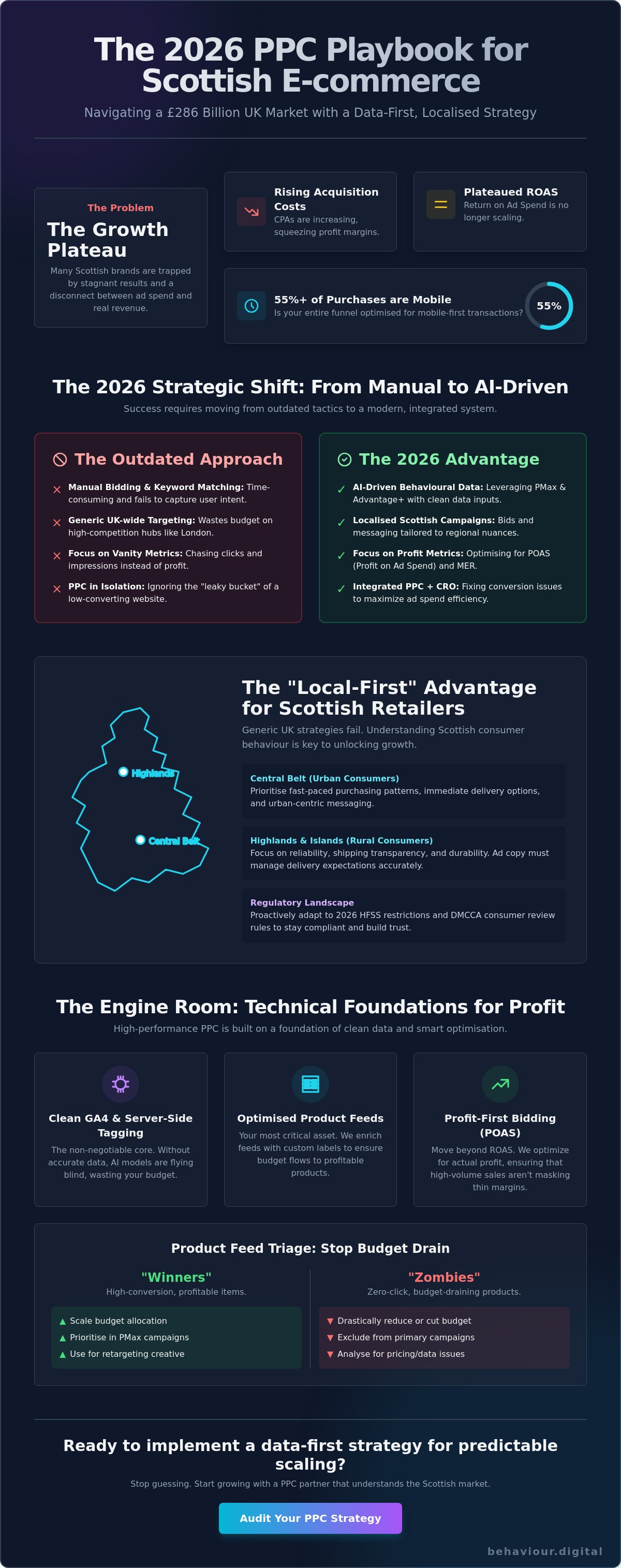
In 2026, the growth of your online store isn't defined by aggressive bidding, but by the precise synthesis of behavioural data and conversion-centric strategy. Many Scottish brands find themselves trapped by plateaued ROAS and rising acquisition costs that seem impossible to break. You likely feel the disconnect between your ad spend and actual bottom-line revenue, especially as UK e-commerce moves toward a £286 billion valuation and mobile transactions account for over 55% of all purchases.
If you're tired of the lack of transparency from agencies that don't understand the local landscape, you're not alone. We agree that scaling requires more than just "running ads"; it demands a partner who anticipates regulatory shifts like the 2026 HFSS advertising restrictions and the DMCCA's rules on consumer reviews. This guide promises to show you how to master ppc management for ecommerce scotland to achieve predictable revenue scaling and lower CPAs. We'll examine the specific strategies for integrating digital strategy with conversion rate optimization to turn Scottish market insights into measurable business results.
• Learn why shifting from manual bidding to AI-driven behavioural data is essential for maintaining a competitive edge in the 2026 Scottish market.
• Understand how to identify and fix the "leaky bucket" syndrome by integrating conversion rate optimization with your paid ad spend.
• Discover the specific criteria for evaluating ppc management for ecommerce scotland, focusing on transparent metrics like POAS and MER instead of vanity clicks.
• Explore the strategic transition from generic UK-wide targeting to localized campaigns that account for the unique economic context of Scottish e-commerce.
• Gain a clear framework for auditing your current account structure to ensure every pound spent contributes to predictable, data-driven revenue scaling.
Effective Pay-per-click (PPC) management in 2026 requires a departure from broad, national strategies. For Scottish retailers, the economic context is distinct. You're operating in a market where UK online retail sales reached £127.41 billion in 2024, yet your specific regional overheads and consumer expectations differ from those in the South East. Generic campaigns often hemorrhage budget in high-competition hubs like London. This leaves your Scottish campaigns underfunded or overpriced. Localised ppc management for ecommerce scotland ensures your bids reflect actual regional competition levels rather than inflated national averages. We focus on the synthesis of local market data and precise audience intent to stop the drain on your ROAS.
The shift in 2026 has moved the industry away from simple keyword matching toward intent-based audience targeting. It's no longer enough to bid on "luxury knitwear." Success now depends on identifying whether a user is researching artisanal heritage or seeking immediate delivery in the Central Belt. Local expertise in Glasgow and Edinburgh directly impacts your bottom line by aligning ad messaging with actual logistics. If your agency doesn't understand the shipping nuances between the Highlands and the Lowlands, your ads will create friction at the checkout. We eliminate this disconnect by integrating supply chain realities into your digital strategy.
Scottish consumer behaviour is not a monolith. Search trends in the Highlands often revolve around reliability and shipping transparency; meanwhile, the Central Belt mirrors urban, fast-paced purchasing patterns. Ad copy that leverages "Made in Scotland" branding consistently outperforms generic alternatives in both domestic and international markets. A strategic partner understands that shipping to the Hebrides involves different logistics than a courier run in London. This knowledge allows for more accurate ad messaging regarding delivery times, which is critical for maintaining trust and reducing cart abandonment.
The rise of niche Scottish artisanal brands has created a surge in high-quality, specialized competition. With mobile transactions now exceeding £100 billion, your PPC strategy must be mobile-first and deeply integrated with social proof. Rising acquisition costs are forcing a pivot. We no longer focus solely on the first click. Instead, we use data-driven PPC to drive retention. By building trust through local social proof and precise targeting, Scottish stores can achieve sustainable growth despite a tightening regulatory environment. This approach turns your ad spend into a predictable engine for revenue scaling rather than a speculative expense.
High-performance PPC in 2026 has moved beyond the era of manual bid adjustments. Today, success is dictated by how effectively you feed data into AI-driven systems like Google's Performance Max and Meta's Advantage+. While many competitors chase raw clicks, advanced ppc management for ecommerce scotland prioritizes behavioural signals. This means tracking user intent long before they type a query. According to the latest e-commerce statistics, UK mobile transactions now exceed £100 billion. This shift requires a technical foundation that standard setups lack. If your data input is flawed, the AI's output will be equally inefficient.
A clean GA4 configuration is no longer optional. It's the engine room of your digital strategy. Without accurate event tracking and server-side tagging, your AI models are effectively flying blind. We focus on profit-first bidding. Instead of scaling revenue at any cost, we optimize for POAS (Profit on Ad Spend). This ensures that high-volume sales don't mask thin margins. It's a shift from vanity metrics to actual business health. You don't need more traffic; you need more profitable transactions.
Your product feed is the most critical asset in your 2026 PPC arsenal. We optimize feeds for high-intent visibility by enriching product data with custom labels and granular attributes. We don't treat all products equally. By segmenting your inventory into "Winners" (high conversion) and "Zombies" (zero-click drain), we ensure budget flows where it generates the most value. "Zombies" are products that consume impressions without converting, while "Winners" are your core revenue drivers. Managing this balance requires constant methodological finetuning. Leveraging the expertise of a specialized PPC agency Glasgow allows you to refine these automated systems, preventing the AI from overspending on low-margin items.
Standard "abandoned cart" ads are now baseline. To scale, you need sequence-based retargeting that mirrors the complex 2026 customer journey. We use Social Media Marketing to fuel the top of your funnel, creating a pool of high-intent audiences for your PPC campaigns to harvest. Social commerce revenue in the UK reached £11.75 billion in 2026, making the integration between social platforms and search essential. Privacy-first tracking, specifically Server-side GTM, is vital here. It bypasses browser restrictions to provide a clear picture of attribution. This method-led approach ensures your ads reach the right user at the exact moment they're ready to convert. If your current tracking feels fragmented, it might be time to audit your data strategy and reclaim your lost margins.
Driving traffic is only half the battle. If your site doesn't convert, you're essentially paying to show potential customers a broken experience. This is the "Leaky Bucket" syndrome. Many businesses invest heavily in ppc management for ecommerce scotland but fail to address why users drop off after the click. With average e-commerce CPCs in the UK ranging from £0.93 to £2.50, every bounce is a direct hit to your profitability. You can't afford to ignore the post-click experience in a market this competitive.
The solution isn't more traffic. It's making the traffic you already have work harder. Conversion rate optimization acts as a force multiplier for your ad spend. By fixing friction points in the checkout journey, you lower your cost per acquisition without touching your bid settings. Scottish shoppers expect clear shipping terms and localized trust signals. If your site uses a generic, off-the-shelf Shopify template without customization, you're likely losing sales to competitors who prioritize a tailored user experience. Data-driven design beats generic templates every time.
A small lift in conversion rate has a massive impact on your bottom line. For example, moving your conversion rate from 2% to 3% doesn't just mean more sales. It effectively reduces your CPA by 33%. We've observed Glasgow-based retailers double their revenue by refining their landing page hierarchy and removing checkout distractions, all while maintaining their existing ad budget. In 2026, as the UK e-commerce market reaches a projected £286 billion, this efficiency is the only way to stay competitive as auction prices rise.
We don't guess what your users want. We use heatmaps and session recordings to identify exactly where the friction lies. This data-driven approach allows us to see if users are getting stuck on shipping calculators or if your mobile layout is hiding the "Add to Cart" button. A/B testing your ad copy against landing page headlines ensures a perfect message match. This is critical for maintaining high Quality Scores. For a deeper look at our methodology, read our conversion optimisation guide. This systematic approach ensures your ppc management for ecommerce scotland is supported by a site built for results.
Selecting a partner for ppc management for ecommerce scotland isn't a task for the procurement department; it's a critical strategic decision for your P&L. You aren't just buying clicks. You're investing in a growth engine that must be calibrated to your specific margins. Start by demanding a deep-dive audit of your current account structure. If an agency cannot identify specific failures in your server-side tracking or audience segmentation within the first hour, they lack the technical depth required for the 2026 market. Accountability starts with data integrity.
Evaluate their mastery of e-commerce metrics beyond raw ROAS. While ROAS is a baseline, it's often a vanity metric that masks thin margins. You need to hear about MER (Marketing Efficiency Ratio) and POAS (Profit on Ad Spend). These figures provide the true picture of how your Pay Per Click spend impacts your bottom line after accounting for COGS and shipping logistics. A strategic partner will also demonstrate a unified approach. They should explain how their digital strategy integrates with your Social Media Marketing and Conversion Rate Optimization efforts. Finally, verify their grasp of Scottish market dynamics. Managing delivery expectations for the Highlands or navigating the competitive density of the Central Belt requires local operational knowledge that a London-based generalist simply doesn't possess.
Agencies that focus on impressions or clicks rather than net profit or acquisition cost.
If you don't have full admin access to your Google Ads or Meta Business Manager accounts, you don't own your data.
E-commerce in 2026 moves too fast for monthly check-ins. You need active, weekly methodological finetuning.
Direct questions reveal the depth of an agency's expertise. Ask them how they integrate behavioural data into their bidding strategy to anticipate user intent. Inquire about their specific process for testing new creative assets for Performance Max campaigns. Most importantly, ask how they handle attribution in a multi-channel Scottish market. If they can't explain their methodology for tracking the online-to-offline journey or cross-device conversions, your budget is at risk. If your current results have plateaued, it's time to book a methodological audit and see what your data is actually telling you.
Scaling isn't a matter of luck. It's the result of a rigorous methodological process. At Behaviour Digital, we implement a four-stage framework: Audit, Strategy, Execute, and Optimize. This ensures that every pound committed to ppc management for ecommerce scotland is backed by quantifiably sound logic. We don't hide behind opaque reports. Our commitment to transparency means you receive real-time visibility into the metrics that actually impact your bottom line, such as POAS and MER. Being based in Glasgow isn't just about location. It allows us to act as a direct extension of your team. We understand your operational rhythm and the specific logistics of the Scottish market. By integrating tactical PPC with a broader Digital Strategy, we move your brand beyond fragmented campaigns toward a cohesive growth engine.
We utilize 2026-grade AI tools to identify emerging consumer trends before they reach their peak. This predictive capability allows us to secure lower CPCs while your competitors are still reacting to old data. Our focus remains on sustainable growth. We avoid high-burn tactics that inflate revenue at the expense of your long-term margins. Our management fees are structured to align with your specific growth goals. This partnership model ensures we're equally invested in your success, focusing on business value rather than just managing spend.
2026 is the year for Scottish brands to shift from survival to niche dominance. The digital landscape is complex, but it's also filled with opportunities for those who use data-driven methodologies. The first step toward scaling is a comprehensive audit of your current account and site performance. We'll identify exactly where your budget is being wasted and where the untapped potential lies. Don't let another quarter pass with plateaued results. Book a strategy session with Behaviour Digital today and start building a predictable path to revenue growth.
Success in 2026 requires a shift from raw traffic volume to margin-focused precision. You've seen how the synthesis of behavioural data and conversion rate optimization creates a sustainable growth engine that generic agencies often overlook. High-performance ppc management for ecommerce scotland is no longer a luxury; it's a technical necessity for brands aiming to scale profitably in a tightening regulatory environment. Accountability starts with moving beyond vanity metrics and focusing on what actually drives your P&L.
Our Glasgow-based senior expert team provides an integrated approach that connects every click to a specific business outcome. We prioritize transparent, margin-focused reporting so you always understand your Marketing Efficiency Ratio and net profitability. Your store's potential is waiting for a methodology that treats your budget with the same respect as your own team does. If you're ready to stop the budget drain and start scaling with precision, Book a Data-Driven PPC Audit for Your E-commerce Store today. Let's turn your data into a measurable competitive advantage.
Average ROAS varies significantly by industry vertical and product margin, but most healthy e-commerce brands target a ratio between 3:1 and 5:1. In the 2026 landscape, chasing a generic benchmark is less effective than establishing a target based on your specific P&L. We focus on your Marketing Efficiency Ratio to ensure that every pound spent contributes to sustainable, bottom-line growth.
A local agency provides essential insights into regional logistics and consumer behaviour that global entities often overlook. Understanding the specific delivery challenges for the Highlands or the competitive density of the Central Belt allows for more precise ad messaging. Local ppc management for ecommerce scotland ensures your digital strategy is aligned with the physical realities of your Scottish supply chain.
Management fees are typically structured as a monthly retainer, a percentage of ad spend, or a hybrid model. The total cost depends on the complexity of your product catalogue, the number of channels managed, and the depth of data integration required. It's more productive to evaluate these fees against your projected Profit on Ad Spend rather than viewing them as a fixed overhead.
The most effective growth strategies utilize both platforms to capture different stages of the shopper journey. Google Ads captures high-intent searchers actively looking for your products, while Meta Ads leverages the £11.75 billion UK social commerce market for brand discovery. Your choice depends on whether your product solves an immediate search need or requires visual storytelling to build demand.
You'll see traffic and initial data within 48 hours, but algorithmic maturity takes longer. AI-driven systems like Performance Max generally require 30 to 90 days of consistent data to optimize bidding effectively. We treat the first three months as a period of methodological finetuning to build a predictable and scalable revenue engine for your store.
You don't need a massive budget to begin, but you must spend enough to generate statistically significant data. AI models require a consistent flow of conversion signals to learn and optimize. We recommend a starting budget that allows for at least 30 to 50 conversions per month to ensure your ppc management for ecommerce scotland can be properly refined by the algorithms.
ROAS measures gross revenue per pound spent, while POAS measures the actual profit generated from that spend. ROAS can often be a vanity metric that hides thin margins or high shipping costs. POAS is the superior metric because it accounts for your Cost of Goods Sold, ensuring your advertising spend is actually increasing your net wealth rather than just your turnover.
PPC will drive traffic, but it won't fix a site that fails to convert visitors. Sending paid traffic to a "leaky bucket" is an inefficient use of capital that will lead to high acquisition costs. We integrate Conversion Rate Optimization with our paid strategies to ensure your landing pages are technically sound and built to turn that traffic into measurable revenue.

Luke leads strategy across every Behaviour Digital account — building data-driven advertising systems for ambitious brands. When he's not auditing ad accounts, he's writing about what he found in them.
Get a free, tailored growth plan — we'll run our framework on your accounts and show you exactly what we'd do.
Get your free growth plan →