.webp) Online
OnlineNot sure which channel fits your business?View all services →
Three inputs. Instant KPIs. No spreadsheets.Open a calculator →
OnlineWith AI Overviews now a standard feature, click-through rates for the top ad positions have plummeted by up to 22% year-over-year. If you're still relying on legacy metrics, your ppc performance analysis is likely missing the friction points where your budget is actually bleeding. You're likely faci...

With AI Overviews now a standard feature, click-through rates for the top ad positions have plummeted by up to 22% year-over-year. If you're still relying on legacy metrics, your ppc performance analysis is likely missing the friction points where your budget is actually bleeding. You're likely facing the pressure of rising CPCs in competitive hubs like London and Glasgow, where data overload often masks a lack of clear attribution. It's a common frustration to see spend increase while the path to a conversion remains a black box.
We'll show you how to move beyond vanity metrics to transform raw signals into scalable business profit. This guide provides the exact frameworks and behavioral metrics required to navigate the 2026 digital environment. We'll explore the Power Pack campaign structure, the critical role of first-party data in an opt-in world, and how to audit the gap between user intent and the final sale. By the end of this article, you'll have a clear methodology for turning automated AI systems into predictable growth engines.
• Transition from superficial ROAS tracking to POAS (Profit on Ad Spend) to ensure your marketing budget generates actual financial growth rather than just vanity revenue.
• Implement a rigorous ppc performance analysis framework that prioritizes structural integrity and creative resonance over basic automated campaign defaults.
• Shift your focus from manual bidding to algorithmic intent auditing to effectively capture high-value traffic in an AI-dominated search environment.
• Adopt a structured behavioral checklist for daily anomaly detection and weekly search term auditing to identify and eliminate budget waste in real time.
• Combine PPC management with Conversion Rate Optimization (CRO) to lower your effective cost per acquisition and maximize the profitability of every click.
The era of manual bid adjustments is over. In 2026, the Pay-per-click (PPC) model is governed by machine learning, which fundamentally changes the definition of a successful audit. Effective ppc performance analysis is no longer about checking if your ads are running; it's about auditing the algorithm's understanding of user intent. If the machine misinterprets why a user is searching, no amount of budget will fix the conversion rate. Success now requires a shift from technical tweaking to strategic data oversight.
Monitoring "vanity metrics" like impressions or raw click volume is the most direct path to budget waste. These numbers look good in monthly reports but often correlate poorly with bottom-line revenue. High engagement doesn't always equal high intent. When you focus on these surface-level figures, you ignore the friction points that prevent a lead from becoming a customer. A professional analysis looks past the click to see if that traffic actually possesses the behavioral signals of a buyer.
Analysis must operate on three distinct levels to be effective. Descriptive analysis summarizes historical data to establish a baseline. Diagnostic analysis identifies the specific causes of performance shifts, such as a sudden rise in CPCs or a drop in asset strength. Finally, predictive analysis uses these insights to forecast future growth and budget requirements. This framework bridges the gap between marketing spend and actual sales by focusing on the quality of the traffic rather than the quantity.
Monitoring tells you what happened. Analysis explains the "why" behind the numbers. PPC analysis is the process of decoding user behavior through quantitative data to uncover actionable business insights. Data visualization is essential here. It helps teams distinguish between temporary volatility and long-term performance trends that require strategic pivots. Without visualization, you're just looking at a spreadsheet; with it, you're seeing the story of your customer's journey.
Modern campaigns like Performance Max and Meta's Advantage+ operate as "black boxes" with limited granular reporting. Auditing these requires a shift in focus. You must analyze the quality of the input signals, such as creative assets and audience lists, rather than just the output metrics. With third-party cookies becoming less reliable due to user-choice models, first-party data has become the primary tool for performance verification. A successful ppc performance analysis in this environment checks whether the algorithm is receiving the right data to make profitable decisions. If your inputs are weak, the AI will optimize for the wrong outcomes.
A systematic ppc performance analysis requires a holistic view that transcends simple click tracking. We categorize this into four distinct pillars that ensure every pound spent is an investment, not an expense. This framework prevents the siloed thinking that often leads to campaign plateaus. By auditing these areas, you move from reactive adjustments to proactive growth strategies.
Account architecture is the foundation of any scalable campaign. We audit for keyword cannibalization, a scenario where multiple campaigns compete for the same auction, effectively driving up your own costs. Your bid strategy must also align with actual business margins. Using a Target ROAS strategy without considering the cost of goods sold is a common strategic error that leads to ads that appear profitable but lose money in reality. We also investigate budget delivery issues. If a campaign is constantly capped by budget, you aren't seeing its true performance potential, only a filtered version of it. A healthy structure ensures the AI has enough data to learn without being restricted by artificial bottlenecks.
Creative is the new targeting in 2026. We analyze "Hook Rates", which is the percentage of users who watch the first three seconds of a video, and "Hold Rates", the percentage who stay until the end. These metrics reveal exactly where your narrative fails to capture or maintain attention. Successful analysis matches search query intent to the specific messaging of your ad copy. If someone searches for a "premium solution" but sees a "budget-friendly" ad, the click is wasted. We identify which audience segments drive high-value conversions rather than just high-volume traffic. It's better to have 10 high-intent visitors than 100 window shoppers who never intend to buy.
Financial efficiency goes beyond the Google Ads dashboard. We evaluate ROAS alongside POAS (Profit on Ad Spend) and CAC (Customer Acquisition Cost). This ensures the account is actually profitable after accounting for fulfillment and overhead. The final pillar, post-click behavior, connects ad data to on-site conversion metrics. We look at bounce rates and scroll depth to see if the landing page fulfills the promise made in the ad. If a high-CTR ad leads to a high bounce rate, your landing page is failing your traffic. For brands looking to fix these gaps, integrating Conversion Rate Optimization with your ad strategy is the most effective way to lower your cost per acquisition. This ppc performance analysis ensures that every stage of the funnel is optimized for maximum return.
Return on Ad Spend (ROAS) is frequently a "liar metric" for businesses focused on sustainable growth. While it measures revenue generated per pound spent, it fails to account for varying product margins, fulfillment costs, or overheads. A high ROAS on a low-margin product can actually result in a net loss. This is why a sophisticated ppc performance analysis in 2026 must pivot toward POAS (Profit on Ad Spend). By integrating your actual gross margin into the data layer, you gain a transparent view of which campaigns are driving bankable profit rather than just top-line revenue.
Quality Score remains a critical pillar of financial efficiency. It functions as a discount mechanism in the auction. In competitive sectors where CPCs are rising, maintaining a high Quality Score is the only way to keep your effective costs manageable. It's a reflection of how well your ad intent matches the user's search query. If your relevance drops, you'll pay a "tax" on every click, eroding your margins before the user even reaches your site.
True performance is measured by the relationship between Customer Acquisition Cost (CAC) and Lifetime Value (LTV). If your CAC exceeds the initial profit of a sale, you're relying on repeat business for viability. We use "Contribution Margin" to determine your maximum allowable CPA, ensuring every bid is mathematically sound. We also address the "Attribution Gap" by cross-referencing platform data with CRM reality. This prevents "ghost conversions" where platform AI claims credit for sales that were already in your pipeline, ensuring your ppc performance analysis reflects genuine incremental growth.
Auction Insights are essential for tracking competitor aggression in the UK market. We analyze Lost Impression Share to identify exactly why you're missing out on traffic. Lost Impression Share (Rank) points to issues with your ad quality or bid levels, while Lost Impression Share (Budget) confirms that you're leaving profitable opportunities on the table due to funding caps. Impression Share dictates the absolute scaling ceiling for your campaigns and tells you exactly how much room is left to grow before you hit diminishing returns. Understanding these benchmarks allows you to pivot your budget to the highest-margin opportunities without over-bidding in saturated auctions.
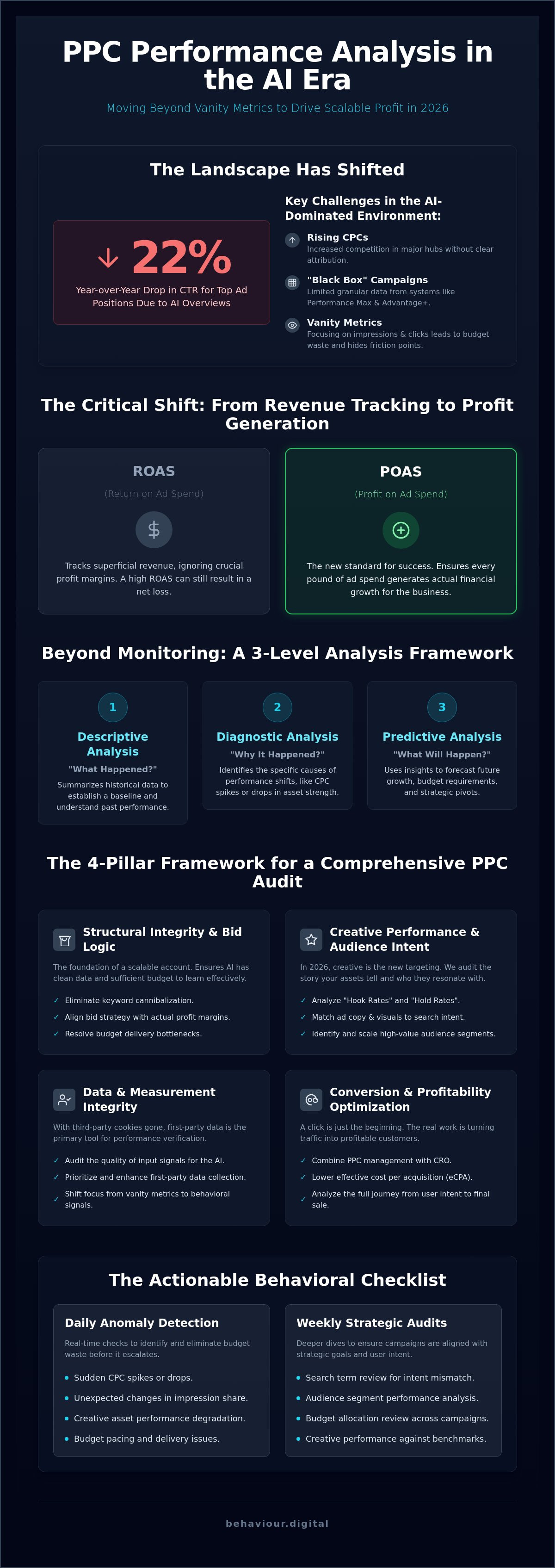
Precision in 2026 requires a disciplined cadence that respects the AI learning phase while maintaining human oversight. Over-managing an account is as detrimental as neglecting it. Frequent manual changes often reset the algorithm's optimization period, leading to volatile performance. A structured ppc performance analysis should follow a tiered schedule to ensure stability and scalable growth.
Daily intervention must be surgical. Your focus is limited to anomaly detection and budget pacing. If spend spikes by 30% without a corresponding rise in conversion signals, it indicates a technical error or a sudden shift in the auction. Beyond these health checks, the goal is to let the data accumulate without interference.
Weekly reviews are where tactical adjustments happen. We follow a three step process to maintain account health:
Apply the Pareto principle. Identify the top 20% of keywords and creative assets that drive 80% of your profitable results. Protect these assets at all costs.
Audit search terms for "intent drift." As AI expands your reach through broad match, it may capture irrelevant queries. Update your negative keyword lists to keep the algorithm focused on high intent traffic.
Compare week over week performance. Look for emerging fatigue in your creative assets. If your CTR is declining while CPC is rising, your audience is likely over-saturated with your current messaging.
Monthly analysis shifts from tactics to business strategy. This is when we analyze the synergy between PPC and conversion rate optimization. If your ads are driving high quality traffic but the on-site conversion rate is stagnant, the bottleneck isn't your ad account; it's your user experience. We also review the "Assisted Conversion" report. This reveals how your PPC campaigns fuel other channels, such as direct or organic search, providing a true picture of your marketing ecosystem.
Reporting at this stage should speak to business owners rather than just marketers. We focus on contribution margins and market share rather than technical jargon. Quarterly, we perform a deep-dive into competitor movements and market share forecasting. By mapping how competitor aggression in the UK market fluctuates, we can predict budget requirements for the coming months. This proactive ppc performance analysis ensures you're never caught off guard by market shifts. To move from basic monitoring to a professional growth framework, request a strategic audit from Behaviour Digital today.
Scaling a digital campaign isn't a matter of simply increasing the budget and hoping the algorithm maintains efficiency. We prioritize data-driven PPC Management because automated defaults often prioritize platform revenue over client profit. While Google's AI is powerful, it lacks the business context of your margins and inventory levels. Our methodology for ppc performance analysis ensures that every automated signal is verified by human expertise, preventing the "black box" from wasting your capital on low-intent traffic.
Local expertise remains a critical differentiator in an increasingly automated world. As a PPC Agency in Glasgow, we understand the specific nuances of the UK market, from regional search intent to the competitive landscape of major cities like London and Edinburgh. We don't just look at global trends; we analyze how local auction dynamics affect your CPC and adjust strategies to protect your market share against aggressive competitors.
Our "Behavioural Lens" identifies the friction points on your landing pages that the Google Ads dashboard can't see. We've seen that aligning ad intent with page experience can reduce CPA by as much as 30% without changing a single keyword. By integrating Conversion Rate Optimization (CRO) directly into our ppc performance analysis, we ensure that the traffic you pay for has a clear, frictionless path to purchase. For Scottish businesses, we provide transparent, real-time reporting that connects marketing spend to actual bankable revenue, ensuring total accountability for every pound invested.
A professional performance analysis from Behaviour Digital is the first step toward a predictable growth roadmap. We don't provide generic reports. Instead, we perform a deep-dive into your account architecture to identify immediate "quick wins," such as eliminating keyword cannibalization or correcting bid logic errors. We look for the 20% of your account that's currently driving the majority of your results and build a plan to scale that success. Contact us to unlock the true potential of your digital strategy and move from reactive adjustments to a methodology of continuous, measurable improvement.
The transition to an AI-driven search environment demands a move away from superficial vanity metrics. As we've explored, a rigorous ppc performance analysis is the only way to ensure your budget isn't being consumed by automated defaults that prioritize platform revenue over your business growth. By shifting your focus from ROAS to POAS and auditing the gap between user intent and page experience, you gain the clarity needed to scale in competitive markets. Success in 2026 is no longer about the volume of clicks; it's about the precision of your data inputs and the elimination of post-click friction.
Our Glasgow-based expert team provides the strategic oversight required to navigate these complexities. We deliver a unique methodology that combines data-driven CRO integration with transparent monthly reporting, ensuring you always understand the direct impact of your investment. It's time to move beyond basic account monitoring and adopt a framework built for measurable financial evolution. Book your bespoke PPC performance audit with Behaviour Digital today to uncover the hidden growth potential in your account. Your path to sustainable, high-margin scaling starts with a single, data-backed decision.
A comprehensive ppc performance analysis should be conducted on a monthly basis to map strategic trends and cross-channel attribution. While daily and weekly checks manage tactical health and budget pacing, the monthly review allows for enough data accumulation to make statistically significant decisions. This cadence ensures you aren't reacting to temporary auction volatility but are instead optimizing for long-term business growth.
In 2026, break-even ROAS benchmarks vary significantly across platforms and verticals. For Google Search, a target of 3.5 to 4.5 is standard, while Performance Max typically operates between 3.0 and 4.0. Social platforms like Meta and TikTok often see lower benchmarks, ranging from 1.5 to 3.0. These figures serve as a baseline, but your specific product margins must dictate your actual target.
Performance Max campaigns can be analyzed by shifting focus from granular keyword data to input signals and asset group performance. You should audit the Asset Strength and Insights tabs to see which audience segments and creative combinations the AI is prioritizing. Verifying these outputs against your first-party CRM data ensures the algorithm is reaching the right intent groups rather than just chasing cheap clicks.
Rising CPCs are often a result of increased competitor aggression rather than internal account issues. In competitive verticals like legal or insurance, CPCs have increased by 12% year over year regardless of Quality Score. High scores provide a relative discount in the auction, but they don't insulate you from the rising floor price set by other advertisers bidding for the same high-intent traffic.
The most critical metric for modern PPC success is the Contribution Margin. This measures the actual profit remaining after ad spend and variable costs are deducted from revenue. While ROAS tracks top-line volume, the Contribution Margin ensures your ppc performance analysis reflects the health of your bottom line. It prevents the common trap of scaling revenue while simultaneously eroding your business's net profitability.
A high-performing agency moves beyond reporting clicks and impressions to discuss business-level outcomes like POAS and customer lifetime value. They should provide transparent, real-time reporting that connects ad spend to your CRM sales data. If their reports lack diagnostic insights into why performance shifted or fail to integrate conversion rate optimization strategies, they aren't providing a true strategic partnership.
Mobile and desktop performance must be analyzed separately due to the fundamental differences in user intent and page experience. Mobile users often exhibit higher bounce rates and shorter session durations, requiring a more streamlined conversion path. By segmenting your data, you can identify if a specific device is underperforming, allowing you to adjust your bid modifiers or optimize the mobile landing page experience.
The best analysis stack in 2026 combines Google Ads native AI Insights with first-party data tools like Google Consent Mode 2.0. You should also utilize server-side tracking to bypass the limitations of browser-based cookies. Visualization tools like Looker Studio are essential for mapping complex data sets into clear, actionable reports that highlight the relationship between ad spend and actual business growth.

Luke leads strategy across every Behaviour Digital account — building data-driven advertising systems for ambitious brands. When he's not auditing ad accounts, he's writing about what he found in them.
Get a free, tailored growth plan — we'll run our framework on your accounts and show you exactly what we'd do.
Get your free growth plan →