.webp) Online
OnlineNot sure which channel fits your business?View all services →
Three inputs. Instant KPIs. No spreadsheets.Open a calculator →
OnlineThe $1.17 trillion digital ad spend projected for 2026 proves that the competition for attention has never been more expensive or more automated. Most advertisers find that scaling google ads campaigns leads to immediate ROAS decay and frustrating "Learning Phase" resets. It's a systemic failure cau...

The $1.17 trillion digital ad spend projected for 2026 proves that the competition for attention has never been more expensive or more automated. Most advertisers find that scaling google ads campaigns leads to immediate ROAS decay and frustrating "Learning Phase" resets. It's a systemic failure caused by treating budget as the only lever for growth. You've likely hit the performance ceiling where increased spend simply erodes your margins and destabilizes your cost per acquisition.
We'll show you how to break that cycle by aligning your strategy with Google's 2026 AI bidding features. You'll learn the methodology for aggressive budget expansion that maintains a stable CPA through advanced data signals and conversion rate optimization. This guide previews the transition from standard Display to Demand Gen, the impact of the August 2026 bidding updates, and the precise mathematical thresholds needed to turn manual uncertainty into predictable, scalable revenue.
• Validate your account readiness using the 30-30 Rule to ensure you've got enough data density before committing more capital.
• Master the 20% Rule for vertical scaling google ads campaigns to increase volume without triggering a disruptive learning phase reset.
• Expand your reach horizontally by leveraging Performance Max Search Themes to identify and capture high-intent audiences your current structure misses.
• Learn why Conversion Rate Optimization is the only sustainable way to combat the natural ROAS decay that occurs as you reach broader audiences.
• Shift from manual adjustments to strategic oversight by integrating advanced data signals that guide Google's 2026 AI bidding algorithms toward profitable growth.
Scaling isn't simply a matter of increasing your daily limit and hoping for the best. In the professional context of online advertising, true scaling is the process of driving higher conversion volume while maintaining or improving your efficiency metrics. If your ROAS drops significantly the moment you add capital, you aren't scaling; you're just overpaying for the same results. Success requires a foundation built on data density and predictable performance.
Before you commit more budget, you must apply the 30-30 Rule. This is a non-negotiable benchmark for scaling google ads campaigns in 2026. Your campaign needs at least 30 conversions within a rolling 30-day window to provide Google's AI bidding models with enough signal to optimize. Without this baseline, the algorithm lacks the statistical significance to predict which users are likely to convert as you enter more competitive auctions. Pushing a low-data campaign into higher spend levels usually triggers a catastrophic "Learning Phase" reset that can take weeks to stabilize.
You also need to evaluate your Impression Share metrics to identify where your growth is currently restricted. Check your "Search Lost IS (budget)" and "Search Lost IS (rank)" columns. If you're losing volume primarily to budget, you have a green light for vertical expansion. However, if your loss is due to rank, simply throwing more money at the problem won't work. You'll also need a "Profitability Buffer." Scaling often pushes your ads into broader, less-targeted auctions, which can cause a temporary 10-15% fluctuation in your CPA. Ensure your business margins can absorb this variance before you pull the trigger.
Decisions based on a three-day sample size are a primary cause of campaign failure. The 2026 bidding models require stability over time. You must account for conversion lag, which is the time between the initial click and the final sale. Use the "Days to Conversion" report in your dashboard. If your average lag is five days, don't judge a budget increase until at least seven to ten days have passed. Gut feelings don't win auctions. Only act when the data confirms a stable trend.
Quality Score acts as a financial multiplier for your scaling efforts. High scores reduce your floor price in every auction, allowing your budget to go further. You should never attempt to scale a campaign where the "Landing Page Experience" is rated as "Below Average." You'd be paying a premium for every click, which erodes your ROAS before the user even arrives. An improvement in Quality Score from 5 to 8 can lead to a 28% reduction in cost per click, effectively increasing your working budget without spending an extra penny of capital.
Vertical scaling is the strategic injection of additional capital into existing, high-performing campaigns. It's the most direct path to growth, but it's also where most advertisers fail by moving too quickly. Rapid budget spikes destabilize the auction environment. When you're scaling google ads campaigns, you're competing for higher-quality placements that often come with a higher cost. If you don't manage this transition with precision, your ROAS will collapse before the algorithm can adjust to the new spend level.
The 20% Rule remains the professional standard for a reason. Increasing your daily budget by more than 20% every 48 to 72 hours typically triggers a full "Learning Phase" reset. In 2026, Google's AI models are even more sensitive to sudden capital fluctuations. If your status column shifts to "Learning," your performance will likely dip as the system re-evaluates user intent. Patience is a prerequisite for profit. You must allow the system to drive relevance at scale by feeding it incremental data rather than overwhelming it with sudden changes.
For campaigns focused on high volume, moving from "Maximize Conversions" to a Target CPA (tCPA) or Target ROAS (tROAS) model provides the necessary guardrails. These strategies give the algorithm a clear efficiency boundary. This is particularly important following the August 17, 2026, update, which modified how automated bids function during unpredictable auction dynamics. By setting a target, you prevent the AI from overbidding on expensive, low-probability clicks as your budget expands.
A successful vertical scale follows a disciplined 14-day cycle. Start on Day 1 with a 15-20% increase. Monitor your CPA and conversion lag from Day 2 through Day 4. If metrics remain stable, repeat the increase on Day 5. This cadence allows the algorithm to digest new data without entering a state of volatility. Use "Seasonality Adjustments" for short-term scaling during peak events, but always keep an eye on the point of diminishing returns where your acquisition cost starts to outpace your Customer Lifetime Value.
To force the algorithm to find more volume, you can gradually lower your tROAS target. This signals the system to bid more aggressively in auctions it might previously have avoided. However, never change your bidding target and your budget on the same day. This "Bid Shifting" sin creates too many variables for the AI to manage effectively, leading to erratic performance. Professional PPC bid management ensures these levers are pulled with mathematical precision. If you're looking for a partner to manage this complexity, a data-led digital strategy can ensure your growth remains both aggressive and sustainable.
Horizontal scaling represents a strategic shift from optimizing existing auctions to capturing entirely new pockets of demand. While vertical scaling focuses on budget depth within established parameters, horizontal scaling prioritizes breadth by introducing new keywords, audiences, and campaign types. In 2026, this expansion is powered by Google's sophisticated data infrastructure for ads, which allows for real-time processing of billions of intent signals to identify high-value users across the entire ecosystem.
Performance Max remains a cornerstone of this expansion strategy. The "Search Themes" feature provides a critical mechanism to guide AI toward untapped intent without the constraints of traditional keyword structures. By providing up to 25 themes per asset group, you give the algorithm a conceptual map of your business. This allows the system to find customers across YouTube, Search, and Display that a standard keyword list would inevitably miss. It's about providing the machine with the right context rather than just a list of terms.
First-party data serves as your most valuable asset during this phase. Uploading encrypted customer lists allows you to build high-intent Lookalike audiences within Demand Gen campaigns. This is essential for scaling google ads campaigns beyond the bottom of the funnel. Geographic expansion follows a similar logic. A Glasgow-based business can use local performance data as a blueprint for UK-wide or global targeting, provided the underlying conversion signals remain strong. Success here depends on the quality of the data you feed into the system.
The transition from Exact Match to Broad Match is a significant milestone in the scaling journey. You should only make this move once your smart bidding algorithm has been "trained" with at least 50 conversions per month at a stable cost. Mining the Search Terms Report remains critical for identifying "hidden" winners that warrant their own dedicated ad groups. A robust Digital Strategy ensures that these new keywords map correctly to the user journey rather than just driving vanity traffic that won't convert.
Creative fatigue is the silent killer of horizontal growth. As you reach broader audiences, your click-through rates will naturally decline if your assets aren't refreshed. We recommend a strict A/B testing rotation for Responsive Search Ads and video content. Since Google now mandates disclosure labels for AI-generated creative, your focus must remain on high-quality, authentic assets. Demand Gen campaigns excel here by using social-style video to capture top-of-funnel interest, effectively feeding the machine with new prospects before they even enter the search auction.
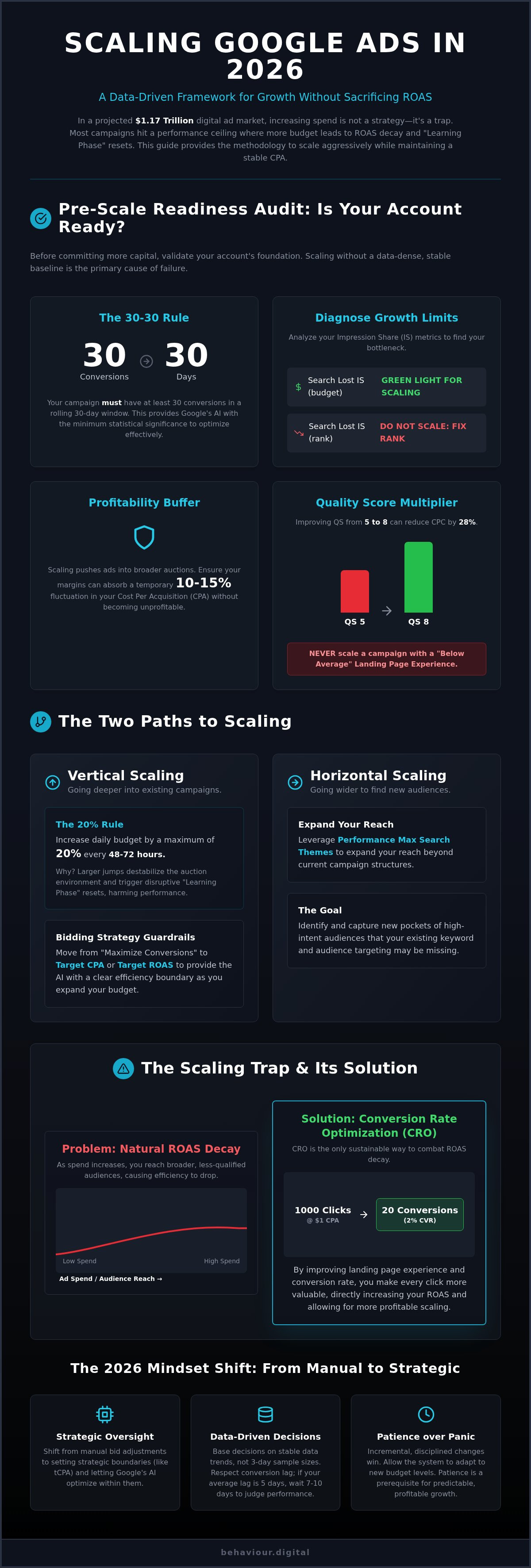
The "Scaling Trap" is a mathematical certainty for advertisers who rely solely on budget increases. As you expand your reach, you move beyond your highest-intent core audience into broader segments. These users are often less familiar with your brand or further from a purchase decision. This expansion naturally causes your conversion rate to dip. If your conversion rate drops by 15% while your traffic increases by 20%, your ROAS will still suffer. This is the primary reason why a 10% increase in conversion rate is significantly more valuable than a 10% increase in traffic. One improves the efficiency of every pound spent; the other just increases the volume of waste.
Professional scaling google ads campaigns requires treating Conversion Rate Optimization (CRO) as "CPA Insurance." When your website converts at a rate higher than the industry average, you can afford to pay a higher Cost Per Click (CPC). This allows you to outbid competitors for top-tier placements while maintaining a profitable CPA. You aren't just buying traffic. You're building a system that extracts more value from every visitor. Integrating behavioral data into your landing page design ensures that the user experience mirrors the specific intent of the ad, reducing bounce rates and increasing the probability of a sale.
Strategic conversion rate optimization transforms keywords that previously seemed "too expensive" into profitable growth drivers. Consider the impact of a conversion jump from 2% to 4%. This doubling of efficiency cuts your effective CPA in half, providing the financial room to increase your budget by 50% or more without sacrificing your bottom line. We focus on identifying friction points in the checkout and lead-form process that often stop scaling in its tracks. If your form has ten fields when three would suffice, you're actively sabotaging your own growth efforts.
Dynamic Keyword Insertion (DKI) is a critical tool for maintaining relevance as you scale into broader audiences. It ensures the landing page headline matches the specific intent of the search query, which is essential for maintaining a high Quality Score. Generic homepages are the graveyard of scaled budgets. They lack the focus required to convert cold traffic effectively. Additionally, your mobile performance is paramount. A one-second delay in landing page speed results in a direct reduction in mobile ad rank and a corresponding spike in your CPC. If you're ready to stop wasting budget on underperforming pages, contact our team at Behaviour Digital to align your CRO and PPC strategies for measurable growth.
The advertising landscape of 2026 has moved beyond the reach of manual bid adjustments and basic keyword matching. With Google's AI now processing billions of intent signals in real-time, scaling google ads campaigns is a technical challenge that requires expert oversight to prevent algorithmic runaway. High-growth brands can no longer rely on "set and forget" strategies. You need a partner that understands the mathematics of the auction and the nuances of machine learning to ensure your capital is deployed where it generates the highest return.
As a specialized PPC agency in Glasgow, we provide the human intelligence that directs Google’s artificial intelligence. We've moved our reporting focus away from vanity metrics like Cost Per Click (CPC) or even simple Click-Through Rate. In a scaled environment, these numbers can be deceptive. Instead, we prioritize "Profit Per Sale" and "Contribution Margin" metrics. This transparency ensures that every budget increment is validated by actual business growth rather than just increased traffic volume.
Our roadmap for sustainable expansion follows a rigorous four-stage process: Audit, Optimize, CRO, and finally, Scale. We don't believe in premature scaling. We first verify your data integrity and account health, then optimize your existing structure for maximum efficiency. Only after we've improved your conversion rate through dedicated conversion rate optimization do we begin the aggressive vertical and horizontal expansion phases described in this guide.
We utilize custom-built scripts and advanced monitoring tools to track your scaling health 24/7. These systems are designed to spot "budget bleed" or sudden CPA spikes immediately, allowing for rapid intervention before significant capital is wasted. An external perspective is vital here. It’s easy to miss subtle performance decay when you're focused on daily operations. Our commitment is to sustainable, predictable growth that builds long-term equity for your brand rather than chasing short-term, volatile spikes.
A professional PPC audit is the first step in determining your readiness for expansion. We analyze your historical data density, Quality Score trends, and the "Profitability Buffer" mentioned in section one. We also work with you to ensure your internal sales capacity and lead-handling processes are prepared for the increased volume. Scaling your marketing is only successful if your operations can fulfill the demand. If you're ready to move from stagnant performance to aggressive, data-led growth, contact us to begin scaling google ads campaigns with professional precision and confidence.
Profitable scaling google ads campaigns in 2026 is a technical discipline that requires a precise balance of budget increments and conversion efficiency. Success isn't found in sudden spend spikes; it's built on a foundation of data density and the strategic use of Google's AI bidding models. By combining incremental vertical expansion with the horizontal reach of Demand Gen and Performance Max Search Themes, you can capture new revenue without the typical erosion of your ROAS.
Behaviour Digital acts as your strategic partner, providing the human intelligence needed to guide automated systems toward your specific business goals. We're a specialist PPC and CRO agency that focuses on the math of growth rather than vanity metrics. Our Glasgow-based team uses data-led strategies to transform accounts into predictable profit engines, providing global reach from a foundation of technical expertise.
Ready to scale your ROI? Book a data-driven PPC audit with Behaviour Digital today.
It's time to stop guessing and start growing with a proven methodology that scales alongside your ambitions. We'll help you navigate the complexities of the 2026 auction environment with confidence and clarity.
You should aim for incremental increases of roughly 20% every 48 to 72 hours. This conservative approach prevents the algorithm from being overwhelmed by sudden capital shifts. If you're scaling google ads campaigns, jumping from £100 to £500 overnight will likely trigger a performance crash. Steady, predictable growth allows the machine learning models to adjust to new auction dynamics without losing efficiency.
Vertical scaling involves increasing the budget on your existing, high-performing campaigns to capture more volume within current parameters. Horizontal scaling is the process of expanding into new territories, such as testing different audience segments, broader keyword themes, or new campaign types like Demand Gen. While vertical scaling maximizes your current winners, horizontal scaling identifies entirely new revenue streams to diversify your account.
Significant budget changes, typically those exceeding 20% of the daily limit, will reset the campaign to a "Learning" status. During this period, Google’s AI re-evaluates the auction environment to find the best users at your new spend level. To avoid this, keep your increases small and frequent. Monitoring the status column is essential to ensure you don't stack changes before the previous one has fully stabilized.
ROAS often decreases because higher budgets force your ads into broader auctions with lower-intent users. You've likely already captured the "low-hanging fruit" of your most profitable core audience. As you scale, you're paying to reach people who are further from the point of purchase. To counter this, you must improve your conversion rate or refine your audience signals to maintain profitability at higher volumes.
You should wait a minimum of two to three full days between each budget adjustment. However, if your average conversion lag is longer, such as seven days for a high-ticket item, you must wait until the data reflects the impact of the previous change. Rushing the process leads to overlapping variables, making it impossible to determine which adjustment actually drove the performance shift.
While you can technically increase spend without CRO, it's a high-risk strategy that often leads to diminishing returns. Scaling google ads campaigns effectively requires a website that can turn more visitors into customers. Without optimization, you're simply paying more for traffic that doesn't convert, which quickly erodes your margins. A robust CRO strategy acts as a floor for your CPA, making aggressive scaling financially viable.
Performance Max is exceptionally effective for horizontal scaling because it accesses inventory across the entire Google ecosystem. It often finds conversions in places standard Search campaigns can't reach. However, it requires a higher data threshold to function correctly. We recommend using PMax once you have a stable flow of conversions to feed the algorithm, while keeping Search for precise, high-intent keyword targeting.
You've hit a ceiling when your "Search Lost Impression Share (Budget)" is near 0% and your CPA begins to rise sharply with every incremental spend increase. This indicates you've captured nearly all available demand for your current targeting. At this point, vertical scaling is no longer effective. You must pivot to horizontal scaling by testing new audiences or improving your conversion rate to unlock higher-tier auctions.

Luke leads strategy across every Behaviour Digital account — building data-driven advertising systems for ambitious brands. When he's not auditing ad accounts, he's writing about what he found in them.
Get a free, tailored growth plan — we'll run our framework on your accounts and show you exactly what we'd do.
Get your free growth plan →