.webp) Online
OnlineNot sure which channel fits your business?View all services →
Three inputs. Instant KPIs. No spreadsheets.Open a calculator →
OnlineDid you know that 44% of UK social media users now follow brands specifically to discover new products, yet many companies still struggle to track a single pound of return? With Meta's new 2% location fee and average LinkedIn CPCs climbing as high as £6.25, social media advertising for small busines...

Did you know that 44% of UK social media users now follow brands specifically to discover new products, yet many companies still struggle to track a single pound of return? With Meta's new 2% location fee and average LinkedIn CPCs climbing as high as £6.25, social media advertising for small business uk has become a high-stakes game of data precision. You've likely felt the pressure of rising costs and the confusion of choosing between TikTok's 49-hour monthly engagement or Meta's established reach.
We recognize that navigating these shifts while managing a business is demanding. It's frustrating when your ad spend disappears into a black hole of engagement without driving actual sales. This article provides a data-driven 2026 framework designed to eliminate waste and deliver measurable growth. We will examine the latest UK regulations, platform-specific ROI benchmarks, and a strategic roadmap to turn social platforms into your most reliable lead generation tools.
• Shift your focus from vanity metrics to performance-led strategies that prioritise measurable business outcomes like leads and sales in the 2026 landscape.
• Identify the optimal platform mix for your specific goals, leveraging Meta’s precision for local UK services and TikTok’s high-engagement discovery commerce.
• Learn how to master social media advertising for small business uk by integrating conversion rate optimization to ensure your ad spend results in actual customers rather than just clicks.
• Establish a resilient budgeting framework using a "test and learn" methodology that treats the first 30 days as a data-gathering phase for long-term ROI.
• Understand the strategic advantage of professional PPC management that combines behavioural science with technical precision to scale growth efficiently.
Paid social advertising is the strategic deployment of sponsored content to reach highly specific UK demographics based on real-time interests, behaviours, and intent. In 2026, the definition of success has shifted fundamentally. We've moved past the era of vanity metrics like follower counts or "likes" that rarely correlate with bank balances. Instead, the focus is squarely on performance metrics such as cost-per-acquisition (CPA) and verifiable return on ad spend (ROAS). This precision is why social media advertising for small business uk is now a non-negotiable component of a scalable digital strategy.
Relying solely on organic reach is no longer a viable growth plan. With UK social media users spending an average of 1 hour and 37 minutes on these platforms daily, the competition for attention is fierce. Social network advertising allows businesses to cut through the noise by paying for guaranteed placement in front of those most likely to convert. It's the difference between shouting into a crowd and having a direct conversation with a qualified lead. When executed correctly, social media advertising for small business uk provides a predictable stream of revenue that organic efforts simply cannot match.
Algorithmic updates over the last 24 months have systematically reduced the visibility of unpaid business posts to near zero. For a local service provider in Glasgow or a boutique brand in Edinburgh, this means your content only reaches a fraction of your existing followers. Paid ads provide the only reliable bypass to these restrictions. They offer a cost-effective way to maintain visibility without being at the mercy of platform changes. Local targeting is particularly powerful here; you can narrow your spend to specific postcodes, ensuring your budget isn't wasted on users outside your service area.
The consumer journey in the UK is shortening. Platforms like TikTok and Instagram have become the primary "search engines" for Gen Z and Millennial buyers who prefer visual discovery over traditional text-based queries. By appearing in these discovery feeds, you bridge the gap between initial awareness and the final purchase. Social media advertising is a precision tool for business scaling that transforms passive scrolling into active lead generation.
Selecting the right channel is no longer a matter of personal preference; it's a data-led decision based on where your specific UK audience demonstrates the highest intent. While 79% of UK internet users are active on WhatsApp, the advertising landscape is dominated by Meta, TikTok, and LinkedIn. Each serves a distinct purpose within a performance-oriented framework. For social media advertising for small business uk, the goal is to match your offering to the platform's native user behaviour to maximise every pound of spend.
Meta remains the powerhouse for B2C targeting, reaching 73% of the UK population through Facebook and 60% via Instagram. It's the most mature ecosystem for local Glasgow services and national retail alike. TikTok has emerged as the 2026 leader for creative-led growth, with the average UK user spending over 49 hours per month on the app. This makes it the primary engine for "discovery commerce," where users find products they didn't know they wanted. For specific retail sectors, niche platforms like Pinterest and Snapchat offer high-conversion opportunities, particularly for home decor and youth-focused fashion brands.
Meta's Advantage+ campaigns have revolutionised how small budgets perform. These AI-driven tools automate audience targeting, allowing the algorithm to find your customers based on real-time conversion data. Local Glasgow businesses should prioritise "Map Ads" and "Call Ads." These formats are designed to drive immediate footfall and direct enquiries, bypassing the friction of a traditional landing page. Instagram Reels continue to dominate the lifestyle sector, providing a high-engagement format that rewards authentic, short-form video. When planning these campaigns, remember to account for the 2% UK location fee implemented in July 2026, which is added to your total invoicing.
LinkedIn is the essential choice for high-value professional services and B2B lead generation. With UK CPCs ranging from £2.00 to £6.25, the focus must be on lead quality rather than volume. Scottish consultancies are seeing significant success with Thought Leader ads, which promote content directly from a founder's profile rather than a faceless company page. This builds the human trust necessary for long-term contracts. Integrating these ads into a broader Social Media Marketing strategy ensures your brand stays top-of-mind throughout the long B2B sales cycle. Success here requires a strategic platform selection that aligns with your specific industry benchmarks.
The 2026 landscape rewards businesses that understand these nuances. Whether you're targeting local homeowners on Facebook or C-suite executives on LinkedIn, your choice of platform dictates your creative requirements and your expected ROI. Avoid spreading your budget too thin; it's better to dominate one channel than to be invisible on four.
Investing in social media advertising for small business uk without a robust conversion strategy is effectively subsidising the platforms at your own expense. Many brands fall into the "Leaky Bucket" trap. They achieve high engagement and low cost-per-click (CPC) rates, yet their bottom line remains stagnant. In the 2026 landscape, where Meta’s 2% location fee and 20% VAT already squeeze profit margins, every click must be treated as a high-value asset. Integrating conversion rate optimization (CRO) allows you to extract maximum revenue from your existing traffic, often doubling your ROI without adding a penny to your ad spend.
UK consumer expectations have reached a peak. Speed and simplicity are the primary currencies of 2026. If a landing page takes longer than two seconds to load on a mobile device, a significant portion of users will abandon the journey. Beyond speed, your site must accommodate the following 2026 standards:
• One-click checkout integration (Apple Pay, Google Pay, or TikTok Shop).
• Dynamic content that mirrors the specific ad the user clicked.
• Zero-friction navigation designed for thumb-led mobile browsing.
• Transparent shipping and return policies visible immediately.
Consistency is the foundation of trust. A frequent error among UK SMEs is directing high-energy social traffic to a generic, corporate homepage. This creates a psychological disconnect that kills conversion. If your ad features a specific product or a unique value proposition, the landing page must mirror that visual style and messaging immediately. For the time-poor UK shopper, the transition from the social feed to your site must be seamless. Eliminating this cognitive friction is the fastest way to turn a curious scroller into a paying customer.
We don't rely on guesswork to determine why a campaign isn't converting. By utilising heatmaps and session recordings, we see exactly where users hesitate or abandon their carts. This level of granular detail allows for rapid methodological fine-tuning. We identify whether a "Buy Now" button is poorly placed or if a checkout form is too intrusive for mobile users. Behaviour Digital uses these quantitative insights to pivot strategies and protect your budget from being wasted on underperforming pages. An ad is only as good as the page it lands on.
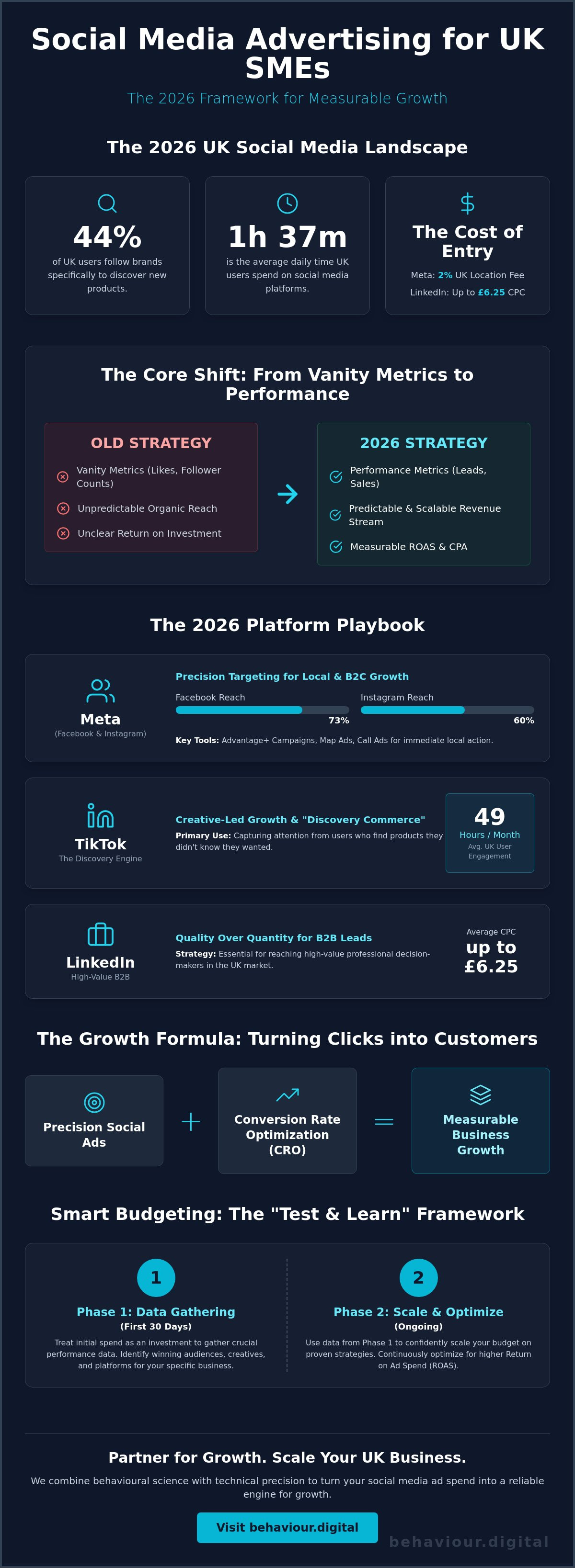
Setting a budget for social media advertising for small business uk requires a departure from arbitrary figures. Successful UK SMEs in 2026 don't ask "how much should I spend?" but rather "how much can I afford to pay for a customer?" We recommend a minimum threshold of £500 to £2,000 per month to provide the platform algorithms with sufficient data to optimise. Spending less often results in statistical insignificance, where you've spent money but haven't gathered enough data to make informed decisions.
The first 30 days of any campaign are the "Test and Learn" phase. During this period, your primary ROI is data, not immediate profit. You're buying information on which creative resonates with your UK audience and which demographics offer the lowest cost-per-acquisition (CPA). By the second month, this data allows for methodological fine-tuning that shifts the focus toward scaling profitable sets. To understand your true performance, you must look beyond platform-specific Return on Ad Spend (ROAS) and monitor your Marketing Efficiency Ratio (MER). This measures your total revenue against your total ad spend, accounting for the "Halo Effect" where social ads drive future direct traffic or brand searches in Glasgow and beyond.
Determining your budget starts by working backwards from your profit margins. If your average customer value is £500 and your margin is 50%, you know your absolute ceiling for acquisition. In 2026, average UK Facebook CPCs fluctuate between £0.45 and £1.10, while high-intent sectors often exceed £2.00. Understanding these benchmarks prevents you from chasing "cheaper" clicks that don't convert. Quality traffic always carries a premium, but it results in a lower final CPA because the conversion rate is significantly higher. If you need help defining these metrics, you can book a digital strategy audit to align your spend with your growth targets.
The "Boost Post" button is a primary source of wasted spend for UK small businesses. It lacks the granular targeting and objective-based optimisations found in the professional Ads Manager. For accurate tracking, your technical setup must include the Meta Pixel and the Conversions API (CAPI). This ensures you capture data even when browser cookies are restricted. Your monthly reporting should ignore vanity metrics and focus on three core pillars:
The actual cost to acquire a lead or sale.
How effectively your landing page handles social traffic.
How often your UK target audience sees your ad before taking action.
Tracking these figures allows you to treat social media advertising for small business uk as a predictable growth engine rather than a speculative expense. When your data is transparent, scaling becomes a matter of logic rather than guesswork.
Managing social media advertising for small business uk internally often results in "expensive lessons" that drain capital without providing actionable data. Without the technical infrastructure to track cross-platform attribution or the creative expertise to trigger specific user actions, many business owners find themselves frustrated by high costs. We position ourselves as a strategic partner, taking full responsibility for the quantitative growth of your brand. Our approach isn't about simply running ads; it's about engineering a system where every pound spent is an investment in measurable business outcomes.
The core of our success lies in merging professional PPC Management with deep behavioural science. We don't just look at what people click; we analyse why they click and what prevents them from converting. Based in Glasgow, we possess a unique understanding of the local Scottish market while maintaining the technical capacity to scale brands across the UK and beyond. Our reporting is transparent and entirely void of marketing jargon. You'll see exactly how your spend translates into leads, sales, and sustainable revenue growth.
We believe that success is the result of continuous methodological fine-tuning. We implement rigorous A/B testing on every variable, from headline psychology to landing page layout, to systematically lower your CPA over time. This data-led rigour ensures your budget is always allocated to the highest-performing assets. When you partner with us, you're assigned a dedicated UK-based account manager who understands your specific commercial goals and provides proactive strategic adjustments. For example, we recently helped a local UK retail brand scale their monthly revenue by 140% in just six months by aligning their paid social creative with a high-performance CRO framework.
Growth doesn't happen by accident; it's the product of a conscious, tailored roadmap. Your journey with Behaviour Digital begins with a comprehensive strategy consultation where we audit your current digital footprint and identify immediate opportunities for efficiency. We reject "one-size-fits-all" packages because every business has a different profit margin and a different target audience behaviour. We build a framework that fits your specific needs, ensuring your social media advertising for small business uk is both scalable and profitable from the start. Ready to scale? Book your 2026 strategy session with Behaviour Digital today.
Mastering social media advertising for small business uk in 2026 requires more than just high-quality content. It demands a rigorous, data-led framework that connects every impression to a conversion. We've moved beyond the era of boosting posts. Technical precision, such as CAPI integration and CRO-aligned landing pages, now dictates your success. By selecting platforms based on user intent rather than popularity, you ensure your budget works as a growth engine rather than a speculative expense.
Success is the result of methodical testing and a deep understanding of the UK consumer journey. As Glasgow-based strategic experts, we specialise in transforming complex data into measurable business outcomes across Meta, LinkedIn, and TikTok. Our performance focus ensures that every campaign is optimised for scalable ROI and sustainable growth. Your business deserves a strategic partner that prioritises performance over vanity. Let's build your 2026 roadmap together.
Get a Tailored Social Media Ad Strategy for Your UK Business
UK businesses should allocate a minimum of £500 to £2,000 monthly for social media advertising for small business uk to ensure platforms have sufficient data for optimization. This range excludes the mandatory 20% VAT and Meta's 2% location fee implemented in July 2026. Lower budgets often fail to reach statistical significance, which makes it difficult to identify and scale profitable audience segments.
The optimal platform is determined by your target audience's intent rather than simple popularity. Meta remains the strongest for local Glasgow services due to its 73% penetration rate among internet users. TikTok is the 2026 leader for discovery commerce, while LinkedIn is non-negotiable for B2B. A multi-channel strategy is often necessary to capture users at different stages of the decision-making journey.
You don't need a massive budget, but you must cover the cost of data acquisition. With average UK Facebook CPCs between £0.45 and £1.10, even a modest daily spend can generate meaningful traffic. The key is ensuring your landing page is fully optimised before you start. This prevents your smaller budget from being wasted on clicks that don't convert into customers.
You'll likely see initial engagement within 48 hours, but a campaign requires a full 30-day "Test and Learn" phase to reach peak efficiency. This period allows the algorithm to identify the most profitable demographics and creative assets. Scaling should only occur once your cost-per-acquisition is stable and your conversion data is statistically significant.
Boosting a post prioritises vanity metrics like likes and shares. Professional ad campaigns via Ads Manager allow for precision targeting and conversion-focused objectives. If your goal is measurable business growth, the Ads Manager is the only viable tool for managing social media advertising for small business uk. It provides the granular control necessary to track true ROI.
While DIY is an option, it often leads to inefficient spending due to poor technical setup or lack of CRO integration. Professional management ensures your Pixel, CAPI, and behavioural tracking are correctly configured. This expertise typically pays for itself by lowering your final CPA and preventing the "expensive lessons" common with unmanaged accounts.
Success is measured by your Cost Per Acquisition (CPA) and Marketing Efficiency Ratio (MER). You must look past the platform's reported ROAS and track how social traffic influences your total revenue. Using heatmaps and session recordings provides qualitative proof of how users interact with your site after clicking an ad, confirming if your strategy is driving real value.
Social media advertising remains highly effective for UK B2B firms, particularly on LinkedIn. While CPCs are higher, ranging from £2.00 to £6.25, the lead quality is significantly superior to other channels. Thought Leader ads are a specific 2026 trend that helps Scottish consultancies build authority and shorten long sales cycles by targeting high-value decision-makers directly.

Luke leads strategy across every Behaviour Digital account — building data-driven advertising systems for ambitious brands. When he's not auditing ad accounts, he's writing about what he found in them.
Get a free, tailored growth plan — we'll run our framework on your accounts and show you exactly what we'd do.
Get your free growth plan →