.webp) Online
OnlineNot sure which channel fits your business?View all services →
Three inputs. Instant KPIs. No spreadsheets.Open a calculator →
OnlineLinkedIn accounts for 80% of B2B leads from social media, yet many UK firms treat it as an expensive digital billboard rather than a precision engine. Success with social media for b2b companies uk in 2026 isn't about the frequency of your posts; it's about capturing demand through specific behaviou...

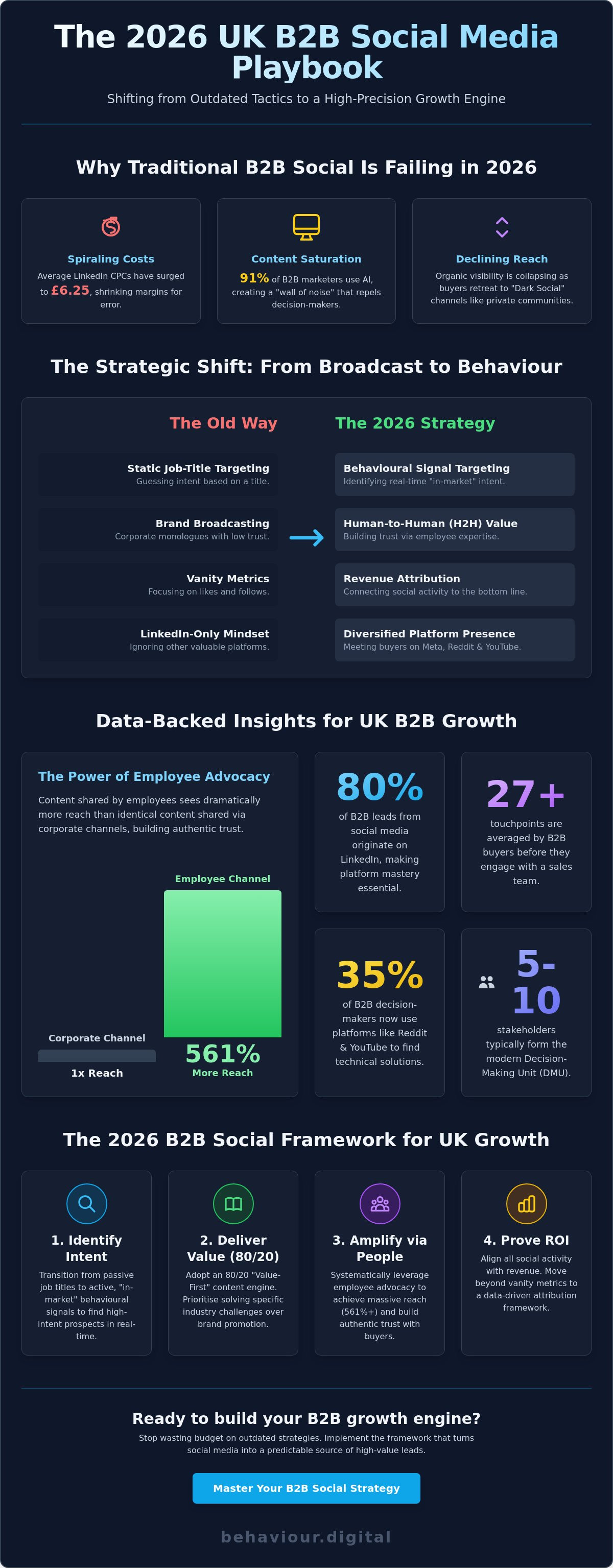
LinkedIn accounts for 80% of B2B leads from social media, yet many UK firms treat it as an expensive digital billboard rather than a precision engine. Success with social media for b2b companies uk in 2026 isn't about the frequency of your posts; it's about capturing demand through specific behavioural signals. With average LinkedIn CPCs now reaching up to £6.25 and Meta's 2% location fee impacting UK budgets, the margin for strategic error has disappeared.
You likely recognize the frustration of high costs per lead and the internal perception that social platforms only serve B2C audiences. It's difficult to reach niche decision-makers when attribution remains a black box and organic reach continues to decline. This guide provides the exact framework to master the platform shifts and behavioural strategies needed to turn your social presence into a high-precision lead generation tool. We'll examine platform prioritisation for 2026, the 561% reach advantage of employee advocacy, and how to align every social action with your bottom line.
• Transition from passive job-title targeting to active "in-market" behavioural signals to identify high-intent prospects in real-time.
• Optimise your strategy for social media for b2b companies uk by diversifying across Meta platforms to capture decision-maker attention at a lower cost-per-lead.
• Adopt an 80/20 "Value-First" content engine that prioritises solving specific industry challenges over generic brand broadcasting.
• Align social media activity with actual revenue by moving beyond vanity metrics toward a data-driven attribution framework.
By 2026, the definition of social media for b2b companies uk has shifted from a broadcast medium to a high-precision behavioural engagement tool. The era of posting generic updates and hoping for visibility is over. UK social media ad spend reached £11.5 billion in 2025, a 21% increase that signals a market moving toward aggressive, data-backed acquisition. Modern B2B buyers don't follow linear paths; they average over 27 touchpoints across multiple platforms before engaging with a sales team. This complexity requires a shift from broad organic reach to signal-based paid social strategies that identify intent in real-time.
The UK B2B sector has matured beyond the "LinkedIn-only" mindset. While LinkedIn remains a primary driver, 35% of B2B decision-makers now utilise platforms like Reddit and YouTube to find technical solutions. Relying on a single channel creates a single point of failure in your digital strategy. Success in 2026 is defined by meeting the buyer where they actually consume information, not just where they maintain a professional profile. This requires a sophisticated approach to Social Media Marketing that prioritises behavioural signals over simple job titles.
Saturation is the primary killer of traditional B2B social. With 91% of B2B marketers incorporating AI into their strategies, the volume of AI-generated "thought leadership" has created a wall of noise. UK decision-makers are reacting by retreating into "Dark Social" channels; private Slack communities, WhatsApp groups, and direct peer-to-peer messaging. Traditional lead-gen forms are also losing efficacy. The modern executive demands frictionless demand capture, where high-value insights are delivered instantly without the barrier of a gated form.
The psychology of the UK business buyer is pragmatic and time-poor. They've developed a high level of cynicism toward corporate monologues. The concept of social selling has evolved into a peer-to-peer value exchange where individual expertise carries more weight than brand logos. Content shared by employees now sees 561% more reach than corporate channels. In Scotland and across the UK, trust is built through transparency and technical depth. Moving to an H2H model means replacing vague marketing claims with quantifiably proven results and direct professional engagement.
Static targeting is dead. Relying solely on job titles like "Head of Procurement" or "IT Director" creates significant budget waste because a title doesn't equal intent. In 2026, the most effective social media for b2b companies uk strategies prioritise behavioural data over demographic labels. We've moved into an era where "In-Market" signals, such as repeated engagement with specific technical whitepapers or long-form video completions, are the primary indicators of a high-value prospect. These actions reveal a level of intent that a static LinkedIn profile simply cannot convey.
The complexity of the UK B2B sales cycle involves a diverse Decision-Making Unit (DMU). It's rarely a single executive making a choice; it's a committee of five to ten stakeholders. According to the latest B2B social media marketing statistics, content shared by employees reaches a much broader segment of these units than corporate pages. To succeed, your social stack must leverage first-party data to build audience segments that mirror your existing high-value clients. This analytical approach ensures your ad spend is concentrated on companies already showing the digital footprints of a buyer.
Tracking intent signals within the UK requires a strict adherence to UK GDPR while maintaining technical precision. We distinguish between passive scrolling and active research. Active research is identified through "Trigger Events," such as a company expanding its UK workforce or a decision-maker engaging with competitor-specific keywords. By identifying these triggers, you can position your solution exactly when the internal conversation begins. This methodology moves your brand from being a random interruption to a timely resource.
Organic reach has become a secondary support act. High-precision paid campaigns are now the engine of growth. Sophisticated Social Media Marketing isn't just about direct lead forms; it's about seeding demand months before a sales call even happens. We use "Retargeting 2.0" to nurture UK C-suite executives who have interacted with specific high-intent pages on your site. This keeps your brand top-of-mind throughout a 6-to-18-month sales cycle. If your current activity lacks this level of precision, it's time to audit your digital strategy for measurable performance gaps.
LinkedIn remains the dominant force for professional networking, with 84% of marketers identifying it as their most valuable channel. However, this dominance comes with a rising financial barrier. In 2026, average CPCs for LinkedIn in the UK range from £2.00 to £6.25, with CPMs often exceeding £35. For social media for b2b companies uk, this means every click must be backed by a high-intent behavioural signal to avoid budget exhaustion. Precision is no longer a luxury; it's a requirement for survival.
Meta has emerged as the surprise powerhouse for B2B growth. While many firms still view Facebook and Instagram as B2C territories, the data suggests otherwise. Facebook CPCs in the UK currently average between £0.26 and £0.50, offering a significantly lower entry point for reaching decision-makers. Even with Meta's 2% location fee, implemented in July 2026 in response to the UK Digital Services Tax, the cost-efficiency of Meta's AI-driven targeting often outshines traditional professional networks. It's about catching the decision-maker when their guard is down and their attention is focused.
For technical sectors like engineering and manufacturing, TikTok and YouTube have become essential authority builders. UK firms are increasingly using lo-fi, "behind-the-scenes" TikTok content to demonstrate technical expertise in a digestible format. Meanwhile, YouTube serves as the long-form pillar of a 2026 strategy. With CPVs ranging from £0.04 to £0.25, it’s a cost-effective way to deliver deep-dive technical demonstrations to an audience that is 35% more likely to use video platforms for solution-finding than traditional search engines.
The rise of LinkedIn Newsletters and Thought Leader Ads has transformed the platform into a content-first ecosystem. Your sales team can't afford to be passive profile holders. They must act as social sellers who facilitate peer-to-peer value exchange. The current algorithm heavily rewards technical depth and employee advocacy over corporate brand posts. Content shared by your team reaches 561% further than your company page, making individual professional branding a core component of your reach.
Reaching a Glasgow-based CEO doesn't end when they close their laptop. A decision-maker might engage with your whitepaper on LinkedIn during office hours and see a retargeting ad on Instagram while scrolling in the evening. Meta’s advanced AI targeting is now incredibly precise at identifying niche business owners based on their professional interests and browsing history. This omnichannel approach requires a unified Digital Strategy to ensure your message remains consistent across personal and professional environments. When your brand appears across multiple contexts, it builds a level of trust that a single-channel approach can't match.
Execution is where most social media for b2b companies uk fail. They have the platforms but lack the methodology to move a prospect from a casual scroll to a sales-qualified lead. A successful 2026 framework requires a five-step approach that prioritises data over intuition. It begins with defining a UK-specific Ideal Customer Profile (ICP) using actual behavioural data from your existing CRM and site analytics. You aren't just looking for job titles; you're looking for the digital footprints of companies in an active buying cycle.
Your content engine must follow the 80/20 rule. 80% of your output should provide pure technical or strategic value without a sales pitch, while only 20% should be directly commercial. This builds the authority necessary to sustain a multi-channel paid funnel. Instead of a single "lead gen" ad, use a tiered approach: awareness through educational video, retargeting through technical proof, and finally, demand capture. By the time the sales call happens, the prospect should already view your brand as the logical solution to their specific operational bottleneck.
The final steps involve alignment and measurement. You must connect your social traffic to high-performance landing pages that respect the user's context. Finally, move your reporting away from vanity metrics. Likes and shares are secondary to pipeline contribution and revenue attribution. If your social activity isn't directly influencing your bottom line, it isn't working.
Traditional whitepapers are being replaced by interactive insights and lo-fi, expert-led video. UK technical audiences value transparency over high production values. A successful scroll-stop hook for technical professionals identifies a specific, high-cost operational pain point and presents a quantifiable solution within the opening three seconds of content. Peer endorsements and specific UK-based case studies provide the social proof required to overcome the natural cynicism of the British business buyer.
Social traffic is notoriously fickle. If you send a high-intent user from a precise LinkedIn ad to a generic, slow-loading homepage, you've wasted your budget. The 2026 approach to Conversion Optimisation focuses on creating frictionless, social-first landing pages that mirror the ad's specific promise. We use rigorous A/B testing to refine messaging based on how users actually behave once they click through. This ensures that the precision of your targeting is matched by the efficiency of your conversion path. To see how your current site measures up, you can request a performance audit to identify hidden conversion leaks.
Effective social media for b2b companies uk requires more than creative execution; it demands a deep understanding of the intersection between data science and buyer psychology. At Behaviour Digital, we operate as an extension of your growth team. Based in Glasgow but serving a global client base, we specialise in navigating the specific nuances of the UK market. We don't report on vanity metrics like impressions or engagement in isolation. Instead, we focus on the quantitative data that drives your pipeline, ensuring every pound of your social budget is an investment in measurable business development.
Our methodology integrates high-precision PPC Management with your social strategy. This unified approach allows us to capture high-intent search traffic while simultaneously seeding demand through behavioural social targeting. By synchronising these channels, we eliminate data silos and create a consistent presence across the entire UK B2B buyer journey. This creates a feedback loop where search data informs social targeting, and social engagement improves search performance.
The Behaviour Digital promise is built on three pillars: transparency, precision, and scalable growth. We provide a clear view of how your social activity influences your bottom line. In an environment where Meta's 2% location fee and rising LinkedIn costs are the new baseline, our precision ensures you aren't overpaying for low-intent traffic. We focus on the "why" behind the click, using that data to scale your most successful campaigns and drive sustainable revenue.
We understand the cultural and professional landscape of Scotland and the wider UK. This local expertise allows us to craft messaging that resonates with time-poor decision-makers who value technical depth over marketing fluff. Our heritage in Conversion Rate Optimization means we don't stop at the click. We audit the entire user experience to ensure your social traffic lands on a page designed for high-precision conversion. We turn behavioural signals into revenue through continuous methodological refinement.
Scaling a B2B brand in 2026 requires a partner who understands the technical complexity of modern platforms. Choosing the right Social media marketing management Scotland partner is a strategic decision that impacts your long-term market positioning. We offer a bespoke behavioural audit of your current UK social presence to identify performance gaps and untapped opportunities. This isn't a generic report; it's a data-driven roadmap for your 2026 growth. Partner with Behaviour Digital for measurable B2B growth and move beyond the noise of traditional social marketing.
The transition from broad broadcasting to high-precision behavioural engagement is no longer optional. To succeed with social media for b2b companies uk in 2026, firms must move beyond the "LinkedIn-only" mindset and embrace a multi-channel strategy that prioritises "In-Market" signals. By aligning social activity with first-party data and rigorous conversion rate optimisation, you turn digital interactions into a predictable revenue engine. Data dictates direction; every click must serve a measurable purpose within your sales pipeline.
Behaviour Digital exists to bridge the gap between complex digital signals and sustainable business growth. As Glasgow-based experts with a UK-wide reach, we provide the technical depth required to integrate PPC, Social, and CRO into a single, high-performance stack. Our focus remains on transparency and quantitative results, ensuring your strategy evolves alongside the shifting professional landscape. It's time to move beyond vanity metrics and build a strategy that scales. Drive Measurable B2B Growth with Behaviour Digital and start transforming your social presence into a precision lead generation tool today.
LinkedIn remains the primary platform for direct lead generation, accounting for approximately 80% of B2B social leads. However, the most effective 2026 strategies utilise a multi-channel approach. High-growth firms combine LinkedIn's precision targeting with Meta's cost-effective retargeting to capture demand across the entire buyer journey. This prevents over-reliance on a single channel while maintaining visibility where decision-makers actually spend their time.
Budget allocation is determined by your specific growth targets and the competitive density of your sector. Most UK B2B organisations allocate between 5% and 15% of their total marketing spend to social channels. With LinkedIn CPCs ranging from £2.00 to £6.25, your investment must be guided by a clear attribution model. Focus on the cost per qualified lead rather than aggregate spend to ensure the budget drives actual pipeline value.
Facebook is highly relevant for UK B2B firms, particularly for retargeting and brand reinforcement. Decision-makers maintain professional interests even when browsing personal feeds. Meta’s lower CPCs, which average between £0.26 and £0.50, allow you to maintain consistent visibility at a fraction of LinkedIn's cost. It's a critical tool for staying top-of-mind during long procurement cycles when prospects are engaging with content in more relaxed environments.
ROI is measured by tracking the contribution of social activity to the total sales pipeline. You must move beyond vanity metrics like likes to focus on Customer Acquisition Cost (CAC) and Pipeline Velocity. Using multi-touch attribution ensures that social media for b2b companies uk is credited for its role in the early research stages. This data-driven approach provides a clear view of how social interactions eventually convert into closed-won revenue.
Demand generation focuses on building awareness and authority among prospects who aren't yet ready to buy. Lead generation is the tactical process of capturing contact data from those with immediate intent. A balanced 2026 strategy uses demand generation to educate the 95% of the market currently in a research phase. Lead generation then captures the remaining 5% who have reached a specific buying trigger and require direct engagement.
Small businesses compete effectively by leveraging employee advocacy and niche behavioural targeting. Content shared by individual experts often sees 561% more reach than corporate brand pages, allowing smaller teams to achieve significant visibility. By focusing on deep technical expertise rather than broad awareness, smaller firms can establish themselves as specialist authorities. Precision targeting allows you to reach high-level decision-makers without the need for a massive enterprise-level budget.
Social media activity supports SEO by driving high-quality traffic and increasing branded search volume. While social links don't serve as a direct ranking factor, the increased visibility leads to more natural backlinks and mentions across the web. A strong strategy for social media for b2b companies uk ensures your technical content reaches a wider audience. This broader distribution indirectly strengthens your search engine authority and improves your overall digital footprint.
The dominant trends include the 91% adoption of AI for content personalisation and a significant shift toward lo-fi, expert-led video. There's also a move toward private communities and "Dark Social" as decision-makers seek peer-to-peer validation. UK businesses are increasingly prioritising transparency and technical depth over polished corporate messaging. This shift reflects a broader market demand for human-to-human connection and quantifiable proof in an AI-saturated digital environment.

Luke leads strategy across every Behaviour Digital account — building data-driven advertising systems for ambitious brands. When he's not auditing ad accounts, he's writing about what he found in them.
Get a free, tailored growth plan — we'll run our framework on your accounts and show you exactly what we'd do.
Get your free growth plan →