.webp) Online
OnlineNot sure which channel fits your business?View all services →
Three inputs. Instant KPIs. No spreadsheets.Open a calculator →
OnlineRelying on a vague social media marketing roi calculator is no longer an option when advertising costs on Meta and LinkedIn have surged by up to 25% since 2024. The margin for error in your digital strategy has effectively vanished. You've likely spent hours trying to attribute a single B2B sale to...

Relying on a vague social media marketing roi calculator is no longer an option when advertising costs on Meta and LinkedIn have surged by up to 25% since 2024. The margin for error in your digital strategy has effectively vanished. You've likely spent hours trying to attribute a single B2B sale to a specific post, only to find that rising CPCs, now averaging $1.35 on Meta and $5.60 on LinkedIn, are eating your margins. It's frustrating to face board-level pressure for immediate results when the conversion gap between high engagement and actual revenue continues to widen.
We agree that vanity metrics are no longer a viable currency for professional marketers. This guide provides a comprehensive framework to help you master a data-driven social media marketing roi calculator that dictates your success. You'll learn how to calculate your true return by factoring in management fees, leveraging conversion rate optimization, and implementing a strategy to systematically lower your cost-per-acquisition. We're moving past the likes to give you a clear, quantitative formula you can confidently present at your next board meeting to prove real business growth in 2026.
• Transition to multi-touch attribution models to capture the complete journey of the modern buyer and avoid the pitfalls of last-click measurement.
• Master the social media marketing roi calculator by integrating often-overlooked variables like management fees and content production overhead into your profit equations.
• Define quantifiable 'gain' metrics that move beyond vanity engagement to focus on net profit, lead value, and operational cost savings.
• Identify and fix the 'leaky bucket' syndrome where high social traffic fails to convert due to a lack of behavioral conversion rate optimization.
• Leverage the synergy between paid social and performance-driven digital strategy to build a unified, data-first framework for sustainable growth.
Social media performance in 2026 isn't a guessing game; it's a precise measurement of capital efficiency. At its core, Social Media ROI measures the efficiency of your social investment relative to net profit, rather than just gross revenue. While many platforms offer basic metrics, a robust Return on Investment (ROI) analysis requires a deep dive into the actual business value generated after all operational costs are subtracted. To move beyond surface-level data, you need a social media marketing roi calculator that accounts for the full complexity of the modern buyer journey.
The 2026 market has rendered 'last-click' attribution obsolete. Buyers now interact with a brand across multiple touchpoints, from a TikTok Reel to a LinkedIn whitepaper, before finally converting through a direct search. You must shift toward multi-touch attribution models to accurately track this behavior. This shift allows you to see how social media impacts the entire digital marketing funnel explained in our strategic guides, moving prospects from initial awareness to high-intent consideration.
Understanding the distinction between ROAS (Return on Ad Spend) and true ROI is vital for financial transparency. ROAS only compares revenue to direct ad spend, which often paints an incomplete picture. A professional social media marketing roi calculator must incorporate management fees, content production costs, and software overhead to present a clear picture of profitability to your board. Without these inputs, you're measuring campaign efficiency, not business growth.
Likes, shares, and comments are leading indicators, but they don't pay the bills. In 2026, successful brands distinguish between these vanity metrics and Value-Driving Actions (VDA). A VDA might be a newsletter sign-up, a demo request, or an 'add to cart' event. Your strategy should prioritize these high-intent behaviors over passive engagement. ROI is the net financial gain generated from social investments, measured against both direct revenue and long-term strategic brand valuation.
Social media often acts as the catalyst rather than the closing agent. It nurtures leads that eventually convert via other channels. By using GA4 and platform-native tracking, you can map the 'path to purchase' and assign value to these assisted conversions. Scottish brands must look beyond immediate clicks to understand how social presence builds long-term brand equity in a competitive global market. This perspective ensures that your social spend is viewed as a growth engine rather than a sunk cost.
Precision is the hallmark of a high-performing digital strategy. To build an accurate social media marketing roi calculator, you must first categorize every pound that leaves your business and every pence that returns. Most generic tools fail because they ignore the operational friction that exists in professional environments. You can't rely on a "spend vs sales" ratio if you're ignoring the overhead required to generate those sales. A true calculation accounts for the rising costs of distribution, where LinkedIn CPCs have reached $5.60 and Meta costs have surged by 23% since 2024.
This is the net capital paid to platforms like Meta, LinkedIn, or TikTok. Ensure you're looking at the gross cost including any platform-specific transaction fees or taxes.
Professional oversight is a strategic investment. Integrating social media marketing management Scotland fees into your equation ensures you're measuring the profitability of the entire operation, not just the algorithm's performance.
High-quality video generates 3.2 times the engagement of static posts in 2026. You must factor in the costs of videography, graphic design, and professional copywriting to see the full financial picture.
Effective Measuring The ROI requires a disciplined approach to data collection. Many brands make the mistake of using inconsistent time-frames. We recommend a monthly cadence for evergreen performance tracking, while using specific campaign-based windows for seasonal launches or product drops. This allows you to isolate variables and understand which specific tactics are driving the needle. Refining these inputs is a core component of our digital strategy services, where we align spend with measurable business outcomes.
The 'Gain' side of your social media marketing roi calculator isn't always a direct checkout event. For B2B firms in particular, the focus shifts to lead value. If your average contract value is £10,000 and your close rate is 10%, every qualified lead is worth £1,000 to your business. You should also consider Customer Lifetime Value (CLV). A social campaign that acquires a customer who stays for three years is significantly more valuable than a one-off transaction. In 2026, e-commerce brands should also subtract platform transaction fees and VAT from their total return to ensure the resulting ROI figure represents actual net profit. This level of granularity prevents the inflation of success and provides a sober, analytical view of your market position.
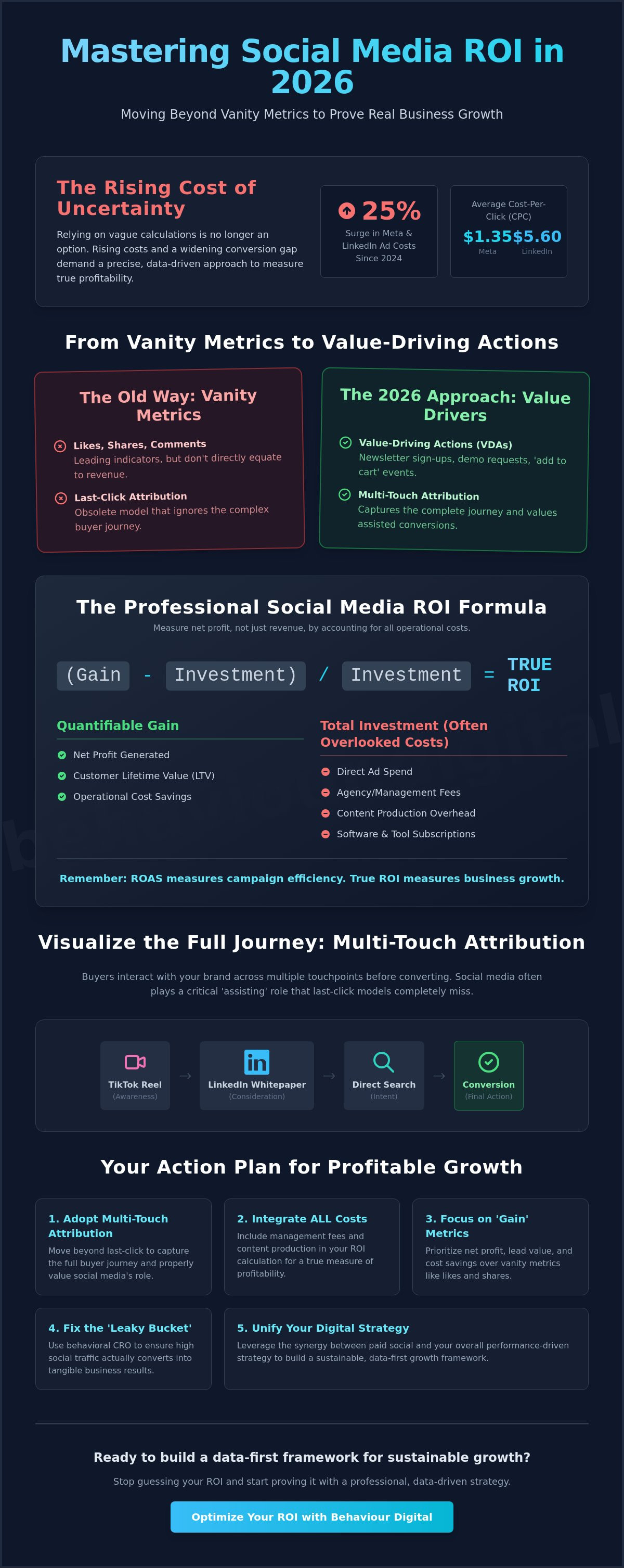
Moving from data collection to analysis requires a standardized mathematical approach. While a social media marketing roi calculator can automate the heavy lifting, understanding the underlying logic is essential for strategic decision-making. The universal formula for calculating your return is: (Net Profit / Cost of Investment) x 100. This calculation provides a percentage that represents the efficiency of every pound spent. To get this right, you must ensure your net profit figure has already accounted for the "Gain" minus the "Total Investment" detailed in the previous section.
Financial transparency is the only way to justify scaling a budget. You can find various templates on how to calculate social media ROI, but the most effective models are those that remain consistent month-over-month. Consistency allows you to strip away market noise and focus on the internal variables you can actually control, such as your ad creative or landing page performance.
Let's look at a concrete scenario for a Glasgow-based retailer. In this example, the business allocates a total budget of £10,000 for a seasonal push, but the actual deployed costs include £5,000 on direct ad spend and £2,000 on professional management fees, totaling £7,000 in investment. If the campaign generates £25,000 in tracked revenue, the net profit is £18,000. Applying the formula, we see the following result: (£18,000 / £7,000) * 100 = 257% ROI. This figure gives the board a clear, unambiguous look at the campaign's success beyond mere engagement rates.
Benchmarks vary significantly based on your industry and target audience. In 2026, the platform you choose dictates your baseline expectations for a social media marketing roi calculator:
With an average CPC of $1.35 and CPM of $11.20, Meta remains the high-volume choice for B2C. It's built for scale, though rising costs require tighter conversion optimization to maintain historical ROI levels.
You'll face a much higher CPC of $5.60 and CPM of $34.50. However, for B2B marketers, the lead quality is often superior, resulting in a higher Customer Lifetime Value that justifies the premium entry price.
This platform offers the lowest entry costs with a $0.90 CPC and $6.20 CPM. Engagement rates here are often 3 to 10 times higher than competitors, making it a powerful tool for brand awareness and Gen Z acquisition.
Don't panic if you encounter a negative ROI during the first 30 days of a new campaign. Social algorithms require a "learning phase" to optimize delivery, and B2B cycles are naturally longer. A negative return in month one might actually be a successful "top-of-funnel" investment that pays dividends in month three. The key is to monitor the trend; if the ROI isn't improving as the pixel gathers more data, it's a signal to audit your creative or your post-click experience.
If your social media marketing roi calculator results have flatlined despite increasing traffic, you're likely suffering from the 'Leaky Bucket' syndrome. High social engagement is a vanity metric if your post-click environment fails to convert interest into revenue. In 2026, the gap between a social click and a confirmed sale has widened significantly. This is where conversion rate optimization becomes your most potent strategic tool. You cannot simply spend your way out of a poor user experience. With social media advertising costs rising by up to 25% across Meta and LinkedIn since 2024, every bounce represents an expensive failure of your digital strategy.
Many marketing managers face the internal objection that their ads work, but the website doesn't convert. This siloed thinking is a primary cause of stagnant growth. Success requires a unified view where the social creative and the landing page function as a single, frictionless journey. If your social media marketing roi calculator is showing a downward trend, the first place to audit is the transition from the social feed to your domain.
Mismatched messaging creates an 'Expectation Gap' that destroys trust instantly. If your LinkedIn ad promises a high-level B2B strategy but your landing page is a generic contact form, the user will leave within seconds. Strategic A/B testing for social-specific landing pages allows you to refine the narrative for different audience segments. We've found that consistent conversion optimisation drastically reduces your Cost Per Acquisition (CPA) by ensuring your site works as hard as your paid distribution.
Technical friction is often the invisible enemy of profitability. Data blackouts caused by broken tracking pixels or misconfigured Conversions API (CAPI) make it impossible to measure success accurately. Without a reliable data stream, your performance optimization is based on guesswork rather than facts. Speed is another critical factor. Since 90% of social browsing happens on mobile devices, a slow page load time is a death sentence for ROI. Social users are notoriously impatient. If your mobile UX is clunky or your checkout process involves more than three steps, you're actively pushing customers toward your competitors. To fix these gaps and maximize your returns, partner with our performance experts to audit your entire conversion funnel.
Measuring performance is the first step; mastering it is the next. At Behaviour Digital, we move beyond the theoretical use of a social media marketing roi calculator to implement a data-first methodology that eliminates guesswork. We don't just report on what happened; we engineer what happens next. By aligning your social spend with quantitative business outcomes, we ensure every campaign contributes to measurable growth rather than just inflating reach metrics. This level of precision is required to navigate a market where ad costs have risen by up to 25% across major platforms since 2024.
Our approach leverages the deep technical synergy between our PPC agency Glasgow expertise and high-level social strategy. This cross-channel perspective is vital in 2026, where the lines between paid search and paid social have blurred. We treat your social channels as performance engines, applying the same rigor to social creative as we do to high-intent search queries. This ensures a unified digital strategy that captures demand wherever it originates, removing the silos that often lead to data blackouts and wasted budget.
We don't function as a distant vendor. We act as a strategic partner focused on net business outcomes rather than just campaign metrics. Our Glasgow-based team understands the nuances of the UK market, providing a regional context that global agencies often miss. This local insight, combined with custom attribution modeling, allows us to track the entire sales cycle from the first social touchpoint to the final conversion. We provide the transparency required to see past 'likes' and 'shares' to the actual revenue hitting your balance sheet.
Data-driven marketing creates a virtuous cycle. Once your social media marketing roi calculator identifies a winning campaign, we use those insights to scale with precision. We don't just increase budgets; we optimize the entire funnel to maintain efficiency at higher spend levels. This involves reinvesting profits into the most effective creative formats, such as video content which currently generates 3.2 times the engagement of static posts across all major platforms. Scaling is a methodical process of fine-tuning, not a gamble based on intuition.
The path to sustainable growth starts with a clear view of your current position. If your reporting feels superficial or your attribution is unclear, it's time for a professional assessment. Book a social media ROI audit with Behaviour Digital today to uncover the hidden potential in your social strategy and start measuring real growth.
The shift from tracking engagement to measuring net profit is the defining challenge for marketers in 2026. You've seen how a robust social media marketing roi calculator must account for everything from management fees to the conversion gap on your landing pages. Relying on surface-level data in an environment of rising costs is a risk your business can't afford. Success requires a transition toward multi-touch attribution and a focus on Value-Driving Actions that impact your balance sheet.
Our Glasgow-based strategic experts specialize in bridging the divide between high-performing social creative and bottom-line revenue. We provide transparent, revenue-focused reporting that gives you the clarity needed for board-level decision-making. By integrating PPC, social media marketing, and conversion rate optimization into a single framework, we remove the technical and strategic friction that stalls your growth.
It's time to stop guessing and start scaling. Scale your growth with a data-driven social media strategy and transform your social channels into predictable revenue drivers. You have the framework; now it's time to execute with precision.
You calculate brand awareness ROI by assigning a proxy monetary value to reach and impressions based on your historical cost-per-acquisition. Alternatively, measure the cost savings achieved by using social media versus more expensive traditional media channels. This approach allows you to quantify the efficiency of your brand building efforts within a financial framework.
A healthy return for most UK businesses typically ranges between 3:1 and 5:1, though this varies by industry and product margin. High-growth sectors might prioritize a lower initial ratio to capture market share, while established firms often demand higher efficiency. Your specific digital strategy and target audience will dictate your ideal benchmark.
Privacy regulations and the deprecation of third-party cookies require a shift toward first-party data and server-side tracking. In 2026, a social media marketing roi calculator must rely on Conversions API (CAPI) and probabilistic modeling to fill data gaps. These technologies ensure you maintain visibility into the customer journey without violating consumer privacy laws.
Yes, you must include management fees to obtain an accurate picture of your business growth. Excluding these costs from your calculations leads to an inflated sense of success and inaccurate financial reporting. Professional oversight is a core part of the 'Cost of Investment' side of the ROI equation.
You calculate organic ROI by subtracting the labor and production costs from the total revenue generated through organic referral traffic. Use UTM parameters to isolate these conversions in your analytics. This data helps you determine if the time spent on community management is delivering a tangible financial return.
Review your high-level ROI on a monthly basis to identify performance trends and quarterly for deep strategic adjustments. While you'll monitor tactical ad performance daily, the overall return on investment requires a longer time-frame to account for sales cycles. This cadence ensures your strategy remains aligned with long-term business goals.
ROAS measures gross revenue generated per pound of ad spend, while ROI calculates net profit after all operational costs are subtracted. ROI is the superior business metric because it factors in management fees, content production, and software overhead. Using a social media marketing roi calculator focused on net profit provides a more honest view of your bottom line.
Track offline sales by implementing unique offer codes specific to social campaigns or by using platform-native 'Offline Conversions' tools. These tools allow you to upload encrypted transaction data from your CRM to match in-store purchases with users who viewed your ads. This connection is vital for businesses with a physical presence or long-cycle B2B sales.

Luke leads strategy across every Behaviour Digital account — building data-driven advertising systems for ambitious brands. When he's not auditing ad accounts, he's writing about what he found in them.
Get a free, tailored growth plan — we'll run our framework on your accounts and show you exactly what we'd do.
Get your free growth plan →