.webp) Online
OnlineNot sure which channel fits your business?View all services →
Three inputs. Instant KPIs. No spreadsheets.Open a calculator →
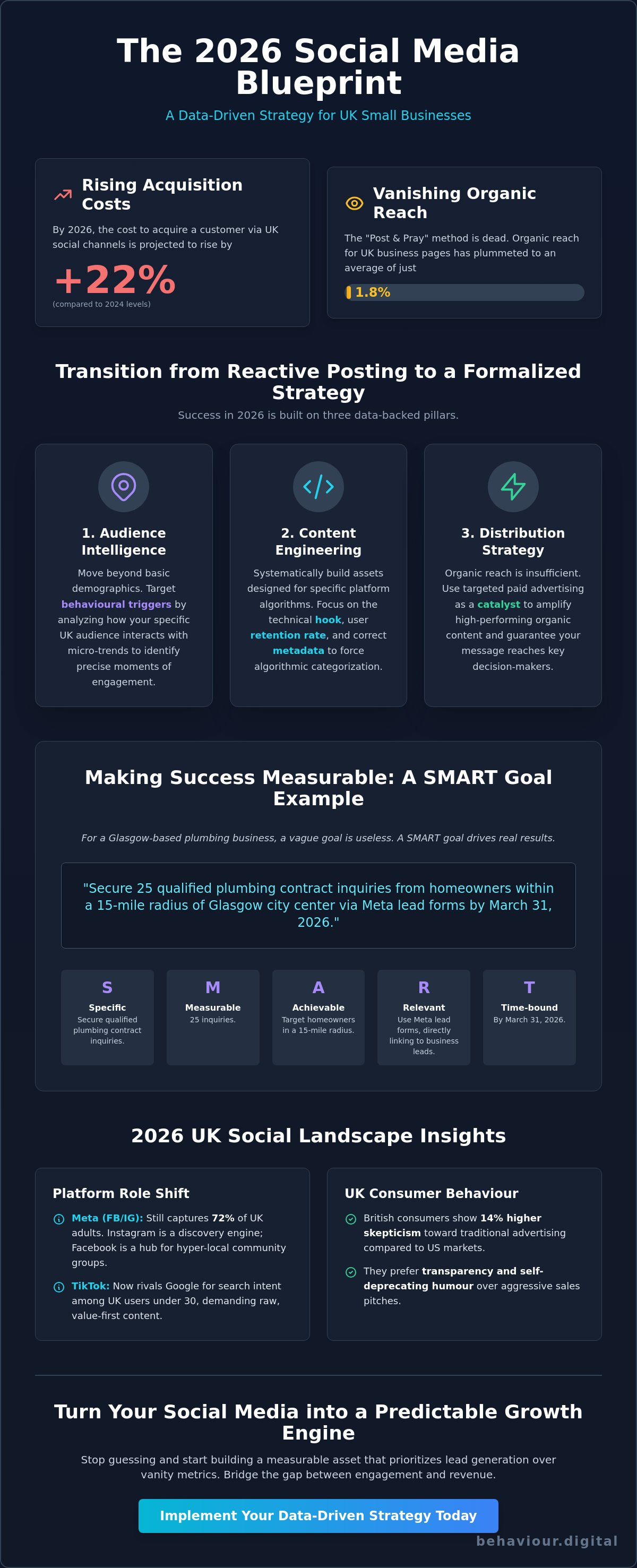
OnlineBy 2026, the cost of customer acquisition via UK social channels is projected to rise by 22% compared to 2024 levels. You've likely noticed that organic reach is stagnant and managing a social media strategy for small business uk feels like a race you can't win. It's exhausting to invest hours into...

By 2026, the cost of customer acquisition via UK social channels is projected to rise by 22% compared to 2024 levels. You've likely noticed that organic reach is stagnant and managing a social media strategy for small business uk feels like a race you can't win. It's exhausting to invest hours into content only to see zero impact on your bottom line. Success in this environment isn't about luck. It's the result of a conscious strategy and continuous optimization.
We've developed this guide to help you master a data-driven approach that turns quiet profiles into high-performance growth engines. You'll gain the confidence to allocate your ad spend where it actually yields a return, moving away from guesswork and toward predictable results. We'll show you how to transform your digital presence into a measurable asset that prioritizes lead generation over vanity metrics. Our focus is on transparency and real business impact, ensuring your efforts translate into scalable growth.
This blueprint covers everything from 2026 platform selection based on user behavior to a clear framework for building a scalable strategy document that drives sales.
• Transition from reactive posting to a formalized social media strategy for small business uk that aligns with 2026 algorithmic realities.
• Identify the specific platform shifts and consumer browsing habits unique to the UK market to gain a distinct competitive advantage.
• Engineer measurable customer actions using a behavioural framework that maps user intent across the entire awareness-to-advocacy funnel.
• Bypass the sub-2% organic visibility limit by utilizing paid social as a scalable growth lever rather than a simple marketing expense.
• Bridge the gap between social engagement and revenue by integrating your strategy with data-driven on-site conversion optimisation.
A social media strategy for small business UK is no longer a luxury or a creative side project. It's a formalized, data-backed roadmap that aligns every digital interaction with measurable business objectives. In the 2026 landscape, success depends on moving away from vanity metrics toward a performance-based framework. Effective social media marketing requires a systemic approach where content, distribution, and conversion tracking function as a single, integrated machine.
The "post and pray" method officially died in late 2025. This shift occurred because platform algorithms evolved into a total meritocracy. Simply showing up is insufficient. If your content fails to trigger specific behavioral signals within the first sixty seconds of publication, it's effectively invisible. Modern UK consumers demand immediate relevance. They use social platforms as discovery engines, moving from initial awareness to final conversion within a single ecosystem. This compressed buyer journey means your social media strategy for small business uk must account for every stage of the funnel simultaneously.
A general marketing plan outlines who you are and what you sell. A platform-specific social strategy defines how you win. It dictates the technical execution required to satisfy both the user's intent and the platform's specific delivery requirements. Without this distinction, businesses waste resources on high-effort content that generates zero commercial impact.
We've moved beyond basic demographics. In 2026, we target behavioral triggers. This involves analyzing how your specific UK audience interacts with micro-trends and identifying the exact moments they're ready to engage with a service provider.
This is the process of building assets designed for specific platform algorithms. It's not just about "good" video; it's about the technical hook, the retention rate, and the metadata that forces the algorithm to categorize your business correctly.
Organic reach for UK business pages dropped to an average of 1.8% in 2025. A viable strategy now requires a paid catalyst. You must use targeted ad spend to amplify high-performing organic content, ensuring your message reaches the right decision-makers.
Success isn't a feeling; it's a number. You must define whether you're chasing brand awareness, lead generation, or direct sales. For a Glasgow-based service business, a SMART goal would be: Secure 25 qualified plumbing contract inquiries from homeowners within a 15-mile radius of Glasgow city center via Meta lead forms by March 31, 2026.
Aligning social KPIs with your primary revenue drivers is the only way to ensure a positive ROI. If your social activity doesn't directly correlate with your CRM data or bank balance, the strategy is failing. We focus on scalable growth and transparent reporting to turn social platforms into predictable revenue streams.
Success in 2026 requires more than just "being active" on social media. It demands a data-driven approach to platform selection and a deep understanding of local behavioural patterns. Meta platforms, specifically Instagram and Facebook, still capture 72% of the UK adult population, but their roles have shifted. Instagram has evolved into a high-intent discovery engine, while Facebook serves as the primary hub for local community groups and marketplace activity. For a robust social media strategy for small business uk, ignoring these community hubs means missing out on hyper-local conversion opportunities.
TikTok now rivals Google for search intent among users under 30 in Britain. This shift forces brands to move away from polished commercials toward raw, value-first documentation. British consumers show a 14% higher skepticism toward traditional advertising compared to US markets, according to 2025 consumer sentiment reports. They prefer transparency and dry, self-deprecating humour over aggressive sales pitches. When building your framework, consult this comprehensive guide to social media marketing to ensure your foundational goals align with these shifting user expectations.
Regional nuances are equally critical. A strategy that converts in London's fast-paced, globalised market often fails in Glasgow or Manchester, where community identity and local dialect play a larger role in brand affinity. Data shows that UK users are 22% more likely to engage with content that references their specific city or region. Small businesses should use geo-targeted ads not just for reach, but to deliver culturally relevant messaging that resonates with local pride.
B2B firms must treat LinkedIn as their primary revenue driver. In 2026, LinkedIn's UK user base has reached 37 million, with a heavy focus on "thought leadership ads" that bypass traditional feed friction. Conversely, B2C brands are finding higher ROI within "dark social" channels. WhatsApp Channels and Discord servers allow small businesses to bypass algorithm volatility and speak directly to their most loyal 5% of customers. Your social media strategy for small business uk should allocate at least 15% of resources to these closed-loop communities to build long-term resilience.
Compliance isn't optional; it's a trust signal. The Advertising Standards Authority (ASA) has intensified its crackdown on non-transparent influencer partnerships. Every paid collaboration must use the #ad identifier clearly, positioned before the "see more" break. Data privacy also remains a priority. Following the latest UK-specific data protection updates, businesses must ensure their Meta pixels and tracking scripts are strictly "opt-in" to avoid heavy fines. Transparent data usage isn't just about legal safety; it's an opportunity to prove your brand's integrity. If you're unsure how to balance performance with privacy, partnering with a strategic agency can help bridge the gap between compliance and growth.
Behaviour Digital rejects vanity metrics. Likes and follows don't guarantee revenue. We focus on user intent because data shows that high engagement doesn't always correlate with bottom-line growth. A high-performing social media strategy for small business uk requires a clinical understanding of the social funnel. We map every touchpoint across four distinct stages: Awareness, Consideration, Conversion, and Advocacy. By 2026, 65% of UK consumers will expect brands to anticipate their needs before a direct search occurs.
The "Psychology of the Scroll" is a battle for the first 1.5 seconds. Average users scroll through roughly 300 feet of content every day. To stop the thumb, your creative must align with the user's immediate psychological state. We use social listening to identify UK-specific pain points, such as the rising demand for transparent pricing and sustainable sourcing. This practical guide to social media provides a foundation for these engagement tactics, ensuring every post serves a strategic purpose rather than just filling a feed.
Demographics are outdated. We move beyond "Who they are" to "How they behave" online. Our behavioural personas leverage UK search and social data to track specific user journeys. We identify "micro-moments," those intent-rich instances where a consumer needs an immediate solution. Whether it's a quick "how-to" search or a "near me" query, your business must be the friction-less answer in that specific second. Mapping these behaviours allows for a social media strategy for small business uk that scales with the user's actual needs.
The 80/20 rule remains the gold standard for UK consumer trust. 80% of your content must provide genuine value before you attempt a hard sell. For Scottish professional services, such as legal or consultancy firms, educational content acts as a critical trust-builder. Providing insights on regional regulations or industry shifts establishes your authority before a contract is even discussed. Educational content reduces the barrier to conversion by pre-emptively answering the prospect's most critical objections. High-value content turns a cold lead into a confident buyer by demonstrating competence without a sales pitch.
Targeted reach based on intent signals.
Educational assets that solve problems.
Low-friction calls to action.
User-generated content and loyalty loops.
A modern social media strategy for small business uk cannot rely on the hope of going viral. By 2026, organic reach for UK business pages has plummeted to sub-2% visibility. This means for every 1,000 followers, fewer than 20 people see your updates. Content production without a paid distribution plan is a waste of resources. We view paid social as a precision growth lever, not an overhead expense. It's the only way to guarantee your message reaches the right desk at the right time.
Setting a realistic advertising budget is the first step toward predictable revenue. Small businesses often fail because they treat ads as a one-off experiment rather than a consistent data-gathering tool. There's a powerful synergy when you align social spend with professional PPC management. While search ads capture existing demand, paid social creates it. This dual approach ensures your brand stays visible throughout the entire customer journey.
Data is your most valuable asset. Using Meta and LinkedIn pixels allows you to track specific user actions on your UK website. This data enables you to retarget visitors who abandoned a shopping cart or spent time on a service page. You aren't guessing; you're responding to clear intent. Lookalike audiences further amplify this by identifying 1,000 new potential UK customers who share the exact behavioural traits of your highest-value clients.
Capture high-intent signals to reduce cost-per-acquisition.
Use 1% UK seeds to find users similar to your existing buyers.
Protect your budget by removing existing customers or non-converting segments from top-of-funnel campaigns.
Success in 2026 is defined by behavioural testing. We don't just A/B test button colours. We test psychological hooks and creative angles to see what resonates with the UK market. Integrating paid spend into your social media strategy for small business uk allows for rapid experimentation. Dynamic Creative Optimisation (DCO) automates this by mixing headlines, images, and descriptions to find the winning combination for every individual user.
Stop falling in love with your ads. Use hard data to kill underperforming creatives before they drain your ROI. If an ad doesn't hit its KPIs within the first 72 hours, it's replaced. This ruthless approach to optimisation ensures that every pound spent contributes to measurable business growth.
Ready to turn your social platforms into a predictable revenue engine? Partner with Behaviour Digital for data-driven growth.
Strategy remains theoretical until it hits the market. A successful social media strategy for small business uk requires a disciplined 90-day execution window to move from planning to profitability. The first 30 days involve auditing your current footprint and installing tracking pixels. By day 60, you should be running A/B tests on creative assets. By day 90, your data will show which channels deserve increased investment and which should be cut.
Driving traffic is only half the battle. Your social efforts must integrate seamlessly with conversion optimisation on your website. If your landing pages don't mirror the promise of your social ads, your bounce rate will climb. We've seen UK businesses increase their lead volume by 38% simply by aligning their social messaging with the final on-site call to action.
Efficiency requires the right stack. For UK-based businesses, tools like Sendible or Sprout Social offer robust scheduling and localized reporting features. These platforms help you maintain a consistent presence without manual posting every hour. However, technology can't replace expertise. You must decide when to keep operations in-house and when to hire a Social Media Marketing Management partner to handle technical scaling and complex algorithm shifts.
Forget vanity metrics. Likes and follows don't pay the bills. You need to track Cost Per Lead (CPL) and Return on Ad Spend (ROAS) with clinical precision. The "Attribution Challenge" is real in 2026; a customer might see an Instagram post on Monday but not buy until they search for you on Friday. Use custom dashboards that pull data from GA4 and your social platforms to see the full journey. This transparency ensures every pound spent on your social media strategy for small business uk is accountable.
Our Glasgow-based team doesn't guess. We apply rigorous, data-driven frameworks to help UK small businesses scale. We move beyond simple posting by combining social media with PPC and CRO. This multi-channel approach ensures that your brand stays visible throughout the entire buyer journey. Success in 2026 isn't about being everywhere; it's about being where the data tells us your customers are ready to convert.
Your next steps are clear:
• Audit your current social presence to identify data gaps.
• Align your social content with specific conversion goals.
• Build a 2026 roadmap that prioritises ROI over engagement.
Success in the 2026 market doesn't happen by accident. It's the result of precise execution. With UK organic reach often dipping below 2% on major platforms, your brand's visibility depends on a sophisticated, paid-first approach. You've seen how a behavioural framework turns passive scrolling into measurable business impact. Compliance with the latest UK digital regulations isn't just a legal hurdle; it's a trust signal that converts modern consumers.
Generic posting is a liability. You need an aggressive social media strategy for small business uk that prioritizes ROI over vanity metrics. Data from Statista indicates that over 84% of the UK population remains active on social platforms, making the opportunity for growth immense for those who utilize data-driven scaling. We don't guess. We optimize. As a data-driven Glasgow agency, we focus on high-ROI paid social scaling and provide transparent performance reporting. Every pound spent must be a pound tracked. It's time to stop chasing likes and start engineering growth.
Book your 2026 social media strategy audit with Behaviour Digital and secure your competitive edge today. Your future market share is waiting for a better strategy.
UK small businesses should allocate between 7% and 12% of their total annual revenue to marketing, with roughly 40% of that budget dedicated to social media channels. According to the 2024 CMO Survey, digital spend continues to rise as traditional methods lose efficiency. For a business turning over £250,000, this equates to a monthly social spend of £800 to £1,200. This investment covers high-quality content production and paid distribution to ensure measurable business growth.
Instagram remains the superior choice for UK service businesses because of its mature conversion tools and 35 million active UK users. While TikTok offers high organic reach, Instagram's Direct Message and "Book Now" integrations drive 3.1 times higher lead quality for professional services. We recommend using Instagram for bottom-funnel conversions and TikTok for top-funnel brand awareness. This dual approach balances immediate lead generation with long-term brand equity.
You can expect to see initial engagement shifts within 30 days, but meaningful business growth typically requires 3 to 6 months of consistent execution. Data from the Content Marketing Institute indicates that 60% of successful strategies hit their peak performance after the 180-day mark. A robust social media strategy for small business uk relies on compounding data. We use the first 90 days to test variables and the subsequent 90 days to scale winning patterns.
No, you don't need a large following because paid social ads bypass your existing audience to reach specific personas based on 50+ unique data points. Meta's 2024 performance data shows that ads targeting "Lookalike Audiences" convert 2.5 times better than ads served to a brand's own followers. Success depends on your pixel data and offer relevance, not your follower count. We focus on conversion metrics like Cost Per Acquisition rather than vanity metrics like follower growth.
The most frequent error is prioritising "likes" over lead generation, which results in 45% of UK small businesses failing to see a clear ROI. Another mistake is cross-posting the exact same content across all platforms without adjusting for specific user behaviours. Each platform requires unique technical specifications and psychological triggers to work. Neglecting community management also kills conversion rates, as 70% of users expect a response to their inquiries within 4 hours.
Social media improves website conversion rates by pre-qualifying traffic through educational content and social proof. According to a 2024 Shopify report, visitors coming from social media platforms stay on-site 15% longer than those from cold search engines. By the time a user clicks your link, they've already consumed your brand values and trust markers. This reduces friction in the sales funnel and increases the likelihood of a completed transaction on your landing page.
You can manage it internally if you have 15 to 20 hours per week for strategy, creation, and analysis, otherwise a Glasgow agency provides a better return on time. Professional management ensures your social media strategy for small business uk stays updated with algorithm changes that happen roughly 500 times a year. Agencies provide access to enterprise-level analytics tools and specialized creators. This prevents the founder burnout that often leads to inconsistent posting schedules.
The Advertising Standards Authority (ASA) requires all paid or incentivised content to be clearly labelled with "Ad" or "Advert" at the start of the caption. Failure to comply can lead to your brand being named on the ASA's non-compliant social media influencer list, which was updated in 2023. Labels must be prominent and visible on all devices. Transparency isn't just a legal requirement; it builds trust with 82% of UK consumers who prefer honest brand communication.

Luke leads strategy across every Behaviour Digital account — building data-driven advertising systems for ambitious brands. When he's not auditing ad accounts, he's writing about what he found in them.
Get a free, tailored growth plan — we'll run our framework on your accounts and show you exactly what we'd do.
Get your free growth plan →