.webp) Online
OnlineNot sure which channel fits your business?View all services →
Three inputs. Instant KPIs. No spreadsheets.Open a calculator →
OnlineDid you know that traffic from AI search referrals currently converts at 3.49%, outperforming traditional organic search by 22%? This shift proves that success isn't about simply capturing more traffic; it's about how effectively you use conversion optimisation tools 2026 to capture high-intent user...

Did you know that traffic from AI search referrals currently converts at 3.49%, outperforming traditional organic search by 22%? This shift proves that success isn't about simply capturing more traffic; it's about how effectively you use conversion optimisation tools 2026 to capture high-intent users. You're likely already feeling the pressure of information overload. It's difficult to prove ROI when enterprise tools can cost upwards of $36,000 a year while your mobile conversion rates still lag 42% behind desktop performance.
We agree that a cluttered tech stack often creates more questions than answers. This guide promises to help you cut through the noise and identify the essential tools that transform raw data into a clear competitive advantage. We'll examine the top-performing platforms for the coming year, from AI-integrated analytics to privacy-safe tracking. This overview will help you build a streamlined workflow that drives measurable growth and clarifies user friction across every touchpoint.
• Transition from collecting high volumes of data to achieving "velocity of insight" by leveraging AI-integrated analytics.
• Build a balanced tech stack that combines quantitative testing with qualitative insights like heatmaps and session replays to eliminate user friction.
• Discover which conversion optimisation tools 2026 best align with your operational scale, from agile SME solutions to robust enterprise-level platforms.
• Apply a rigorous implementation framework that prioritises data quality audits and the definition of a clear North Star metric before deploying new software.
• Recognise why human intuition and professional digital strategy are essential for translating raw tool data into sustainable, measurable revenue growth.
The era of passive data collection has ended. In 2026, the definition of Conversion Rate Optimization (CRO) has expanded from simple A/B testing to a holistic integration of behavioral science and predictive analytics. Digital ad costs continue to climb. This makes every bounce more expensive. Businesses can't afford to buy their way out of a leaky funnel anymore. This economic reality has turned conversion optimisation tools 2026 into essential infrastructure rather than optional add-ons.
We've moved beyond the volume of data era. Having millions of data points is a liability if you can't act on them. The current standard is velocity of insight. It's about how quickly a tool can identify a friction point and suggest a statistically valid remedy. With mobile conversion rates still sitting 42% lower than desktop in 2026, the focus has shifted to identifying specific mobile friction points in real time. The goal is no longer just to see what happened, but to understand why it happened and how to fix it before the next session begins.
The 2026 tech landscape differs from previous years in three critical ways:
Tools now anticipate user needs rather than just reporting on past failures.
Compliance is no longer a bolt-on; it's a core feature of data collection.
Real-time analysis has replaced the days of waiting weeks for statistical significance.
The sunsetting of third-party cookies forced a pivot toward server-side tracking and robust first-party data strategies. Your 2026 tool stack must be compliant with GDPR and UK-GDPR standards to ensure long-term viability and avoid significant legal risks. Modern tools now use modeled data to bridge gaps where users opt out of tracking. This approach respects consumer privacy while maintaining the integrity of your conversion funnel. It's about building trust through transparency while still capturing the behavioral signals needed for growth.
Generative AI transformed software from a recording device into a strategic partner. Traditional session recordings are being replaced by AI-powered predictive heatmaps that forecast user behavior before a single visitor arrives. These conversion optimisation tools 2026 now perform automated hypothesis generation. They analyze historical performance to propose tests with the highest probability of success. Real-time dynamic content personalisation ensures that every user sees a version of your site tailored to their specific intent. This drastically reduces the time between data collection and revenue impact. AI can now achieve statistical significance 31% faster than manual methods, allowing for a much more aggressive testing cadence.
A high-performance tech stack isn't about collecting every available feature. It's about creating a logical flow between data collection and execution. In 2026, the average ROI for companies using conversion optimisation tools 2026 stands at 223%. This return isn't generated by a single software solution. It's the result of synergy between three distinct layers: insights, testing, and personalisation. Without a structured framework, your data remains a collection of disconnected numbers rather than a roadmap for business growth.
The "Insights Layer" serves as your diagnostic center. It includes heatmaps, session replays, and form analytics. These tools reveal where users hesitate or abandon their journey. Next, the "Testing Layer" allows you to validate solutions through A/B, multivariate, and split-URL testing. The global A/B testing market reached a valuation of $1.43 billion in 2026, reflecting how critical experimentation has become to survival. Finally, the "Personalisation Layer" applies these findings through dynamic CTAs and audience-specific messaging. This ensures the right user sees the right offer at the right time.
Quantitative data provides the skeleton of your strategy. By leveraging GA4 and advanced product analytics, you can pinpoint exactly where users drop off in your funnel. Click-stream data remains the foundation of any scalable digital strategy. It tells you that a problem exists, even if it doesn't explain the cause. In 2026, tracking AI assistant traffic as a separate channel is vital for understanding how high-intent users interact with your site compared to traditional searchers.
If quantitative data is the "what", qualitative data is the "why". Session recordings allow you to identify "rage clicks" and UX friction that raw metrics might miss. On-site surveys and feedback loops provide the context needed to inform your conversion rate optimization process. This qualitative layer ensures your experiments are based on real user frustration rather than internal guesswork. Optimising these layers requires a precise methodology. If you're looking to refine your approach, exploring a tailored digital strategy can help align your conversion optimisation tools 2026 with your specific revenue targets.
Combining these data types allows you to move from observation to action. You don't just see a 2.35% conversion rate; you see the specific mobile checkout hurdle causing it. This level of clarity is what separates market leaders from those struggling with high acquisition costs.
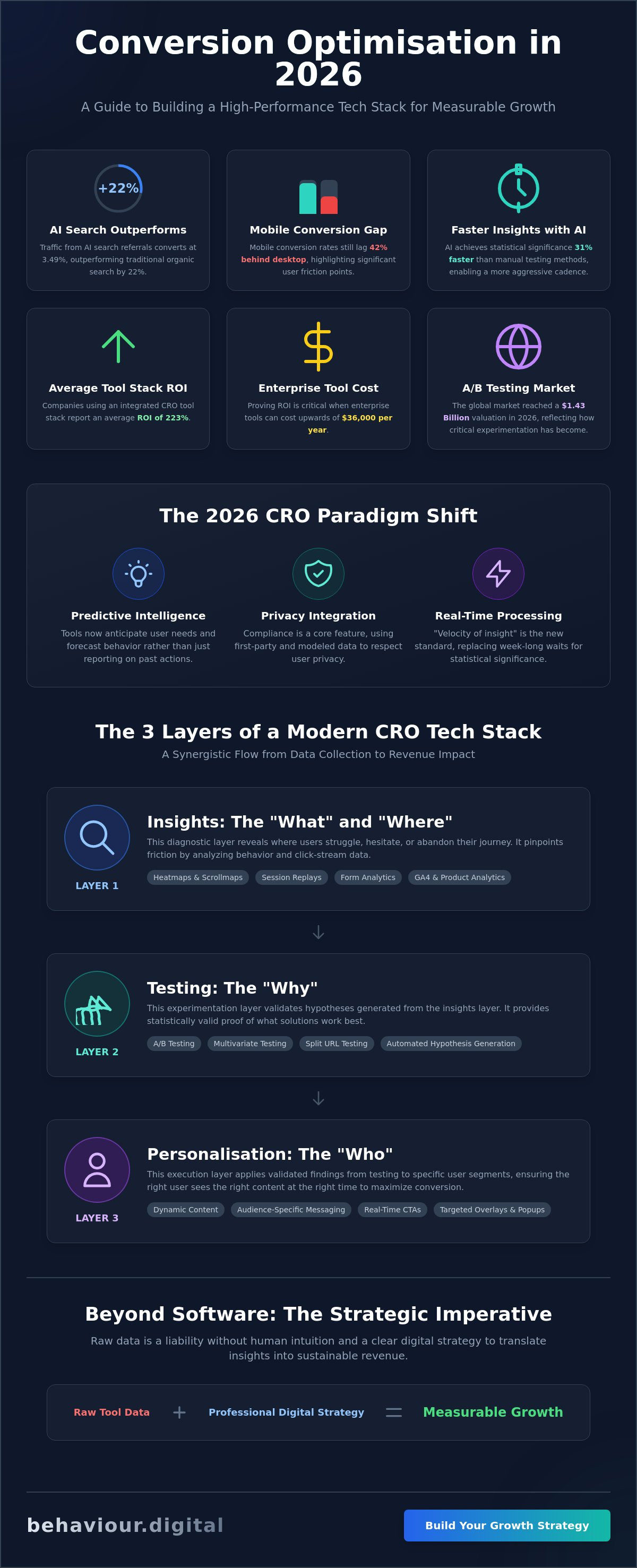
Selecting conversion optimisation tools 2026 requires a rigorous evaluation of three factors: integration depth, AI-driven predictive capabilities, and low-code accessibility. Marketing teams can't wait for development cycles to deploy every experiment. The median conversion rate in 2026 sits at 2.35%. However, the top 10% of performers achieve 11.45% or higher. This performance gap is determined by the speed at which a team can deploy, measure, and iterate. A streamlined tech stack eliminates technical bottlenecks and focuses resources on high-impact tests.
Optimizely remains the benchmark for enterprise experimentation. Its annual entry-level plans are estimated between $36,000 and $60,000. It's designed for complex, server-side testing across large-scale digital properties. Contentsquare offers a more accessible entry point for behavioral data. Its Growth plan is priced at $40 per month. It excels at identifying mobile UX friction. This is critical because mobile conversion rates (1.82%) remain 42% lower than desktop. VWO bridges the gap for mid-market growth. Its Growth plan starts at $314 per month for up to 10,000 tracked users.
Hotjar leads the visual insights category with its "Observe" product. Pricing tiers range from a free Basic plan to a $213 per month Scale plan. This provides flexibility for growing brands to scale their session recording needs. Microsoft Clarity is the strongest free alternative. It offers high-volume session replays without sampling limits. For e-commerce brands requiring immediate intervention, Lucky Orange provides real-time conversion monitoring. This allows teams to see abandonment as it happens and adjust live elements to save the sale.
Unbounce has evolved into an AI-powered routing engine. Plans range from $99 to $249 per month. It uses smart traffic to send visitors to the landing page variant most likely to convert based on their specific profile. Wynter is the essential tool for B2B copy validation. It ensures your messaging resonates with your target audience before you commit your PPC budget. Specialist tools like these prevent generic UX by tailoring the experience to specific audience segments. Finally, Behaviour Digital serves as the strategic implementation layer. We integrate your conversion optimisation tools 2026 into a cohesive managed ecosystem. Software doesn't fix conversion rates; methodology does. We ensure your tools actively drive your North Star metrics rather than just collecting dust on your site.
Data without a framework is just noise. Your conversion optimisation tools 2026 are only as effective as the methodology driving them. Strategy must precede software installation. Start with a rigorous data audit. Verify that your server-side tracking and GA4 events fire correctly before you trust the numbers. Next, define your North Star metric. While revenue is the ultimate goal, you must track micro-conversions like "add to cart" or "shipping calculator usage" to understand where the journey breaks down.
Use your behavioral research to form testable hypotheses. If session recordings show users abandoning at the checkout login, your hypothesis should target that specific friction point. Prioritise these experiments using the PIE framework. Rate each test on its Potential for growth, its Importance to the business, and the technical Ease of execution. This prevents wasting resources on low-impact tweaks. Execute the test, analyse the results, and iterate immediately. CRO isn't a project; it's a cycle of continuous improvement.
Analysis paralysis occurs when you collect every possible metric without an action plan. Don't drown in numbers. Focus on the 20% of data points that drive 80% of your revenue. Set up custom alerts in your conversion optimisation tools 2026 to notify you of significant conversion drops in real time. A centralized dashboard for cross-tool reporting ensures your team focuses on actionable insights rather than manual data entry. This clarity allows you to move from observation to execution with professional precision.
CRO doesn't exist in a vacuum. It's the engine that powers your paid media efficiency. High-converting landing pages can significantly lower your Google Ads cost in the UK by improving Quality Scores and reducing cost-per-acquisition. If you're running targeted campaigns in Glasgow, use CRO insights to refine your audience segments. Seeing how specific traffic sources interact with your site allows you to create a feedback loop between ad creative and the on-site experience. If you need a partner to bridge the gap between traffic and revenue, our Conversion Rate Optimization services provide the strategic oversight needed to scale your results.
Software is a force multiplier. However, a multiplier of zero remains zero. Many organisations invest heavily in conversion optimisation tools 2026 only to find their conversion rates stagnant at the 2.35% industry median. AI now handles 70% of analytical tasks. It can process data 31% faster than manual methods. Yet, it lacks the ability to understand the cultural nuances and brand-specific psychology that drive a user to trust a business. Human intuition remains the primary engine for high-impact experimentation.
The cost of a DIY approach often exceeds the price of the software itself. Internal teams frequently succumb to "tool bloat," where they pay for enterprise features they lack the capacity to implement. This leads to analysis paralysis. Professional agency management shifts the focus from managing software to driving revenue. We ensure that every tool in your stack serves a specific purpose within your broader digital strategy. This methodology turns an overhead cost into a profit center.
Local expertise provides a critical edge in the UK and Glasgow markets. Cultural UX nuances, such as specific payment preferences or regional messaging tones, can't be identified by a global AI algorithm. A strategic partner understands these subtleties. We bridge the gap between raw behavioral data and the execution of tests that actually resonate with your specific audience. This localized, data-driven approach is what separates a generic website from a high-performance sales engine.
Our approach to conversion optimisation is built on methodological precision. We don't just install software; we engineer a managed ecosystem. Our team handles the technical complexity of server-side tracking and multi-platform integration so you can focus on scaling your operations. In a recent engagement, we leveraged this integrated stack to drive a 3x ROI for a local client. We achieved this by identifying a single mobile checkout friction point that traditional analytics had missed for months.
The first step toward a high-converting site is a clean data environment. If you don't have visual behavioral insights yet, install a tool like Microsoft Clarity today to begin seeing where users struggle. However, a tool is only a diagnostic. The cure requires a conscious strategy and continuous refinement. Now is the time to audit your 2026 digital strategy and ensure your conversion optimisation tools 2026 are delivering the ROI you expect. Don't leave your growth to chance. Book a conversion audit with Behaviour Digital and let's transform your raw data into measurable business expansion.
The digital environment in 2026 rewards those who prioritise the velocity of insight over the mere volume of data. We've explored how a balanced tech stack, combining predictive AI with privacy-first tracking, is no longer optional for maintaining a competitive edge. Success requires more than just installing the right conversion optimisation tools 2026. It demands a rigorous methodology that connects user behavior directly to your revenue targets. As acquisition costs rise, the ability to squeeze more value from existing traffic is the only sustainable path to growth.
Relying on software alone often leads to the "data swamp" trap. Real progress happens when data-driven methodology meets human strategic intuition. Our Glasgow-based strategic experts specialise in bridging this gap, delivering proven ROI across PPC and Social campaigns through precise technical implementation. We don't just provide numbers; we provide a roadmap for measurable business evolution. Now is the time to audit your current framework and ensure your tools are working as hard as you are. Stop guessing and start growing. Get your 2026 CRO audit. Your next level of growth is waiting to be unlocked.
Microsoft Clarity and Hotjar Basic are the leading free conversion optimisation tools 2026 offers. Clarity provides unlimited session replays and heatmaps at no cost. Hotjar's Basic plan is limited to 35 daily sessions. These tools allow smaller brands to diagnose user friction without upfront investment. While free tiers often lack advanced AI predictive features, they remain the best starting point for qualitative behavioral research.
CRO tools can impact loading speed if they aren't implemented via asynchronous scripts or server-side tracking. Heavy JavaScript tags can increase Time to Interactive (TTI). To mitigate this, use a tag manager and prioritise tools that offer lightweight snippets. Modern platforms in 2026 are designed to fire after the main page content. This ensures that your data collection doesn't compromise the user experience or Core Web Vitals.
Yes, you can use CRO tools for mobile apps through specialized Software Development Kits (SDKs). Platforms like Optimizely and VWO offer robust mobile app testing features. These allow you to run experiments on native app elements just as you would on a website. Optimising the app experience is vital. Mobile conversion rates (1.82%) remain significantly lower than desktop (3.14%), making app-specific testing a high-priority growth lever.
Budgeting depends on your traffic volume and the complexity of your digital strategy. A small business might spend around $39 per month for a Hotjar Plus plan. In contrast, enterprise solutions like Optimizely start between $36,000 and $60,000 annually. Most mid-market UK firms find a balance by spending $300 to $500 per month on an integrated stack. This typically covers heatmaps, A/B testing, and basic personalisation features.
A/B testing compares two versions of a single variable, while multivariate testing analyzes multiple variables simultaneously to see which combination performs best. A/B testing is faster and requires less traffic to reach statistical significance. Multivariate testing is more complex. It's used to understand how different elements, like a headline and a hero image, interact with each other. Both are essential components of a mature conversion optimisation tools 2026 strategy.
You don't always need a developer for basic installations, but they are essential for complex, server-side experiments. Most modern tools use a single JavaScript snippet that you can install via Google Tag Manager. This allows marketing teams to deploy heatmaps and simple A/B tests without touching the source code. However, for deep structural changes or custom data layer integrations, professional technical oversight ensures data accuracy and site stability.
GA4 is primarily a quantitative analytics platform rather than a dedicated CRO tool, but it's the foundation for all optimisation. It identifies "what" is happening, such as funnel drop-offs. In May 2026, GA4 introduced a new "AI Assistant" channel to measure traffic from agents like ChatGPT and Gemini. This data is critical for CRO because AI-referred traffic converts at 3.49%, which is 22% higher than traditional organic search.
It typically takes two to four weeks to see statistically significant results, depending on your traffic volume. High-traffic sites reach significance faster. AI-driven tools in 2026 can achieve significance 31% faster than traditional methods by using predictive modeling. However, CRO is a continuous cycle. While individual tests yield quick wins, the average ROI of 223% is usually realized over several months of consistent methodological refinement.

Luke leads strategy across every Behaviour Digital account — building data-driven advertising systems for ambitious brands. When he's not auditing ad accounts, he's writing about what he found in them.
Get a free, tailored growth plan — we'll run our framework on your accounts and show you exactly what we'd do.
Get your free growth plan →