.webp) Online
OnlineNot sure which channel fits your business?View all services →
Three inputs. Instant KPIs. No spreadsheets.Open a calculator →
OnlineFewer than one-third of large enterprises actually hit their digital transformation targets, even as global digital ad spend hits $740 billion. You've likely felt the friction of declining PPC returns and the exhaustion of chasing every new AI agent while your data remains trapped in disconnected si...

Fewer than one-third of large enterprises actually hit their digital transformation targets, even as global digital ad spend hits $740 billion. You've likely felt the friction of declining PPC returns and the exhaustion of chasing every new AI agent while your data remains trapped in disconnected silos. It's frustrating to watch budgets climb while performance plateaus. This guide provides the digital strategy framework 2026 requires to move beyond a simple online presence toward high-performance behavioral loops that turn user data into measurable ROI.
We'll show you how to master the architectural shift from static campaigns to goal-oriented, AI-first workflows. With the EU AI Act now in full enforcement and GDPR fines exceeding €7.1 billion, your strategy must prioritize privacy-compliant measurement without sacrificing growth. You'll learn a repeatable blueprint for aligning your social, PPC, and web conversion efforts into a single, data-driven engine built for 2026 and beyond.
• Shift your business from a static digital presence to a high-performance behavioral ecosystem that prioritizes quantitative data over marketing fluff.
• Discover how to implement the 4-pillar digital strategy framework 2026 to unify Insight, Acquisition, Conversion, and Retention into a single growth engine.
• Eliminate the "Strategy-Execution Gap" by replacing vanity metrics like likes and shares with a single North Star Metric focused on revenue.
• Learn why a behavioral audit of your current touchpoints is the essential first step for any scalable execution roadmap.
• Understand the competitive advantage of local strategic alignment and how face-to-face partnership drives better PPC and social media performance.
The traditional definition of Digital Strategy has officially moved from a static roadmap to a dynamic, behavioral-first ecosystem. In years past, businesses could survive with "set-and-forget" campaign structures. That's no longer a viable option. In 2026, the digital strategy framework 2026 requires a shift toward Performance Orchestration. This isn't about managing channels in isolation. It's about how your social media presence feeds your PPC data, and how those touchpoints collectively inform your web conversion logic. If your data doesn't flow between these silos, you're wasting budget on fragmented insights.
Control is the theme of this era. Third-party data reliance has crumbled, forcing a mandatory transition to first-party data ownership. Companies that don't own their audience data are effectively renting their growth from platforms like Meta or Google. This shift isn't just a technical hurdle; it's a strategic imperative. You must build systems that capture user behavior directly, allowing for a feedback loop that refines execution every single day. The goal is a repeatable engine where every pound spent generates a data point that makes the next pound more efficient.
Digital transformation was once an IT-led initiative focused on infrastructure. Today, it's a marketing-led performance strategy. The distinction is critical. While IT builds the pipes, performance strategy dictates the flow. User intent mapping has replaced traditional keyword research as the primary driver of acquisition. We're now analyzing the behavioral breadcrumbs users leave before they even enter a search query. Predictive analytics play a central role here, allowing strategists to allocate resources based on projected lifetime value rather than immediate, surface-level clicks. It's a shift from reactive spending to proactive investment.
The UK market operates in a strictly privacy-compliant environment. With cumulative GDPR fines topping €7.1 billion by early 2026, compliance isn't optional. It's a competitive advantage. AI automation has fundamentally changed the strategist's daily workflow. You aren't manually adjusting bids or testing headlines anymore; the machines handle that. Your job is to architect the behavioral loops and ethical data frameworks that these AI agents use. Collecting zero-party data, where users voluntarily share preferences, is now the most effective way to build brand trust and bypass the limitations of a post-cookie world. Success in 2026 belongs to those who treat data ethics as a core component of their value proposition.
Scaling a business in 2026 requires more than just high ad spend; it demands a structured, interconnected ecosystem. The digital strategy framework 2026 is built upon four non-negotiable pillars: Insight, Acquisition, Conversion, and Retention. These aren't isolated departments or silos. They function as a unified data model where every customer interaction informs the next stage of the funnel. By implementing a Value Realization Framework, businesses can ensure that every digital touchpoint translates directly into measurable business value rather than just vanity metrics.
Success depends on the "Glasgow advantage." While your reach might be global, execution benefits from local agility and precision. Our approach leverages a tight-knit strategic alignment that allows us to pivot faster than bloated global conglomerates. This local partnership ensures that your strategy remains responsive to real-time data shifts. We prioritize iterative testing across all four pillars. If you don't test, you aren't learning. If you aren't learning, your growth is stagnant. Every campaign must be treated as a data-gathering exercise that refines the broader digital strategy framework 2026 for better performance in the next cycle.
Behavioral data is the primary fuel for modern acquisition. We use Social Media Marketing and PPC to gather rapid insights into user intent. In 2026, PPC Management has evolved beyond simple keyword bidding. It's now about managing algorithmic intent and feeding the AI the right signals. Scaling on social platforms requires creative-led growth, where high-quality content serves as the primary filter for your audience. This qualitative data from social channels then informs the quantitative precision of your search campaigns, creating a powerful feedback loop for acquisition.
Traffic is a cost until it converts. This is why conversion optimisation is the engine of our entire framework. We don't just look at the initial click; we measure Total Customer Value. Turning a one-time buyer into a brand advocate requires automated loops and personalized retention paths. If your strategy stops at the first sale, you're leaving the majority of your potential profit on the table. We build systems that nurture leads through the entire lifecycle, ensuring that the cost of acquisition is offset by long-term, repeatable revenue. To achieve this level of precision, you need a behavioral-first strategy that treats every user as a unique data point.
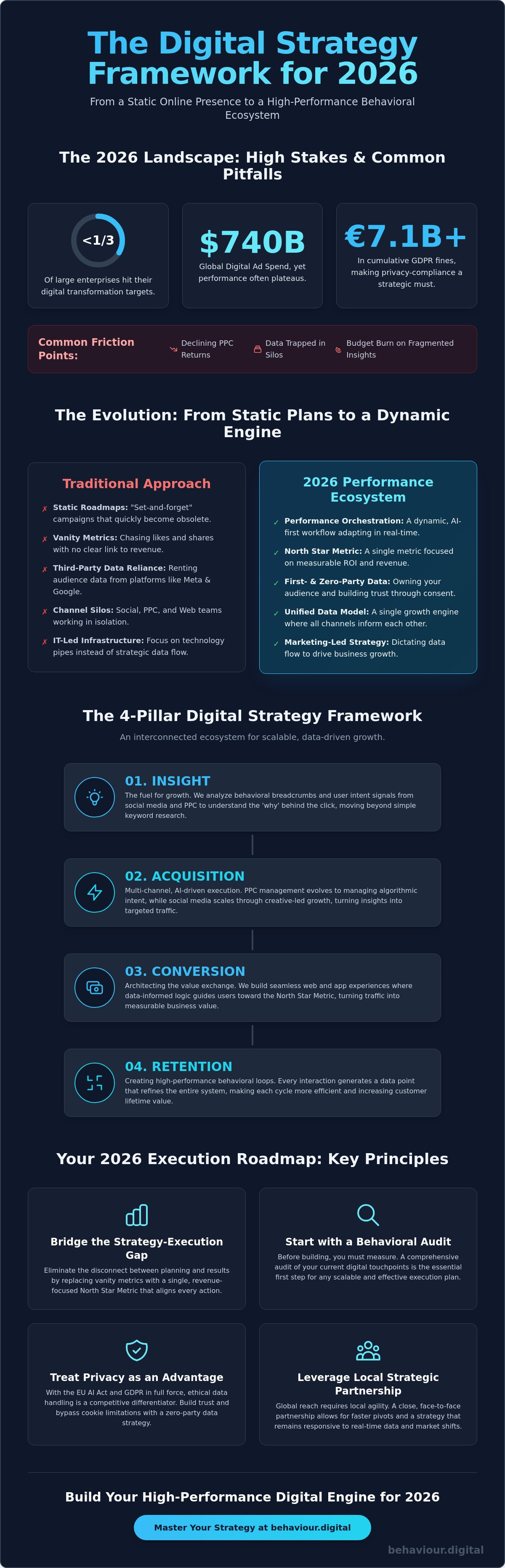
Statistics confirm that fewer than one-third of large enterprises achieve their stated digital transformation targets. It's a staggering failure rate that usually stems from a "Strategy-Execution Gap." In many UK marketing departments, there's a profound disconnect between the executive vision and the actual technical implementation. Legacy business models often lack the agility to adapt to the 2026 regulatory environment, including the EU AI Act's strict requirements. Without a cohesive digital strategy framework 2026, businesses end up with a collection of expensive tools that don't talk to each other.
Vanity metrics are another primary culprit. Likes, shares, and impressions look great in a monthly report, but they rarely correlate with bottom-line revenue. If your strategy prioritizes engagement over conversion, you're building on sand. Performance must be measured through business outcomes like qualified leads and actual sales. Siloed agency relationships also kill ROI. When your PPC management is handled in a vacuum, separate from your social media marketing or conversion rate optimization efforts, the results are always suboptimal. You lose the behavioral insights that should be flowing between channels to lower your acquisition costs.
Starting a project by saying "we need TikTok ads" is a recipe for failure. It's a tactic, not a strategy. Effective growth requires a channel-agnostic Digital Strategy. You must align your business goals with technical KPIs before a single campaign goes live. This ensures that every platform you choose serves a specific purpose within your broader ecosystem. Don't let the platform dictate the message; let the behavioral data dictate the platform. Success isn't about being everywhere. It's about being where the data proves you can convert.
Fragmented reporting is the fastest way to drain a marketing budget. When data lives in separate spreadsheets, you can't see the true path to purchase. A "Single Source of Truth" is mandatory in your digital strategy framework 2026. You need to integrate your CRM data directly with your advertising platforms. This allows you to track a user from the first social impression to the final sale. It's the only way to measure true Customer Lifetime Value and allocate your budget with mathematical precision. If you don't own the data loop, you don't own your growth.
Execution is the graveyard of most marketing plans. Moving from a conceptual model to a high-performance engine requires a disciplined roadmap. The digital strategy framework 2026 relies on an operational cycle that prioritizes behavioral data over gut feeling. You can't scale what you don't measure, and you can't measure what you haven't audited. This roadmap moves your business through five critical stages: conducting a behavioral audit, defining a single North Star Metric, deploying rapid-testing cycles, implementing continuous conversion rate optimization, and re-allocating budget based on behavioral attribution. This sequence turns your digital presence into a predictable growth machine.
A North Star Metric is the cornerstone of this process. It's the one value that truly represents business growth, such as "Qualified Leads with a High LTV" rather than just "Total Leads." When every channel, from social media to PPC, is aligned toward this single outcome, you eliminate the friction of competing KPIs. Behavioral attribution then allows you to see exactly which touchpoints contributed to that metric. You'll stop over-valuing the last click and start understanding the entire journey, allowing you to move budget with mathematical certainty.
Accuracy is the foundation of performance. We begin by evaluating your current tracking accuracy and data hygiene. In 2026, Google Analytics 4 has introduced cross-channel budgeting and forecasting, which we use to project your ROI before a single pound is spent. We benchmark your current metrics against Glasgow and UK industry competitors to see exactly where you stand. This phase identifies "low-hanging fruit," those small technical or behavioral fixes that can provide an immediate lift in performance. With the EU AI Act now in full effect, we also ensure your data collection is ethically compliant, protecting your brand from penalty structures that can reach 7% of global turnover.
Scaling isn't a one-time event; it's a rhythm. We establish a "Test, Learn, Scale" cycle that treats every ad and landing page as a data-gathering experiment. Monthly PPC management is no longer just about adjusting bids. It's about tactical strategy adjustment based on real-time behavioral signals. We use direct feedback from your social media marketing to inform your website's copy and CRO efforts. This creates a synergy where your acquisition channels and your conversion engine work in tandem. If you're tired of fragmented results, you can book a behavioral performance audit to identify the gaps in your current execution roadmap.
In a world dominated by remote AI agents and global conglomerates, the value of a local strategic partnership has never been higher. Choosing a PPC agency Glasgow allows for a level of face-to-face alignment that simply can't be replicated through a screen. At Behaviour Digital, we bridge the gap between high-level global data standards and the specific nuances of the Scottish market. This local empathy allows us to craft messages that resonate deeply while maintaining the technical precision required by a modern digital strategy framework 2026. Success in this landscape isn't just about the tools you use; it's about the conscious strategy behind them.
We operate with a culture of directness. Glasgow’s business landscape doesn't have room for fluff or empty marketing promises. We focus on a "No-Fluff" approach because that's what drives results. When you partner with us, you aren't just getting a service provider; you're gaining a strategic ally committed to your measurable growth. We don't hide behind complex jargon. We let the quantitative data speak for itself, ensuring every pound of your budget is working toward a documented business outcome.
Our methodology is built on transparency and precision. We don't just "manage" accounts; we optimize them through a constant behavioral feedback loop. This is particularly evident in how we handle social media marketing management Scotland. Instead of chasing likes or shares, we focus on how social interactions feed into your broader acquisition engine. Every campaign is backed by a commitment to transparent monthly performance reporting. You'll see exactly where your budget is going and the specific business outcomes it's generating, from lead quality to total customer value.
Transitioning from a legacy marketing plan to a modern digital strategy framework 2026 can feel overwhelming. The key is to start with a partner who understands the "Behavioral" loop we've discussed throughout this guide. You need a team that can integrate your PPC, social, and conversion data into a single, cohesive engine. Don't let another quarter pass with disconnected data silos and declining performance. It's time to move toward a repeatable framework for scaling. If you're ready to see how these behavioral performance loops can transform your business, contact us today for a strategic framework audit.
Scaling your business in 2026 isn't about chasing the latest AI hype; it's about mastering the behavioral feedback loop between data and execution. You've seen how a unified digital strategy framework 2026 eliminates the friction of disconnected silos and replaces vanity metrics with measurable revenue growth. By prioritizing first-party data ownership and establishing a North Star Metric, you move from reactive spending to proactive performance orchestration. Success requires a commitment to iterative testing and a technical agility that legacy models often lack.
As Glasgow-based experts since 2022, Behaviour Digital specializes in bridging the gap between high-level strategy and daily campaign mechanics. We provide data-driven results for UK SMEs through our specialization in PPC, Social, and CRO. Don't let your growth be limited by fragmented reporting or a lack of strategic alignment. Take the first step toward a repeatable growth engine today.
Book your 2026 Digital Strategy Audit with Behaviour Digital to secure your competitive edge. It's time to build a scalable engine that turns every user interaction into a predictable business outcome.
A digital strategy framework is a structured blueprint that aligns your technology, data, and marketing channels with specific business outcomes. In 2026, you need one because digital ad spend now accounts for 73% of total global media spend. Without a repeatable framework, your budget is at risk of being diluted across disconnected platforms. It provides the architectural discipline required to turn raw data into a high-performance growth engine.
Digital transformation is an IT-centric process involving the modernization of infrastructure and internal processes. In contrast, a digital strategy is a marketing-led performance roadmap. While transformation builds the pipes, strategy dictates what flows through them to generate revenue. In 2026, successful companies distinguish between the two to ensure their technology investments actually translate into measurable ROI and customer acquisition.
The most critical KPIs in 2026 move beyond surface-level engagement. You should track Customer Lifetime Value (CLV), Customer Acquisition Cost (CAC) relative to margin, and behavioral conversion rates. These metrics provide a quantitative view of business health. Avoid vanity metrics like follower counts or shares. Instead, focus on data points that directly impact your bottom line and reflect the efficiency of your behavioral performance loops.
Your core digital strategy framework 2026 should be audited every six months to stay ahead of regulatory and technological shifts. However, tactical performance should be reviewed in monthly cycles. With the EU AI Act now in full enforcement as of August 2026, frequent reviews ensure your data collection remains compliant. This rhythm allows you to pivot your budget based on real-time behavioral insights without losing sight of long-term goals.
Small businesses can and should implement a structured strategy. Complexity doesn't mean high cost; it means methodological precision. By focusing on first-party data and specific behavioral segments, smaller firms can achieve 2-3x better ROI than those using ad-hoc projects. A well-defined framework allows a small business to outmaneuver larger competitors through agility and a deeper understanding of their specific customer intent.
AI serves as the operational layer that automates execution and predictive forecasting. It handles the heavy lifting of bid management and multi-variant testing within platforms like Google Ads and Meta. In a modern framework, your strategist's role is to feed these AI agents the correct behavioral signals and ethical guidelines. This synergy ensures that automation remains aligned with your specific business goals and brand values.
You measure ROI by integrating your CRM data with your advertising platforms to create a "Single Source of Truth." This allows you to track the entire customer journey from the first social media interaction to the final web conversion. By calculating the "Total Customer Value" against the blended acquisition cost, you get a transparent view of your actual profit. This data-driven approach removes the guesswork from budget allocation.
A Glasgow-based agency offers a unique combination of local market empathy and high-level global data standards. This partnership facilitates face-to-face strategic alignment, which is often lost in purely remote relationships. The direct, results-oriented culture of Glasgow business means you get transparent reporting without marketing fluff. It ensures your strategy is executed by a partner who is personally invested in your regional and global success.

Luke leads strategy across every Behaviour Digital account — building data-driven advertising systems for ambitious brands. When he's not auditing ad accounts, he's writing about what he found in them.
Get a free, tailored growth plan — we'll run our framework on your accounts and show you exactly what we'd do.
Get your free growth plan →