.webp) Online
OnlineNot sure which channel fits your business?View all services →
Three inputs. Instant KPIs. No spreadsheets.Open a calculator →
OnlineWhat if your rising CPAs aren't actually a traffic problem, but a failure to steer the machine learning algorithms you're paying for? With AI-powered bidding strategies like Performance Max now driving 78% of all Google Ads spend, the traditional manual approach to management is no longer enough to...

What if your rising CPAs aren't actually a traffic problem, but a failure to steer the machine learning algorithms you're paying for? With AI-powered bidding strategies like Performance Max now driving 78% of all Google Ads spend, the traditional manual approach to management is no longer enough to maintain a competitive edge. You've likely noticed that constant account tweaks aren't stopping the disconnect between high click volumes and actual revenue. It's a frustrating plateau where budgets increase while returns stagnate. This PPC audit checklist is designed to break that cycle by shifting your focus from vanity metrics to the technical integrity and post-click behaviour that actually drives scalable growth in 2026.
We understand that managing the transition to a cookieless environment while justifying budget increases to stakeholders is a complex balancing act. You need more than just a surface-level review; you need a framework that treats AI as a partner to be directed rather than a pilot to be ignored. By following this guide, you'll master the exact methodology top-tier agencies use to eliminate wasted spend and bridge the gap between initial interest and final conversion. We'll walk through a clear, actionable roadmap that ensures your account structure is future-proof, data-driven, and built for measurable business development.
• Align your account structure with modern machine learning protocols to transition from manual campaign management to strategic algorithmic steering.
• Utilize our 2026 PPC audit checklist to verify technical hygiene, including server-side tracking and Consent Mode v2, for accurate data attribution.
• Apply behavioural psychology to your creative assets to improve Responsive Search Ad performance and better match user intent.
• Evaluate the post-click experience to identify friction points on landing pages that prevent high-quality traffic from converting into measurable business value.
• Prioritise your audit findings using an Impact vs. Effort matrix to build a clear, actionable roadmap for sustainable ROAS improvement.
A PPC audit is a rigorous, systematic evaluation of your account's health, strategy, and technical hygiene. It's the diagnostic tool that separates high-performing assets from those bleeding capital. In the context of Pay-per-click (PPC), an audit identifies where your methodology aligns with business goals and where it deviates into inefficiency. By 2026, the landscape has shifted significantly. We've moved beyond manual keyword adjustments toward algorithmic steering. This transition requires a comprehensive PPC audit checklist that accounts for "invisible" waste, such as over-reliance on automation without proper guardrails or tracking gaps that feed the AI incorrect data.
Effective audits aren't just about tactical fixes. They serve as a foundational element for long-term PPC Management planning. Without this baseline, any attempt to scale is built on a fractured foundation. If you aren't auditing, you aren't managing; you're simply observing the erosion of your margins.
Data from unaudited accounts frequently reveals that 20% to 30% of ad spend is wasted on non-converting traffic or inefficient settings. This isn't just about direct loss. It's about the compounding effect on Quality Score. A higher Quality Score reduces your actual CPC, allowing your budget to work harder for every click. These insights provide the quantitative evidence required to build a robust Digital Strategy. Regular reviews ensure your capital is allocated to the highest-performing segments rather than being diluted across underperforming audiences.
If your lead volume has plateaued despite budget increases, you're likely overdue for a deep dive. Erratic ROAS and frequent "Limited by Budget" warnings are clear red flags that your account structure is fighting against the platform's bidding logic. Many advertisers fall victim to "Black Box" syndrome, particularly within Performance Max campaigns, where a lack of transparency leads to audience fatigue and brand cannibalisation. In the UK and global markets, changing consumer behaviours and privacy regulations mean that what worked six months ago is likely obsolete today. Using a structured PPC audit checklist allows you to reclaim control from the algorithms and ensure every pound spent contributes to measurable growth.
Technical integrity is the non-negotiable floor of performance. In 2026, bidding algorithms are only as effective as the data they consume. AI-powered bidding strategies now drive 78% of all Google Ads spend, which means your PPC audit checklist must start with a structural assessment. Are you still using fragmented, granular structures that starve the machine learning engine of conversion data? Modern frameworks like "Hagakure" or Single Theme Ad Groups (STAG) are designed to provide the data density required for Smart Bidding to function effectively. Without sufficient data volume, the algorithm can't identify the patterns that lead to profitable conversions.
Beyond structure, tracking hygiene is paramount. With the full deprecation of third-party cookies in Chrome as of Q2 2026, server-side tagging and Enhanced Conversions aren't optional. They're survival tools. You must verify that Consent Mode v2 is correctly implemented to recover lost conversion signals while maintaining UK/GDPR compliance. It's also vital to review your "Auto-apply" settings. These recommendations often prioritise platform spend over advertiser efficiency. A rigorous audit identifies and disables suggestions that dilute strategic control, such as automated keyword expansions that ignore your carefully curated negative keyword lists. For a foundational look at these technical requirements, you can reference the 10-Step PPC Audit Checklist to ensure no technical stone is left unturned.
Performance Max often becomes a "black box" that prioritises cheap, low-intent Display traffic over high-intent Search queries. Audit your asset groups for creative diversity. If you aren't providing unique videos, images, and headlines for every segment, the algorithm defaults to generic, underperforming placements. Use the "Insights" tab to verify where spend is going. If too much budget is leaking into the Display Network without conversions, it's time to refine your Audience Signals and Search Themes to guide the AI more precisely. If this technical complexity feels overwhelming, engaging a professional strategy team can help bridge the gap between data and profit.
Ensure GA4 and Google Ads are perfectly synced with no double-counting. Discrepancies in conversion data artificially inflate ROAS and lead to poor bidding decisions. The most advanced accounts in 2026 are moving toward Value-Based Bidding (VBB). This involves feeding "Profit" or "Lifetime Value" data back into the engine rather than just raw revenue. This shift ensures the AI optimises for actual business growth. Additionally, with the August 17, 2026, update to Smart Bidding behavior for budget-limited campaigns, you must audit your targets to ensure they aren't causing a sudden spike in CPA or a drop in ROAS.
As automation handles the mechanical aspects of bidding, the strategic weight shifts toward the creative lever. A modern PPC audit checklist must scrutinise whether your messaging resonates with user intent or simply fills space. High click volumes mean nothing if the creative fails to pre-qualify the user. You must evaluate your assets through the lens of behavioural psychology, ensuring every headline addresses a specific pain point or desired outcome. In 2026, the differentiator isn't how you bid, but what you say and who you say it to.
Responsive Search Ads (RSAs) require a delicate balance. We often see accounts where excessive pinning restricts the algorithm's ability to test and optimise combinations. Conversely, zero pinning in highly regulated industries can lead to compliance risks. Your audit should verify that you're providing at least 10 to 15 headlines and 4 descriptions per RSA. This volume allows the machine to identify the highest-performing variations for different user contexts. If your "Ad Strength" is consistently below "Good," you're likely leaving money on the table through lower auction eligibility.
Generic "Book Now" or "Contact Us" calls-to-action are no longer sufficient to capture attention in a crowded SERP. Your audit should identify clear, unique Value Propositions that differentiate your brand from competitors. You must maximise your digital real estate by utilising every available Ad Component, from sitelinks and callouts to structured snippets. Ad copy must align with the user’s emotional state at each funnel stage, moving from educational awareness to high-intent urgency as they progress toward a conversion. If your copy feels like a template, your audience will treat it like one.
With the full deprecation of third-party cookies in Chrome as of Q2 2026, relying on broad "Interest" categories is a failing strategy. An effective PPC audit checklist evaluates your transition toward First-Party Customer Match lists. You should check whether you're using "Observation" mode to gather data on secondary audiences without restricting reach, or "Targeting" for high-precision remarketing. This data-first approach ensures your budget targets actual buyers rather than digital ghosts.
Finally, assess the health of your CRM integration. Offline conversion tracking is the only way to close the loop between a digital click and a physical sale or qualified lead. If your bidding engine isn't receiving this feedback, it's optimising for volume rather than value. We frequently find that accounts lacking CRM synchronisation suffer from "creative fatigue" because they keep showing ads to users who have already converted offline. This waste is easily avoidable with a structured, data-driven review of your audience infrastructure.
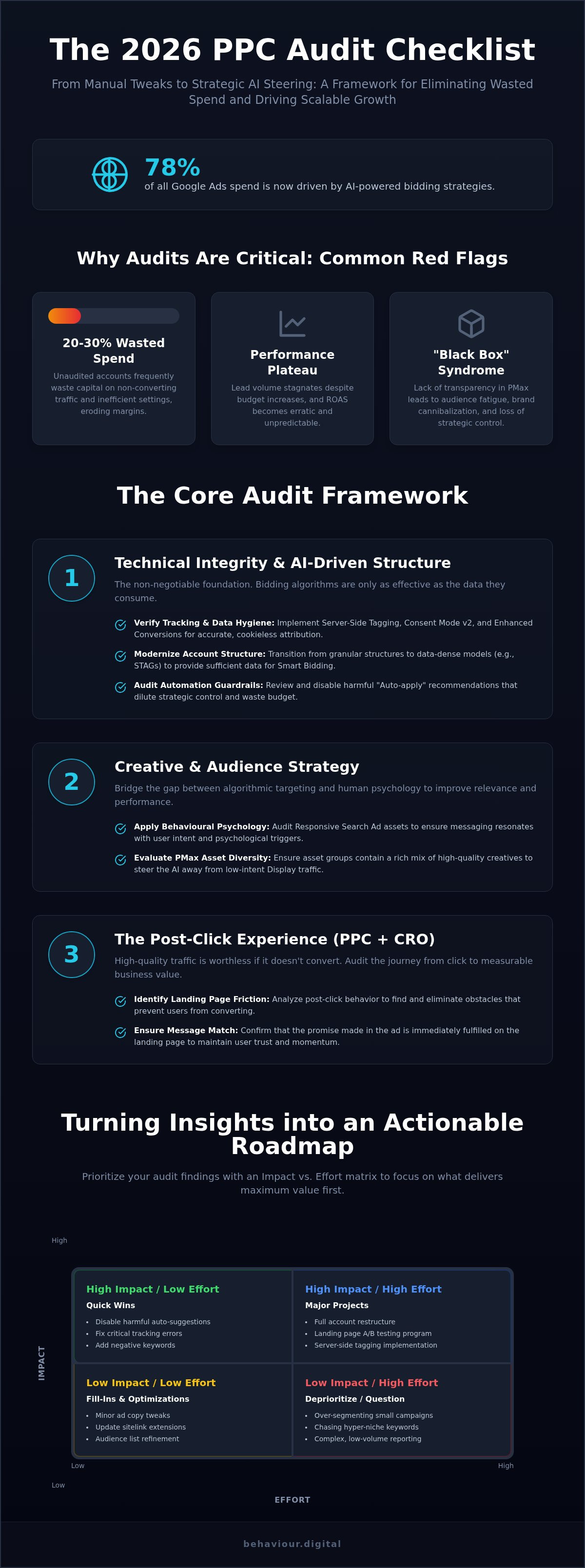
Many advertisers treat the click as the finish line. In reality, the click is merely the start of a high-stakes transaction. If your PPC audit checklist stops at the ad level, you're ignoring the very stage where profit is actually realised. A disconnect between an ad’s promise and the landing page’s delivery is the primary cause of high bounce rates and stagnating ROAS. Every second a user spends searching for the information promised in your copy is a second they spend considering your competitor. Message match is the first technical hurdle; your headline must mirror the ad’s hook exactly to provide immediate cognitive reinforcement.
Mobile performance is no longer a secondary concern. In 2026, mobile traffic dominates most sectors, yet many conversion paths remain riddled with friction. You must evaluate your landing pages for "thumb-friendly" navigation and layout stability. If a user has to hunt for a CTA or if the page shifts while loading, they'll bounce. We use heatmaps and session recordings to identify these specific friction points, transforming subjective opinions into quantitative data. This analytical rigour is essential for professional Conversion Optimisation, ensuring your paid traffic doesn't leak through a poorly designed funnel.
Core Web Vitals directly influence your Quality Score and, by extension, your actual CPC. A slow-loading page doesn't just frustrate users; it makes your ads more expensive. Your audit must include a rigorous check of page speed and technical stability across all major browsers. Verify that your tracking tags are firing correctly on the "Thank You" page and that there are no broken forms or redirect loops. We frequently find that "invisible" technical errors on the conversion page are the single biggest source of wasted ad spend in established accounts.
Friction is the enemy of scalable growth. Audit the number of steps required to complete a transaction. If a lead form asks for ten fields when three would suffice, you're voluntarily capping your conversion rate. Trust signals, such as industry logos, reviews, and guarantees, should be placed strategically near the point of conversion to lower the user's perceived risk. Your CTA must be prominent and use action-oriented, behavioural language that clearly defines the next step. If your post-click experience is underperforming, our CRO specialists can audit your funnel to reclaim your lost margins.
Data without execution is merely noise. Once you've completed your PPC audit checklist, the challenge shifts from identification to prioritisation. A common mistake is attempting to fix every identified issue simultaneously, which often leads to diluted focus and delayed results. Instead, we categorise findings into three distinct tiers: Critical Fixes, Optimisation Opportunities, and Strategic Shifts. This structured approach ensures that the most damaging leaks are plugged before you attempt to fine-tune your growth engine.
We use an Impact vs. Effort matrix to dictate the workflow. Critical Fixes, such as broken conversion tracking or bleeding keywords, represent high-impact, low-effort tasks that must be addressed within the first 48 hours. Optimisation Opportunities require more data and testing, while Strategic Shifts involve foundational changes to your account architecture. Navigating these complexities often requires the objective perspective of a PPC Agency in Glasgow. An external partner identifies blind spots that internal teams, often blinded by the inertia of daily management, might overlook.
Immediate wins are the fuel for long-term buy-in. Pausing keywords with high spend but zero conversions or fixing "Thank You" page redirects provides instant relief to your ROAS. However, sustainable growth requires a shift toward long-term wins, such as iterative creative testing cycles and landing page A/B testing. Your PPC audit checklist isn't a one-time event; it's a living document. Establishing a schedule for quarterly deep-dive audits prevents performance decay and ensures your strategy evolves alongside platform updates and shifting market dynamics.
Execution requires clear KPIs and accountability. You must define how to track the success of each audit finding's implementation. If you implement a new bidding strategy, what specific uplift in conversion value do you expect to see within 30 days? Third-party audits are particularly effective here, as they remove internal bias and provide a transparent view of account health. To truly bridge the gap between clicks and revenue, we encourage readers to seek professional Conversion Rate Optimization. PPC can bring the horse to water, but CRO ensures it actually drinks. By aligning your audit roadmap with a robust behavioural growth strategy, you ensure every pound of ad spend contributes to measurable business development.
Profitable scaling in 2026 requires a departure from reactive account tweaks toward a methodology of algorithmic steering. This PPC audit checklist provides the framework to identify technical leaks, refine audience signals, and align your post-click experience with user intent. By treating your account as a data engine rather than a static list of keywords, you ensure every pound invested contributes to measurable business development. Success isn't a result of chance; it's the outcome of conscious strategy and continuous methodological refinement.
As data-driven Glasgow PPC specialists with a proven track record in Scottish and global markets, we understand the complexity of bridging high-intent clicks with actual profit. Our integrated expertise in PPC and CRO allows us to uncover hidden inefficiencies that standard reviews miss. To transform these insights into a clear, actionable roadmap for growth, you can request a professional PPC audit from Behaviour Digital. Take the first step toward a future-proof account structure that delivers predictable, quantitative results.
You should conduct a comprehensive deep dive into your account every quarter to ensure your strategy remains aligned with market shifts. While basic hygiene checks occur during weekly management, a quarterly review using a structured PPC audit checklist prevents performance decay. This frequency allows you to identify long-term trends and structural inefficiencies that monthly reporting might overlook.
Technical integrity and conversion tracking accuracy are the most critical components of any modern audit. Since AI-powered bidding now drives 78% of Google Ads spend, feeding the algorithm incorrect data will lead to immediate capital waste. If your tracking tags are misfiring or Consent Mode v2 is incorrectly implemented, every other optimisation effort is built on a flawed foundation.
You can perform a basic internal review, but a professional agency provides the objectivity required to identify deep-seated blind spots. Internal teams often develop "account blindness" due to their daily proximity to the campaigns. An external strategic partner brings cross-industry benchmarks and advanced technical expertise that internal resources typically lack.
A professional audit typically requires between 10 and 20 hours of focused analysis. The exact duration depends on account complexity, the number of active platforms, and the depth of the post-click experience review. We prioritise thoroughness over speed to ensure every potential efficiency gain is identified and quantified.
The audit process is entirely passive and doesn't impact live campaign performance while it is being conducted. It involves reviewing historical data, account settings, and technical configurations without making immediate changes. Performance only shifts once you begin implementing the prioritised roadmap of fixes and strategic adjustments identified during the review.
We utilise a combination of Google Ads Editor, GA4, and specialized scripts for automated data extraction and anomaly detection. For the post-click experience, heatmapping tools like Microsoft Clarity are essential to identify conversion friction points. These tools provide the quantitative data needed to move beyond subjective opinions and make evidence-based strategic decisions.
Account management focuses on daily execution and incremental tweaks, while an audit is a high-level diagnostic snapshot. An audit challenges the fundamental strategy and account structure to ensure they remain fit for purpose. It's the difference between routine maintenance and a full engine diagnostic designed to reclaim lost margins and improve overall performance.

Luke leads strategy across every Behaviour Digital account — building data-driven advertising systems for ambitious brands. When he's not auditing ad accounts, he's writing about what he found in them.
Get a free, tailored growth plan — we'll run our framework on your accounts and show you exactly what we'd do.
Get your free growth plan →