.webp) Online
OnlineNot sure which channel fits your business?View all services →
Three inputs. Instant KPIs. No spreadsheets.Open a calculator →
OnlineMost brands treat paid social as a gamble, but in 2026, relying on luck is a fast way to burn through a six-figure budget. If you're still targeting broad audiences without a rigorous creative testing methodology, you're likely seeing your ROI vanish into platform algorithms. Success requires more t...

Most brands treat paid social as a gamble, but in 2026, relying on luck is a fast way to burn through a six-figure budget. If you're still targeting broad audiences without a rigorous creative testing methodology, you're likely seeing your ROI vanish into platform algorithms. Success requires more than just high-quality assets. It demands a structured social media advertising strategy template that treats every pound spent as a data point for future growth.
You've probably felt the frustration of stagnant conversion rates while Meta CPMs climb toward $11.20 and TikTok minimums demand more of your capital. It's difficult to prove value to stakeholders when the rules of engagement change every quarter. We understand that the pressure to deliver predictable lead generation is higher than ever.
This guide provides the exact framework leading UK agencies use to eliminate guesswork and build scalable, high-performance campaigns. You'll move beyond boosting posts to a system where creative and data work in perfect alignment. We've designed this approach to help you master the complexities of modern behavioral advertising and algorithmic shifts.
We'll break down the methodology for rigorous creative testing, algorithmic pricing navigation, and the precise steps to turn social platforms into predictable revenue engines. By the end of this article, you'll have a repeatable system for scaling your paid social efforts with surgical precision.
• Transition from basic demographic targeting to intentional behavioral engineering to prevent wasted ad spend on low-intent audiences.
• Utilize a professional social media advertising strategy template to align campaign objectives with your specific marketing funnel for measurable business growth.
• Map specific pain-point triggers to the emotional state of users on different platforms to ensure messaging resonates on both LinkedIn and TikTok.
• Implement a "Creative Sandbox" framework to identify statistical winners through low-budget testing before committing significant capital to scaling.
• Prioritize a data-first execution model that focuses on quantitative outcomes and long-term ROI rather than superficial engagement metrics.
Success in paid social is no longer a matter of luck or platform automation. Many brands fall into the trap of launching "zombie campaigns" that appear active but fail to generate measurable business equity. These failures typically stem from a reliance on outdated, generic frameworks. A modern social media advertising strategy template must function as a behavioral engine rather than a simple content calendar. If you aren't engineering specific user actions through data, you're simply donating your budget to the platforms.
The core issue is the shift from algorithmic luck to intentional behavioral engineering. In 2026, Meta's average CPM has reached $11.20, an increase from $9.10 in 2024. High costs mean that broad targeting is a recipe for wasted spend. Relying solely on platform-automated targeting often ignores the nuanced psychological triggers that drive a modern consumer to act. Without a comprehensive social media marketing strategy that accounts for these shifts, your ad spend is merely subsidizing the platforms' bottom lines. We focus on transitioning away from vanity metrics to hard business growth, where every impression is a calculated step toward a conversion.
Your 2025 approach won't survive the 2026 privacy landscape. New regulations, such as the New York law effective June 9, 2026, requiring disclosure of AI-generated likenesses, have added layers of complexity to creative execution. A static plan is a liability in an environment where algorithmic pricing and data privacy rules change monthly. Success requires real-time data feedback loops where your Digital Strategy informs every tactical adjustment. We prioritize quantitative data over superficial engagement, ensuring that your social media advertising strategy template remains agile enough to respond to immediate market shifts.
Great ads often fail because they are attached to poor funnels. There's a costly disconnect between creative intent and media buying execution in most agencies. If an ad captures attention but the post-click experience is disjointed, the campaign will fail to prove ROI. This is why a high-performance strategy must integrate conversion optimisation from the very beginning. You aren't just buying impressions; you're architecting a journey from the first scroll-stop to the final transaction. Ignoring the post-click environment is the fastest way to ensure your paid social efforts remain a cost center rather than a profit driver.
A high-performance social media advertising strategy template is not a creative mood board; it is a technical blueprint for capital deployment. While competitors often focus on visual aesthetics, we prioritize the financial and structural components that turn ad spend into revenue. To scale effectively in 2026, your framework must rest on five non-negotiable pillars that bridge the gap between creative intent and algorithmic execution. If your current setup lacks this level of technical rigor, reviewing your foundation with a strategic partner can prevent further budget leakage.
Every campaign must map directly to a specific stage of the marketing funnel. Top-of-funnel (TOFU) objectives focus on high-efficiency reach and brand salience, while bottom-of-funnel (BOFU) goals prioritize direct conversion and return on ad spend (ROAS). The KPIs for a Glasgow-based SME often differ from global brands; local businesses should focus on high-intent geographic triggers rather than raw impression volume. To maintain clarity, every campaign requires a specific definition of success. SMART goals for social ad spend must define a specific conversion volume, a measurable maximum CPA, and a time-bound window for achieving statistical significance. For those seeking a deeper academic perspective on these structures, this comprehensive guide to social media marketing provides a robust methodology for goal alignment.
Demographics like age and gender are increasingly irrelevant to 2026 algorithms. Success now depends on behavioral segmentation and the aggressive use of first-party data. By utilizing CRM uploads and site interaction data, you can build custom audiences that outperform broad interest-based targeting. We've seen that "Interest-Overlay" targeting remains useful for niche B2B sectors on LinkedIn, but Meta and TikTok often perform better with "Broad" targeting where the creative does the filtering. Our approach to Social media marketing management Scotland leverages these local behavioral insights to ensure ads reach users when their intent is highest.
The remaining pillars complete the technical circuit of your social media advertising strategy template:
We utilize the "Sandbox" method, testing isolated variables like hooks and headlines with low budgets before moving winners into scaling campaigns.
Protecting margins is critical. This involves setting strict bid caps and understanding platform requirements, such as TikTok's $500 campaign minimum and $20 daily ad group minimums.
Solving the multi-touch puzzle requires moving beyond last-click attribution to understand how social touchpoints contribute to the total customer lifetime value.
Effective audience mapping in 2026 requires a shift from "who the customer is" to "what the customer is doing." Basic demographics like age and location are insufficient when platform algorithms prioritize user behavior over profile data. Your social media advertising strategy template must account for the specific pain-point triggers that drive action. Identifying these triggers allows you to move beyond broad targeting and focus on high-intent segments that actually convert. If you're still relying on basic interest groups, you're likely missing the nuanced signals that indicate a buyer is ready to transact.
Understanding the emotional state of your prospect is vital for campaign efficiency. Consider what your target customer is thinking at 8 PM on a Tuesday. Are they relaxing, or are they stressing over a business problem that your service solves? Messaging must be tailored to whether the audience is "Problem-Aware" or "Solution-Aware." A problem-aware user needs education on the "why," while a solution-aware user needs a reason to choose you over a competitor. For example, a local Glasgow service provider recently lowered their CPA by 22% simply by shifting their ad copy from generic service descriptions to addressing specific nocturnal stressors of small business owners. This level of psychographic depth is what separates high-performance campaigns from average ones.
Each platform serves a different psychological purpose, and your strategy should reflect that. Meta remains the primary engine for broad behavioral data, capturing users in a passive, discovery-oriented mindset. It's the king of finding users based on deep-seated habits rather than stated interests. LinkedIn, however, is a surgical tool for B2B digital strategy. The intent here is professional growth and problem-solving, making it the ideal environment for high-value service offerings. TikTok demands a different approach entirely. Users have a high tolerance for raw content but a very low threshold for boredom. With 51% of people naming TikTok their top influencer for impulse buys, your social media advertising strategy template must prioritize rapid, hook-heavy messaging to capitalize on these short-form attention spans.
Scaling doesn't just mean reaching more people; it means reaching the right people more efficiently. Building "Lookalike" audiences based on high-value seed data, such as past purchasers or long-term clients, is far more effective than building them from general site visitors. Equally important is the aggressive use of exclusion lists. If you aren't excluding existing customers or low-quality leads from your top-of-funnel campaigns, you're inflating your acquisition costs. We treat exclusion as a primary lever for protecting your margins and ensuring your budget is always focused on fresh opportunities.
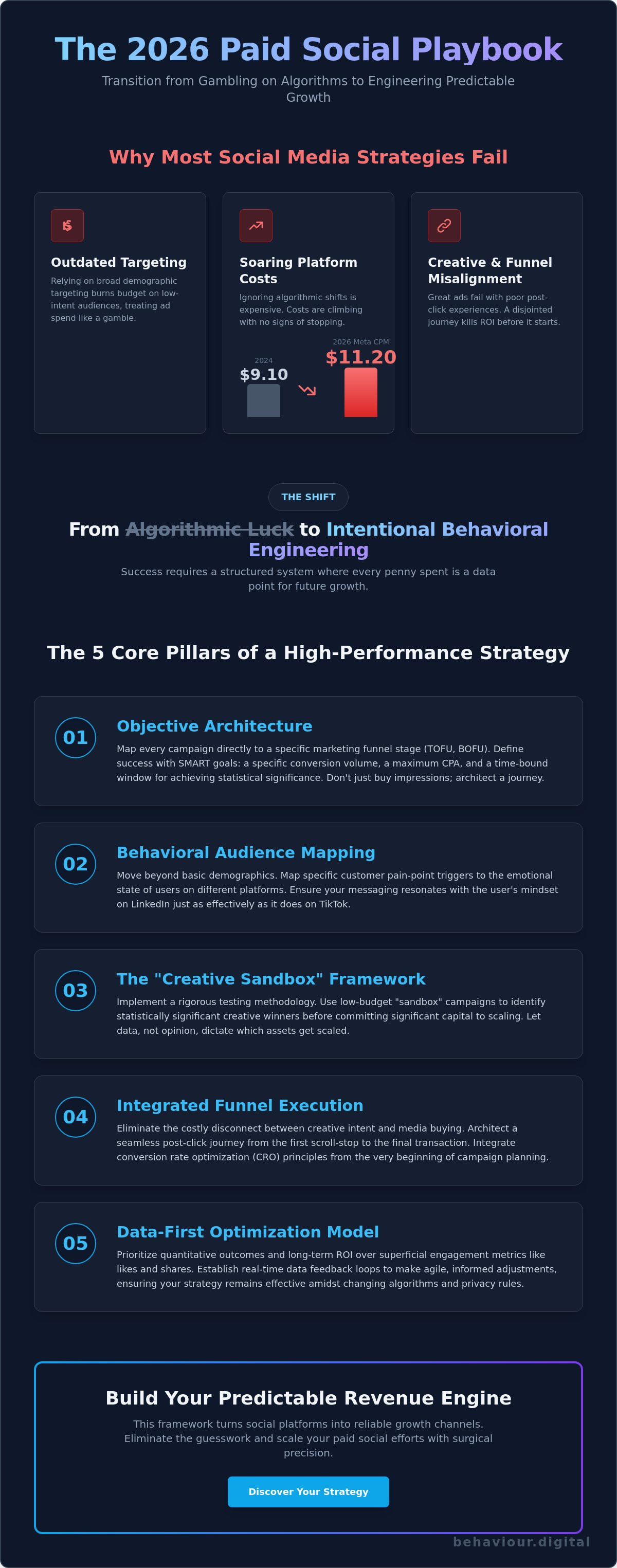
A social media advertising strategy template is effectively a laboratory for high-performance creative. In an environment where Meta’s average CPM has climbed to $11.20, you cannot afford to guess which visuals will resonate. We replace subjective opinions with a four-step technical framework designed to isolate winning assets before they receive significant capital. This methodology ensures your scaling efforts are backed by statistical significance rather than hope.
We deploy new hooks, headlines, and visuals into a low-budget testing environment. This allows us to gather raw data on engagement and click-through rates without risking your primary budget.
We use clear performance benchmarks, such as a minimum 1% CTR or a specific hook-rate percentage, to filter out underperforming assets. Only the top 5% of creative should move forward.
Once an asset proves it can maintain efficiency at a low spend, it is moved into a high-budget campaign designed for volume.
Even the best ad has a shelf life. We monitor for creative fatigue and begin the Sandbox process again the moment ROAS begins to dip.
Your creative must perform three specific functions in under five seconds. First, it requires a 3-second hook that stops the scroll in a crowded feed. This is especially critical on TikTok, where 51% of users report impulse buys driven by short-form influence. Second, the copy must be value-driven; it should solve a specific problem rather than listing generic features. Finally, every ad needs a frictionless Call to Action (CTA) that clearly states the next step without adding cognitive load. If you are struggling to identify which assets deserve more capital, our PPC and paid social specialists can audit your current testing protocol to ensure every pound is working toward a conversion.
Scaling requires a choice between vertical and horizontal methods. Vertical scaling involves increasing the budget on a winning ad set, while horizontal scaling involves duplicating that ad set to reach new audience segments. Both methods must respect the platform's "Learning Phase," where algorithms stabilize their delivery. To avoid resetting the platform's learning phase and destabilizing performance, you should limit budget increases to no more than 20% every 48 to 72 hours. This disciplined approach prevents the volatility that often occurs when brands attempt to scale too aggressively without a data-backed foundation.
A social media advertising strategy template is a powerful starting point, but its effectiveness is entirely dependent on the technical proficiency of the team executing it. Static documents cannot account for the daily fluctuations in platform algorithms or sudden spikes in competitor bidding. We provide the operational rigor required to turn these frameworks into high-performance revenue engines. Our approach isn't just about managing ads; it's about engineering growth through constant methodological refinement and data-backed decision-making.
We view Social Media Marketing as a quantitative discipline. By integrating social advertising with comprehensive PPC Management, we create a 360-degree digital ecosystem where data flows between search and social channels. This synergy allows us to identify high-intent signals in search and use those insights to sharpen social targeting. For Glasgow-based businesses, this means having the technical infrastructure to scale from local market dominance to global reach without losing efficiency or inflating acquisition costs.
Our methodology is built on transparency. You'll never receive a report filled with vanity metrics like "likes" or "shares" that don't correlate to your bottom line. Instead, we focus on measurable business impact and quantitative growth. Our deep expertise in conversion rate optimization ensures that every click we generate has the highest possible probability of becoming a transaction. We position ourselves as a strategic partner, taking full responsibility for the success of your campaigns and working as an extension of your own team.
Ready to move beyond basic templates and start scaling with precision? A generic social media advertising strategy template can only take you so far in a competitive 2026 landscape. We offer a bespoke audit of your current social ad performance to identify exactly where your budget is being wasted and where the untapped opportunities lie. This is the first step toward a strategy that prioritizes predictable revenue over platform noise and vanity engagement.
Book your strategy consultation with Behaviour Digital today. Let's build a framework that turns your social media presence into a primary driver of business equity and sustainable growth.
Mastering the complexities of 2026 paid social requires more than just high-quality visuals; it demands a technical infrastructure that prioritizes business equity over vanity engagement. We have moved past the era of algorithmic luck. Success now depends on the precise integration of creative testing, behavioral audience mapping, and rigorous margin protection. You understand that a high-performance social media advertising strategy template is a dynamic blueprint, not a one-time setup. It requires constant iteration based on quantitative data and real-time feedback loops to stay ahead of platform shifts and rising costs.
As Glasgow’s leading data-driven PPC and Social agency, we specialize in ROI and behavioral growth through no-fluff, results-oriented management. We bridge the gap between abstract strategy and measurable revenue. Every pound spent must be a calculated investment in your brand's future. Our focus remains on turning your social ad spend into a predictable engine for lead generation and sales.
Download our Agency-Grade Strategy Framework or Book a Strategy Call to audit your current performance and identify untapped scaling opportunities. Your path to sustainable growth starts with a commitment to methodological precision. We are ready to help you navigate these shifts and achieve the results your business deserves.
The most critical component is the creative testing methodology and the resulting data feedback loop. Without a rigorous system to isolate variables like hooks and headlines, you cannot identify which assets drive revenue and which simply consume budget. A successful strategy prioritizes these quantitative insights over subjective creative opinions to ensure scalable growth.
Budget allocation should be determined by your target customer acquisition cost (CAC) and overall revenue goals rather than arbitrary figures. However, you must account for platform entry requirements, such as TikTok's $500 minimum per campaign. Most businesses find that a daily spend allowing for at least 50 conversion events per week is necessary to exit the algorithmic learning phase effectively.
LinkedIn remains the primary tool for surgical B2B targeting due to its professional data accuracy. While cost-per-click is often higher, the lead quality typically justifies the investment for high-ticket services. Meta can also be effective for B2B when using broad behavioral targeting, often resulting in a lower overall CPA for general business solutions.
Initial data patterns usually emerge within 72 hours, but achieving statistical significance typically requires 7 to 14 days of consistent spend. This window allows the platform's algorithm to stabilize and clear the learning phase. You shouldn't make major structural changes to your social media advertising strategy template before this period concludes to avoid resetting the optimization process.
The core structural pillars of your framework remain consistent, but the tactical execution must adapt to platform-specific user intent. A user on LinkedIn has a professional, problem-solving mindset, while a TikTok user prioritizes rapid discovery and entertainment. Your creative hooks and messaging must reflect these different psychological states to maintain high engagement rates across channels.
ROI tracking requires robust server-side tracking and a multi-touch attribution model to account for complex buyer journeys. Relying on platform-reported metrics alone often leads to over-counting or missed touchpoints. We recommend integrating your ad data directly with your CRM to track a lead from the initial social click through to the final transaction and lifetime value.
A social media plan is a tactical schedule of activities, such as a content calendar or posting times. A social media advertising strategy template is a high-level logical framework designed to achieve specific business outcomes. The strategy defines the "why" and "how" of capital deployment, focusing on behavioral engineering and measurable business equity rather than just activity.
Yes, the structural framework is platform-agnostic because it focuses on the fundamental principles of behavioral advertising and financial management. While the specific creative formats and bidding minimums differ between Meta and TikTok, the requirements for objective architecture and creative testing remain identical. This consistency allows you to maintain a unified approach to growth across your entire paid social portfolio.

Luke leads strategy across every Behaviour Digital account — building data-driven advertising systems for ambitious brands. When he's not auditing ad accounts, he's writing about what he found in them.
Get a free, tailored growth plan — we'll run our framework on your accounts and show you exactly what we'd do.
Get your free growth plan →