.webp) Online
OnlineNot sure which channel fits your business?View all services →
Three inputs. Instant KPIs. No spreadsheets.Open a calculator →
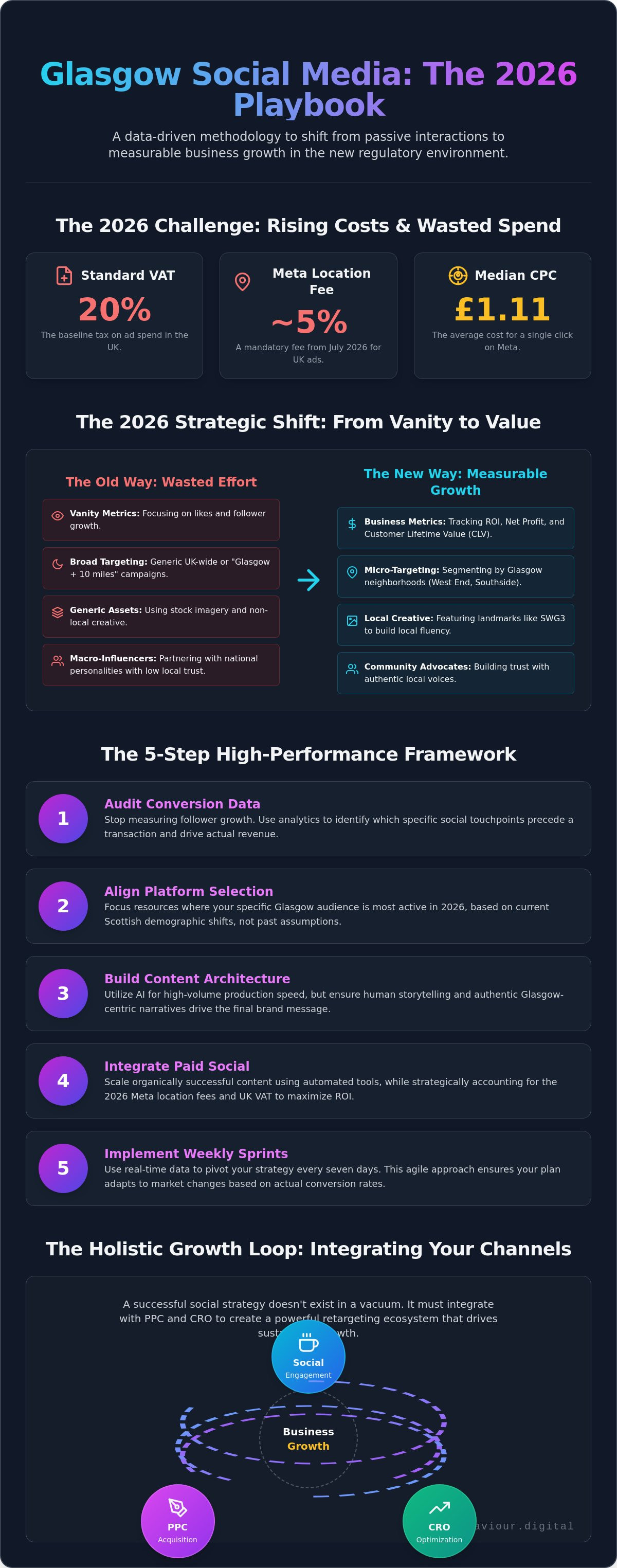
OnlineDid you know that as of July 2026, every pound you spend on Meta ads in the UK now carries a mandatory location fee of up to 5 percent on top of the standard 20 percent VAT? For many, this extra cost combined with a median CPC of £1.11 means that a poorly optimized social media marketing plan for gl...

Did you know that as of July 2026, every pound you spend on Meta ads in the UK now carries a mandatory location fee of up to 5 percent on top of the standard 20 percent VAT? For many, this extra cost combined with a median CPC of £1.11 means that a poorly optimized social media marketing plan for glasgow business isn't just ineffective; it's a drain on your bottom line. You've likely felt the frustration of watching your budget disappear into broad targeting while local competitors crowd the feed and likes fail to translate into actual revenue.
Engagement is a hollow metric unless it directly facilitates commercial objectives. This article provides the precise methodology required to shift from passive interactions to behavioral conversions. You'll learn how to build a data-driven social media strategy that turns Glasgow-based followers into measurable business growth. We'll dissect the 2026 regulatory environment, capitalize on the local opportunities of the Commonwealth Games, and establish a framework where every action supports your broader digital strategy and conversion rate optimization goals.
• Learn why hyper-local, Glasgow-specific creative assets are essential for outperforming generic UK-wide campaigns in 2026.
• Discover how to build a high-performance social media marketing plan for glasgow business by prioritizing conversion data over vanity metrics.
• Understand the synergy between social engagement, PPC, and CRO to build a retargeting ecosystem that drives measurable business growth.
• Shift your measurement framework from "Likes" to quantifiable ROI, focusing on net profit and long-term Customer Lifetime Value (CLV).
• Audit your current conversion paths to ensure your platform selection aligns with the shifting 2026 demographic landscape in Scotland.
Digital geography in 2026 has shifted from broad national targeting to hyper-local relevance. Data indicates that Glasgow consumers now ignore generic UK-wide advertising at a significantly higher rate than localized content. A successful social media marketing strategy no longer relies on high-volume reach alone. It requires a deep understanding of regional sentiment and community hubs. For a social media marketing plan for glasgow business to succeed, it must move beyond the "one size fits all" approach that dominated the early 2020s.
Algorithmic updates on Meta and TikTok in 2026 prioritize content that generates meaningful local interaction. This means creative assets featuring recognizable landmarks like SWG3 or the specific aesthetic of Finnieston outperform stock imagery by a wide margin. Glasgow buyers expect brands to demonstrate local fluency. They look for signals that a business is an active participant in the city's culture rather than a detached entity. This shift toward "Glasgow-centric" creative isn't just an aesthetic choice; it's a performance necessity for maintaining competitive conversion rates.
Traditional targeting of "Glasgow + 10 miles" is an inefficient use of ad spend in 2026. Precision is now the primary driver of ROI. You must segment your audience by neighborhood cultural nuances to bypass algorithm fatigue. A campaign designed for the West End requires a different tone and value proposition than one targeting the Southside or Merchant City. By utilizing micro-geographic interest groups, you can speak directly to the specific lifestyle aspirations of each district. This methodology reduces wasted impressions and ensures your message reaches high-intent local users.
The era of the macro-influencer has ended. In 2026, the most effective social media marketing plan for glasgow business focuses on community advocates. These individuals embody the "People Make Glasgow" ethos and maintain high levels of trust within specific city niches. Unlike national influencers, local advocates provide authentic social proof that resonates with the city's skeptical consumer base. Building long-term partnerships with these creators allows for sustainable brand growth. It moves your marketing from a series of transactional ads to a narrative of community involvement that builds lasting customer loyalty.
Execution requires a rigid methodology to avoid the common pitfall of wasted ad spend. A high-performance social media marketing plan for glasgow business must move beyond tactical posting to strategic engineering. Success in 2026 requires a five-step framework focused on measurable outcomes rather than surface-level engagement. This process ensures every creative asset and ad pound supports your commercial bottom line.
Stop measuring follower growth. Use your analytics to identify which specific social touchpoints preceded a transaction.
Focus resources where your specific Glasgow audience is most active in 2026.
Utilize AI for high-volume production speed, but ensure human storytelling drives the final brand narrative.
Scale organic winners using automated tools while accounting for the 2026 Meta location fees and UK VAT.
Use real-time data to pivot your strategy every seven days based on actual conversion rates.
KPIs must reflect the 2026 Glasgow market reality. Top of Funnel awareness is useful for brand recognition, but Bottom of Funnel metrics like Cost Per Acquisition (CPA) determine your actual viability. Your social objectives must align with your broader Digital Strategy to ensure cross-channel consistency. If you're establishing these benchmarks for the first time, reviewing a guide for small businesses can provide a foundational baseline for resource allocation. Effective execution depends on technical precision. You can explore how a specialized digital partner can refine these processes for your specific industry.
TikTok has become the primary discovery engine for Glasgow retail and hospitality. Short-form video is no longer optional; it's the standard for local search discovery. For the professional services sector, LinkedIn remains the dominant force for B2B lead generation. Meta platforms continue to offer the most sophisticated targeting through AI-driven Advantage+ campaigns. These tools automate audience selection, allowing your social media marketing plan for glasgow business to focus on high-quality creative that converts local users into repeat customers.
Siloed marketing channels are a primary cause of inefficient budget allocation. In 2026, social media functions as a high-visibility billboard that directly influences search engine behavior. When a user interacts with your brand on TikTok or Instagram, their subsequent action is frequently a branded search on Google. This synergy is a cornerstone of a high-performance social media marketing plan for glasgow business. By capturing this initial interest, you can populate retargeting lists for high-intent PPC campaigns, ensuring your brand remains visible throughout the decision-making process.
Data-driven integration allows for a "Social-to-Sale" pipeline where conversion rate optimization (CRO) identifies and removes friction points in the user journey. For example, a Glasgow-based professional services firm recently achieved a 30 percent reduction in their Customer Acquisition Cost (CAC) by aligning their social creative with their search intent data. This holistic approach ensures that social media isn't just an engagement tool but a catalyst for measurable commercial growth.
Social platforms provide a cost-effective environment for testing headlines and visual hooks before deploying them in high-stakes environments. Insights gained from social engagement should directly inform your PPC Management strategy. If a specific value proposition generates high engagement on social, it's statistically more likely to drive a higher click-through rate on Google Ads. This methodology builds brand search volume, which often results in lower costs for competitive local keywords.
Directing social traffic to a generic homepage is a tactical error that leads to immediate bounce rates. Users arriving from a social feed expect a seamless transition that matches their specific "scroll" intent. Utilizing conversion optimisation techniques ensures that landing pages are mobile-first and platform-specific. A social media marketing plan for glasgow business is only as strong as its final conversion point. Reducing friction for mobile users, who account for the vast majority of social traffic, is essential for maintaining high conversion rates in the 2026 Glasgow market.
Vanity metrics are the primary obstacle to profitable scaling. In 2026, a successful social media marketing plan for glasgow business must define ROI strictly as net profit generated from social activity divided by the total investment. This investment figure is not just your ad spend; it must include the 20 percent UK VAT, the 2 to 5 percent Meta location fee, and your content production costs. If your reporting focuses on likes or shares, you're looking at engagement, not business growth. Data doesn't lie. Profitability is the only metric that guarantees sustainability in the competitive Glasgow market.
Tracking must shift toward Customer Lifetime Value (CLV). A single conversion from a local follower is valuable, but the long-term revenue that customer generates is the true measure of campaign success. We also implement the 72-hour rule to measure the "halo effect." This involves tracking spikes in direct traffic or branded searches within three days of a high-reach social campaign. Often, the most significant impact of social media occurs off-platform, where users see an ad and later visit your site directly to complete a transaction.
Privacy updates have made traditional cookie-based tracking obsolete. To maintain a closed-loop view of your marketing, implementing server-side tracking is essential. This technology allows your business to reclaim attribution data lost to browser restrictions, providing a clearer picture of the customer journey. For high-ticket Glasgow services like legal or financial consulting, "view-through" conversions are critical. These track users who saw your ad, didn't click, but converted later. Without this data, you're likely underestimating your social media contribution by as much as 40 percent.
Effective reporting ignores noise and focuses on three core pillars: Cost Per Acquisition (CPA), Return on Ad Spend (ROAS), and CLV. You must also regularly audit your audience to identify and remove "zombie followers." These are inactive or bot accounts that inflate your numbers while dragging down your engagement rate and algorithmic reach. Your 2026 dashboard should link social spend directly to your bank balance. Engineered growth requires this level of transparent, quantifiable data. You can partner with a performance-driven strategist to build a reporting framework that prioritizes net profit over superficial popularity.
Strategy without precise execution results in wasted capital. At Behaviour Digital, we don't simply manage profiles; we engineer behavioral growth for brands that demand measurable outcomes. A high-performance social media marketing plan for glasgow business requires a partner who operates at the intersection of psychology and data science. Our methodology moves beyond the superficial "agency" model. We function as a strategic extension of your team, focusing on the quantitative metrics that drive your bottom line. Our approach to Social Media Marketing Management in Scotland is built on technical precision and a deep understanding of local market dynamics.
Transparency is our operational standard. In a 2026 environment where Meta location fees and UK VAT can obscure your actual performance, you need a partner who provides a granular view of every ad pound. We provide real-time dashboards that link social activity directly to commercial results. As a specialized PPC agency in Glasgow, we understand how to synchronize your social visibility with search intent. This ensures your brand dominates the local landscape across the entire digital ecosystem.
Our process is divided into three distinct phases designed to eliminate guesswork. Phase 1 involves a deep-dive behavioral analysis of your Glasgow audience, identifying the specific triggers that move them from scrolling to clicking. In Phase 2, we implement rapid creative testing. We iterate on high-performing assets to find the most efficient conversion paths. Finally, Phase 3 focuses on scaling the winners. We optimize your budget for maximum ROI, ensuring that your growth is both sustainable and predictable.
2026 is the year to move past trial-and-error marketing. The complexity of the current digital landscape rewards those who prioritize data-led strategy over generic content. Success requires a commitment to continuous methodological refinement and a partner who takes responsibility for your commercial goals. Stop managing social media in a silo and start dominating your sector with a unified growth loop. Book a strategy session with our Glasgow-based experts to audit your current performance. Contact Behaviour Digital today for a data-led social media plan that turns local followers into long-term business assets.
The 2026 digital landscape demands more than just visibility; it requires mathematical precision and local fluency. A successful social media marketing plan for glasgow business is built on the integration of hyper-local creative, cross-channel data, and a relentless focus on net profit. We've established that vanity metrics are a liability. True success comes from understanding the behavioral triggers of the Glasgow audience and removing every friction point in the conversion funnel through targeted CRO and PPC synergy.
Our Glasgow-based experts utilize a data-driven behavioral methodology to ensure your brand doesn't just participate in the conversation but dominates it. We have a track record of delivering proven ROI for local Scottish brands by treating social media as a performance engine rather than a siloed broadcast tool. It's time to stop guessing and start engineering your future expansion.
Get Your Custom 2026 Social Media Strategy from Behaviour Digital
The opportunity for growth in the West of Scotland has never been more significant for those with a conscious strategy. We look forward to building your success together.
A realistic monthly budget for a small business in 2026 typically ranges between £1,500 and £5,000. This figure covers both professional management fees and advertising spend across your primary channels. You must also account for the 20 percent UK VAT and the mandatory 2 to 5 percent Meta location fee added to all impressions delivered within the United Kingdom as of July 2026.
WhatsApp is the most popular platform in Scotland with 79 percent of internet users active monthly. However, for business growth, Facebook and Instagram remain the dominant platforms for targeted advertising. TikTok has also become a critical tool for local discovery, as 98 percent of UK consumers now use the internet to research local businesses before making a purchase decision.
You can manage a basic social media marketing plan for glasgow business internally if you have the resources for content production and community management. However, scaling requires technical expertise in server-side tracking and behavioral data analysis. Professional agencies provide the methodological precision needed to navigate 2026 privacy regulations and ensure your ad spend translates into measurable net profit rather than just engagement.
Initial data and conversions from paid campaigns usually appear within the first 30 days. This period allows the platform algorithms to complete their learning phase and identify high-performing creative assets. Achieving sustainable, scalable growth typically requires a commitment of three to six months. This timeframe is necessary for the continuous refinement of your targeting and the optimization of your Customer Lifetime Value.
Organic social is a community-building tool used to nurture your existing audience through authentic, human-generated content. Paid social is a performance engine designed to reach new, high-intent users through strategic investment. In 2026, organic reach is significantly restricted by algorithms. This makes paid advertising a necessity for any business that requires predictable lead generation and a scalable way to acquire new customers.
You can target specific postcodes like G1, G12, or G41 by using the geographic location settings in your ad manager. This is a core component of a high-performance social media marketing plan for glasgow business as it eliminates wasted spend on users outside your service area. Combining postcode targeting with behavioral data ensures your ads reach the most relevant local prospects with high conversion potential.
TikTok is highly relevant for B2B brands as a platform for establishing industry authority and driving social search discovery. Decision-makers increasingly use the platform to find authentic, educational content from potential partners. Success in the B2B sector requires moving away from entertainment trends toward demonstrating your methodological precision and sharing data-driven insights that solve specific business challenges for your local clients.
Social media doesn't directly change your search engine rankings, but it creates a powerful "halo effect" on your overall digital performance. High visibility on platforms like YouTube or Instagram drives an increase in branded search volume on Google. These signals of brand authority indirectly support your digital presence. Additionally, social media is a primary driver of traffic to optimized landing pages where conversion rate optimization can turn visitors into customers.

Luke leads strategy across every Behaviour Digital account — building data-driven advertising systems for ambitious brands. When he's not auditing ad accounts, he's writing about what he found in them.
Get a free, tailored growth plan — we'll run our framework on your accounts and show you exactly what we'd do.
Get your free growth plan →