.webp) Online
OnlineNot sure which channel fits your business?View all services →
Three inputs. Instant KPIs. No spreadsheets.Open a calculator →
OnlineAccording to data from the Baymard Institute, 70% of online shopping carts are abandoned before a single cent is spent. This isn't just a design flaw; it's a structural failure to align user experience and conversion rate optimisation into a single, cohesive strategy. You've likely seen your custome...

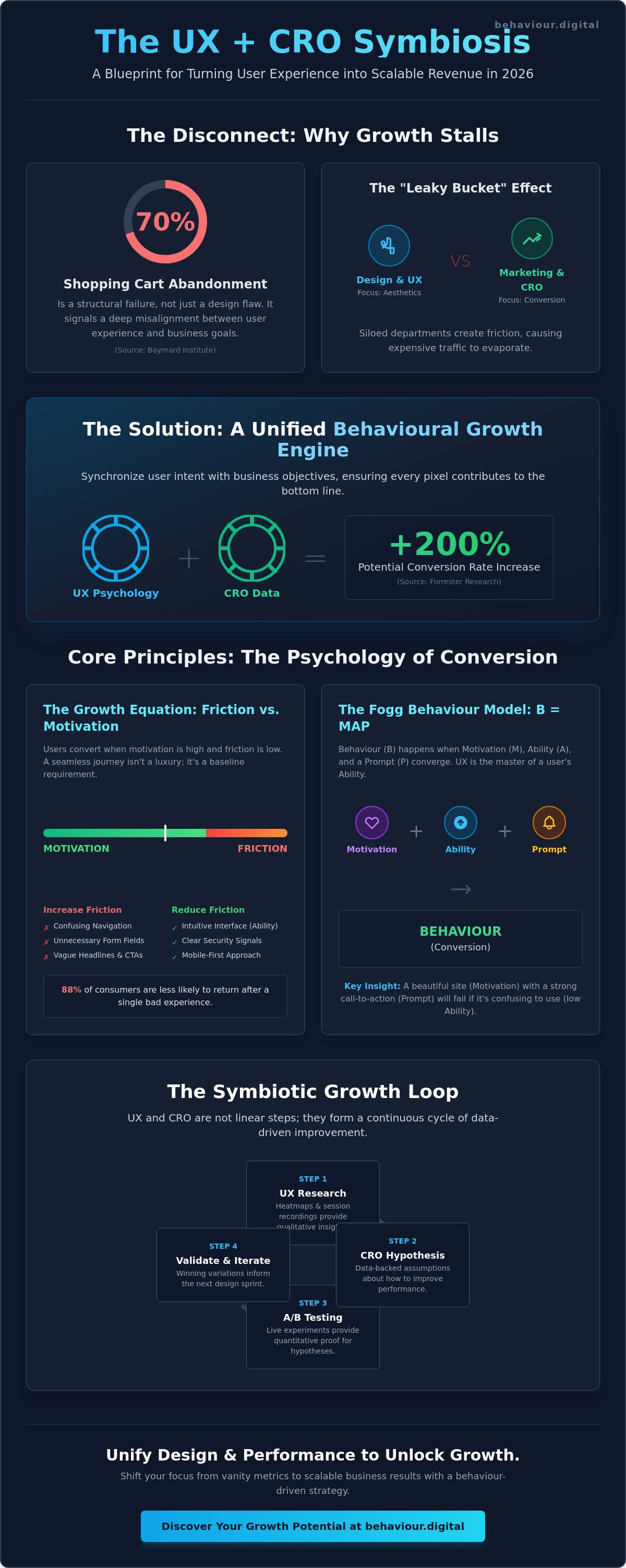
According to data from the Baymard Institute, 70% of online shopping carts are abandoned before a single cent is spent. This isn't just a design flaw; it's a structural failure to align user experience and conversion rate optimisation into a single, cohesive strategy. You've likely seen your customer acquisition costs climb while conversion rates remain stagnant, often leading to internal friction between your creative and sales departments. It's frustrating to invest heavily in traffic only to watch it evaporate due to subtle usability barriers.
We're here to bridge that gap. This guide provides a definitive roadmap to unify these two disciplines, ensuring your digital presence is both aesthetically authoritative and ruthlessly efficient. You'll discover how to build trust through seamless interactions while leveraging behavioral data to drive measurable business growth. Based on Forrester Research showing that superior interface design can increase conversion rates by 200%, we'll break down the specific 2026 frameworks that allow you to scale revenue without increasing your current advertising spend.
• Stop siloing design and marketing to create a unified performance layer where UX serves as the essential foundation for all conversion efforts.
• Reduce cognitive load and establish "Digital Trust" by understanding the psychological triggers that drive user decision-making in the 2026 landscape.
• Implement a strategic synergy between user experience and conversion rate optimisation to eliminate friction and adapt to user intent using AI-driven personalization.
• Conduct comprehensive behavioral audits that bridge the gap between qualitative insights and quantitative data to identify high-impact growth opportunities.
• Shift your focus from vanity metrics to scalable business results through a mobile-first approach designed to drive measurable impact in competitive markets.
User experience forms the structural foundation of a digital product, while performance marketing serves as the engine. By 2026, the artificial wall between design and marketing has crumbled. High-growth companies now treat user experience and conversion rate optimisation as a single, unified discipline. We define this unified approach as a behavioural growth engine that synchronizes user intent with specific business objectives to ensure every pixel contributes to the bottom line.
Growth is a mathematical outcome of the Friction vs. Motivation equation. When motivation is high and friction is low, users convert. If a site is beautiful but difficult to navigate, friction wins. Data from 2024 industry benchmarks shows that 88% of online consumers are less likely to return to a site after a single bad experience. Businesses can't afford to silo these departments because a seamless journey isn't a luxury; it's a baseline requirement for survival in a competitive landscape.
To understand the mechanics of this synergy, we must look at Conversion Rate Optimization as a scientific method applied to human behaviour. It's not about guessing what users want. It's about using data to remove the barriers that stop them from achieving their goals. When you align the user's needs with your conversion targets, you create a sustainable path to revenue that doesn't rely on increasing your ad spend.
The most persistent myth is that CRO is limited to changing button colours or tweaking headlines. This surface-level view ignores the depth of the discipline. While 94% of a user's first impression is design-related, a beautiful interface fails if it lacks a clear conversion path. Aesthetics without utility create a "leaky bucket" where expensive traffic disappears. We also see a shift away from dark patterns in 2026. Manipulative tactics might provide a 3% or 5% short-term spike, but they destroy customer lifetime value and brand trust.
The relationship between these two fields is cyclical rather than linear. UX research provides the qualitative data, such as heatmaps and session recordings, that informs CRO hypotheses. In turn, CRO testing provides the quantitative proof needed to validate design decisions. Integrating conversion rate optimization into the initial design sprint ensures that performance isn't an afterthought. This integration allows teams to build scalable systems where every design iteration is backed by measurable user data, reducing the risk of costly post-launch pivots. When user experience and conversion rate optimisation work together, the result is a product that users love and a business that scales predictably.
Conversion isn't a fluke. It's the calculated outcome of cognitive alignment. Effective user experience and conversion rate optimisation work together to lower the mental energy required to say "yes." When a site feels intuitive, it's because the design respects the user's cognitive load. Every unnecessary form field, decorative icon, or vague headline adds friction. When the brain works too hard to process information, it defaults to the easiest path: leaving the site.
Hick’s Law dictates that the time it takes to make a decision increases with the number and complexity of choices. In a 2024 analysis of 1.2 million e-commerce sessions, reducing navigation categories from twelve to six resulted in a 19% increase in product page views. Choice overload kills momentum. A streamlined interface ensures that the user's limited mental energy is spent on the product, not on figuring out how to use the website.
Digital Trust serves as the silent engine of the conversion journey. It's built through professional aesthetics, clear security signals, and consistent design patterns. Without this foundation, even the most aggressive "Prompts" will fail. This brings us to the Fogg Behaviour Model, which states that behaviour (B) happens when Motivation (M), Ability (A), and a Prompt (P) converge at the same moment. While marketing often focuses on Motivation, UX is responsible for Ability. If a user is motivated but the checkout process is confusing, the conversion will never happen.
Friction is any hurdle that prevents a user from completing a task. We identify these "pain points" using quantitative data like drop-off rates and qualitative tools like session recordings. Most friction occurs when a site demands "slow-brain" analytical thinking for tasks that should be "fast-brain" and automatic. Technical UX plays a massive role here. Data from Google indicates that a 100ms delay in load time can hurt conversion rates by up to 7%. Stability and speed aren't just technical metrics; they're conversion requirements.
Visual hierarchy acts as a silent guide, using scale, contrast, and whitespace to direct the eye toward the primary CTA. It's not about making things pretty; it's about information architecture. We reinforce this with social proof and strategic micro-copy that addresses user anxieties at the exact moment they arise. These micro-moments of delight, such as a perfectly timed success message or a seamless transition, accumulate to turn a hesitant browser into a confident buyer. To see how these psychological triggers can be scaled, you can evaluate our performance-based growth strategies.
Design without data is just art. In 2026, your strategy must merge aesthetic appeal with hard performance metrics to stay competitive. A behavioural audit reveals why users drop off at the checkout or why a high-traffic landing page fails to generate leads. By leveraging conversion optimisation, you uncover hidden frustrations that standard analytics often miss. These friction points, such as a non-responsive button on a specific mobile browser version, can decrease conversion rates by 18% if left unaddressed.
Heatmaps and session recordings provide the visual evidence needed to identify UX leaks. If 40% of your visitors are clicking a non-clickable element, your design is misleading them. Identifying these "dead clicks" allows for immediate fixes that directly impact the bottom line. You don't need to guess where the friction lies; the users show you through their cursor movements and scroll depth.
Google Analytics 4 (GA4) and server-side tracking are mandatory for data accuracy in 2026. Server-side tracking reduces the impact of ad-blockers, ensuring 98% data reliability compared to the 70% typical of client-side methods. Funnel visualisation allows you to pinpoint the exact stage where you lose the most money. You must segment data by device, location, and traffic source to find outliers. A 2025 industry report showed that mobile users have a 55% higher bounce rate when page load exceeds 2.2 seconds. Precise tracking identifies these technical bottlenecks before they drain your marketing budget.
Numbers show the "what," but qualitative data explains the "why." User testing and "Think Aloud" protocols reveal the emotional hurdles users face during their journey. Post-purchase surveys and exit-intent polls capture real-time sentiment that numbers can't reflect. Don't treat feedback as anecdotal; turn subjective complaints into objective A/B test hypotheses. For instance, if 22% of users mention "unclear pricing" in exit surveys, test a transparent pricing table earlier in the funnel. This synergy between user experience and conversion rate optimisation ensures every design change serves a measurable business goal. Success isn't about following trends, it's about reacting to how your specific audience interacts with your interface.
The 2026 digital landscape demands a shift from static design to mobile-first behavioural optimisation. Data from Statista indicates that mobile devices will generate 73% of all e-commerce sales by the start of 2026. This reality makes it impossible to treat user experience and conversion rate optimisation as separate silos. They are two sides of the same coin. A unified strategy focuses on how users actually move through your site, not just how you want them to move.
Personalisation at scale is no longer a luxury. By 2026, AI-driven engines will adapt interfaces in real-time based on user intent. If a visitor demonstrates "transactional intent" through rapid scrolling and interaction with pricing tables, the UX should automatically prioritise trust signals and frictionless checkout paths. For those in the "informational phase," the system pivots to show educational content. This level of responsiveness is a core pillar of a sustainable Digital Strategy aimed at long-term growth.
Growth is a process of elimination. You must follow a strict iterative cycle: Plan, Test, Analyse, and Scale. Every modification to your site must be a hypothesis tested against hard data. This removes ego from the decision-making process and ensures that only high-performing elements remain.
Prioritisation is the most critical step in testing. We use the PIE framework to rank experiments. Potential measures the expected improvement; Importance looks at the volume of traffic on the page; Ease calculates the technical effort required. You shouldn't stop tests early. Reaching a 95% statistical significance level is mandatory to avoid "false positives" that can lead to a 10% or higher drop in revenue when implemented site-wide. Even "failed" tests are valuable. They provide 100% accurate data on what your specific audience dislikes, which refines your overall user experience and conversion rate optimisation efforts.
Mobile UX in 2026 centres on "thumb-zone" navigation. Research shows that 75% of users interact with their screens using only their thumb. Placing primary CTAs in the bottom third of the screen can increase click-through rates by 18% compared to top-aligned headers. Progressive Web Apps (PWAs) are also essential. They reduce load times to under 1.2 seconds, which is vital since every 100ms delay can slash conversion rates by 7%. Finally, integrating biometric checkout (FaceID or TouchID) is a non-negotiable requirement. It eliminates the 26% of cart abandonments caused by complex form-filling, creating a seamless path to purchase.
Stop guessing and start growing with a data-driven approach. Partner with Behaviour Digital to transform your conversion metrics today.
Success in 2026 doesn't happen by accident. It's the result of a deliberate strategy where user experience and conversion rate optimisation work in total harmony. At Behaviour Digital, we've moved past the era of simple aesthetic updates. We focus on the mechanics of growth. As a Glasgow-based agency, we've built a reputation for navigating the UK's competitive digital landscape by prioritising performance over hype. We understand that local businesses and global brands alike need more than just traffic; they need a measurable return on every marketing pound spent.
We reject vanity metrics. Impressions and clicks are starting points, not end goals. Our team focuses on real business impact, such as lifetime value, average order value, and lead quality. By combining technical precision with a deep understanding of psychological triggers, we transform your digital presence into a high-performance sales engine. The Behaviour Digital promise is simple: transparency, data-backed decisions, and scalable growth.
Traffic acquisition is only half the battle. Our PPC agency Glasgow services are built to integrate directly with CRO. We don't just send users to your homepage and hope for the best. We align paid social and search campaigns with high-converting landing pages designed for specific user intents. This synergy ensures that the user experience and conversion rate optimisation efforts are never siloed.
We don't believe in "one-and-done" projects. Digital environments change weekly. We employ continuous optimisation cycles to keep your brand ahead of the curve. In a recent 2025 case study, we helped a B2B service provider turn local Glasgow traffic into global revenue. By refining their mobile checkout flow and syncing it with targeted Google Ads, we achieved a 31% increase in conversion volume within four months. This wasn't luck; it was a systematic refinement of the user journey.
• Syncing ad copy with landing page headers to reduce bounce rates.
• Implementing heatmaps to identify friction points in real-time.
• A/B testing call-to-action buttons based on 2026 accessibility standards.
A professional perspective often reveals the friction points you've grown used to seeing. Our CRO audit is a deep dive into your data. We look at why 15% of your users drop off at the shipping page or why your mobile users aren't clicking your primary CTA. We provide a roadmap that prioritises high-impact changes first. Stop guessing and start growing with a partner that values your bottom line as much as you do.
Take the first step toward a more profitable digital ecosystem. Contact Behaviour Digital for a Data-Driven Audit today and let's build your 2026 growth strategy together.
The digital landscape in 2026 won't reward businesses that treat design and performance as separate entities. Success requires a unified approach where data-driven auditing replaces guesswork. We've seen that the bridge between aesthetics and revenue is built on behavioral psychology. By mastering the intersection of user experience and conversion rate optimisation, brands can stop chasing vanity metrics and start scaling real profit. It's about understanding why users click, not just where they click.
Based in Glasgow and serving global brands, Behaviour Digital delivers transparent, ROI-focused results. Our expertise across PPC, Social, and CRO ensures every touchpoint is an opportunity for growth. We don't believe in luck; we believe in strategic, measurable performance. If your current strategy feels stagnant, it's time to pivot toward a model that prioritizes the user's journey as much as the final sale. The future belongs to those who adapt to these behavioral shifts today.
Ready to see the data behind your next growth phase? Book your 2026 behavioural growth audit with Behaviour Digital and start building a scalable future.
UX focuses on the overall usability and satisfaction of the visitor's journey, while CRO targets specific business actions like sales or sign-ups. Think of UX as the foundation that makes a site functional and CRO as the engine that drives revenue. According to Forrester research, a well-designed user interface can increase conversion rates by up to 200% by removing friction points.
You'll typically see measurable performance shifts within 90 to 180 days of launching a structured testing cycle. Initial data patterns often emerge after the first 30 days, but achieving 95% statistical significance requires consistent traffic over a longer period. We don't rely on quick wins. We build scalable growth through iterative testing and rigorous data analysis.
No, a professional approach to user experience and conversion rate optimisation actually strengthens your SEO profile by improving engagement metrics. Google's 2021 Core Web Vitals update confirmed that page speed and visual stability are direct ranking factors. When you reduce your bounce rate through better UX, you signal to search engines that your content provides genuine value.
You need a minimum of 1,000 monthly conversions to reach statistically valid conclusions in a traditional A/B test. If your traffic is lower, we switch to qualitative methods like heatmaps or user testing sessions. Don't waste time on split tests that won't produce clear winners. Focus on high-impact heuristic evaluations until your volume supports automated experimentation.
A benchmark conversion rate for UK service providers in 2026 sits between 3.5% and 5.2% according to recent IRP Commerce industry reports. Top-tier performers in the professional services sector often reach 10% or higher by refining their lead capture funnels. We don't settle for averages. We aim for the top 10% by eliminating every unnecessary click in the user journey.
Industry data from platforms like Clutch shows that UK agencies typically charge between £2,500 and £8,000 for a deep-dive CRO audit. This price varies based on the complexity of your tech stack and the volume of user data analyzed. It's an investment in your infrastructure. A single audit can identify leaks that cost your business thousands in lost monthly revenue.
Neither is more important because they're two sides of the same coin. 88% of online consumers won't return to a site after a bad experience, which makes UX vital for retention. However, great UX without CRO is just a beautiful site that doesn't pay the bills. We integrate both to ensure your site is both pleasurable to use and highly profitable.
Modern user experience and conversion rate optimisation relies on a stack including Google Analytics 4, Hotjar, and VWO. GA4 tracks the quantitative "what," while Hotjar's session recordings reveal the qualitative "why" behind user exits. It's not about having the most tools. It's about using the right data to make informed, high-stakes decisions that drive your business forward.

Luke leads strategy across every Behaviour Digital account — building data-driven advertising systems for ambitious brands. When he's not auditing ad accounts, he's writing about what he found in them.
Get a free, tailored growth plan — we'll run our framework on your accounts and show you exactly what we'd do.
Get your free growth plan →