.webp) Online
OnlineNot sure which channel fits your business?View all services →
Three inputs. Instant KPIs. No spreadsheets.Open a calculator →
Online53% of mobile users will abandon your website if it takes longer than three seconds to load. In an era where mobile devices account for 82.9% of landing page visits, the margin for technical error has disappeared. Even a 0.1-second improvement in page speed can boost conversions by up to 10%. You're...
53% of mobile users will abandon your website if it takes longer than three seconds to load. In an era where mobile devices account for 82.9% of landing page visits, the margin for technical error has disappeared. Even a 0.1-second improvement in page speed can boost conversions by up to 10%. You're likely spending significant budget on PPC and social ads, yet high bounce rates suggest a disconnect between your traffic and your site's performance. Optimizing social media landing pages for conversion isn't just about aesthetics; it's about engineering a seamless transition from a user's feed to your checkout.
You know that design matters, but you're probably tired of contradictory feedback and design changes that don't move the needle on revenue. It's frustrating when you can't measure the ROI of a new layout or justify a design shift with hard numbers. This article shows how integrating User Experience (UX) and Conversion Rate Optimisation (CRO) creates a data-driven engine for sustainable business scaling. We'll explore the specific framework that combines design intuition with quantitative data to turn your existing traffic into higher ROI and a website your users actually value.
• Understand that UX and CRO form a unified feedback loop where qualitative user insights fuel high-impact quantitative experiments.
• Master the art of optimizing social media landing pages for conversion by aligning mobile-first design with data-driven performance metrics to capture high-intent traffic.
• Leverage advanced tools like GA4 and heatmapping to identify and eliminate friction points, ensuring every design change is backed by measurable behavioural data.
• Protect long-term Customer Lifetime Value by rejecting aggressive "dark patterns" in favour of transparent, trust-first design strategies that build sustainable growth.
• Integrate UX and CRO into a cohesive digital strategy to move beyond surface-level metrics and achieve professional predictability in business scaling.
Many digital strategists treat User Experience (UX) and Conversion rate optimization (CRO) as competing forces. This is a strategic error. In 2026, the distinction between "making it pretty" and "making it sell" has collapsed into a single discipline: Behavioural Design. If you are optimizing social media landing pages for conversion, you cannot afford to separate the two. UX is the holistic perception of a user interacting with your brand; it encompasses every touchpoint from the initial ad click to the final confirmation email. CRO is the systematic process of increasing the percentage of users who complete a specific goal. One focuses on the emotional journey, the other on the functional outcome.
The core tension often lies in the timeline. Short term conversion hacks might spike your revenue today, but they frequently erode long term brand equity. A unified approach ensures that your growth is sustainable. You aren't just looking for a one time transaction; you're building a scalable engine where data and design work in tandem. When these disciplines are siloed, you end up with a site that either looks beautiful but doesn't sell, or a site that converts well today but alienates customers tomorrow.
CRO is your primary diagnostic tool for website performance. It relies on quantitative metrics to identify where your funnel is leaking. By analyzing conversion rates, Average Order Value (AOV), and bounce rates, you can pinpoint exactly where users drop off. A/B testing plays a critical role here. It allows you to test different variants of a page to see which one performs better under real world conditions. This methodology removes the guesswork from optimizing social media landing pages for conversion. It provides the hard evidence needed to justify design changes to stakeholders. It is the science of identifying what is happening on your site at any given moment.
While CRO tells you what is happening, UX explains why. It focuses on qualitative insights, such as user intent and specific friction points that prevent a sale. In the modern UK market, accessibility has become a non negotiable standard for web design. A site that isn't accessible isn't just poor UX; it's a liability that limits your total addressable market. UX research, including heatmaps and user recordings, provides the context that raw data alone cannot reveal. It uncovers the psychological barriers, such as lack of trust or confusing navigation, that stop a user from converting. UX ensures the path to purchase is intuitive, satisfying, and aligned with the user's original intent.
UX research is the engine that drives high-quality CRO experiments. Without it, A/B testing is just expensive guesswork. By conducting a Heuristic Evaluation, we systematically identify where a website violates established usability principles, such as consistency and error prevention. This provides a structured starting point for both disciplines. When you are optimizing social media landing pages for conversion, UX research reveals the specific disconnects between an ad's promise and the page's reality. This insight becomes the hypothesis for your next test. Improving the user experience naturally removes the friction that stops a sale, leading to higher conversion rates without increasing your ad spend. It's a continuous feedback loop; CRO results provide the quantitative validation for UX design choices, which then informs the next strategic iteration of the interface.
Effective optimization requires tracking micro-conversions, such as scroll depth, button clicks, or video views. These metrics serve as leading indicators for the final conversion. Empathy maps are essential here to understand the specific hesitations a user feels when they reach a checkout page. Are they worried about security? Is the shipping cost hidden? The user journey is the definitive blueprint for all CRO efforts. By visualizing the path from social discovery to conversion, we identify the exact moments where users need more reassurance or less complexity. You can find more details on how to Optimize Landing Pages For Social Media Traffic to ensure your journey mapping aligns with platform-specific user behaviours.
The "don't make me think" principle is vital for modern conversion funnels. If a user has to pause to figure out your navigation or interpret a vague call to action, you've already lost them. Simplifying forms and streamlining navigation represent a significant joint victory for UX and CRO teams. For example, a Glasgow-based retailer recently increased their mobile ROI by 18% after simplifying their site navigation for users arriving from paid social campaigns. By reducing the number of form fields from six to three, they lowered the cognitive load and saw a direct spike in completed checkouts. This demonstrates that efficiency is often the highest form of user experience. If you want to align these design improvements with a broader digital strategy, it's essential to look at the entire funnel as a unified system.
Data without visualization is just a spreadsheet. In 2026, the shift to GA4 (Google Analytics 4) has moved the focus from simple page views to complex behavioural event tracking. We no longer just count visitors; we measure how they interact with specific design elements. This technical transition is essential when optimizing social media landing pages for conversion. It allows us to see exactly where a user from Instagram or LinkedIn stops scrolling or fails to engage with a lead form. Visualizing this friction requires more than just numbers. Heatmaps and scroll maps provide a spatial understanding of user attention, showing which areas of your page are hot with activity and which are ignored.
Session replay tools take this a step further. They allow you to watch recorded sessions of users struggling to find your primary call to action or getting stuck in a validation loop on a mobile form. It's a sobering but necessary exercise in empathy. When you see a user "rage click" a non-responsive element, the design flaw becomes undeniable. To manage this complexity, AI-driven personalisation now tailors the UX in real-time. By serving different layouts or headlines based on the user's specific segment or past behaviour, you can address conversion barriers before they lead to a bounce.
A/B testing platforms like Varify.io, Convert, or VWO provide the statistical significance required to validate design changes. You can't rely on gut feeling when business growth is at stake. Funnel analysis in GA4 identifies the precise drop-off points in your checkout or lead generation process. Because these tools require precise configuration to yield clean data, many brands rely on professional conversion rate optimisation services to oversee the technical implementation and hypothesis testing. This ensures that every test is both statistically sound and strategically aligned with your revenue goals.
Numbers tell you what happened; qualitative tools tell you why. User testing platforms provide direct feedback from your actual target audience, revealing frustrations that analytics might miss. Post-purchase surveys are equally valuable for uncovering why a customer almost decided not to buy. Was the pricing unclear? Did the mobile layout feel untrustworthy? Using exit-intent surveys allows you to capture the motivation behind a bounce before the user leaves your ecosystem. This methodology is how you Optimize Your Landing Page For Conversions by solving the psychological friction points that data alone cannot fix.
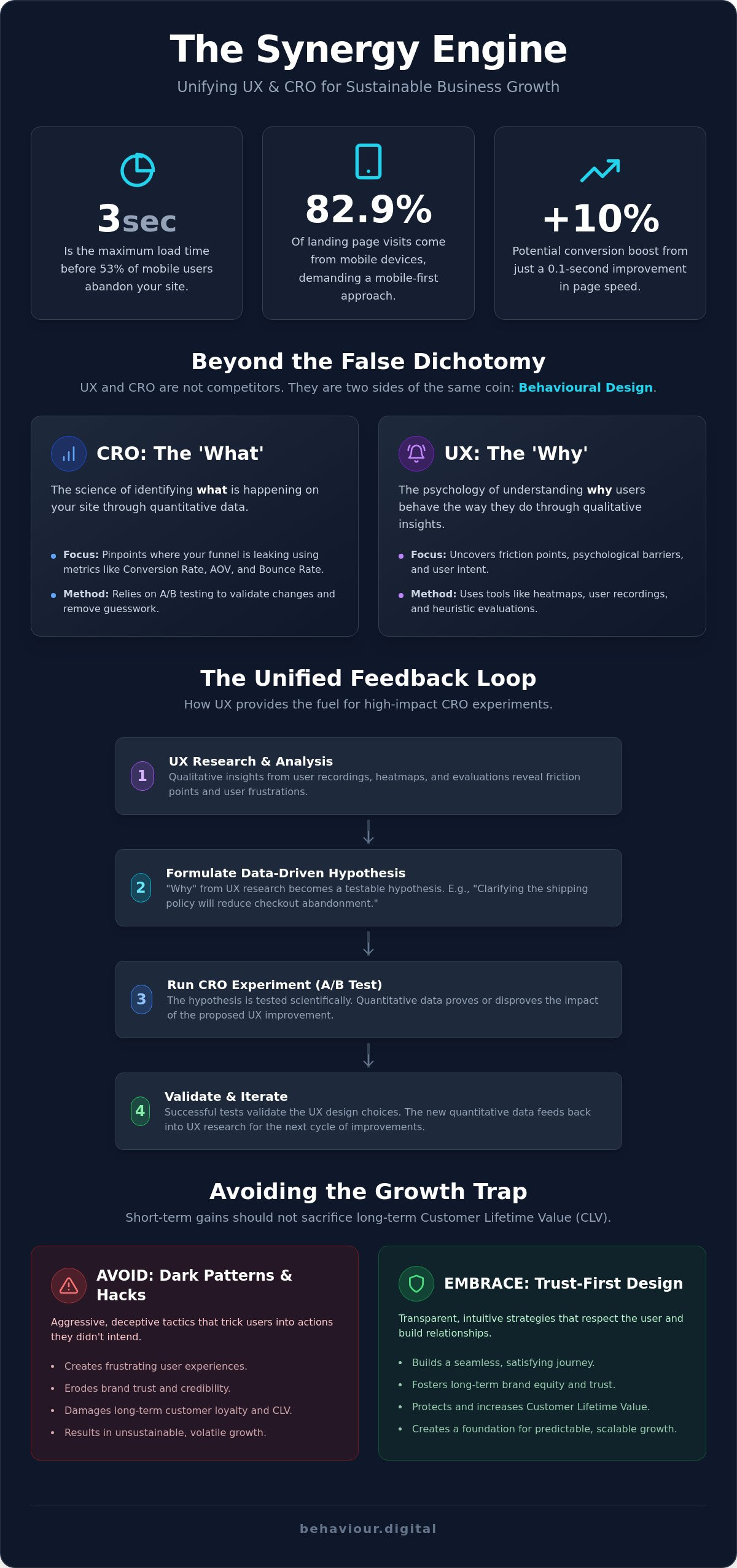
Conversion Rate Optimisation is a double-edged sword. Aggressive tactics often yield immediate gains at the expense of long term Customer Lifetime Value (CLV). "Dark patterns" such as manipulative countdown timers or fabricated social proof may inflate your metrics temporarily; however, they fundamentally damage the trust required for repeat business. When optimizing social media landing pages for conversion, your goal shouldn't be to trick the user into a single action. It should be to facilitate a decision they won't regret later. Brand equity is the ultimate victim when UX is sacrificed for a decimal point improvement in conversion rate.
There is also the "Local Maxima" problem. This occurs when you spend months refining a fundamentally flawed page. You might find the best possible version of a bad design, but you will eventually hit a ceiling where no further A/B test can produce significant growth. At this stage, incremental CRO becomes a waste of resources. A total UX overhaul is often the only way to break through to a new "Global Maximum" of performance. If you focus only on the "what" without understanding the "why", you'll eventually reach a point where your data stagnates despite constant testing.
Persuasion is about highlighting value; trickery is about hiding friction. Sustainable growth relies on transparent UX design that acts as a conversion driver. When users feel in control of their journey, they are more likely to convert and remain loyal. Ethical CRO is the alignment of user needs with business goals. This approach ensures that every optimization serves the customer as much as the company. By building trust through clarity, you create a foundation for scaling that doesn't rely on high pressure gimmicks.
Poor mobile UX leads to massive ad spend waste in social campaigns. If your landing page is confusing, users won't just bounce; they'll remember the frustration. In the tight-knit Scottish market, a reputation for difficult or untrustworthy interfaces spreads quickly. This increases your customer support costs as users struggle to complete basic tasks or abandon their carts in frustration. If your current site is leaking revenue due to design friction, it's time to partner with experts who prioritize measurable, ethical growth. You can see how we handle these challenges by reviewing our conversion rate optimization solutions.
Scaling a business in 2026 requires more than just an increased ad spend. It demands a sophisticated Digital Strategy where every click is treated as a financial asset. At Behaviour Digital, we don't view UX and CRO as isolated projects. We integrate them into a unified growth engine. This multi-disciplinary approach eliminates the friction often found when different agencies handle your social ads and your website design. By housing these specialisms under one roof, we ensure that the data gathered from your social media campaigns directly informs the design iterations on your site. This creates a feedback loop that turns raw traffic into a predictable revenue stream.
Based in Glasgow at the Red Tree Business Suites, our agency provides a distinct advantage for UK-based brands. We understand the specific nuances of the local market and the high expectations of modern consumers. This local expertise allows us to build trust with your audience through transparent, high-performance design. Our methodology follows the user from the first social media interaction to the final conversion, ensuring a seamless experience that prioritizes measurable business results over superficial metrics. A siloed approach to growth is no longer viable; success in 2026 belongs to those who align their entire digital ecosystem around user behaviour.
Successful performance marketing relies on "Message Match." If your social ad promises a specific solution but your landing page is generic, the user will bounce immediately. As a specialist PPC agency Glasgow, we use our advertising insights to fuel our CRO efforts. We don't just send traffic; we prepare the destination. Optimizing social media landing pages for conversion means aligning the creative intent of the ad with the functional layout of the page. This maximizes the value of every visitor, turning expensive clicks into profitable revenue streams through behavioural precision.
Our process begins with a comprehensive behavioural audit. We identify the "low-hanging fruit", the immediate technical or design fixes that can provide a rapid ROI for your business. This isn't a one-off project; it's an iterative cycle of testing, learning, and refining. We use the technical stack discussed earlier to monitor how users interact with your brand in real-time. This constant fine-tuning ensures your website evolves alongside your customers' needs. Optimizing social media landing pages for conversion is a continuous journey that compounds small wins into significant, sustainable growth. If you're ready to stop guessing and start growing based on quantitative evidence, Contact Behaviour Digital for a Conversion Audit today.
The digital landscape of 2026 demands a shift from isolated tactics to a unified methodology. By treating UX and CRO as a single feedback loop, you replace guesswork with professional predictability. We've explored how qualitative research fuels quantitative experiments and why the right technical stack is vital for visualizing user friction. Optimizing social media landing pages for conversion is no longer just about high-speed layouts; it's about building trust through transparent, high-performance design that respects the user journey.
Sustainable scaling happens when data-driven precision meets an integrated strategy. As Glasgow-based strategic growth experts, Behaviour Digital bridges the gap between expensive social traffic and measurable revenue. Our methodology focuses on a deep, multi-disciplinary approach across PPC, Social, and CRO to ensure every design change contributes to your ROI. It's time to move beyond surface-level metrics and commit to a process of continuous, methodological fine-tuning.
Scale your business with a data-driven CRO strategy from Behaviour Digital and turn your digital presence into a high-converting asset. Success is the logical result of a conscious strategy.
UX focuses on the qualitative quality of a user's interaction with your brand, while CRO is the quantitative process of increasing the percentage of visitors who complete a specific goal. UX is the emotional and functional journey; CRO is the measurable business outcome. While they have different primary metrics, they function as a single feedback loop in a professional digital strategy.
Technically, you can run A/B tests without UX research, but it's essentially expensive guesswork. UX research provides the "why" behind user behaviour, which allows you to form high-quality hypotheses for your CRO experiments. Without these insights, you'll likely waste resources testing elements that don't actually address the friction points preventing your users from converting.
Most businesses begin to see actionable data and initial uplifts within four to eight weeks. The exact timeline depends on your current traffic volume and the complexity of the tests. You need enough data to reach statistical significance to ensure that any conversion increase is a result of your changes rather than random chance.
No. A design that users find aesthetically pleasing or "better" doesn't always lead to more sales. In some cases, a highly experimental UX can actually distract users from the primary call to action. This is why optimizing social media landing pages for conversion requires constant A/B testing to ensure that design improvements actually move the needle on revenue.
The 2026 technical stack is dominated by GA4 for behavioural event tracking and A/B testing platforms like Varify.io or VWO. Qualitative tools such as Hotjar or Microsoft Clarity are essential for heatmapping and session replays. These tools are critical when optimizing social media landing pages for conversion as they reveal exactly where mobile users drop off in your funnel.
An agency provides an unbiased, analytical perspective and a team of specialists that most businesses can't afford to hire in-house. CRO requires a mix of data analysis, psychology, and technical development. Outsourcing this to experts ensures that your strategy is statistically sound and that you avoid the common "local maxima" trap where growth stagnates.
You measure ROI by tracking the direct uplift in conversion rates and the subsequent increase in revenue per visitor. You should also look at secondary metrics like reduced customer support tickets and higher repeat purchase rates. When UX is integrated with CRO, the return on investment becomes a transparent, quantifiable figure rather than a vague design preference.
Dark patterns are manipulative design elements, like fake countdown timers or hidden costs, designed to trick users into converting. You must avoid them because they destroy brand trust and severely damage long-term Customer Lifetime Value. Professional growth is built on transparency and providing genuine value, not on short-term psychological deception.
Luke leads strategy across every Behaviour Digital account — building data-driven advertising systems for ambitious brands. When he's not auditing ad accounts, he's writing about what he found in them.
Get a free, tailored growth plan — we'll run our framework on your accounts and show you exactly what we'd do.
Get your free growth plan →