.webp) Online
OnlineNot sure which channel fits your business?View all services →
Three inputs. Instant KPIs. No spreadsheets.Open a calculator →
OnlineIf 97% of your website visitors leave without clicking "Enquire" or "Buy," your marketing budget isn't an investment; it's a leak. According to 2024 industry benchmarks, the average conversion rate remains below 3%, meaning most businesses lose the vast majority of their potential leads instantly. Y...


If 97% of your website visitors leave without clicking "Enquire" or "Buy," your marketing budget isn't an investment; it's a leak. According to 2024 industry benchmarks, the average conversion rate remains below 3%, meaning most businesses lose the vast majority of their potential leads instantly. You've likely felt the frustration of staring at complex GA4 dashboards that offer plenty of data but zero clarity on why sales are stalling. We understand that traffic is a vanity metric if it doesn't result in measurable growth. This is why a rigorous website conversion analysis Scotland strategy is no longer optional for 2026; it's the foundation of every scalable business.
Success in the digital space isn't about luck. It's the result of conscious strategy and continuous optimization. You deserve a clear roadmap that replaces guesswork with facts and improves your Return on Ad Spend. By mastering the science of user behavior, you'll stop wasting budget on underperforming campaigns and start seeing a significant, measurable impact on your revenue. This guide provides a deep dive into the specific website fixes and analytical frameworks required to transform your digital presence. We'll outline how to decode your customers' digital footprints to build a high-performing, transparent growth engine that works as hard as you do.
• Distinguish between vanity metrics and value-driven data to ensure your digital strategy focuses on measurable revenue rather than just clicks.
• Identify and remove hidden behavioral friction points through a systematic website conversion analysis scotland to better align user intent with your business objectives.
• Apply a rigorous 5-point audit framework to optimize technical performance and guarantee your website communicates its value in under three seconds.
• Prepare for a cookieless future by utilizing AI and predictive analytics to forecast user behavior while maintaining strict data privacy standards.
• Transition from static reporting to a continuous "Analyze-Test-Learn-Repeat" cycle that turns behavioral insights into scalable, long-term growth.
Website conversion analysis is the systematic, data-driven study of user behavior designed to identify and eliminate friction points that prevent a desired action. It isn't about guessing which button color works better. It's about auditing the entire digital journey to understand why 98% of your traffic leaves without converting. For businesses leveraging website conversion analysis scotland, this process moves beyond basic analytics to uncover the "why" behind the "what."
Scottish SMEs frequently fall into the trap of prioritizing vanity metrics over value metrics. High traffic volume and click-through rates look impressive on a monthly report, but they don't guarantee solvency. Value metrics, such as lead quality, customer acquisition cost (CAC), and average order value, provide the only true measure of digital health. By integrating Conversion Rate Optimization (CRO) into your core strategy, you shift the focus from merely attracting eyes to capturing intent.
The financial implications are mathematical certainties, not marketing hyperbole. Consider a Glasgow-based service provider generating £500,000 in annual revenue with a 2% conversion rate. By optimizing the path to purchase and increasing that rate to 3%, the business doesn't just see a 1% improvement; it experiences a 50% increase in revenue without spending an extra penny on advertising. Because fixed overheads remain stable, this 1% absolute increase can often double the company's net profit margin.
By 2026, standard A/B testing has become a baseline requirement rather than a competitive edge. Modern website conversion analysis scotland requires a transition toward behavioral optimization. We no longer just look at where users click; we analyze the psychological heuristics, such as loss aversion or the scarcity effect, that drive those clicks. Data science now allows us to predict user frustration before it leads to site abandonment. Behavioral optimization is the intersection of data science and consumer psychology.
Businesses in Edinburgh and Glasgow face unique market dynamics. Scottish users often display higher levels of brand skepticism, requiring stronger trust signals to complete a transaction. Precision analysis identifies these region-specific barriers. To outperform national competitors, local firms must integrate their conversion strategy with local SEO. This involves:
• Displaying physical Scottish addresses and local contact numbers prominently to build immediate geographic trust.
• Showcasing testimonials and case studies from recognizable Scottish brands or locations.
• Optimizing site speed for regional connectivity variations to ensure a seamless experience across the Highlands and Central Belt.
Growth isn't a product of luck. It's the result of a transparent, performance-based approach that treats every user interaction as a data point for improvement. When you align your digital infrastructure with the specific expectations of the Scottish market, you create a scalable engine for long-term profitability.
Growth doesn't happen by accident; it's the result of a calculated balance between user motivation and behavioral friction. In the context of website conversion analysis scotland, we define motivation as the internal drive that brings a visitor to your site. Friction represents every obstacle, whether it's a slow-loading script or a confusing navigation menu, that prevents them from converting. By 2026, the digital landscape demands a surgical approach to these forces. If the friction of your checkout process outweighs the user's motivation to buy, they'll abandon the cart 85% of the time.
Our methodology focuses on the interplay between quantitative data (the "What") and qualitative data (the "Why"). Quantitative metrics show us where the leaks are, while qualitative insights reveal the psychological barriers causing them. We map user intent across multiple devices, recognizing that 68% of modern journeys start on a smartphone but conclude on a desktop or tablet. This cross-device fluidity is a core component of our conversion rate optimization framework, ensuring no data points are lost in transition.
Standard tracking tools often provide an incomplete picture. With the rise of privacy-centric browsing, up to 30% of user data can be lost to ad-blockers and cookie restrictions. We solve this by leveraging server-side tracking, which ensures a 100% data match between your server and your analytics dashboard. This precision allows for granular funnel visualization. We don't just see that users leave; we see the exact form field where they hesitate. For businesses looking to strengthen their data foundation, this introduction to analytics clarifies how structured data collection informs user experience. We also prioritize segmentation, comparing how PPC traffic behaves against organic social visitors to tailor the experience for different levels of intent.
Numbers tell us a story, but they don't explain human emotion. We utilize AI-powered session recordings to identify non-obvious friction points, such as "rage clicks" on non-interactive elements or "dead clicks" that lead nowhere. In the Scottish market, we've found that remote user testing and "Five-Second Tests" are vital. These tests determine if your core value proposition is understood within the first five seconds of a page load. If it's not, you've already lost the visitor. We also survey existing customers to identify "Post-Purchase Dissonance." By understanding what made a customer hesitate before buying, we can eliminate those fears for future visitors.
Our team at Behaviour Digital applies these rigorous analytical standards to turn raw data into a scalable growth engine. We believe that website conversion analysis scotland should be a transparent, results-driven process that leaves nothing to chance.
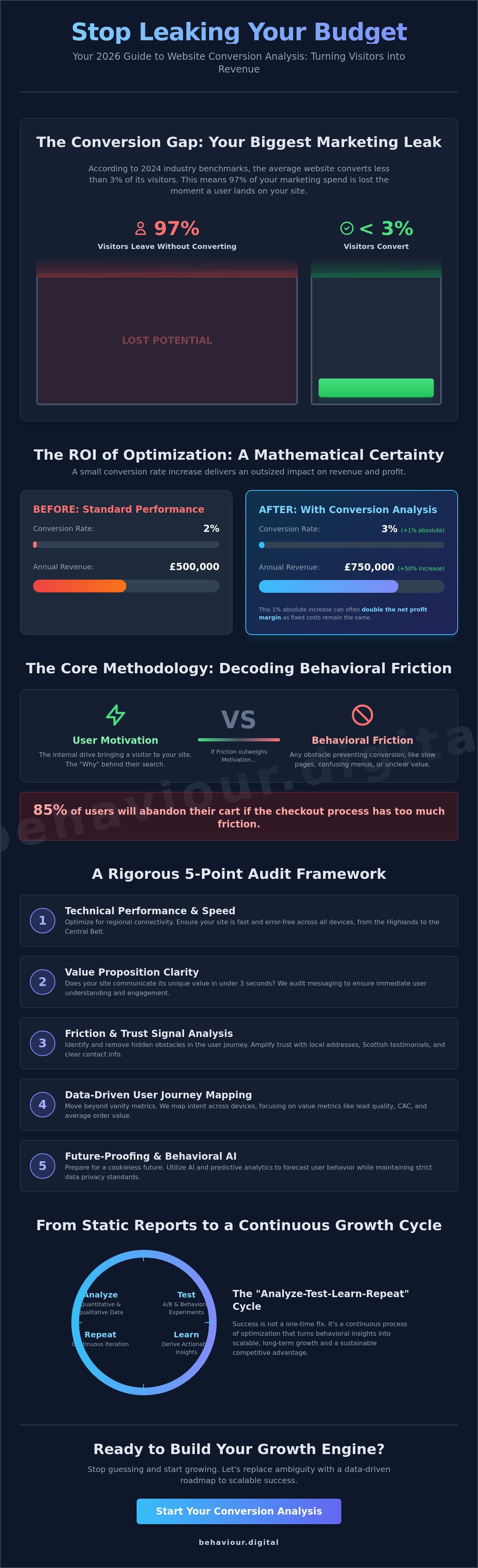
Effective growth isn't a byproduct of luck. It's the result of a systematic diagnostic process. To perform a high-impact website conversion analysis scotland companies need more than a surface-level review. They need a framework that isolates friction and amplifies intent. This 5-point audit provides the roadmap for turning traffic into revenue through data-driven precision.
Speed is a prerequisite for profit. By 2026, Google’s mobile-first indexing penalizes any site with a Largest Contentful Paint (LCP) exceeding 2.5 seconds. A one-second delay can reduce conversions by 7%. This technical foundation is a core pillar of a Digital Strategy in 2026.
Users decide to stay or leave in under 3 seconds. If your value proposition isn't immediately obvious, they bounce. We analyze if the "Above the Fold" content answers: what do you do, and what should the user do next?
Friction is a silent profit-eater. Every unnecessary form field reduces completion rates by roughly 11%. We identify checkout hurdles and complex navigation that prevent users from reaching their destination.
Scottish consumers prioritize local credibility. Case studies from Aberdeen, Glasgow, or Edinburgh carry more weight than generic global logos. We evaluate if your site displays the specific credentials required to build regional trust.
You can't ask for a marriage on the first date. We ensure the Call to Action (CTA) matches the user's current stage in the funnel. To Use Website Analytics Strategically, you must segment users by behavior before presenting a hard-sell offer.
In 2026, accessibility is a conversion driver, not just a box to tick for legal compliance. Roughly 1 in 5 users has a disability that affects how they browse. Ignoring WCAG 2.2 standards means you're intentionally ignoring 20% of your potential market. Page speed remains the primary conversion killer on mobile devices. If your site takes longer than 3 seconds to load on a 4G connection, expect a 40% bounce rate before the first image even appears.
High bounce rates often stem from a disconnect between marketing and landing pages. If your PPC campaigns in Glasgow promise a specific solution, the landing page must deliver that exact reality instantly. We focus on reducing choice overload to guide users toward a single objective. Users scan content in an F-pattern on text-heavy pages and a Z-pattern on visual landing pages. A professional website conversion analysis scotland must account for these biological scanning habits to ensure the most important information is never missed.
The 2026 digital landscape demands a pivot from intrusive tracking to sophisticated, consent-based modeling. Third-party cookies are obsolete. Success now relies on first-party data acquisition. This shift forces a higher standard for website conversion analysis scotland. Businesses must own their data pipelines to maintain 100% accuracy in performance reporting. Relying on external identifiers is a strategy of the past. We focus on building sustainable conversion engines that respect user boundaries while maximizing profit.
Predictive analytics has moved from experimental to essential. AI models now forecast user intent with 88% accuracy based on the first 15 seconds of a session. By analyzing historical patterns, these systems identify which visitors are likely to convert and which require a specific nudge. This allows for dynamic resource allocation, ensuring your marketing spend targets high-value prospects. First-party data serves as the fuel for these engines, turning anonymous traffic into actionable business intelligence.
Machine learning algorithms now process behavioral patterns in real-time. We focus on identifying "rage clicks" where a user clicks an element three or more times within two seconds. These friction points represent immediate revenue leaks. AI automates A/B test iterations, reaching 95% statistical significance in half the time required in 2024. This rapid testing cycle allows for weekly rather than monthly optimizations. AI handles the heavy lifting of data processing, but human strategic analysis remains the critical filter for interpreting business context and creative direction.
UK businesses must implement Consent Mode v3 to remain compliant with current data protection standards. This technology uses conversion modeling to fill data gaps when users decline cookies. It ensures you don't lose 40% of your attribution data to "dark" traffic. Anonymized user journey mapping allows us to see how visitors move through your Scottish storefront without storing personally identifiable information. Transparency isn't just a legal hurdle; it's a competitive advantage. Clear data policies build 15% higher brand trust according to 2025 consumer sentiment reports.
Assigning value to users before they reach the checkout.
Tailoring landing pages based on the visitor's specific Scottish region.
Moving tracking away from the browser to improve site speed by up to 1.2 seconds.
Effective website conversion analysis scotland requires a blend of technical precision and local market understanding. Personalization in 2026 isn't just about names; it's about context. If a user visits from Inverness during a specific weather event or local holiday, your site must reflect that relevance. Dynamic content blocks can increase conversion rates by 22% compared to static pages. This level of granularity is only possible when your tech stack is integrated and your data is clean.
Data sitting in a spreadsheet doesn't generate revenue. Analysis without implementation is just expensive trivia. Many Scottish businesses fall into the trap of commissioning a website conversion analysis scotland and then letting the findings gather digital dust. In 2026, the competitive gap isn't between those who have data and those who don't; it's between those who act on insights and those who hesitate. Growth is a byproduct of execution.
Conversion Rate Optimization (CRO) is never a "one and done" project. It's a perpetual cycle of Analyze, Test, Learn, and Repeat. This iterative nature ensures your website evolves alongside shifting user behaviors. You must choose a partnership model that fits your velocity. A project-based audit provides a snapshot of current friction points. In contrast, ongoing conversion optimisation services provide the technical and strategic muscle to move the needle month after month.
Behaviour Digital operates differently. We don't deliver fluff or vanity metrics. We focus on the delta between your current performance and your maximum market potential. Our approach is rooted in transparency and measurable business impact. We act as a strategic partner, taking full responsibility for the technical implementation and the resulting growth. Success isn't a lucky guess; it's the result of a rigorous, data-backed strategy.
You can't fix everything at once. We use the PIE framework to ensure your resources go where they'll have the most impact:
How much improvement can be made on this specific page?
How valuable is the traffic reaching this page?
How technically difficult is the implementation?
This system helps us distinguish between "Quick Wins," like correcting a broken mobile CTA, and "Strategic Overhauls," such as redesigning a multi-step checkout flow. For your first 90 days, we set hard KPIs. We don't just aim for "better." We target specific outcomes, such as a 14% increase in lead quality or a 20% reduction in bounce rates on high-intent landing pages.
Conversion analysis is the glue that holds your digital strategy together. It significantly improves the ROI of your Social Media Marketing by ensuring the traffic you pay for doesn't land on a dead end. There's a direct synergy between PPC management and landing page optimization. If your ads are perfect but your site is confusing, you're subsidizing your competitors. A website conversion analysis scotland identifies these gaps before they drain your budget.
Stop guessing why your visitors aren't converting. Start scaling with precision. Book your 2026 Website Conversion Analysis with Behaviour Digital and turn your traffic into a predictable revenue stream.
Success in the evolving digital market isn't a matter of luck. It's the result of a deliberate, data-driven strategy. We've explored how identifying behavioral friction and leveraging a 5-point audit framework can transform stagnant traffic into measurable revenue. By 2026, industry data indicates that 80% of leading firms will prioritize privacy-first AI personalization to maintain their competitive edge. Our Glasgow-based experts specialize in these high-performance PPC and CRO methodologies. We provide transparent, results-oriented reporting that moves beyond vanity metrics to deliver real business impact. A professional website conversion analysis scotland provides the technical foundation for this scalable growth. It's time to stop guessing what your users want and start using hard data to build a system that works. We're ready to help you navigate the complexities of the modern digital landscape with precision and clarity. Your business deserves a strategy built on evidence, not assumptions.
Ready to turn your traffic into revenue? Book your data-driven audit today.
Your path to sustainable growth starts with a single, informed decision. Let's build something remarkable together.
A healthy conversion rate for Scottish e-commerce in 2026 averages between 2.8% and 4.2% based on latest IMRG industry benchmarks. High-performing sectors like health and beauty often see rates exceeding 5%, while luxury goods may hover around 1.2%. Your specific target depends on your traffic source and product price point. We focus on exceeding these industry averages through precise data-driven adjustments.
A comprehensive professional website conversion analysis scotland typically requires 4 to 6 weeks to yield actionable data. This timeframe includes 14 days of heatmapping and session recording to capture statistically significant user behavior. We then spend 10 days on heuristic evaluation and technical audits. Rushing this process leads to surface-level observations that fail to drive real growth.
Conversion optimization improves your SEO ranking by decreasing bounce rates and increasing dwell time; these are key Google signals. According to Search Engine Journal's 2025 reports, pages with high engagement rates see a 22% improvement in organic visibility. We ensure every CRO change aligns with Core Web Vitals. Better user experience leads to higher rankings and more sustainable organic traffic.
You can perform a basic analysis using Google Analytics 4, but free tools often lack the qualitative depth needed for scaling. GA4 tracks the "what," showing you that 70% of users drop off at checkout. It won't show you the "why" behind the behavior. Professional analysis integrates biometric data and eye-tracking to identify friction points that standard dashboards miss entirely.
UX design focuses on the overall user experience and satisfaction, while CRO targets specific business actions like sales or sign-ups. Think of UX as building a comfortable store layout and CRO as the strategy that ensures customers reach the till. While 88% of users won't return after a bad UX, CRO is the mechanism that turns that positive experience into measurable revenue.
Industry data from published 2025 UK Agency Reports shows professional CRO audits range from £3,000 to £12,000 for mid-market companies. Costs depend on the number of unique page templates and the volume of traffic required for valid A/B testing. We treat this as a strategic investment rather than a cost. The return on investment usually manifests within the first 90 days of implementation.
We utilize a stack including Microsoft Clarity for session replays and VWO for multivariate testing. In 2026, we've integrated AI-driven predictive heatmaps that simulate user attention with 92% accuracy before a single visitor hits the page. These tools allow us to bypass guesswork. We rely on hard data to map the exact path your customers take toward a conversion.
You should conduct a full website conversion analysis scotland every 6 months to stay ahead of shifting consumer behaviors. Market dynamics in the UK change rapidly; for instance, mobile checkout preferences shifted by 15% in the last year alone. Regular audits ensure your funnel remains frictionless. Continuous optimization is the only way to maintain a competitive edge in a saturated digital landscape.
Luke leads strategy across every Behaviour Digital account — building data-driven advertising systems for ambitious brands. When he's not auditing ad accounts, he's writing about what he found in them.
Get a free, tailored growth plan — we'll run our framework on your accounts and show you exactly what we'd do.
Get your free growth plan →